

Marketing Your Drone Photography Business: The 2026 Professional Guide
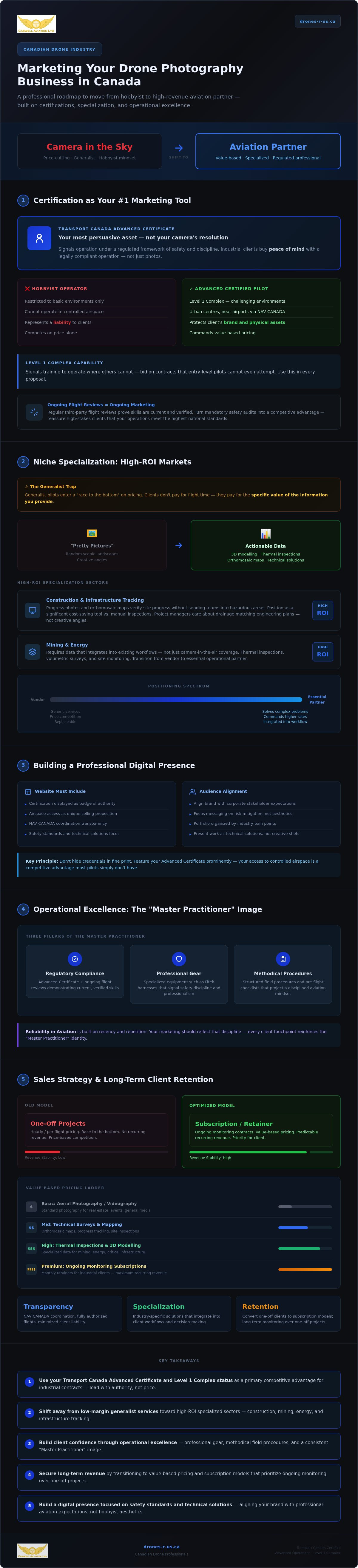
What if your Transport Canada Advanced certificate was actually your most effective sales pitch? Many pilots believe that a stunning portfolio is the only way to win contracts, yet they often find themselves struggling to compete in a crowded market where price-cutting is the norm. You've likely realized that marketing your drone photography business effectively requires more than just a high-resolution sensor; it demands a reputation for safety and regulatory discipline.
This guide will show you how to shift from being a "camera in the sky" to becoming a professional aviation partner. You'll learn to leverage professional credentials, such as your Advanced flight review status and specialized gear like Fitek harnesses, to build a brand that commands respect from industrial clients. We'll provide a clear roadmap for client acquisition, explain how to use your certification as a primary sales tool, and help you develop a professional identity that resonates with corporate stakeholders. By following this methodical approach, you'll move past the hobbyist mindset and establish a high-revenue operation rooted in Canadian aviation standards and operational excellence.
Key Takeaways
- Establish immediate authority by using your Transport Canada Advanced Certificate and Level 1 Complex status as a primary competitive advantage for industrial contracts.
- Shift your strategy for marketing your drone photography business away from low-margin generalist services toward high-ROI specialized sectors.
- Enhance client confidence through operational excellence, utilizing professional gear and methodical field procedures to project a "Master Practitioner" image.
- Secure long-term revenue by transitioning to value-based pricing and subscription models that prioritize ongoing monitoring over one-off projects.
- Build a digital presence that focuses on safety standards and technical solutions to align your brand with the expectations of professional aviation.
Establishing Authority: Certification as a Marketing Tool
Professionalism in the Canadian drone industry is defined by compliance. When marketing your drone photography business, your most persuasive asset isn't your camera's resolution; it is your Transport Canada Advanced Certificate. This document serves as the baseline for professional trust, signaling to clients that you operate under a regulated framework of safety and discipline. While a hobbyist with a camera focuses on the aesthetic of a shot, a certified aviation professional focuses on the mitigation of risk. Industrial clients, particularly in construction and infrastructure, prioritize vendors who understand these stakes. They aren't just buying photos; they're buying the peace of mind that comes with a legally compliant operation.
Communicating your "Level 1 Complex" capability is essential for winning high-value contracts. This terminology indicates you have the training to operate in challenging environments where others cannot. In your pitches, contrast your status with uncertified operators. A hobbyist is a liability. A certified pilot is a partner. You should frame your certification as a specialized qualification that protects the client's brand and physical assets. This shift in positioning allows you to move away from price-based competition and toward value-based partnerships. To see how established firms structure their service offerings for industrial clients in similar high-stakes markets, you can learn more about professional drone solutions.
Leveraging Your Advanced Certificate
Your website and digital proposals should feature your certification as a badge of technical authority. Don't hide your credentials in the fine print. Instead, use your access to controlled airspace as a unique selling proposition. Many entry-level pilots are restricted to basic environments, but an Advanced pilot can operate in complex urban centres or near airports. This capability allows you to solve problems your competitors cannot even bid on. When marketing your drone photography business, explain that your certification allows for seamless coordination with NAV CANADA, ensuring that every flight is fully authorized. This transparency minimizes client liability concerns and establishes you as a reliable professional.
The Role of Ongoing Flight Reviews
Maintaining your status requires more than a one-time test. Regular flight reviews signal to your market that your skills are current and verified by a third-party examiner. This commitment to ongoing proficiency is a powerful marketing tool. It proves you stay updated on the latest drone regulations in Canada, which are subject to frequent updates. By turning these mandatory safety audits into a competitive advantage, you reassure high-stakes clients that your operations meet the highest national standards. Reliability in aviation is built on recency and repetition; your marketing should reflect that discipline.
Niche Specialization: Finding High-ROI Markets
Generalist pilots often find themselves in a "race to the bottom" regarding their pricing. When marketing your drone photography business, you must realize that clients don't pay for flight time; they pay for the specific value of the information you provide. In Canada, sectors like mining, energy, and large-scale infrastructure require more than just a camera in the air. They require data that integrates into their existing workflows. By specializing, you transition from a vendor to an essential operational partner. This shift allows you to command higher rates because you're solving complex industrial problems rather than just providing aesthetic imagery.
Your portfolio should not be a random collection of scenic landscapes. It must be organized to address specific industry pain points. For example, a project manager doesn't care about a creative angle; they care about whether the drainage on a site matches the engineering plans. Presenting your work as a series of technical solutions creates immediate credibility with decision-makers. You should demonstrate a transition from "pretty pictures" to actionable data, such as 3D modelling or thermal inspections. If you're looking to refine your technical capabilities for these high-stakes markets, consider our specialized training programs to elevate your operational standards.
Construction and Infrastructure Tracking
Project managers use drone data to verify progress without sending teams into hazardous areas. Marketing progress photos and orthomosaic maps allows you to position your services as a significant cost-saving tool. Instead of manual site inspections, which are time-consuming and prone to error, you provide a comprehensive aerial record. You should develop case studies that highlight how your data prevented a costly delay or identified a structural discrepancy early. This evidence-based approach is far more effective than generic advertising when dealing with industrial clients who value precision and reliability. In many cases, these aerial audits are used to support broader security protocols, mirroring the technical maintenance standards advocated by experts like Scaitec Security Solutions Ltd.
While residential real estate is often saturated, high-value commercial assets remain a lucrative niche. Aerial video helps stakeholders visualize future developments, showing how a new office tower fits into the existing urban centre. This work requires a higher level of technical skill, often involving professional drone photography and videography that adheres to strict corporate branding guidelines. Linking your services to the visualization of return on investment for developers is a powerful sales strategy. You aren't just taking photos; you're helping them sell a multi-million dollar vision to their investors.
Building a Professional Digital Presence
Your digital footprint serves as your virtual flight deck. When marketing your drone photography business, your website must communicate precision and reliability rather than just creative flair. A visual brand that mirrors aviation standards, utilizing clean lines, organized layouts, and precise language, reassures industrial clients that you value discipline. Instead of listing camera specifications, focus on the technical solutions you provide, such as asset inspection accuracy or site safety improvements. This approach positions you as a serious operator who understands the regulatory environment and the specific needs of Canadian enterprise.
LinkedIn remains the most effective platform for reaching B2B decision-makers in the Canadian industrial sector. Connect with project managers and safety officers by sharing content that highlights operational excellence. Social proof is vital here. Endorsements from certified flight reviewers or industry mentors carry significantly more weight than generic social media engagement. These endorsements act as a third-party validation of your technical proficiency and your strict adherence to safety protocols. When a decision-maker sees that you are respected by aviation authorities, the perceived risk of hiring you drops significantly.
Portfolio Curation for Professionals
A professional portfolio requires careful selection. While sunset vistas are visually appealing, they rarely convince a construction firm of your technical capability. Prioritize images that demonstrate close-range inspections, orthomosaic mapping, or thermal imaging. Transparency is a key part of your brand identity. Consider including redacted safety documentation or flight logs as part of your work samples to prove your methodical approach. Your "About" page should explicitly detail your Transport Canada drone certification to establish immediate regulatory credibility and show you are fully authorized for advanced operations.
Strategic Social Media Usage
Shift your social media focus toward education-based marketing. Use video content to show the "Behind the Scenes" of a safe flight, such as pre-flight checklists and site risk assessments. This transparency builds authority by showing clients exactly how you mitigate risk on their behalf. Avoid the "hobbyist" aesthetic by maintaining a consistent, formal tone across all channels. Your goal is to be seen as a subject matter expert who happens to use a drone, rather than a drone enthusiast looking for work. Use these platforms to explain how aerial data solves specific problems, which reinforces your position as a master practitioner in the field.
Operational Excellence: The "Master Practitioner" Image
Your physical presence at a job site is a continuous advertisement. While digital assets attract interest, your field operations secure repeat business. Onlookers, including potential clients and site managers, judge your competence by your equipment and your methodology. A "Master Practitioner" doesn't just fly; they manage an aviation environment. When marketing your drone photography business, your behaviour on-site is a critical component of your brand identity. This silent marketing tool is often overlooked by those who focus solely on social media, yet it is the most effective way to demonstrate reliability in person.
Effectively marketing your drone photography business involves proving that you are a low-risk, high-value asset. When a client sees a pilot who is calm, organized, and using professional-grade tools, their confidence in the final result increases. This psychological impact is significant. It justifies professional pricing and separates you from the casual operators who lack a structured field setup. High-stakes industrial clients expect a level of discipline that matches their own safety cultures.
Ergonomics and Professionalism in the Field
The equipment you wear is as important as the drone you fly. Utilizing a drone harness for smart controllers is a clear visual signal of expertise. Fitek Gear, for instance, provides the ergonomic support necessary for high-precision flight while reducing pilot fatigue during long missions. This equipment allows you to maintain focus on the controller for extended periods, resulting in better data quality and longer billable hours. A professional pilot’s "uniform" should include high-visibility vests, ergonomic harnesses, and organized kits. This level of preparation shows that you are a technical professional rather than a hobbyist with a camera.
Client-Facing Safety Protocols
Safety procedures are not just regulatory requirements; they are marketing touchpoints. Performing a formal pre-flight briefing with the client or site manager demonstrates your commitment to their operational safety. Use site surveys to identify and discuss risks before the drone ever leaves the ground. This transparency shows that you understand their environment and are working to protect their assets. Maintaining a clean, professional flight centre at the job site further reinforces this image. These methodical habits build a reputation for reliability that leads to long-term contracts and referrals. Equip your business for professional-grade operations to ensure your field presence matches your technical expertise.
Sales Strategy and Long-Term Client Retention
Marketing your drone photography business effectively requires a transition from transactional sales to a relationship-based model. High-revenue operations don't rely on the constant pursuit of one-off projects. Instead, they focus on long-term client retention by proving consistent, repeatable value. Your pricing should reflect the complexity of the operation and the risk management you provide, rather than a simple hourly rate. When you price based on value, you account for your technical expertise, your regulatory compliance, and the high-stakes nature of industrial work. This approach ensures you aren't viewed as a commodity, but as an essential part of your client's operational workflow.
A sustainable business model utilizes your certification as a recurring trust signal. You should treat your mandatory recency requirements as a business audit rather than a regulatory hurdle. By demonstrating that your skills are current and verified, you reassure long-term partners that your standards never slip. This commitment to proficiency allows you to maintain premium pricing even as the market evolves. It proves that you are a stable partner capable of managing the legal and safety complexities of modern aviation.
Developing Recurring Revenue Models
Recurring revenue provides the stability needed for business growth. You can achieve this by offering monthly site progress reports for construction projects or seasonal monitoring for large-scale agriculture. Property managers often require bi-annual structural inspections, which can be secured through multi-year service agreements. By bundling these drone pilot jobs into long-term contracts, you create predictable cash flow and reduce the need for constant lead generation. These agreements should emphasize the continuity of data, allowing clients to track site changes over time with high precision.
The Professional Pitch Deck
Your sales deck is where your technical authority meets your business strategy. Essential slides must include your Transport Canada Advanced Certificate, proof of liability insurance, and a summarized safety record. You should also highlight your specialized gear, such as ergonomic harnesses, to demonstrate your commitment to field professionalism. When a client asks if you can do it cheaper, use regulatory facts to explain why a cut-price operator is a liability. Explain that your pricing covers the legal requirements and safety standards that protect their organization from significant risk. Ready to professionalize your operations and command higher rates? Start your Advanced Drone Training today to build the technical foundation your business deserves.
Building a Sustainable Future in Canadian Aviation
Establishing a high-revenue operation requires a shift from a hobbyist mindset to that of a certified aviation professional. By prioritizing regulatory compliance and specialized industrial data over generic imagery, you create a brand that commands respect and premium pricing. Success in marketing your drone photography business depends on your field discipline and ergonomic precision as much as your digital portfolio. Maintaining your recency through regular flight reviews and utilizing professional-grade equipment ensures your operational excellence remains a core selling point.
Caswell Aviation Ltd provides the essential infrastructure for your growth as a master practitioner. As Transport Canada Advanced certification experts and authorized Fitek Gear retailers, we offer the comprehensive flight review services you need to stay compliant and competitive. Upgrade your professional credentials with Caswell Aviation Ltd today. Your path to a resilient, high-value drone business starts with a commitment to these professional standards.
Frequently Asked Questions
Do I need an Advanced Certificate to market my drone business in Canada?
While you can technically market basic services, the Advanced Certificate is the professional standard for any serious commercial operation. It allows you to fly in controlled airspace and near bystanders, which are the primary locations for high-value contracts. Most industrial clients require this certification as a prerequisite for their own safety compliance. Without it, your service area is severely limited, making it difficult to secure consistent work.
How much should I charge for drone photography in 2026?
Pricing should be based on the value and risk of the project rather than a simple hourly rate. Professional pilots often structure their fees around specific deliverables, such as 3D maps or thermal reports, instead of just flight time. You must account for your technical expertise, specialized gear, and the cost of maintaining regulatory compliance. Avoid competing on price; instead, justify your rates through your Advanced certification and safety record.
What is the best way to find commercial drone clients?
Focus your efforts on LinkedIn and industry networking to reach B2B decision-makers directly. Marketing your drone photography business successfully involves demonstrating how your data solves specific problems for project managers. Develop case studies that highlight cost savings or safety improvements on previous sites. Direct outreach to construction firms and commercial developers allows you to bypass the saturated residential market and secure higher-margin industrial contracts that value technical precision.
Can I market drone services if I only have a Basic Certificate?
You can market basic services, but you will face significant operational restrictions that limit your revenue potential. A Basic Certificate prohibits flight in controlled airspace and near bystanders, which excludes most urban and industrial job sites. To build a high-revenue business, you will eventually need the Advanced Certificate. This qualification is necessary to access the complex environments where professional aerial data is in high demand across the country.
How does a drone harness help my professional image?
A drone harness acts as a visual indicator of your "Master Practitioner" status on the job site. Using specialized gear like a Fitek harness shows clients that you prioritize ergonomics and precision during flight. It signals that you are prepared for long-duration missions and have invested in professional-grade tools. This field presence reassures onlookers that you are a serious aviation professional rather than a hobbyist using a consumer camera for a casual flight.
What industries in Canada hire drone pilots the most?
The most consistent demand comes from the construction, infrastructure, and commercial real estate sectors. Large-scale projects require regular progress tracking and orthomosaic mapping to keep stakeholders informed. Additionally, the agriculture and energy sectors hire pilots for specialized inspections and resource management. Focusing on these high-ROI markets allows you to transition from one-off photography tasks to recurring, data-driven service agreements that provide stable and predictable business growth.
How do I explain Transport Canada regulations to a potential client?
Frame the regulations as a safety framework that protects the client's interests and assets. Explain that your Advanced Certificate and flight review status mean you have been vetted to operate in complex environments. Use plain English to describe how these rules mitigate operational risks on their site. By positioning compliance as a professional standard, you demonstrate that you are a reliable partner who understands the legal complexities of Canadian aviation.
Is drone insurance a marketing requirement or just a legal one?
It serves both purposes. While liability insurance is a practical necessity for professional operations, it is also a powerful marketing tool. High-value clients will not hire an uninsured operator due to the significant financial risks involved. Mentioning your coverage in your pitch deck proves that you are a legitimate business entity. It provides the final layer of reassurance that allows corporate stakeholders to authorize your presence on their property with confidence.
Leave a comment