

Building a Drone Pilot Portfolio: 2026 Canadian Guide
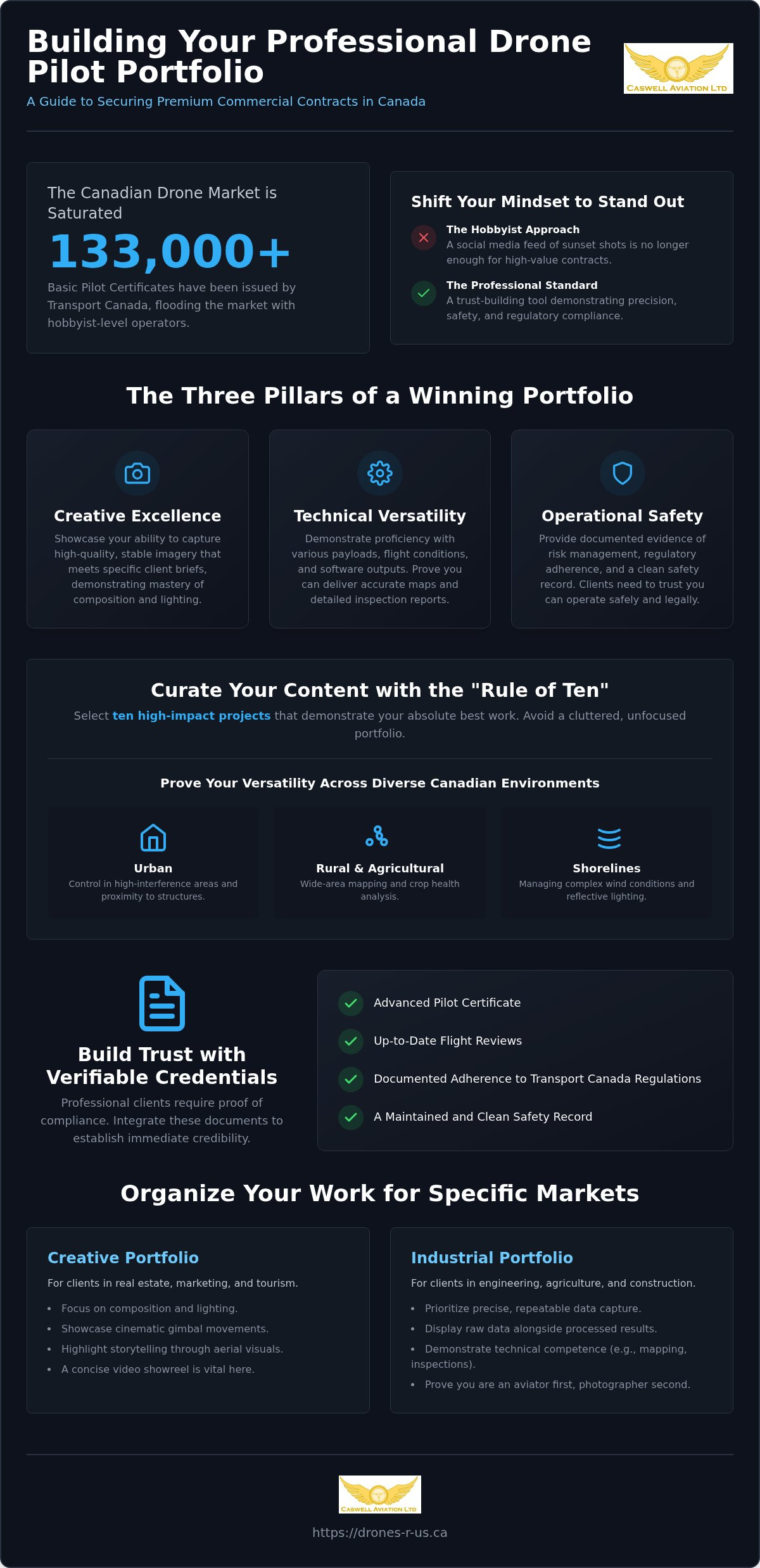
In 2026, a stunning reel of sunset shots is no longer enough to secure a premium commercial contract in Canada. With over 133,000 Basic Pilot Certificates already issued by Transport Canada, the market is saturated with hobbyists who have high-quality cameras but lack professional discipline. You likely realize that standing out requires more than just a drone; it requires a reputation for precision. It's frustrating to have the technical skills but struggle to present them as a cohesive, compliant business offering that centres on safety and reliability.
This guide will teach you the exact steps for building a drone pilot portfolio that functions as a powerful trust-building tool. You'll learn how to showcase your technical proficiency alongside documented evidence of regulatory compliance and flight safety. We will explore how to organize diverse flight data into a professional story, demonstrate your mastery of Advanced Operations, and present yourself as a reliable partner for industrial projects. By the end of this article, you'll have a clear roadmap to creating a portfolio that doesn't just look good but actually lands the job.
Key Takeaways
- Understand why a professional portfolio must prioritize Transport Canada compliance and technical competency over a simple social media feed.
- Apply the "Rule of Ten" to select your highest-impact projects across diverse Canadian environments to demonstrate operational versatility.
- Learn the strategic importance of building a drone pilot portfolio that documents your Advanced Pilot Certificate and flight reviews to establish immediate client trust.
- Discover how to organize your work by specific industry categories using hosting platforms that preserve high-resolution visual quality.
- Identify how signalling operational maturity through professional field gear and ergonomic harnesses helps you capture the high-stakes shots required for premium contracts.
What is a Professional Drone Pilot Portfolio?
Building a drone pilot portfolio in 2026 requires a shift in perspective. You shouldn't view it as a mere collection of your favourite aerial shots. Instead, think of it as a comprehensive record of your flight competency, creative skill, and strict adherence to Transport Canada regulations. While the underlying technology of an unmanned aerial vehicle (UAV) has become more accessible, the professional standard for commercial work has never been higher. This collection is the digital resume for the modern RPAS operator.
Many newcomers rely on a simple Instagram feed to find work, but this is often insufficient for high-value Canadian commercial contracts. Professional clients in sectors like engineering or large-scale agriculture need to see more than aesthetic flair. They require evidence that you can operate within the legal frameworks of the Canadian Aviation Regulations. A professional portfolio is built on three core pillars:
- Creative Excellence: Your ability to capture high-quality, stable imagery that meets specific client briefs.
- Technical Versatility: Demonstrating that you can handle various payloads, flight conditions, and software outputs.
- Operational Safety: Proving that you prioritize risk management and maintain a clean safety record.
Creative vs. Industrial Portfolios
It's important to realize that a developer looking for real estate marketing shots has different needs than a site manager requiring a bridge inspection. You should organize your portfolio into distinct galleries to address these specific markets. A creative gallery might focus on composition and lighting, while an industrial gallery highlights your ability to capture precise, repeatable data. Even in 2026, a concise video showreel remains a vital tool. It provides a quick summary of your best work, but it must be backed by the raw deliverables that industrial clients actually pay for.
The Shift Toward Technical Competence
The Canadian market is moving away from purely cinematic looks toward data accuracy and reliability. Commercial clients now look for pilots who can demonstrate technical competence in complex environments, such as near active construction sites or in controlled airspace. Showing that you can produce accurate maps or detailed inspection reports is often more valuable than a sunset flight. To understand how these skills translate into income, you can review our guide on Drone Pilot Jobs in Canada. You might also visit BlueBridge Group Placement Corp to discover how AI-driven employment services can streamline the hiring process for technical roles in the aviation sector. High-paying roles go to those who prove they are aviators first and photographers second.
Selecting Content: What to Include and What to Cut
Building a drone pilot portfolio is an exercise in rigorous curation. Many operators make the mistake of including every flight they have ever recorded, resulting in a cluttered and unfocused presentation. You should follow the 'Rule of Ten' by selecting ten high-impact projects that demonstrate your absolute best work. This approach ensures that a potential client sees only your highest standards of precision and safety without being overwhelmed by repetitive shots.
Your selection must prioritize diverse environments to prove versatility. A well-rounded portfolio includes work across various Canadian landscapes:
- Urban: Demonstrating control in high-interference areas and proximity to structures.
- Rural and Agricultural: Showing wide-area mapping and crop health analysis.
- Shorelines: Proving you can manage complex wind conditions and reflective lighting.
This variety signals to contractors that you can handle different operational challenges. Crucially, every piece of content must reflect current Canadian flight standards. Including a shot that appears to violate distance requirements or altitude limits can disqualify you immediately. To ensure your credentials match your visual work, you must maintain a valid Transport Canada drone pilot certificate at all times.
High-Value Imagery and Video
Professional clients look for technical discipline in your visual media. They want to see smooth gimbal movements, consistent frame rates, and proper exposure in varied lighting conditions. While cinematic looks are popular, industrial clients often find value in seeing raw data alongside the final processed version. This transparency demonstrates that you didn't just get lucky with a filter but actually captured high-quality source material. If you are looking to benchmark your work against industry standards, reviewing professional aerial imagery services can provide a clear target for your own content.
Technical Deliverables: Mapping and 3D Modelling
The growth of the Canadian drone market is increasingly driven by sectors like construction and agriculture. Including orthomosaic maps in your portfolio is now essential for these industries. These high-resolution, georeferenced maps prove that you understand how to overlap images and maintain consistent altitudes. You should also demonstrate proficiency with 3D point clouds. Showing a 'before and after' of a raw flight path alongside a completed 3D reconstruction proves you understand the software side of RPAS operations. It's not just about flying; it's about delivering actionable data—similar to the high-accuracy 3D deliverables from Site Wiz Surveys—that a site manager or agronomist can use.
Integrating Regulatory Proof and Safety Standards
Building a drone pilot portfolio involves more than just selecting high-impact imagery. In the Canadian commercial sector, your portfolio must serve as a testament to your operational discipline. Displaying your Transport Canada Advanced Pilot Certificate builds immediate trust with high-value clients who prioritize safety above all else. While many hobbyists possess basic certificates, showing that you have successfully completed Advanced & Level 1 Complex Flight Reviews signals a level of technical maturity that sets you apart. This documentation proves you have the skills required to operate in controlled airspace and near people.
Professionalism in this industry is defined by your adherence to the law. You should include a dedicated section for your Standard Operating Procedures (SOPs) or a formal Safety Statement. This content proves you have a deep knowledge of drone regulations in Canada. It demonstrates that you don't just fly; you manage an aviation operation with precision and care. Providing a clear outline of your pre-flight checklists and emergency protocols reassures industrial partners that you are prepared for any scenario.
Showcasing Your Flight Review Success
You should frame your flight review as a major professional milestone rather than a simple administrative hurdle. When building your drone pilot portfolio, display the specific competencies verified by your flight reviewer, such as emergency procedure management and site survey accuracy. If you are still in the training phase, finding a qualified drone flight school is the first step toward this goal. For those unsure of the process, our guide on What is a Drone Flight Review in Canada? provides a comprehensive overview of what to expect during this critical evaluation. Highlighting these achievements shows that you have been vetted by a Master Practitioner.
Documenting Operational Safety
A professional-grade portfolio includes redacted examples of site surveys and risk assessments. This documentation shows potential clients that you understand how to identify hazards and mitigate risks before the drone leaves the ground. You must also demonstrate a clear understanding of controlled airspace requirements and the coordination needed with NAV CANADA. Finally, always mention your liability insurance and coverage limits. Including these details transforms your portfolio from a creative gallery into a professional business proposal. This transparency reassures clients that they are hiring a technician who values standards as much as they value the final shot. It positions you as a partner who understands the high stakes of commercial aviation.
Portfolio Hosting: Where to Build and Organize
Selecting the right platform is a critical technical decision when building a drone pilot portfolio. You need a solution that prioritizes high-resolution visual media without compromising load speeds. Most industrial clients will evaluate your work on various devices, so your chosen host must handle 4K video and high-density orthomosaic maps smoothly. A professional presentation starts with a logical, four-step structure:
- Step 1: Prioritize Resolution. Choose a host that does not overly compress your imagery. Your technical data must remain sharp when zoomed.
- Step 2: Organize by Industry. Categorize your work into clear galleries such as Infrastructure, Real Estate, or Agriculture. This helps clients find relevant proof of competency quickly.
- Step 3: Optimize for Mobile. Many site managers and contractors will view your work while in the field. Ensure your site is responsive and functional on smartphones.
- Step 4: Refine Your 'About' Section. Use this space to highlight your aviation background, flight hours, and commitment to Transport Canada standards rather than just your creative interests.
Website Builders vs. Specialized Platforms
General website builders like Squarespace or Wix offer excellent visual templates and easy customization. For most professionals, a custom domain name ending in .ca is non-negotiable. It signals that you are a legitimate Canadian business entity. While specialized drone portfolio sites exist, they often lack the SEO flexibility of a dedicated website. If you use video, integrate hosting from platforms like Vimeo or YouTube to ensure playback is stable across all browsers. This hybrid approach keeps your site lean while maintaining high playback quality for your showreels.
The 'Technical Specs' Section
The 'Technical Specs' section provides a detailed inventory of your operational capabilities. Clients need to know exactly what tools you bring to a job site. List your fleet clearly, including specialized sensors or thermal cameras. Highlighting your use of professional accessories also signals operational maturity. For example, mentioning your use of Fitek Gear drone harnesses for smart controllers shows that you value ergonomics and focus during high-stakes flights. This attention to detail suggests that you are a disciplined pilot who invests in the right equipment for the job. To ensure you have the proper foundation for these technical projects, you can explore our online drone courses and in-person training options. Building a portfolio is easier when you have the right gear and certifications to showcase.
The Professional Edge: Signalling Operational Maturity
Your physical presence on a job site often dictates the quality of the content you eventually include when building a drone pilot portfolio. High-value clients in the industrial sector don't just hire a camera operator; they hire a professional partner who understands the rigours of field work. If you appear disorganized or fatigued during a long inspection, it reflects poorly on your operational standards. Conversely, a pilot who remains focused and disciplined throughout a multi-hour flight session is far more likely to capture the precise data required for a premium contract.
Professional pilots prioritize comfort not just for convenience, but as a core component of safer flight operations. Fatigue is a known risk factor in aviation that leads to slower reaction times and lapses in judgment. By investing in ergonomic gear, you mitigate these risks and ensure that every flight is conducted with maximum situational awareness. This commitment to safety is exactly what corporate clients look for when reviewing a potential hire. Positioning yourself as a partner who respects these operational standards will always give you a competitive advantage.
Ergonomics and Pilot Performance
Ergonomics play a vital role in pilot performance and the resulting quality of your portfolio. Utilizing a drone harness for smart controllers allows you to distribute the weight of your equipment across your torso, which significantly improves flight precision. By reducing physical strain, you can maintain steady stick inputs for longer durations, which is essential for capturing smooth cinematic orbits or detailed bridge inspections. This professional aesthetic also signals to site managers that you take your role seriously. You aren't just a hobbyist with a remote; you are an aviator with a dedicated workstation that allows for maximum focus.
Next Steps: Certification and Training
Continuous education is the foundation of long-term success. Building a drone pilot portfolio is an ongoing process that evolves as you gain more experience and higher certifications. Upgrading to Advanced or Level 1 Complex certifications proves you can handle the most demanding environments in Canada. These credentials should be prominently displayed alongside your best work to confirm your technical authority and regulatory compliance. If you are ready to enhance your credentials and expand your portfolio's reach, you can book your next flight review or course with Caswell Aviation. Investing in your training ensures that your portfolio remains a true reflection of your professional growth and technical mastery.
Elevating Your Commercial Flight Career
Success in the 2026 commercial drone market requires a shift from artistic hobbyist to disciplined aviator. Building a drone pilot portfolio that highlights your Transport Canada certifications and technical versatility is the most effective way to separate yourself from the competition. You've learned that selecting high-impact projects and documenting your safety standards are non-negotiable steps for landing premium contracts. By organizing your work into industry-specific galleries and demonstrating operational maturity through professional field gear, you signal to clients that you are a reliable partner.
To ensure your portfolio is backed by the highest level of technical authority, you need the right credentials and equipment. Start building your professional foundation with Caswell Aviation training. As experts in Transport Canada Advanced and Level 1 Complex certifications, we provide the comprehensive online and in-person training options you need to succeed. Our role as specialized Fitek Gear retailers further ensures you have the ergonomic tools to maintain focus during every flight.
Your journey toward becoming a top-tier commercial pilot starts with a commitment to continuous improvement. Take the next step today and watch your professional opportunities in the Canadian aviation sector expand.
Frequently Asked Questions
Do I need a website for my drone portfolio or is Instagram enough?
A dedicated website is essential for securing premium commercial contracts. While Instagram is a useful social tool, it lacks the professional structure required to showcase high-resolution data and technical specifications. A website allows you to use a custom .ca domain, which signals your legitimacy as a Canadian business. It also provides a stable platform for hosting large files and detailed project descriptions that social media platforms often compress or simplify.
Should I include my Transport Canada certificate number in my portfolio?
Including your Transport Canada certificate number is a best practice for professional pilots. It provides immediate proof of your status and allows potential clients to verify your credentials through official channels. This transparency builds trust and demonstrates that you operate within the legal framework of the Canadian Aviation Regulations. It's a simple addition that reinforces your identity as a compliant, safe, and disciplined operator who values regulatory standards.
How many videos should be in my drone pilot showreel?
Your showreel should consist of one high-impact video lasting between 60 and 90 seconds. Busy project managers usually decide within the first 30 seconds if your style fits their needs. Focus on your best 10 to 12 clips that demonstrate smooth gimbal control and proper exposure. Avoid including multiple reels; instead, curate one master video that represents the absolute peak of your current technical and creative capabilities.
Is it better to have a niche portfolio or a general drone portfolio?
A niche portfolio is typically more effective for landing high-paying industrial work. When building a drone pilot portfolio, focusing on a specific sector like infrastructure or precision agriculture positions you as a specialist. Clients with complex needs prefer hiring someone who understands their specific industry requirements rather than a generalist. You can still maintain separate galleries for different niches, but your primary marketing should target the industry where you have the most expertise.
Can I include work from my basic flight training in my professional portfolio?
You may include training work if the imagery meets professional quality standards and reflects your technical control. In the early stages of building a drone pilot portfolio, these shots can demonstrate your ability to execute specific manoeuvres. However, you should prioritize replacing training content with real-world commercial projects as soon as they become available. Professional clients always prefer to see how you solved a specific problem for a paying customer in a live environment.
What is the best way to show 3D mapping data to a client who doesn't have the software?
The most efficient method is using web-based sharing links from your processing software. Most modern photogrammetry platforms allow you to generate a public URL where clients can rotate 3D models or zoom into orthomosaic maps without installing any specialized tools. Alternatively, you can provide high-resolution PDF reports that summarize the key data points and accuracy metrics. This ensures the client receives the value of your data in a format they can easily navigate.
How often should I update my drone pilot portfolio?
You should aim to update your portfolio every six months or after completing a significant project. The drone industry moves quickly, and your oldest work may no longer reflect your current skill level or the capabilities of your latest equipment. Regular updates also allow you to ensure all your certification details and safety statements remain accurate according to the most recent Transport Canada guidelines. Fresh content keeps your business looking active and relevant.
Do clients care about what kind of drone I use?
Clients primarily care about the final results, but they do pay attention to your equipment for technical applications. For specialized tasks like thermal inspections or LiDAR mapping, the specific drone and sensor you use are critical to the project's success. Listing your fleet in your portfolio proves you possess the necessary hardware to meet their technical requirements. It also demonstrates that you invest in professional-grade tools to ensure reliable and accurate data collection.
Leave a comment