

What is a Drone Flight Review in Canada? A Professional Guide for 2026
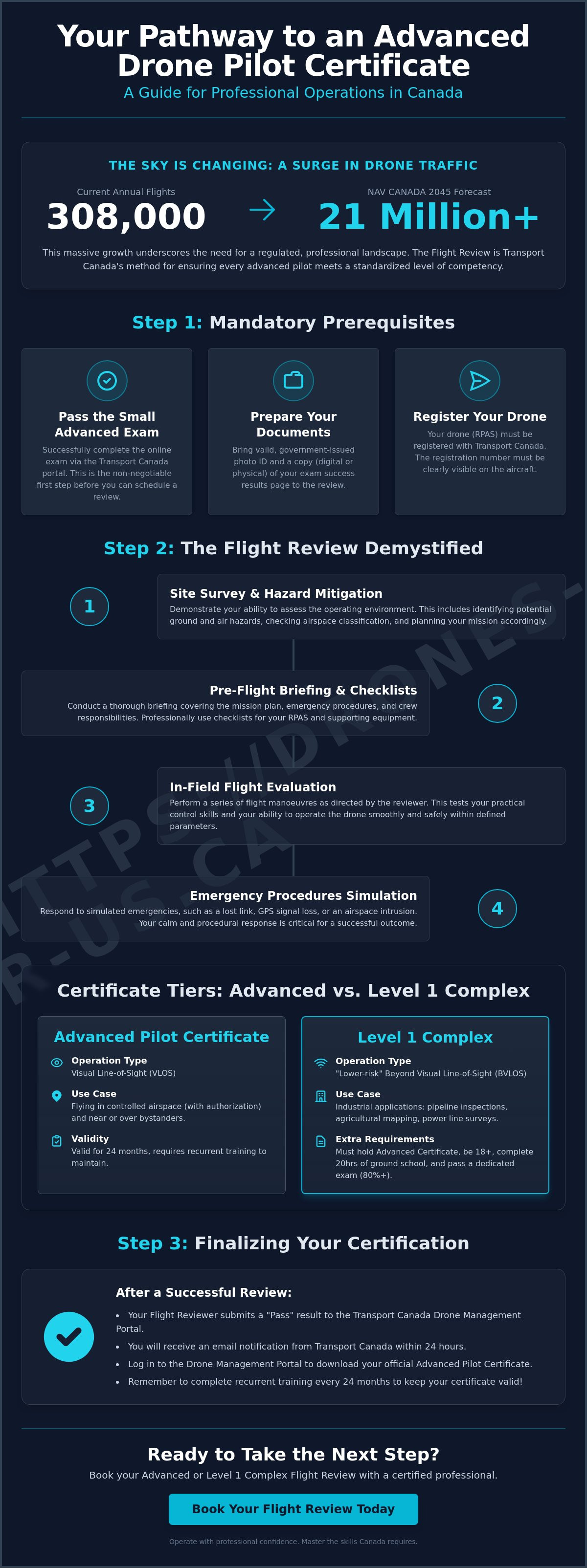
With NAV CANADA forecasting a surge from 308,000 annual flights to over 21 million by 2045, the era of casual flying is being replaced by a regulated professional landscape. For many pilots, the most significant hurdle to entering this industry is understanding exactly what is a drone flight review Canada requires for an Advanced Pilot Certificate. This in-person assessment is more than a simple test of your stick skills; it's a comprehensive validation of your ability to operate safely within controlled airspace and near bystanders.
It's natural to feel some uncertainty about specific flight maneuvers or the fear of failing and losing your review fee. We understand that the distinction between Advanced and the new Level 1 Complex requirements can also seem confusing. This guide provides a clear, technical breakdown of the Transport Canada syllabus so you can book your session with professional confidence. You'll discover the mandatory prerequisites, exactly what to expect during the field evaluation, and how to finalize your Advanced Pilot Certificate through the Drone Management Portal for 2026.
Key Takeaways
- Complete the mandatory prerequisites, such as passing the Advanced Exam and registering your drone, before scheduling your session.
- Understand that what is a drone flight review Canada mandates is a practical safety validation performed by a Transport Canada-approved flight reviewer.
- Master the site survey and pre-flight briefing protocols to demonstrate your ability to manage technical hazards and airspace requirements.
- Utilize professional checklists to mitigate nerves and avoid critical pilot errors that frequently result in an unsuccessful assessment.
- Navigate the final administrative steps to download your Advanced Pilot Certificate after the reviewer submits your results to the Transport Canada portal.
Understanding the Drone Flight Review in Canada
To operate a drone commercially in controlled airspace or near bystanders, you must hold an Advanced Pilot Certificate. A central requirement for this certification is understanding exactly what is a drone flight review Canada mandates as your practical evaluation. This session is not a casual flight test; it's a formal, in-person validation of your operational discipline. It serves as the mandatory practical component that proves you can apply the theoretical knowledge from your Advanced Exam to a real-world flight environment. Every review must be conducted by a Transport Canada-approved flight reviewer who assesses your ability to plan, execute, and manage risks during a mission.
This validation is critical for maintaining the safety of national airspace. As the number of Unmanned aerial vehicle (UAV) operations continues to grow, Transport Canada uses these reviews to ensure that every advanced pilot meets a standardized level of competency. Once you successfully complete your review and receive your certificate, it remains valid for 24 months. To keep your Advanced Pilot Certificate active, you must complete a recurrent training activity every two years to ensure your knowledge of the Canadian Aviation Regulations (CARs) remains current.
The Role of the Flight Reviewer
Flight reviewers are not government employees. They are experienced pilots from the private sector who have earned specific authorizations from Transport Canada to conduct these assessments. When you book a session for Advanced & Level 1 Complex Flight Reviews, you're working with a professional who acts as a gatekeeper for aviation safety. It's vital to select a reviewer who demonstrates a methodical and grounded approach. These reviewers must also maintain their own recency requirements. If a reviewer's own qualifications lapse, they cannot legally validate your skills, so it's always wise to confirm their status before your session.
Advanced vs. Level 1 Complex Reviews
The regulatory landscape in Canada evolved significantly on November 4, 2025, with the implementation of Level 1 Complex Operations. While a standard Advanced flight review focuses on Visual Line-of-Sight (VLOS) operations in challenging environments, the Level 1 Complex review is designed for "lower-risk" Beyond Visual Line-of-Sight (BVLOS) missions. This newer certification is essential for industrial applications such as linear pipeline inspections, large-scale agricultural mapping, or power line surveys.
The complexity of the review increases substantially when moving from Advanced to Level 1 Complex. To qualify for a Level 1 Complex review, you must already hold a valid Advanced Pilot Certificate and be at least 18 years of age. You're also required to complete 20 hours of specialized ground school and pass a dedicated online exam with a score of 80% or higher. The practical review for this level tests your ability to manage a drone when it's no longer within your direct line of sight, requiring a higher degree of technical proficiency and risk assessment.
Mandatory Prerequisites Before Your Flight Review
Before you can demonstrate your practical skills, you must satisfy several administrative and regulatory requirements. Understanding what is a drone flight review Canada requires begins with the Advanced Exam. You cannot legally schedule a review until you've successfully passed the Small Advanced Exam through the Transport Canada portal. This exam serves as the gatekeeper for the practical portion of your certification. It tests your knowledge of airspace, weather, and regulations, ensuring you have the theoretical foundation to operate safely in complex environments.
On the day of your session, your reviewer will verify your identity and eligibility. You must present a valid piece of government-issued identification that includes your full name and date of birth. Additionally, you need to provide a physical or digital copy of your exam success results page. This document proves you've met the prerequisite knowledge standards set by the Transport Canada flight review requirements. Understanding what is a drone flight review Canada mandates also means knowing that the reviewer is checking for regulatory compliance before the motors even start.
The Importance of Ground School
Ground school is more than just exam preparation. It's the framework for professional flight operations. While self-study might help you pass the multiple-choice test, it often fails to provide the technical nuances needed for advanced manoeuvres. Enrolling in structured online drone courses ensures that your theoretical knowledge translates seamlessly into the field. This preparation reduces the risk of making critical errors during your practical evaluation. A disciplined approach during your studies builds the confidence needed to handle high-pressure scenarios during the review.
Equipment Readiness and Registration
Your Remotely Piloted Aircraft System (RPAS) must be fully prepared for the evaluation. You're responsible for ensuring the drone is registered with Transport Canada. The Certificate of Registration must be accessible on-site, either as a printed copy or a digital file on your mobile device. Before arriving at the flight field, check that your firmware is updated and your batteries are at optimal health. The reviewer will expect you to confirm that the aircraft is capable of performing the specific manoeuvres outlined in the official Flight Reviewer’s Guide. Technical delays caused by uncharged controllers or outdated software reflect poorly on your operational readiness.
The Flight Review Process: What to Expect on the Day
The evaluation day follows a methodical chronological flow designed to test both your technical skill and your operational discipline. When considering what is a drone flight review Canada pilots must undergo, the focus is on the professional execution of a safe flight mission. The process begins with a pre-flight briefing. During this discussion, you will present your flight plan to the reviewer and explain your intended emergency procedures. This is your opportunity to demonstrate that you've considered all variables, including weather conditions and nearby airspace restrictions. Precision is mandatory from the moment the briefing starts.
Following the briefing, you will conduct a comprehensive site survey. You must identify all potential hazards, such as power lines, tall structures, or bystanders. The reviewer will observe how you assess the environment and whether you identify nearby aerodromes that could affect your mission. Once the survey is complete and the aircraft is prepared, you will move into the flight portion. This involves executing specific manoeuvres to prove precise control. You will also face emergency simulations, such as a lost link or a battery failure, where you must verbalize your response and take immediate corrective action. The day concludes with a post-flight debrief where you receive direct feedback on your performance.
Demonstrating VLOS and Safety Discipline
Safety discipline is the cornerstone of the advanced certification. You must maintain Visual Line-of-Sight (VLOS) at all times without relying solely on your first-person view (FPV) feed. If your mission profile requires a visual observer, you must demonstrate how to communicate effectively with them to maintain situational awareness. Adopting a "Pilot-in-Command" mindset is essential. This means taking full responsibility for the aircraft and the safety of everyone on the ground, regardless of the reviewer's presence. Professionalism in InPerson Training often focuses on this mental transition from hobbyist to certified operator.
Technical Manoeuvres and Precision
Precision is mandatory during the flight evaluation. You will be asked to execute squares, circles, and figure-eights while maintaining a steady altitude and heading. These manoeuvres prove that you can handle the aircraft in varying wind conditions without drifting off course. Additionally, you must demonstrate landing precision by bringing the drone down safely within a designated safety zone. Monitoring your telemetry is just as important as watching the aircraft. The reviewer will check that you are actively tracking battery levels, signal strength, and GPS health throughout the flight. Precision isn't just about the sticks; it's about managing the entire system.
Preparation Strategies to Avoid Common Pilot Errors
Success in a flight review depends on more than just stick skills. It requires a disciplined operational environment. When candidates ask what is a drone flight review Canada examiners look for most, the answer is often consistency and attention to detail. Managing nerves is a common challenge for many pilots. Using a methodical checklist approach reduces anxiety because it removes the guesswork from your pre-flight routine. If you follow your list, you don't have to worry about forgetting a critical safety step during the assessment.
The site survey is another area where pilots frequently falter. Failing to identify a nearby obstacle, such as a thin guy-wire or a camouflaged cell tower, can lead to an automatic fail. You must be exhaustive in your hazard identification and speak your findings aloud. Additionally, ensure your logbook maintenance is current and organized for inspection. A professional logbook proves you are an operator who respects the regulatory framework and maintains a history of safe flight hours.
Optimizing Your Control Station
Precision during slow-speed manoeuvres is significantly improved by proper ergonomics. Using professional equipment like Fitek Gear Drone Harnesses for Smart Controllers allows you to distribute the weight of the controller across your shoulders. This stability is vital when you need to execute the precise circles or squares required by the reviewer. A harness also reduces pilot fatigue during longer review sessions, allowing you to focus entirely on the aircraft. Ensure your screen is shielded from glare so you can maintain clear telemetry awareness without losing sight of the drone.
Rehearsing Emergency Procedures
Verbalizing your actions is a critical component of the review. The reviewer cannot read your mind; they need to hear you state exactly what you are doing in response to a hazard. For example, if a simulated lost-link occurs, announce your intention to monitor the Return to Home (RTH) sequence or transition to manual control. Practising manual emergency landings is just as important as relying on automated safety features. Review your specific airframe manual to understand how your drone behaves in degraded flight modes before you arrive at the field.
Finalizing Your Advanced Operations Certification
After you successfully complete the practical evaluation, the final administrative steps take place within the Transport Canada Drone Management Portal. Your reviewer is responsible for submitting your results, usually within 24 hours of the session. Once these results are uploaded, you'll receive a notification to log in and finalize your application. This is the concluding phase of understanding what is a drone flight review Canada requires for legal compliance. You must pay the C$25.00 application fee to download your Pilot Certificate – Advanced Operations. For those pursuing the Level 1 Complex Operations certificate, the application fee is C$125.00. The process is efficient and straightforward.
Holding the certificate is only the beginning of your professional responsibilities. To keep your status valid across Canada, you must maintain recency every 24 months. This isn't a repeat of the full review; rather, it involves completing a recurrent training activity to prove your knowledge of current regulations and safety protocols. Caswell Aviation Ltd supports this entire journey, providing the structured path from your initial ground school to the successful completion of professional flight reviews. Professionalism remains the standard for every mission you undertake.
Scaling Your Drone Career
Achieving your Advanced certification opens significant commercial opportunities. Many pilots transition into specialized fields such as Drone Aerial Photography and Video to serve the real estate or cinema industries. For those looking toward high-stakes industrial work, the Level 1 Complex certification allows for beyond visual line-of-sight operations. This is a rapidly growing sector for infrastructure and agricultural inspections. Continuing education ensures you stay ahead of technological shifts and regulatory updates in a market projected to reach billions by the 2030s. Growth requires constant learning and a disciplined approach to new technology.
Why Choose a Veteran Mentor for Your Review?
The quality of your review experience depends largely on the expertise of your evaluator. Choosing a mentor with deep industry experience provides more than just a pass or fail result; it offers professional insights into field operations. You can access comprehensive online and in-person training through Caswell Aviation Ltd to ensure you're fully prepared before the evaluation begins. Booking your Advanced or Level 1 Complex flight review with a professional team ensures that you're measured against the highest standards of safety and technical proficiency. This methodical approach is what defines what is a drone flight review Canada expects from its elite pilot community.
Advancing Your Professional Aviation Standards
Transitioning from a student pilot to a certified professional requires a commitment to safety and operational discipline. You now have a clear understanding of the mandatory prerequisites, the chronological flow of the evaluation day, and the technical precision expected by examiners. Understanding what is a drone flight review Canada mandates ensures you arrive at the field with the correct documentation and a "Pilot-in-Command" mindset. This preparation is the critical difference between a stressful session and a successful validation of your professional capabilities.
Success in this regulated environment is defined by the quality of your preparation and the equipment you utilize. As Transport Canada Authorized Flight Reviewers, the team at Caswell Aviation Ltd offers comprehensive Advanced and Level 1 Complex training to help you navigate these requirements with confidence. We also serve as a specialized Fitek Gear retailer to ensure your control station is optimized for maximum precision during your evaluation. Book Your Professional Flight Review with Caswell Aviation Ltd today to finalize your certification. We look forward to seeing you in the field and supporting your long-term growth in the Canadian aviation sector.
Frequently Asked Questions
How much does a drone flight review cost in Canada?
The cost for a flight review is determined by the specific flight school or reviewer you select, as these are private-sector services. Prices typically range between C$200 and C$270 depending on the provider and the complexity of the evaluation. Remember that this fee is separate from the C$25 application fee you must pay to Transport Canada to download your certificate once you pass.
Can I fail a flight review, and what happens if I do?
You can fail a flight review if you demonstrate unsafe flying, lose control of the aircraft, or fail to identify a major hazard during your site survey. If you're unsuccessful, the reviewer will provide a debriefing on the specific areas that require improvement. You're permitted to retake the review after a 24-hour waiting period, though you'll typically need to pay a new review fee to the provider.
What drone should I bring to my flight review?
You must provide a Remotely Piloted Aircraft System (RPAS) that is registered with Transport Canada and in good working order. The drone should be the same model you intend to use for your advanced operations and must be capable of performing all required manoeuvres. Ensure you have enough charged batteries to complete a 90-minute session, including the pre-flight checks and any potential retakes of specific patterns.
How long does the actual flight review take?
Most flight reviews take approximately 60 to 90 minutes to complete from start to finish. This timeframe includes the initial documentation check, the pre-flight briefing, your comprehensive site survey, and the actual flight manoeuvres. The session concludes with a post-flight debrief where the reviewer provides immediate feedback and confirms whether you've met the standards for the Advanced or Level 1 Complex certificate.
Do I need a flight review for Basic operations?
No, a flight review is not required for a Pilot Certificate – Basic Operations. Basic pilots only need to pass the Small Basic online exam and be at least 14 years of age. The flight review is strictly a requirement for the Advanced and Level 1 Complex certificates, which allow you to fly in controlled airspace and closer to bystanders.
What is the difference between an Advanced and a Level 1 Complex flight review?
Understanding what is a drone flight review Canada requires for different levels is essential for your career path. An Advanced review tests your ability to fly safely within visual line-of-sight in controlled airspace. In contrast, a Level 1 Complex review evaluates your competency for lower-risk Beyond Visual Line-of-Sight (BVLOS) operations, which involves more rigorous risk assessment and technical telemetry monitoring protocols.
How do I find a flight reviewer near me in Canada?
Authorized reviewers are listed on the Transport Canada website under the directory of drone flight schools. It's best to choose a reviewer who has a professional background in aviation or industrial drone operations. Many pilots prefer booking through established training centres that offer both ground school and practical reviews to ensure a consistent educational experience and a higher chance of success on the day.
Is my flight review valid forever once I pass?
The results of what is a drone flight review Canada examiners submit are valid for 12 months for the purpose of applying for your certificate. Once you hold your Advanced Pilot Certificate, it does not expire, but you must maintain recency. You're required to complete a recurrent training activity every 24 months to keep your certificate valid and ensure you're up to date with the latest Canadian Aviation Regulations.
Leave a comment