

Drone Regulations in Canada: The 2026 Professional Reference Guide
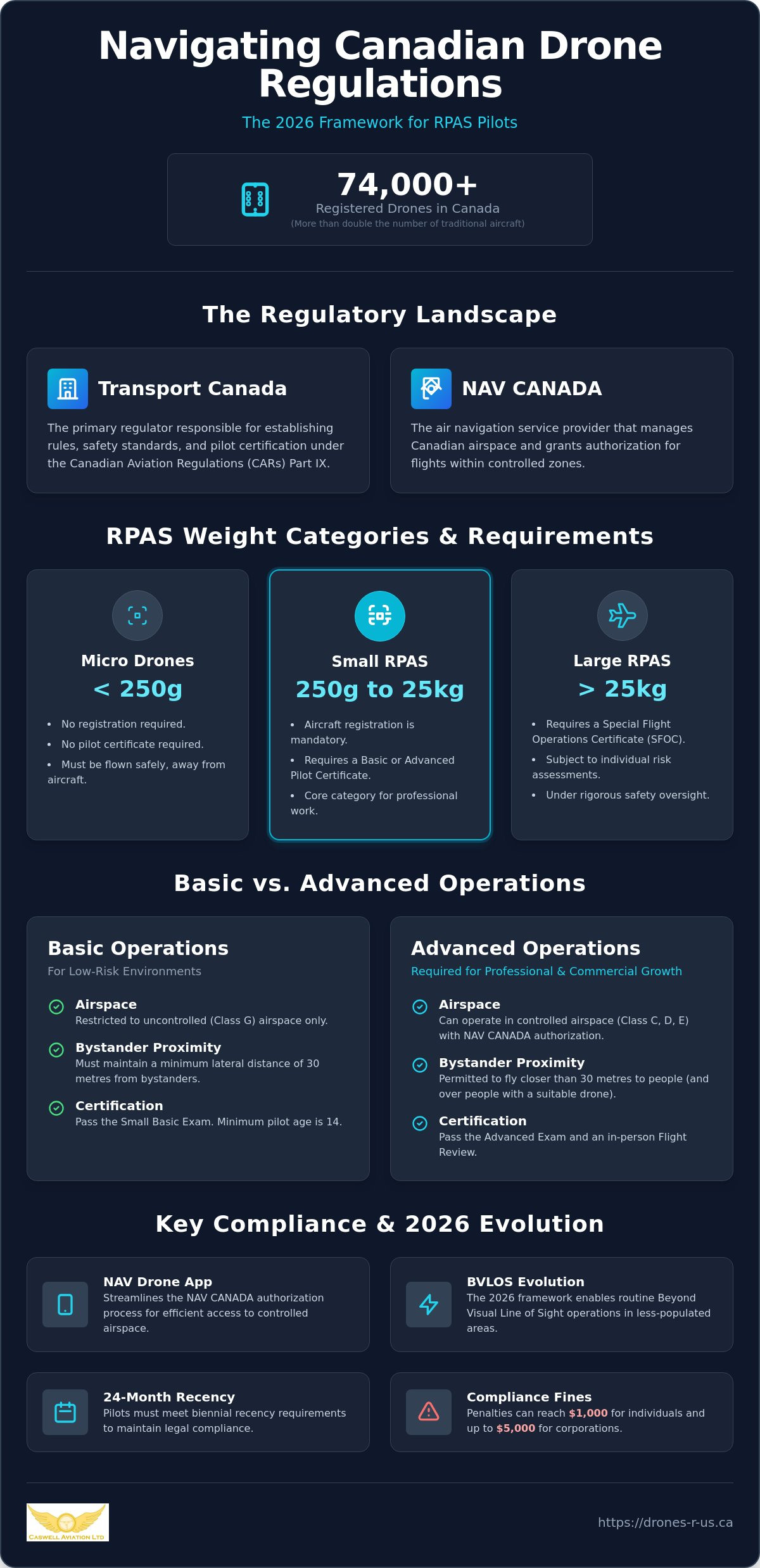
Did you know there are now over 74,000 registered drones in Canada, which is more than double the number of traditional aircraft? As the skies become more crowded, Transport Canada has shifted its focus from simple flight boundaries toward a comprehensive risk management model. While many pilots established their foundations using the drone regulations Canada 2024 framework, the landscape has evolved with the introduction of Level 1 Complex Operations and new BVLOS standards. Staying compliant is no longer just about avoiding a $1,000 fine. It's about maintaining the safety and professionalism of the entire aviation industry.
It's understandable if you feel some anxiety regarding the latest updates to Remote ID or the specific requirements for advanced certification. We recognize that the authorization process with NAV CANADA often feels like a daunting task. This guide provides a clear breakdown of the current RPAS framework and the latest 2026 updates. You'll learn exactly how to transition into complex operations, meet your biennial recency requirements, and ensure your flight operations remain fully legal and efficient.
Key Takeaways
- Understand how the drone regulations Canada 2024 framework has expanded to include the latest 2026 standards for Beyond Visual Line of Sight (BVLoS) flight.
- Distinguish between Basic and Advanced operation limits to ensure you maintain legal distances from bystanders and fly within authorized airspace.
- Streamline your NAV CANADA authorization process using the NAV Drone app to gain efficient access to controlled Class C, D, and E airspace.
- Explore the prerequisites for the Level 1 Complex Operations certification, a critical requirement for professional pilots managing sophisticated drone fleets.
- Implement a structured approach to meeting 24-month recency requirements and maintaining mandatory flight documentation to ensure continued legal compliance.
The 2026 Canadian Drone Regulatory Framework: An Overview
The Canadian Aviation Regulations (CARs) Part IX remains the primary legal framework for all drone activities within the country. While the foundation was established years ago, the transition from the drone regulations Canada 2024 standards to the current 2026 requirements reflects a move toward performance-based compliance. Transport Canada serves as the primary regulator, establishing the rules of the air and pilot certification standards. NAV CANADA functions as the service provider, managing the actual airspace and granting access to controlled zones. Understanding this distinction is vital for any professional pilot who needs to coordinate with both agencies to stay legal.
A Remotely Piloted Aircraft System (RPAS) is defined as a set of configurable elements including the aircraft, the remote pilot station, and the command and control links necessary to operate the system safely. The History of Canadian Drone Regulations illustrates how the government has balanced innovation with public safety. In 2026, the focus has shifted from simply where you fly to how you manage the specific risks of your mission.
Weight Categories and Their Legal Impact
Transport Canada categorizes drones primarily by weight, which determines your legal obligations. Your choice of hardware dictates the level of certification you must hold. The categories are organized as follows:
- Micro-drones (under 250g): These systems are the only category exempt from registration and pilot certification. However, you must still fly safely and avoid interfering with traditional aircraft.
- Small RPAS (250g to 25kg): This category represents the core of the professional market. Pilots must register their aircraft and hold either a Basic or Advanced certificate.
- Large RPAS (over 25kg): These operations require a Special Flight Operations Certificate (SFOC). They are subject to individual risk assessments and more rigorous safety oversight.
The Evolution of BVLoS Rules in 2026
The 2025 updates significantly reduced the administrative burden for commercial operators. Before these changes, Beyond Visual Line of Sight (BVLoS) missions were often stalled by lengthy approval processes. Today, the framework allows for routine BVLoS operations in less-populated areas, provided the pilot holds the appropriate certification. This evolution has transformed sectors like agricultural mapping and remote cargo delivery. Professional certification is now more than a badge; it is a prerequisite for accessing these high-value operational areas. Success in this new landscape requires a deep understanding of the drone regulations Canada 2024 legacy and the sophisticated safety protocols required for 2026 missions.
Categorizing Your Flight: Basic vs. Advanced Operations
In the eyes of Transport Canada, your mission profile determines your certification level. The transition from the drone regulations Canada 2024 standards to the current 2026 framework has solidified the boundary between recreational and professional capabilities. While some hobbyists find success within Basic limits, professional pilots usually realize that an Advanced certificate is a non-negotiable asset for commercial growth. The primary distinction rests on where you fly and how close you get to the public, as outlined in the Canadian Aviation Regulations.
Every operation also requires a "Safety Assurance" from the manufacturer. This is a formal declaration that the drone meets specific safety standards for the intended flight. If you plan to fly near people or in controlled airspace, your drone must be listed on Transport Canada’s website as eligible for those specific categories. Operating a drone without the proper safety declaration for Advanced missions can result in significant fines, ranging up to $5,000 for corporations.
Basic Operation Requirements
Basic operations are designed for low-risk environments. To qualify, you must be at least 14 years old and pass the Small Basic Exam, which costs $10 per attempt. These flights are restricted to uncontrolled (Class G) airspace. You must maintain a minimum lateral distance of 30 metres from any bystander not involved in your operation. This distance is a strict safety buffer; if a person enters this 30-metre zone, you must land or fly away to restore the gap.
Advanced Operation Requirements
Professional pilots often find Basic limits too restrictive for urban or industrial work. Advanced operations allow you to fly in controlled airspace and closer to people. You must be at least 16 years old and pass the Small Advanced Exam. Following the exam, you must complete an in-person Flight Review with a qualified reviewer. This practical assessment ensures you can manage a checklist and handle emergencies effectively. For a deeper look at this process, see The Complete Guide to Transport Canada Drone Certification. Once you have mastered these requirements, you can organize your training to move into more complex commercial roles.
The Advanced certificate is the standard for anyone serious about the industry. It removes the 30-metre bystander restriction, allowing you to fly within 5 to 30 metres of people, or even over people if your drone has the appropriate Safety Assurance. As the drone regulations Canada 2024 framework evolved into today's standards, the ability to operate in controlled airspace near city centres has become the hallmark of a professional pilot.
Navigating Controlled Airspace and NAV CANADA Authorization
Operating in controlled airspace requires a level of coordination that separates professional pilots from casual users. While the drone regulations Canada 2024 framework established the initial rules for airspace access, the 2026 environment relies on near-real-time digital authorizations. Airspace in Canada is categorized into several classes. Class G is uncontrolled, allowing for Basic operations without prior permission. However, Class C, D, and E represent controlled environments where you must obtain authorization from NAV CANADA before your rotors start turning. Unauthorized entry into these zones is a serious safety violation that can result in fines of up to $3,000 for individuals and $15,000 for corporations.
The primary tool for this coordination is the NAV Drone application. This platform allows you to view airspace constraints and submit flight plans directly to air traffic controllers. Accessing these zones requires using the NAV CANADA Drone Flight Planning portal or the mobile application to ensure your mission does not conflict with traditional aviation. When operating near airports or heliports, you must also adhere to specific communication protocols. This often includes monitoring local frequencies or providing a contact number where controllers can reach you immediately during your flight.
Using the NAV Drone App Effectively
Success in controlled airspace begins with a thorough pre-flight assessment. The NAV Drone app provides essential data, including local NOTAMs (Notices to Airmen) that might indicate temporary flight restrictions or unusual aerial activity. For professional teams, the app allows for managing multiple authorizations across different sites. This centralized approach ensures that every pilot in your fleet remains compliant with their specific geographic boundaries. For a comprehensive look at tactical airspace management, read our guide on Flying a Drone in Controlled Airspace in Canada.
Prohibited and Restricted Airspace
Certain areas remain strictly off-limits regardless of your certification level. You must never fly near emergency scenes, forest fires, or large outdoor events without explicit permission. The legal boundaries for aerodromes are precise. You must stay at least 5.6 kilometres (3 nautical miles) away from airports and 1.9 kilometres (1 nautical mile) away from heliports unless you hold an Advanced certificate and have received specific authorization. Additionally, National Parks and military operations areas have unique restrictions. Flying in a National Park requires a special permit from Parks Canada, which is generally only granted for research or park management purposes. Always verify your flight path against the latest drone regulations Canada 2024 updates to avoid entering restricted zones accidentally.
Professional Standards for Complex and Commercial Operations
The 2026 regulatory environment has introduced a significant tier above standard Advanced flights: the Level 1 Complex certification. While the drone regulations Canada 2024 framework focused on establishing basic and advanced operational boundaries, the current framework addresses the need for scalable commercial operations like BVLOS mapping and precision agriculture. Level 1 Complex certification allows organizations to conduct Beyond Visual Line of Sight flights in low-risk environments without the administrative burden of a Special Flight Operations Certificate (SFOC). This shift requires companies to implement a Safety Management System (SMS), which is a structured approach to identifying hazards and managing risks at an organizational level rather than relying solely on the individual pilot.
Operating at this level often involves long-duration missions that test a pilot's endurance and focus. Fatigue management is now a recognized component of operational safety within professional fleets. Experienced pilots frequently use specialized equipment like drone harnesses to distribute the weight of heavy smart controllers during these extended complex missions. Reducing physical strain is not just a matter of comfort; it is a critical safety measure that ensures the pilot remains responsive throughout the entire flight duration.
Obtaining Level 1 Complex Certification
To qualify for Level 1 Complex status, a pilot must first hold a valid Advanced certificate and demonstrate proficiency in specific complex hardware and software systems. Organizations must also prove they have the infrastructure to support safe BVLOS flight, including robust communication links and emergency protocols. This certification is a prerequisite for high-stakes applications, such as the drone-based pesticide application policy enacted by Health Canada on June 30, 2026. For a detailed roadmap on these requirements, consult our guide on RPAS Complex Operations in Canada.
Safety and Ergonomics in Commercial Flight
Under Part IX, pilot comfort and ergonomic stability are increasingly viewed as essential safety factors. Using smart controller harnesses allows a pilot to organize their field operations by keeping their hands free for pre-flight checks while maintaining total control of the aircraft. Standardizing your equipment is a key part of staying compliant with the updated standards that followed the drone regulations Canada 2024 era.
A common cause of "flyaways" or "uncontrolled descents" in the field is a dropped controller or a slip of the thumb due to hand fatigue. By securing the controller to a harness, pilots mitigate the risk of accidental input or hardware damage. This level of preparation distinguishes a professional operation from a casual one. If you are ready to upgrade your team's capabilities, you can schedule a Level 1 Complex flight review with our expert staff to ensure your operations meet the highest safety standards.
Maintaining Compliance: Recency and Documentation
A pilot certificate is not a lifetime license. It is a credential that requires active maintenance to remain valid. While the drone regulations Canada 2024 standards established the current certification paths, the responsibility for ongoing compliance rests with the operator. Transport Canada mandates that every pilot must meet recency requirements every 24 months. Operating with an expired certificate is legally equivalent to flying without one, exposing you to the same penalties as an uncertified flyer.
Documentation is the second pillar of professional compliance. Under Part IX of the Canadian Aviation Regulations, you must maintain three specific types of records. Flight logs must track the date, time, and location of every operation. Maintenance logs must detail any repairs or firmware updates performed on the system. Finally, incident reports are mandatory if your operation involves a multi-rotor failure, a flyaway, or any contact with a person or property. These records must be available for inspection by Transport Canada or law enforcement upon request.
The financial risks of non-compliance are substantial. In 2026, the fine for flying an unregistered drone is up to $1,000 for an individual and $5,000 for a corporation. Flying in restricted airspace without authorization carries even heavier penalties, reaching up to $3,000 for individuals and $15,000 for corporations. While liability insurance isn't a strict requirement under Part IX for all small RPAS, it's a professional standard for commercial operators. Most industrial contracts require a minimum of $2 million in public liability coverage to manage the risks associated with advanced or complex missions.
The Pilot Recency Checklist
To keep your status active, you must complete a recency activity every two years. You can satisfy this requirement by passing a Small Basic or Small Advanced exam, attending a safety seminar, or completing a Flight Review with a qualified provider. Many professionals choose to attend specialized training to stay updated on the latest software and regulatory shifts. For a full list of valid activities, consult our guide on Drone Pilot Recency Requirements in Canada. Caswell Aviation Ltd supports pilots by offering structured reviews that ensure your skills remain sharp and your documentation stays current.
Operational Checklists for Every Flight
Safety begins before the motors spin up. Every mission requires a pre-flight site survey to identify obstacles and a weather briefing to confirm conditions are within your drone's operating limits. Using a standardized approach reduces the likelihood of human error during high-pressure missions. You can find a comprehensive template in The Ultimate Checklist for Transport Canada Compliant Drone Operations. To ensure your team is fully prepared for the challenges of the current airspace, enrol in professional training to master the 2026 regulations and secure your operational future.
Future-Proofing Your RPAS Operations
The transition from the drone regulations Canada 2024 framework to the current 2026 standards reflects a maturing industry. Success in this landscape requires more than just flight proficiency; it demands a commitment to safety management and meticulous record-keeping. Whether you're moving into Level 1 Complex operations or maintaining your current Advanced standing, it's essential to stay ahead of Transport Canada's requirements to avoid costly fines and operational downtime.
Caswell Aviation Ltd offers the technical expertise and authorized flight reviewers necessary to help you achieve national compliance. We specialize in Advanced and Level 1 Complex certifications and serve as a specialized retailer for Fitek Gear ergonomic harnesses. These tools and training programs are designed to keep your team safe and productive during demanding commercial missions.
While mastering the technical side of aviation is paramount, finding time to unwind after a long day in the field is just as important; you can visit Edge IPTV to discover a premium range of streaming entertainment options available online.
Book Your Professional Drone Training or Flight Review with Caswell Aviation Ltd today. We look forward to helping you master the Canadian skies with confidence and precision.
Frequently Asked Questions
Do I need a license to fly a drone under 250g in Canada in 2026?
No, you don't need a pilot certificate or drone registration to fly a micro-drone weighing less than 250g. These aircraft are exempt from the more rigorous requirements of the drone regulations Canada 2024 framework. However, you must still operate in a safe manner and avoid interfering with traditional aircraft. You are also prohibited from entering restricted airspace or flying near emergency scenes without specific authorization.
How long is my Transport Canada drone pilot certificate valid?
Your drone pilot certificate does not expire, but you must meet recency requirements every 24 months to maintain its validity. To keep your certificate active, you can pass a Small Basic or Advanced exam, complete a flight review, or attend a recognized safety seminar. If you fail to complete a recency activity within this two-year window, you are no longer legally permitted to fly until you do so.
Can I fly my drone in a city park under the 2026 regulations?
Flying in a city park depends on both federal proximity rules and specific municipal bylaws. Under the current framework, Basic pilots must maintain a 30-metre lateral distance from bystanders, which is often difficult in crowded urban parks. Advanced pilots can fly as close as 5 metres to people, but you must still check with your local municipality. Many cities have separate bylaws that restrict drone take-offs and landings on city-owned property.
What happens if I fly my drone in controlled airspace without authorization?
Flying in controlled airspace without a NAV CANADA authorization is a major regulatory violation that carries heavy financial penalties. In 2026, an individual can be fined up to $3,000, while a corporation can face fines of up to $15,000. Beyond the fines, unauthorized entry into Class C, D, or E airspace creates a significant safety hazard for manned aviation and can result in the permanent suspension of your pilot certificate.
Are drone flight reviews mandatory for all pilots in Canada?
Flight reviews are only mandatory for pilots who wish to obtain an Advanced Operations Certificate or a Level 1 Complex certification. Pilots operating under Basic rules only need to pass the Small Basic Exam and do not require a practical assessment. For professional work in controlled airspace, the flight review is a critical step where you demonstrate your ability to manage checklists, emergency procedures, and manual flight manoeuvres.
How do the 2025 BVLoS rules affect recreational pilots?
The 2025 BVLoS updates are primarily designed for professional operators and don't change the rules for recreational flyers. Most recreational pilots are still required to maintain Visual Line of Sight (VLOS) with their aircraft at all times. While the new framework has simplified complex commercial missions like mapping and delivery, hobbyists must keep their drones within their own unaided field of vision to remain compliant with safety standards.
What insurance coverage is required for professional drone operations in Canada?
Transport Canada does not strictly mandate liability insurance for drones under 25kg, but it is a standard requirement for all commercial contracts. Most professional organizations carry at least $2 million in public liability insurance to protect against property damage or personal injury. Having this coverage is essential when performing Advanced missions near high-value industrial infrastructure. For those expanding into global logistics, Cargo Insure Online provides specialized insurance solutions for air and freight operations to ensure comprehensive protection.
Where can I find a certified flight reviewer for my Advanced certificate?
You can find certified reviewers through authorized training providers like Caswell Aviation Ltd, who maintain the expertise required for National Compliance. We conduct flight reviews for both Advanced and Level 1 Complex certifications to ensure your skills meet the current 2026 standards. It is important to work with a reviewer who can provide a technical assessment of your pre-flight site surveys and emergency management protocols to ensure you are ready for professional operations.
Leave a comment