

Choosing the Best Drone Harness for Smart Controllers: A 2026 Professional Guide
Imagine you are six hours into a complex industrial inspection in the Alberta wind, and the weight of your DJI RC Plus feels like a lead brick around your neck. You need to adjust your radio or consult a tablet, but you cannot safely release the sticks without risking a high-value asset. Professional RPAS pilots know that flight endurance is often limited more by physical fatigue than by battery cycles. Operating a heavy smart controller for a full shift is a recipe for chronic strain and diminished flight precision.
We understand that your gear must match the rigour of your certification level. This guide will show you how selecting the right drone harness for smart controller operations transforms your mobile station into a stable, ergonomic flight deck. By distributing weight across the torso and providing hands-free stability, the right setup reduces physical exhaustion and improves safety during critical missions. We will examine the latest 2026 ergonomic standards, the utility of MOLLE-integrated systems, and how a professional-grade harness supports the demands of advanced Canadian operations.
Key Takeaways
- Understand how professional weight-distribution systems shift the centre of gravity to eliminate chronic neck and shoulder strain during long flight days.
- Learn the technical differences between bracket-integrated and universal mounts to select the most stable drone harness for smart controller operations.
- Identify essential material specifications, including closed-cell foam and breathable mesh, that maintain pilot comfort in various Canadian weather conditions.
- Explore how MOLLE-compatible attachments and quick-release mechanisms transform a standard harness into a highly efficient, wearable workstation.
- Discover how a secure, chest-mounted flight deck improves control stick precision and enhances overall safety for advanced RPAS missions.
The Role of Ergonomics in Professional Drone Operations
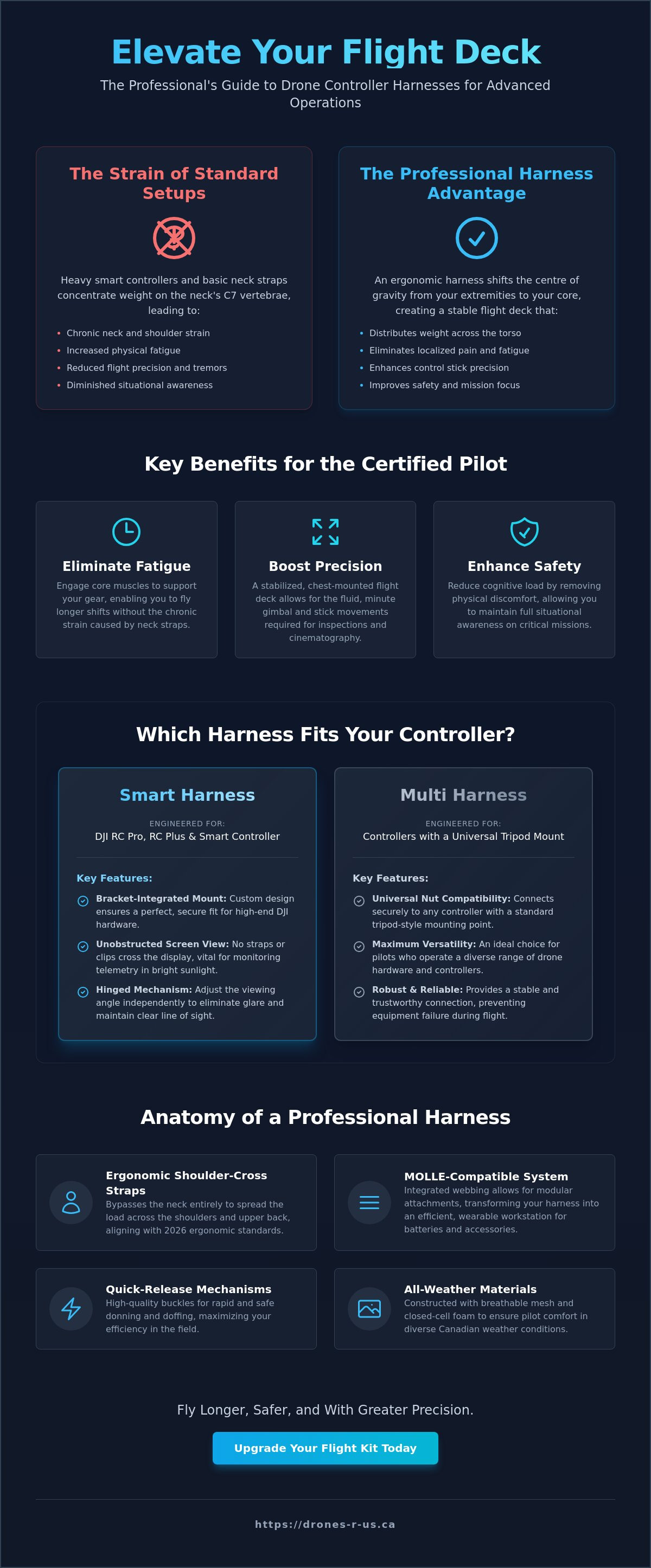
A professional drone harness functions as a specialized weight-distribution system designed to support modern, heavy smart controllers. Equipment such as the DJI RC Plus or the Autel Smart Controller V3 provides incredible functionality, but their substantial weight can quickly become a physical liability. Without a proper support system, your hands and wrists carry the full load, leading to tremors and reduced control precision over time. A professional drone harness for smart controller operations corrects this by shifting the centre of gravity from your extremities to the core of your body. This alignment allows the torso to absorb the weight, keeping your hands free for delicate stick inputs rather than supporting the hardware.
The connection between physical comfort and operational safety is undeniable. If you're distracted by localized pain or muscle exhaustion, your cognitive load increases significantly. This degradation of situational awareness for drone pilots is often the precursor to operational incidents. For those pursuing Transport Canada drone certification, ergonomics should be viewed as a safety-critical component of your flight kit. Proper gear ensures that you remain focused on the mission parameters rather than your own physical discomfort.
Reducing Neck Strain and Long-Term Fatigue
Standard neck straps are a common entry-point for hobbyists, but they present significant risks for professional use. These straps concentrate the entire weight of the controller on the C7 vertebrae at the base of the neck. Over an eight-hour shift, this leads to tension headaches and long-term musculoskeletal issues. High-quality harnesses utilize shoulder-cross straps that bypass the neck entirely, spreading the load across the shoulders and upper back. Pilot fatigue is a primary risk factor in RPAS safety. By engaging the larger core muscles, you can maintain a neutral posture and remain in the field for extended periods without compromising your health.
Stability for High-Precision Flight
Precision is the hallmark of a professional. A stabilized drone harness for smart controller use allows for the fluid, minute gimbal movements required in high-end cinematography and industrial inspections. When the screen is held in a fixed, predictable position against the chest, it creates a reliable flight deck. This consistency is vital for maintaining visual line of sight (VLOS) transitions. Your eyes can move between the aircraft and the telemetry without hunting for a swaying screen. Maintaining this level of control is especially critical during an Advanced drone flight review, where examiners look for steady handling and disciplined spatial awareness.
Smart vs. Multi Harnesses: Which Bracket Suits Your Controller?
Selecting a drone harness for smart controller use requires a clear understanding of your hardware's mounting interface. Professional controllers generally fall into two categories: those with dedicated mounting points for integrated brackets and those that utilize a standard universal nut. Choosing the wrong interface can lead to screen obstruction, unstable viewing angles, or equipment failure during flight. Before you invest in a harness, examine the chassis of your controller. If your device features specific screw holes designed for accessories, a bracket-integrated Smart system is likely the best fit. If your controller relies on a single tripod-style mounting point, a Multi system provides the necessary versatility.
The Smart Drone Controller Harness
The Smart variant is engineered specifically for pilots using high-end DJI hardware, including the DJI RC Pro, RC Plus, and the original Smart Controller. These devices feature integrated high-brightness screens that must remain completely unobstructed for safe operation. The custom bracket design ensures that no straps or clips cross the display area, which is vital when monitoring telemetry in bright Canadian sunlight. A key advantage of this system is the hinged mounting mechanism. This allows you to adjust the viewing angle of the screen independently of your body position. Whether you are standing on a flat flight line or navigating uneven terrain, you can tilt the controller to eliminate glare and maintain a clear line of sight to your flight data.
The Multi Drone Controller Harness
For pilots operating enterprise-grade hardware from other manufacturers, the Multi harness is the industry standard. This system is designed for controllers equipped with a 1/4"-20 inset nut, such as those found on the Autel EVO series or the Skydio X10. It uses a robust universal mounting plate that creates a solid connection between the harness and the controller body. This mounting philosophy is ideal for future-proofing your gear. As manufacturers release new iterations of hardware, the 1/4"-20 standard remains consistent, allowing you to transition between different drone platforms without replacing your entire harness system. This stability is especially beneficial when using larger controllers that incorporate external tablets, as the centralized mount prevents the top-heavy setup from tilting unexpectedly. If you are uncertain which bracket matches your current fleet, you can consult with our flight team to find the right flight deck configuration.
Essential Features: Fatigue Reduction and Field Stability
Professional flight operations often take place in demanding environments where equipment failure isn't just about the drone; it's about the pilot's physical endurance. A high-quality drone harness for smart controller systems must prioritize both material science and mechanical stability. While hobbyist straps focus on simple attachment, professional gear utilizes advanced weight-distribution architecture. This ensures that the heavy smart controller remains a tool rather than a physical burden. Precision requires stability. If your hardware is bouncing against your chest while you navigate a job site, your focus is divided. A secure harness creates a fixed flight deck that moves with your body, allowing you to maintain control even on the move.
Closed-cell foam is a non-negotiable requirement for all-day comfort. Unlike cheaper open-cell alternatives, closed-cell foam doesn't absorb water, mud, or perspiration. This prevents the harness from becoming heavy or unhygienic during long shifts. For the Canadian climate, this material remains flexible and supportive whether you're working in a humid Ontario summer or a dry Prairie winter. Adjustable load lifters are another critical feature. These small straps allow you to pull the weight closer to your centre of gravity. This prevents the controller from pulling your shoulders forward, which is the leading cause of upper back pain among RPAS professionals. This level of field-ready stability is vital when traversing uneven terrain. A swinging controller is a safety hazard that can lead to trips or accidental stick inputs.
Breathability and Material Durability
Canadian pilots require gear that performs across a vast thermal range. Your equipment must remain reliable from -20°C during winter utility inspections to +30°C in the height of summer. Breathable mesh backing is superior for airflow, preventing heat buildup and moisture traps against the pilot's chest. UV-resistant nylon and heavy-duty hardware are equally important. Gear that lives outdoors is subject to constant solar degradation. Using UV-stabilized materials ensures the drone harness for smart controller use retains its structural integrity and colour over years of service. Durable gear is a hallmark of a professional setup.
Ergonomic Viewing Angles
The mechanical hinge on a professional bracket is more than a convenience; it's a tool for visual precision. This mechanism allows the controller to fold flat against your chest when you're moving between launch sites. This protects the screen and sticks from accidental damage. When flying, you can organize your strap tension to hold the controller at a perfect 90-degree viewing angle. This alignment is critical for maintaining a neutral neck position. Proper screen positioning reduces glare and eye strain by ensuring the display is always in your direct line of sight without requiring constant head tilting.
Maximizing Field Efficiency with MOLLE and Quick-Release Systems
MOLLE, an acronym for Modular Lightweight Load-carrying Equipment, is a heavy-duty webbing system that allows for the secure attachment of various pouches and tools. For a professional RPAS pilot, a drone harness for smart controller setups serves as the foundation for a modular, wearable workstation. This system is critical during solo operations where maintaining situational awareness is paramount. Instead of placing your controller on the ground to retrieve a radio or spare battery, your gear remains accessible within your immediate reach. This level of organization reduces the cognitive load during high-stakes missions. It's about having what you need, exactly where you need it, without breaking your concentration.
MOLLE Integration for Professional Gear
Customizing your harness configuration allows you to tailor your loadout to the specific requirements of the mission. For pilots working near controlled airspace, attaching a handheld radio directly to the shoulder strap ensures that ATC communications are always audible and within reach. Other common attachments include range extenders, utility pouches for spare SD cards, or even hydration carriers for long summer days. Balancing the load is essential to prevent lopsided muscle strain. You should distribute heavier items symmetrically across the harness to maintain your centre of gravity. Having these tools available by touch means you don't have to look away from your aircraft to find essential equipment. This efficiency is a hallmark of a disciplined flight operation.
The Quick-Release Advantage
The ability to transition between different mounting platforms is a significant operational advantage. Quick-release mechanisms allow you to detach the smart controller from the harness in seconds, facilitating a smooth transition to a tripod or a handheld position. This feature is vital for multi-pilot hand-offs or training scenarios where an instructor may need to take control of the sticks instantly. Caswell Aviation Ltd utilizes these systems during advanced training sessions to ensure maximum safety and instructor intervention capability. It's a professional standard that prioritizes flexibility without compromising security.
Quick-release hardware also protects your expensive smart controller from accidental drops during gear transitions. By using a standardized mounting plate, you can move from a chest-mounted flight deck to a stationary command station without fumbling with complex hardware. This is particularly useful for long-duration industrial inspections where a pilot might switch between standing and seated positions. If you're ready to improve your field efficiency, you can view our selection of Fitek Gear harnesses to find a modular system that matches your operational needs.
Elevating Your Flight Deck with Fitek Gear from Caswell Aviation
A professional flight operation requires more than just a certified aircraft and a qualified pilot. It requires an interface that allows for sustained, high-precision control without physical compromise. Fitek Gear has established itself as the industry standard for ergonomic drone harnesses, providing the structural integrity needed for complex RPAS missions. By choosing a drone harness for smart controller operations through a Canadian provider, you ensure that your gear is vetted by professionals who understand our specific regulatory and environmental challenges. This equipment is not a luxury; it is a safety-critical component that supports better flight performance and ensures compliance with fatigue management best practices.
Selecting the correct model from the Caswell inventory involves a simple assessment of your current and future fleet. Use this final checklist to guide your decision:
- Controller Interface: Determine if your hardware requires a dedicated Smart bracket for integrated screens or a universal 1/4"-20 Multi mount.
- Mission Duration: Evaluate if your typical flight day exceeds four hours, necessitating the advanced weight distribution of a full harness rather than a simple strap.
- Modularity Needs: Assess which MOLLE attachments, such as handheld radio pouches or battery carriers, are essential for your specific field workflows.
- Future-Proofing: Consider if you plan to expand to different manufacturer platforms that might require the versatility of a Multi-bracket system.
Why We Recommend Fitek Gear
The Comox Harness base serves as the proven platform for UAV professionals across North America. Its design reflects a deep understanding of human factors and ergonomics, offering a level of durability tested in the most rugged environments Canada has to offer. We apply a "Master Practitioner" seal of approval to this gear because we use it for our own aerial photography and industrial inspection contracts. When you are operating in high-stakes environments, you need the reassurance that your flight deck is stable and secure. Fitek Gear provides that stability, allowing you to focus entirely on the data you are collecting rather than the strain on your neck or shoulders.
Getting Started with Your New Harness
Initial setup is vital for achieving the full ergonomic benefits of your new system. Begin by adjusting the shoulder straps to ensure the controller sits at a height that allows your elbows to maintain a relaxed, 90-degree angle. This neutral posture prevents fatigue and ensures your stick inputs remain fluid throughout the day. Once the harness is fitted, we encourage you to pair your new hardware with our professional online drone courses to achieve total operational mastery. Combining the right gear with advanced training is the most effective way to elevate your career in the RPAS industry. You can browse our selection of Fitek Gear drone harnesses today to find the perfect fit for your professional flight deck.
Optimize Your Professional Flight Deck
Transitioning from a basic neck strap to a dedicated flight deck is a defining step for any serious RPAS operator. You now understand how the correct weight distribution prevents chronic strain and how specific brackets ensure your telemetry remains unobstructed. By prioritizing materials that withstand the Canadian climate and utilizing modular MOLLE systems, you transform your controller into a highly efficient workstation. These features collectively ensure that your focus remains on the mission rather than physical discomfort.
Selecting a high-quality drone harness for smart controller operations is an investment in both safety and career longevity. We are an authorized Fitek Gear retailer, offering equipment that is designed for all-day ergonomic comfort and has been field-tested by Transport Canada Flight Reviewers. This level of gear provides the stability required for advanced manoeuvres and long-duration industrial inspections. Shop Professional Fitek Gear Drone Harnesses today to secure your equipment and improve your flight precision. Fly with the confidence that your gear is as professional as your certification.
Frequently Asked Questions
Will this drone harness fit the DJI RC Pro controller?
Yes, the Smart Drone Controller Harness is specifically engineered for models with integrated screens like the DJI RC Pro. It utilizes a custom bracket that attaches to the dedicated mounting points on the back of the controller. This design ensures the screen remains completely unobstructed and provides a stable viewing angle for long-duration missions.
Is a drone harness required by Transport Canada regulations?
No, a harness is not a legal requirement under the Canadian Aviation Regulations. However, it is considered a best practice for safety and fatigue management. Many professional organizations mandate their use to ensure pilots maintain high levels of situational awareness and stick precision during complex advanced operations or flight reviews.
Can I wear a backpack while using the Fitek Gear drone harness?
Yes, you can comfortably wear a backpack over the harness. The straps are designed with a low profile to sit flat against your shoulders and back. This prevents the gear from bunching or creating uncomfortable pressure points, allowing you to carry your drone cases and essential field equipment while keeping your flight deck ready.
How does a drone harness help with neck pain during long flights?
A drone harness for smart controller use shifts the weight of your hardware from the sensitive C7 vertebrae in your neck to your shoulders and core. By distributing the load across a larger surface area, it eliminates the localized strain that causes tension headaches and muscle fatigue. This allows you to maintain a neutral posture throughout an eight-hour shift.
What is the difference between the Smart and Multi bracket options?
The Smart bracket is a dedicated system for controllers with built-in screens and specific screw-in mounting points. The Multi bracket uses a universal 1/4"-20 tripod-style nut, making it compatible with a wider range of enterprise hardware from manufacturers like Autel or Skydio. Both options provide the same level of stability and ergonomic support for the pilot.
Are these harnesses adjustable for different body sizes and winter clothing?
Yes, the harness system is fully adjustable to accommodate various body types and seasonal gear. You can easily expand the straps to fit over a heavy winter parka or tighten them for a secure fit over a summer high-visibility vest. This flexibility ensures that your drone harness for smart controller operations remain stable in any Canadian weather condition.
Can I attach my handheld radio to the harness?
Yes, the integrated MOLLE webbing allows for the easy attachment of handheld radio pouches. This ensures that your aviation band or team radios are always audible and within reach. You can also add pouches for spare batteries, range extenders, or multi-tools, effectively turning your harness into a modular, wearable workstation for field operations.
What happens if I need to quickly detach the controller in an emergency?
The harness features a robust quick-release mechanism that allows for near-instant detachment. By engaging the release hardware, you can separate the controller from the harness in seconds. This is vital for emergency hand-offs to a secondary pilot or for transitioning the controller to a stationary tripod mount without fumbling with complex clips or screws.
Leave a comment