

Drone Services Pricing Guide Canada 2026: Professional Rates and Training Costs
In 2026, the value of a professional drone operation is no longer measured by flight minutes, but by the precision of its regulatory compliance and specialized data output. Whether you're a project manager seeking site surveys or an aspiring pilot looking to realize a new career, understanding the current market is essential. This drone services pricing guide Canada 2026 provides the financial clarity you need to navigate a sector that has transitioned from a niche hobby into a multi-billion dollar pillar of national infrastructure.
You've likely realized that Transport Canada requirements can be confusing and that aerial photography quotes often vary wildly across different provinces. It's difficult to gauge if you're overpaying for a flight review or underestimating the gear required for a safe, professional mission. We'll demystify these costs by breaking down current exam fees, certification paths, and the necessary investment in professional-grade field equipment like specialized harnesses.
This guide offers a methodical look at the industry's financial requirements. We'll cover everything from the $125 Level 1 Complex Operations fee to the standardized expectations for aerial imagery and the long-term value of expert-led training programs.
Key Takeaways
- Learn how Transport Canada regulations and the shift toward specialized RPAS operations dictate modern professional service rates.
- Identify exact costs for 2026 certifications and flight reviews using this comprehensive drone services pricing guide Canada 2026.
- Compare hourly and project-based pricing models for various service tiers, from basic residential photos to complex industrial mapping.
- Calculate the return on investment for professional-grade gear and ergonomic accessories that enhance pilot safety and field endurance.
- Discover how to consolidate your training, certification, and imagery needs by partnering with a provider backed by 25 years of aviation experience.
The 2026 Canadian Drone Market: Key Pricing Factors
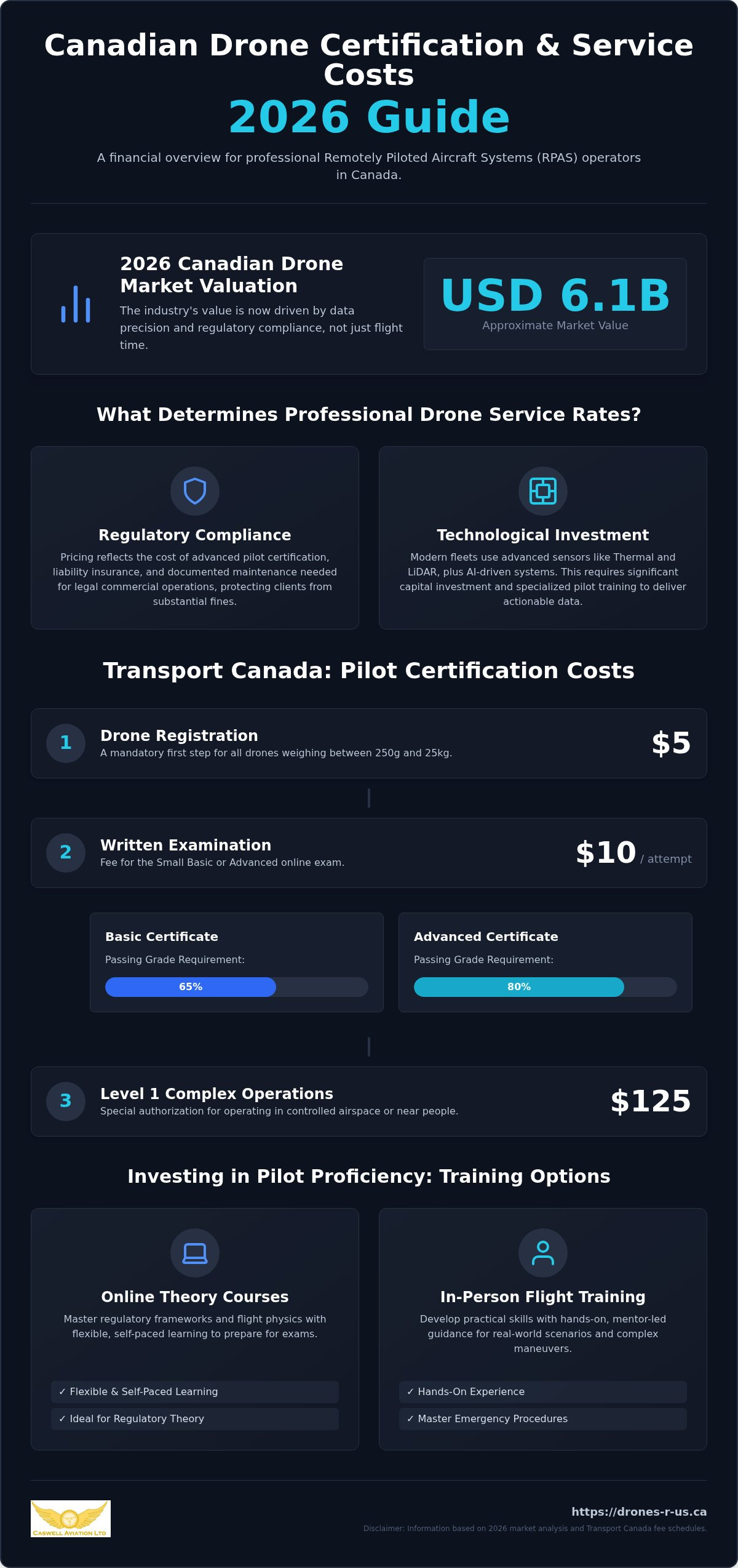
The Canadian drone industry has reached a pivotal stage of maturity in 2026. Recent market valuations place the sector at approximately USD 6.1 billion, a figure driven by the rapid adoption of Remotely Piloted Aircraft Systems (RPAS) across agriculture, mining, and infrastructure. This growth has fundamentally changed how businesses budget for aerial work. When reviewing a drone services pricing guide Canada 2026, it's vital to recognize that you're no longer paying for a simple flight; you're investing in a regulated aviation service that prioritizes data precision and safety.
Hiring a licensed professional differs significantly from engaging a recreational hobbyist. While a hobbyist might operate under specific exemptions for drones under 250g, commercial projects typically require heavier, more capable aircraft. These operations fall under strict oversight. Professionals carry the weight of certification, liability insurance, and documented maintenance logs. These factors ensure that your project remains compliant with federal laws, protecting your organization from the substantial fines associated with unauthorized flights.
Regulatory Compliance as a Price Driver
The complexity of your mission dictates the required pilot certification level. Operations in controlled airspace or near bystanders require an Advanced Pilot Certificate, which involves more rigorous testing and higher insurance premiums. Professional service providers often leverage decades of experience to navigate these requirements. For example, Caswell Aviation Ltd utilizes over 25 years of aviation expertise to manage risk effectively. This level of experience ensures that complex missions are planned with the same discipline found in traditional manned aviation, which is reflected in the service quote. Full compliance with Canadian drone regulations is a non-negotiable overhead that guarantees operational safety and legal standing.
Technological Advancements in 2026
Technology in 2026 has moved beyond simple RGB cameras. Modern fleets now integrate AI-driven flight systems that enhance project efficiency and data accuracy. Specialized sensors, such as thermal imagers and LiDAR for 3D mapping, require significant capital investment and technical training to operate. For a look at how these technologies are applied to data processing, you can visit SkySnap to explore their AI-driven analysis services. Maintaining a fleet that meets current safety standards involves regular hardware updates and software subscriptions. These technological requirements ensure that the imagery you receive isn't just a picture, but a set of actionable data points that can be integrated into professional workflows. Consequently, pricing reflects the high-tier hardware and software necessary to deliver these results.
Professional drone operations begin with legal compliance. Becoming a certified pilot in 2026 involves a series of mandatory administrative fees and educational investments. This drone services pricing guide Canada 2026 outlines the current fee structure set by Transport Canada, which remains the foundation for any commercial venture. Every drone weighing between 250g and 25kg must be registered for a fee of $5. While the $10 fee for a Small Basic or Advanced exam is relatively low, these costs can accumulate if multiple attempts are required to meet the necessary passing grades.
The path to professional certification is tiered. A passing grade of 65% is required for the Basic certificate, while the Advanced certificate demands a higher 80% threshold. For those looking to operate in the most complex environments, the Pilot Certificate for Level 1 Complex Operations carries a $125 fee. These administrative costs are fixed, but the real investment lies in the quality of your preparation and training.
Online Drone Courses and In-Person Training
Budgeting for education often involves choosing between self-paced online courses and immersive in-person instruction. Online theory courses provide the flexibility needed to master regulatory frameworks and flight physics at your own pace. However, in-person training offers mentor-like guidance that is difficult to replicate through a screen. This hands-on approach is particularly valuable for mastering complex flight maneuvers and emergency procedures. For a detailed breakdown of the certification process, consult The Complete Guide to Transport Canada Drone Certification in 2026. Investing in professional drone training ensures you don't just pass the exam, but develop the discipline required for high-stakes aviation.
Advanced Flight Review Pricing
An in-person flight review is a mandatory prerequisite for the Advanced Pilot Certificate. Standard rates for these reviews typically range between $150 and $300, depending on the complexity of the assessment and the expertise of the reviewer. You must achieve the 80% exam threshold before booking this session. Additionally, many professionals choose to obtain a Restricted Operator Certificate with Aeronautical qualification (ROC-A). This certification allows for legal communication on aviation radio frequencies, which is essential for operations near airports. While it involves an additional testing cost, the ability to coordinate with air traffic control significantly increases your operational safety and professional credibility.
Professional Aerial Photography and Video Rates
Service pricing in 2026 has shifted toward a modular structure. Most professional providers now utilize two primary models: project-based flat fees for standardized imagery and hourly rates for technical or open-ended missions. This drone services pricing guide Canada 2026 highlights that while flight time is the most visible part of the invoice, the final quote reflects the pilot's expertise in mission planning and the complexity of the operational environment. You'll find that standardized rates often include a set number of high-resolution deliverables. Hourly billing is typically reserved for industrial inspections where the drone must remain on-site for extended periods; these rates generally fall between $150 and $500 per hour.
One of the most significant factors in price variance is the proximity to controlled airspace. If your project is located near an airport or within a restricted zone, the pilot must coordinate with NAV CANADA and adhere to stricter safety protocols. These missions require an Advanced Pilot Certificate and often involve higher insurance premiums to mitigate the increased risk. Post-processing represents a significant portion of the total cost. Transforming raw sensor data into a polished 4K video or a centimetre-accurate map requires powerful computing hardware and specialized software subscriptions. These technical requirements are reflected in the professional service fee.
Real Estate and Residential Imagery
Residential drone work has expanded beyond simple home listings. Acreage and farm photography now require large-scale mapping capabilities to capture the full scope of the property, often necessitating multiple flight cycles. Similarly, promotional videos for vacation destinations and golf courses involve high-frame-rate captures and complex storytelling techniques to engage viewers. Average booking costs for professional sessions often sit around $550, though high-end marketing assets demand a level of creative direction that justifies a premium. For a deeper look at production standards for commercial projects, refer to The Professional Guide to Corporate Drone Video.
Industrial and Technical Drone Services
Industrial applications represent the high-precision end of the market. Thermal imaging projects for building envelopes or electrical grids utilize sensors that detect minute temperature variations, requiring specialized training to interpret the results correctly. In the construction and mining sectors, stockpile analysis uses photogrammetry to provide accurate volume measurements. This process is far more efficient than traditional ground-based surveying. For organizations requiring specialized oversight in legal or corporate security matters, you can learn more about Canadian Special Investigations and their licensed approach to professional evidence gathering. These technical services often take place in complex environments, such as airport controlled airspace, where the pilot's ability to maintain constant communication with air traffic control is vital. The specialized skills and equipment required for these missions naturally result in higher project costs compared to visual-only photography.
Professional drone operations require a significant investment in hardware that extends far beyond the aircraft itself. While a drone services pricing guide Canada 2026 often focuses on flight hours, a successful business must account for the high-tier smart controllers and accessories that ensure mission success. These controllers are precision instruments that require regular firmware updates and hardware maintenance to remain compliant with current safety standards. Neglecting these maintenance schedules can lead to operational delays or hardware failure during a critical mission. You should budget for annual sensor calibration and professional inspections to ensure your fleet remains airworthy and reliable.
Ergonomics play a vital role in the long-term profitability of a drone service provider. It's essential to calculate the return on investment for pilot comfort, as physical fatigue directly impacts flight precision and situational awareness. A pilot who is physically strained by the weight of a heavy controller is more likely to make errors or require frequent breaks, which extends project timelines. By investing in ergonomic support systems, you ensure that your team can maintain high standards of data collection throughout an eight-hour field day.
Fitek Gear Drone Harnesses for Smart Controllers
Specialized harnesses are no longer optional for professional pilots. These systems distribute the weight of the controller across the shoulders and back, allowing for more granular control over the joysticks. Whether you are using DJI, Skydio, or Autel equipment, a professional harness improves flight safety by preventing accidental drops and reducing hand tremors. For a comprehensive look at the options available, read Choosing the Best Drone Harness for Smart Controllers: A 2026 Professional Guide. You can browse Fitek Gear drone harnesses to find the right ergonomic solution for your specific controller model.
Essential Field Gear Checklist
A complete field kit includes several layers of secondary equipment. Budgeting for extra batteries and multi-port charging hubs is necessary to maintain continuous flight operations without waiting for hardware to cool or recharge. These items ensure that your equipment remains protected in varied Canadian climates, from humid summer days to the dry, dusty conditions found on industrial sites. Protecting your primary assets through proper storage and field discipline is the most effective way to manage long-term operational costs.
- High-visibility landing pads to protect gimbal sensors from dust and debris during take-off
- Professional safety signage and cordons to clearly mark your operational area for bystanders
- Weather-proof cases and protective covers designed for current 2026 drone models
- High-speed storage media capable of handling massive 4K video and 3D mapping data files
- Field repair kits containing spare propellers and basic tools for minor adjustments
Maximizing Value with Caswell Aviation Ltd
Caswell Aviation Ltd serves as a comprehensive resource for those navigating the complexities of the 2026 drone industry. By operating as a "One-Stop-Shop," the firm provides a seamless transition between regulatory compliance and professional execution. This holistic approach is grounded in over 25 years of aviation experience, spanning both manned and unmanned flight operations. For organizations reviewing a drone services pricing guide Canada 2026, partnering with a veteran mentor ensures that budgets are allocated efficiently toward certified training and high-tier data acquisition.
Customizing service bundles allows both enterprise clients and individual pilots to realize better value. Instead of sourcing training, gear, and imagery from separate vendors, you can coordinate these needs through a single point of contact. This integration reduces administrative friction and ensures that your equipment choices align perfectly with your certification level and mission requirements. Whether you're an individual pilot or a project manager, these tailored solutions help you manage the total cost of ownership for your drone program.
Professional Mentorship and Training
Training at Caswell Aviation Ltd focuses on developing real-world operational skills that go beyond the basic requirements of the Small Advanced exam. The goal is to produce disciplined pilots who can manage complex missions with precision. You can schedule Advanced and Level 1 Complex Flight Reviews to validate your proficiency under the guidance of industry experts. This mentor-led approach ensures you're prepared for the unique challenges of Canadian flight environments. To begin your certification journey or upgrade your current skills, visit Caswell Aviation Ltd to explore available course dates and flight review sessions.
Comprehensive Aerial Solutions
For businesses requiring high-precision data, requesting a quote for thermal or 3D mapping projects is the first step toward optimizing your site operations. These specialized services provide actionable insights that drive efficiency in sectors like mining and construction. As you scale your operations, ensuring you have the right combination of professional-grade gear and pilot certification is vital. For those looking to enter the workforce, Drone Pilot Jobs in Canada: A Professional Career Guide for 2026 provides a roadmap for turning your training into a sustainable career.
Booking a consultation or a flight review is a straightforward process. You can reach out to discuss your specific project requirements or training needs, ensuring you receive a tailored solution that meets the safety and technical standards of the 2026 landscape. This methodical approach to service delivery ensures that every flight is conducted with the highest level of professional discipline.
Securing Your Future in the 2026 Drone Industry
The Canadian RPAS landscape is defined by its rigorous safety standards and the high value of its specialized data. This drone services pricing guide Canada 2026 has detailed how regulatory compliance, advanced training, and ergonomic gear form the foundation of a successful operation. Professionals who prioritize these elements don't just avoid penalties; they deliver superior results that justify premium rates. Success in this sector requires a balance of technical skill and aviation discipline.
Effective budgeting must account for both the administrative fees of Transport Canada and the long-term benefits of expert mentorship. High-quality field gear ensures your team can maintain the precision required for complex technical imagery. As a Transport Canada Advanced Certified provider and official Fitek Gear retailer with over 25 years of aviation experience, Caswell Aviation Ltd provides the stability and expertise needed to navigate this evolving sector.
Book Your 2026 Drone Training or Flight Review with Caswell Aviation to ensure your operations are built on a foundation of professional excellence. Your path to a compliant and profitable aerial career is ready when you are.
Frequently Asked Questions
How much does a Transport Canada drone license cost in 2026?
Transport Canada drone certification involves several fixed administrative fees. Registering a drone weighing between 250g and 25kg costs $5 per aircraft. The online Small Basic and Small Advanced exams each cost $10 per attempt. For pilots pursuing higher-tier operations, the Pilot Certificate for Level 1 Complex Operations requires a $125 fee. These costs are mandatory for all legal commercial operations across the country.
Is there a difference in pricing between Basic and Advanced flight reviews?
A flight review is only required for pilots seeking an Advanced Pilot Certificate. Basic operations do not require an in-person assessment; therefore, there is no flight review cost for that tier. Professional flight reviewers typically charge between $150 and $300 for the Advanced review. This session validates your ability to operate safely in controlled airspace or near bystanders, ensuring you meet federal safety standards.
What is the average hourly rate for a professional drone pilot in Canada?
Professional drone pilot rates in Canada generally range between $150 and $500 per hour. This drone services pricing guide Canada 2026 notes that rates vary based on the complexity of the mission and the required sensor technology. General aerial photography bookings often average around $550 per session, while specialized industrial inspections or thermal mapping projects typically command higher hourly fees due to the technical expertise required.
Do I need to pay extra for drone operations in controlled airspace?
Operations in controlled airspace usually incur higher costs due to increased regulatory and planning requirements. Pilots must hold an Advanced Pilot Certificate and coordinate with NAV CANADA for flight authorization. These missions often require more comprehensive insurance coverage and additional ground crew, such as visual observers. While there isn't a direct fee paid to the regulator for the space, the professional's time spent on coordination is reflected in the quote.
Are drone training courses tax-deductible for small businesses in Canada?
Professional drone training is typically considered a legitimate business expense for Canadian corporations and sole proprietorships. If the training is required to maintain or improve skills for your current business operations, it can often be deducted as a professional development or education expense. You should consult with a qualified tax professional to understand how these investments apply to your specific financial situation and business structure.
How much should I budget for a professional drone harness like Fitek Gear?
Budgeting for professional ergonomic gear depends on the specific smart controller model you utilize. Fitek Gear harnesses are designed to distribute the weight of heavy controllers across the shoulders and back, which is essential for long field days. While the cost is a separate investment from the drone itself, the return on investment comes through improved pilot precision and reduced physical fatigue during complex missions.
Does Caswell Aviation offer pricing bundles for training and flight reviews?
Caswell Aviation Ltd provides customized solutions for individuals and enterprise teams looking to streamline their certification process. By combining online drone courses with in-person flight reviews, pilots can often realize better value than sourcing these services separately. These bundles are designed to take a candidate from initial theory to final flight review under the mentorship of an instructor with over 25 years of aviation experience.
What factors most influence the cost of aerial mapping and thermal imaging?
The cost of aerial mapping and thermal imaging is primarily influenced by specialized sensors and post-processing requirements. High-resolution thermal cameras and LiDAR sensors involve significant capital investment. Additionally, the time required to process raw data into actionable 3D models or temperature reports adds to the project total. Environmental factors, such as the size of the site and the proximity to controlled airspace, also play a critical role.
Leave a comment