
The Complete Guide to Transport Canada Drone Certification in 2026
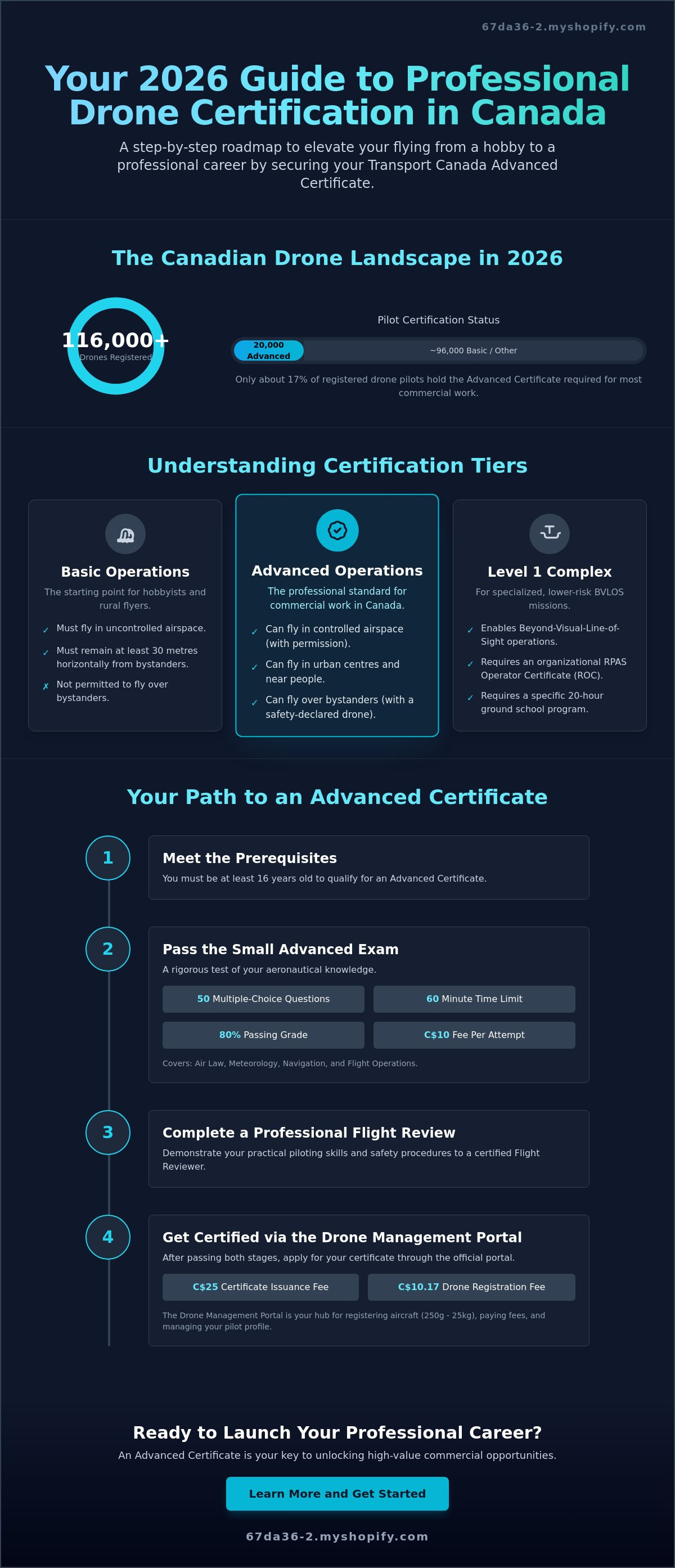
With more than 116,000 drones registered across Canada as of late 2025, the national airspace is busier than ever, yet only about 20,000 pilots have achieved the professional standards required for Advanced operations. Securing your Transport Canada drone certification in 2026 is the most effective way to move beyond hobbyist limitations and access high-value commercial opportunities. It's common to feel a sense of hesitation when faced with the technical complexities of the Drone Management Portal or the rigour of a professional flight review.
We recognize that staying compliant with evolving aviation rules can feel like a daunting task. This guide simplifies the process by providing a clear, step-by-step roadmap to obtaining your professional credentials with confidence. You'll learn exactly how to prepare for the 2026 exam structures, what to expect during your flight review to ensure a first-time pass, and why the ROI of an Advanced certificate is essential for your long-term career growth in the Canadian drone industry.
Key Takeaways
- Identify the specific requirements for Basic, Advanced, and Level 1 Complex operations within the updated 2026 regulatory framework.
- Master the two-step process of passing the Small Advanced Exam and completing a professional flight review to secure your Transport Canada drone certification.
- Prepare for the technical rigours of a flight review by selecting a recognized training provider and utilizing the Drone Management Portal efficiently.
- Learn how proper ergonomics and specialized gear enhance operational safety and control precision during professional missions.
- Explore the commercial advantages of high-level credentials for launching a career in professional aerial photography and complex flight operations.
Understanding the 2026 Transport Canada Drone Certification Framework
In Canada, any pilot operating a drone between 250 grams and 25 kilograms is legally required to hold a Pilot Certificate - Remotely Piloted Aircraft System (RPAS). This document serves as the foundation for aviation safety and regulatory compliance. Understanding Drones (UAVs) and their classification is the first step toward securing your professional credentials. The framework ensures that every operator possesses the technical knowledge to manage their aircraft without compromising the safety of the national airspace or the public on the ground.
The 2026 regulatory environment organizes flight operations into three distinct categories based on risk levels and proximity to bystanders. The Transport Canada drone certification you choose defines where you can fly and how close you can get to people. While the Basic certificate serves as a starting point, the Advanced certificate is the industry standard for professional Canadian pilots. It provides the necessary permissions to operate in controlled airspace and urban centres, which is where most commercial work occurs. It's also important to realize that while these certificates do not expire, you must meet mandatory recency requirements every 24 months to maintain your flight privileges.
Basic vs. Advanced Operations: Which Path Fits Your Needs?
The primary difference between these categories lies in proximity and airspace access. Basic operations require you to stay at least 30 metres away from bystanders and only permit flight in uncontrolled airspace. In contrast, an Advanced certificate allows you to fly within 30 metres of people, or even directly over them if you use a drone with the appropriate safety assurance declaration. The Basic certificate is the entry point for hobbyists or rural operators. Most commercial pilots require the Advanced tier to access controlled airspace near airports or within busy municipal boundaries.
The Emergence of Level 1 Complex Operations
As of late 2025, Transport Canada introduced the Level 1 Complex certification to accommodate the growing demand for lower-risk beyond-visual-line-of-sight (BVLOS) operations. A complex operation involves flying in environments that exceed standard Advanced limits, such as extended distances where the pilot cannot see the aircraft. This tier requires an RPAS Operator Certificate (ROC) at the organizational level. Individual pilots must also complete a specific 20-hour ground school program. This ensures a deeper understanding of meteorology, radio telephony, and advanced navigation required for high-stakes missions.
Navigating the Advanced Drone Certificate Requirements
Securing your professional credentials requires following a methodical two-step process overseen by the federal regulator. Every pilot must first pass the Small Advanced Exam before they can book a practical flight review. Central to this entire journey is the Drone Management Portal. This digital system is where you register your aircraft, pay fees, and track your certification progress. It acts as the official record of your compliance with Transport Canada Drone Rules. You'll use it to register any drone weighing 250g or more, which currently carries a fee of C$10.17 per aircraft.
To qualify for an Advanced Transport Canada drone certification, you must be at least 16 years old. The financial investment for government fees remains accessible for most professionals. As of 2026, the Small Advanced Exam costs C$10 per attempt. Once you successfully complete both the written exam and the practical flight review, the issuance fee for the Pilot Certificate - Advanced Operations is C$25. Keeping your contact information and aircraft fleet updated in the portal is essential, as this is how the regulator communicates safety alerts or changes to the Canadian Aviation Regulations (CARs).
The Advanced Written Exam: Preparation and Strategy
The exam consists of 50 multiple-choice questions that must be completed within 60 minutes. A high passing grade of 80% is required, which reflects the technical nature of professional flight. You'll be tested on Air Law, Meteorology, Navigation, and Flight Operations. While the exam is "open book," don't rely on searching for every answer. The time limit is strict. Success depends on your ability to quickly reference the CARs rather than memorizing every clause. Organization is your best tool. Have your reference materials indexed and ready before you begin the timer.
Ground School vs. Self-Study: Maximizing Your Success Rate
While self-study is an option, many professionals find that structured Online Drone Courses offer a much higher return on investment. These programs condense thousands of pages of regulatory text into digestible modules focused on what actually matters in the field. Professional ground school goes beyond the test. It prepares you for real-world challenges like managing human factors, fatigue, and complex radio telephony protocols. Instructor-led training provides the technical authority needed to handle high-stakes missions with precision. If you want to ensure you're fully prepared for both the exam and your future career, choosing a comprehensive course provides a clear advantage.
Mastering the Flight Review: From Preparation to Certification
The flight review is the final practical hurdle in obtaining your Transport Canada drone certification. You can only schedule this session after you've successfully passed the Small Advanced Exam. It's a formal evaluation where a third-party reviewer validates your ability to operate safely in complex environments. Choosing a qualified flight reviewer through a recognized school like Caswell Aviation ensures you're being assessed by an industry professional who understands the nuances of the Transport Canada drone pilot licensing system. The reviewer's role is to confirm that you can translate theoretical knowledge into safe, disciplined flight operations.
Preparation for the review follows a logical sequence. You must arrive at the site with all required documentation ready for inspection. This structured approach mirrors the workflow of a professional drone pilot. Follow these steps to move from candidate to certified pilot:
- Step 1: Confirm your Small Advanced Exam results are visible in the Drone Management Portal.
- Step 2: Book your session with a reviewer who specializes in your specific area of operation.
- Step 3: Prepare your site survey, emergency procedures, and maintenance logs in a professional binder or digital format.
- Step 4: Demonstrate flight proficiency and oral knowledge during the in-person assessment.
- Step 5: Apply for the certificate in the Portal and pay the C$25 issuance fee once the reviewer submits your successful results.
What to Expect During Your Advanced Flight Review
The review begins with a rigorous oral component. Expect questions on airspace classifications, weather interpretations, and your legal responsibilities under the CARs. The flight portion tests your manual control through specific maneuvers like precise take-offs, landings, and simulated lost-link procedures. Reviewers look for a "Safety First" mindset. They observe how you handle your gear, how you communicate with crew members, and whether you follow your own checklists without prompting. Technical skill is necessary, but discipline is what earns the certificate.
Common Errors That Lead to Flight Review Failure
Documentation errors are the most frequent reason for failure during the Transport Canada drone certification process. An incomplete or disorganized site survey suggests a lack of preparation. If you haven't identified nearby hazards or emergency landing zones, the reviewer cannot verify your safety protocols. Another common mistake is the failure to check NOTAMs or verify airspace restrictions on the morning of the flight. Nervousness often leads to poor situational awareness. You can mitigate this by practicing your emergency procedures until they become second nature. Treat the review like a standard commercial mission rather than a test. This shift in perspective helps maintain the calm, professional demeanour that reviewers expect.
Professional Standards: Equipment, Ergonomics, and Operational Safety
Professionalism in the drone industry extends beyond the initial Transport Canada drone certification. It involves a commitment to operational safety that includes the physical well-being of the pilot and the technical integrity of the aircraft. Long-duration missions, such as infrastructure inspections or large-scale mapping, place significant physical demands on an operator. When a pilot is uncomfortable or fatigued, their reaction times slow and their situational awareness diminishes. This creates a direct risk to flight safety that no amount of theoretical knowledge can fully mitigate.
Maintaining a compliant aircraft is equally vital for professional standards. For Advanced operations, you must operate a drone that carries a manufacturer's safety assurance declaration for the specific environment, such as flying near people or in controlled airspace. Operating a non-compliant drone in these areas is a violation of the CARs and can lead to the suspension of your credentials. A disciplined pilot ensures that both their physical state and their equipment meet the high standards expected in the Canadian aviation sector.
The Role of Ergonomics in Long-Duration RPAS Missions
A professional Fitek Gear drone harness for smart controllers is a critical tool for serious operators. It shifts the weight of heavy controllers from the hands and wrists to the shoulders and core. This setup enables "fingertip control," allowing the pilot to make minute, precise adjustments to the joysticks without the burden of supporting the device's weight. This ergonomic stability reduces muscle fatigue during full workdays and ensures the steady control required for high-quality aerial media. Using specialized gear marks the transition from a hobbyist to a professional who prioritizes health and precision.
Maintaining Compliance and Pilot Recency in 2026
Your credentials remain valid only if you meet the mandatory 24-month recency requirements. To stay legal, you must complete at least one qualifying activity within the two years preceding any flight. These activities include:
- Attending a safety seminar conducted by Transport Canada or a recognized training provider.
- Completing a drone recurrent training program through a flight school.
- Passing an additional flight review or a different RPAS exam.
Flying with an expired recency status is a serious regulatory offence. Under the current framework, individuals can face fines of up to C$1,000 for flying without a valid certificate. For corporations, the penalty increases to C$5,000. Keeping a detailed log of your recency activities in your pilot binder ensures you can always prove your compliance during a field inspection. If you need to refresh your skills or validate your standing, consider booking one of our Advanced & Level 1 Complex Flight Reviews to maintain your professional edge.
Launching Your Professional Career with Caswell Aviation
Obtaining your Transport Canada drone certification is the foundational step that transforms a technical interest into a viable commercial enterprise. At Caswell Aviation Ltd, we view the certification process as more than a regulatory hurdle. It is the entry point into a professional community defined by discipline and technical excellence. Our "Veteran Mentor" approach ensures that you aren't just memorizing rules to pass a test. Instead, you're learning how to apply those rules to the high-stakes environments found in construction, real estate, and critical infrastructure inspection. We provide the technical authority you need to operate with confidence.
The transition from student to professional aerial media provider requires a fundamental shift in mindset. While a Basic certificate might suffice for rural hobbyists, the Advanced and Complex tiers are where the real commercial value resides. Professionals who hold these credentials command higher rates because they bring a level of risk management and legal compliance that unlicensed operators cannot match. By partnering with a seasoned educator, you gain the practical insights necessary to navigate the complexities of the national airspace with precision. This expertise is what separates a technician from a true industry leader.
Scaling Your Operations: Level 1 Complex and Beyond
For larger organizations, the Level 1 Complex certification represents the next frontier of operational efficiency. This tier allows for routine beyond-visual-line-of-sight (BVLOS) operations that were previously restricted by cumbersome paperwork. Caswell Aviation Ltd supports this transition by guiding pilots through the rigorous mission planning required for complex environments. High-quality Aerial Photography and Video remains a primary revenue driver for many firms. Mastering the technical side of the camera is just as important as mastering the flight controls when scaling a professional drone business in a competitive market.
Comprehensive Training Solutions for Canadian Pilots
The most effective path to success combines rigorous online theory with hands-on, in-person assessment. Our Advanced & Level 1 Complex Flight Reviews are designed to validate your skills while providing practical feedback from experienced practitioners. We invite you to realize your potential as a professional pilot by following a structured training syllabus that leaves no room for error. Organize your certification journey today to ensure you stay ahead of the 2026 regulations and position yourself as a stable, knowledgeable partner for your future clients. Professionalism starts with the right training, and we're here to guide you through every step of the process.
Elevate Your Professional Flight Standards
Achieving your Transport Canada drone certification is a significant milestone that defines your standing in the Canadian aviation industry. By mastering the 2026 regulatory framework and prioritizing operational safety through proper ergonomics, you'll position yourself as a leader in a competitive field. The journey from initial registration to professional flight review requires a methodical approach and a commitment to high-level technical standards. It's not just about passing a test; it's about building a foundation for a safe, sustainable career.
Caswell Aviation provides the expertise you need to navigate this landscape with confidence. We offer comprehensive Level 1 Complex ground school and have specialized Fitek Gear ergonomic harnesses available to enhance your field operations. Our Transport Canada recognized flight reviewers are dedicated to your long-term success as a master practitioner. Book your Advanced Flight Review or Online Course with Caswell Aviation today to secure your credentials. We're ready to help you realize your full potential as a professional pilot in the national airspace.
Frequently Asked Questions
Do I need a drone licence to fly a DJI Mini 4 Pro in Canada?
No, you don't need a licence or certificate to fly a DJI Mini 4 Pro for recreational or commercial use in Canada, provided it weighs less than 250 grams. Aircraft in the micro-drone category are exempt from registration and pilot certification requirements. However, you must still operate in a way that doesn't endanger aviation safety or people on the ground.
How much does the Transport Canada drone exam cost in 2026?
The fee for both the Small Basic and Small Advanced exams is C$10 per attempt in 2026. If you're pursuing the Level 1 Complex Operations certification, the exam fee is C$50.85. These fees are paid directly through the Drone Management Portal. Once you pass your Advanced exams and flight review, there's an additional C$25 fee to issue the actual certificate.
Can I fly my drone in a city if I have an Advanced certificate?
Yes, an Advanced certificate allows you to fly in controlled airspace and urban environments where bystanders may be present. You must use a drone with a manufacturer's safety assurance declaration for operations over or near people. While this certificate provides the legal permission, you're still required to conduct a thorough site survey and follow all municipal bylaws regarding drone take-offs and landings.
How long does it take to get a drone pilot certificate in Canada?
You can obtain a Basic certificate in a single afternoon by passing the online exam. The Transport Canada drone certification for Advanced operations typically takes longer because it requires an in-person flight review. Most pilots spend two to four weeks studying and practicing before booking their assessment. Once the reviewer uploads your successful results to the portal, your certificate is issued almost instantly.
What happens if I fail my drone flight review?
If you don't meet the required standards during your flight review, you can attempt it again after a waiting period determined by your reviewer. There's no limit on the number of attempts, but you'll need to pay the flight reviewer's fee for each session. It's best to review the specific skills or documentation that caused the failure to ensure you're fully prepared for the next evaluation.
What is the difference between a drone licence and a drone certificate?
In Canada, the official term is a "Pilot Certificate - Remotely Piloted Aircraft System (RPAS)" rather than a licence. While many people use the terms interchangeably, Transport Canada exclusively issues certificates. Whether you're operating in the Basic or Advanced category, the document you carry is your legal proof of competency and must be available for inspection during every flight mission.
How do I renew my drone pilot recency in 2026?
You don't renew the certificate itself, as it doesn't expire. Instead, you must meet recency requirements every 24 months to keep your Transport Canada drone certification valid. This is achieved by passing a flight review, retaking an exam, or attending an authorized safety seminar. Keeping a record of these activities in your pilot logbook is essential for proving compliance during a ramp check.
Is a ground school mandatory for the Advanced drone certificate?
Ground school isn't legally mandatory for the Advanced certificate, but it's highly recommended for professional success. While you can technically self-study for the exam, structured training ensures you understand complex topics like human factors and meteorology. However, if you're pursuing the Level 1 Complex certification, a 20-hour ground school program is a mandatory prerequisite before you can attempt the complex exam.
Leave a comment