

Flying a Drone in Controlled Airspace in Canada: The 2026 Pilot Guide
Controlled airspace is not a "no-fly zone" for drone pilots; it is a professional environment that requires a specific sequence of certification, authorization, and specialized gear. Many operators assume that flying drone in controlled airspace Canada is either off-limits or too legally complex to navigate. You likely feel the same pressure when opening the NAV Drone app, perhaps fearing a $3,000 fine for an unauthorized flight or feeling confused by the shifting line between Basic and Advanced operation rules. It's a common challenge for those transitioning into more serious flight operations.
This guide will help you master the regulatory requirements and flight planning steps needed to safely and legally operate your drone within Canadian controlled airspace. We provide a clear breakdown of Class C, D, and E airspace, a step-by-step path to obtaining flight authorization, and the technical insights required to pass a flight review with confidence. By the end of this article, you'll understand how to treat these restricted zones as accessible territory for your next mission. Whether you are aiming for a commercial certificate or simply looking to expand your operational range, the path to compliance is methodical and attainable.
Key Takeaways
- Understand the distinct characteristics of Class C, D, and E airspace to accurately categorize your operational area and requirements.
- Confirm why the Advanced Pilot Certificate is the essential legal foundation for accessing any restricted zone in the country.
- Follow a structured, step-by-step sequence for requesting and receiving digital flight authorization through the official NAV Drone app.
- Develop the technical proficiency required for flying drone in controlled airspace Canada while safely managing the complexities of shared air traffic.
- Identify how expert-led flight reviews translate theoretical knowledge into professional performance and long-term operational safety.
Understanding Canadian Controlled Airspace and RPAS Zones
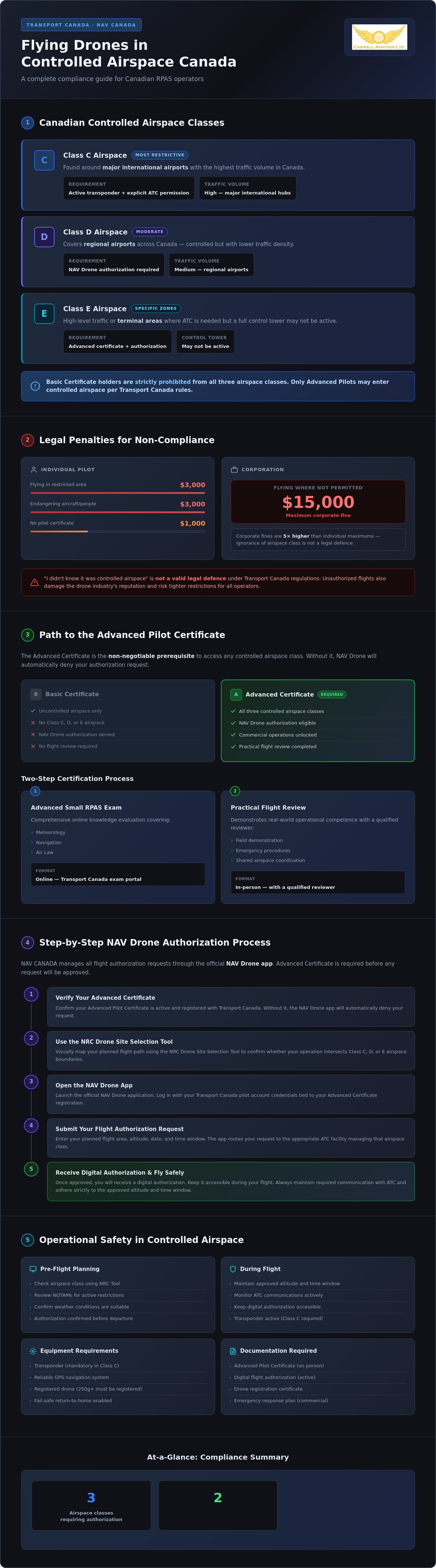
Controlled airspace represents regions where air traffic control (ATC) services are provided to ensure the safety of all aircraft. In the Canadian context, this includes Class C, D, and E airspace. NAV CANADA manages these zones to integrate drone traffic alongside manned aviation. For any pilot interested in flying drone in controlled airspace Canada, identifying these boundaries is the first operational priority. The NRC Drone Site Selection Tool provides a visual map of these zones, allowing pilots to verify whether their planned flight path intersects with controlled territory.
Operating within these zones is strictly prohibited for those holding only a Basic Pilot Certificate. Transport Canada mandates that only Advanced pilots may enter controlled airspace, as these operations require a higher level of coordination and technical awareness. These rules are part of the broader Canadian Drone Regulations designed to prevent mid-air collisions and ensure the reliability of the national civil air navigation system. Failing to identify these zones before take-off puts both your equipment and public safety at risk.
Class C, D, and E Airspace: What Pilots Need to Know
Class C airspace is the most restrictive of the three, typically found around major international airports. These high-volume zones require pilots to have an active transponder and receive explicit permission before entry. Class D airspace covers medium-volume zones, often found around regional airports. While still controlled, the traffic density is lower than in Class C. Class E airspace is used for high-level traffic or specific terminal areas where control is necessary but a full control tower may not be active. Understanding these distinctions helps you prepare for the specific communication requirements of each zone.
The Legal Risks of Unauthorized Entry
Transport Canada enforces strict penalties for unauthorized flights. For individuals, flying in a restricted area can result in a fine of up to $3,000. Operating without a drone pilot certificate carries a penalty of $1,000; meanwhile, endangering aircraft or people can cost up to $3,000. For corporations, these fines increase significantly, reaching up to $15,000 for flying where not allowed. Legal repercussions are not the only concern. Unauthorized flights damage the reputation of the drone industry and can lead to tighter restrictions for all operators. Claiming you didn't realize the airspace was controlled is not a valid legal defence in the eyes of the regulator. Consistent compliance is the only way to build a sustainable professional practice. For those looking to secure the necessary credentials, resources at drones-r-us.ca provide the training required to operate safely in these complex environments.
The Advanced Certificate: Your Key to Controlled Airspace
A common point of confusion for many operators is the distinction between flight authorization and pilot certification. While NAV CANADA grants the permission to fly, they only do so for pilots who already hold a valid Advanced Pilot Certificate. For any pilot, this certificate is the essential credential for flying drone in controlled airspace Canada. This is a non-negotiable prerequisite because Transport Canada Drone Flight Rules dictate that Basic certificate holders must remain in uncontrolled airspace. To bridge this gap, you must follow The Complete Guide to Transport Canada Drone Certification in 2026 to ensure your credentials match your professional goals. Attempting to enter controlled zones with only a Basic certificate is a primary cause of regulatory fines.
The path to this certification involves a methodical two-step process that prioritizes safety and technical expertise. First, you must pass the Advanced Small RPAS Exam, which is a comprehensive online evaluation of your knowledge in meteorology, navigation, and air law. Second, you must complete a practical Flight Review with a qualified reviewer to demonstrate your operational competence in the field. Achieving this status is the only legal way to begin flying drone in controlled airspace Canada. Without this credential, the NAV Drone app will automatically deny any requests for controlled zones, effectively grounding your operations. This structured approach ensures that every pilot in shared airspace understands the culture of discipline required for aviation safety.
Preparing for the Advanced Flight Review
The flight review is a practical evaluation where a reviewer assesses your ability to conduct site surveys and manage emergencies. Common errors include insufficient documentation or poor situational awareness. To prepare, you should consult What is a Drone Flight Review in Canada? A Professional Guide for 2026. If you need hands-on guidance, in-person training sessions provide the technical discipline needed for success.
Drone Safety Assurance Standards
Hardware reliability is critical in busy urban zones. You must verify that your drone is manufacturer-declared for controlled airspace on the Transport Canada website. These declarations differ from "over people" ratings, focusing instead on link stability and flight controller precision. Operating a drone without the correct declaration in a controlled zone violates the Canadian Aviation Regulations, regardless of your pilot certificate level.
Navigating NAV CANADA Authorization and Flight Planning
Securing your Advanced Certificate is a significant milestone, but it does not grant you blanket permission to enter restricted zones. To begin flying drone in controlled airspace Canada, you must navigate the formal NAV CANADA authorization process. This system ensures that every Remotely Piloted Aircraft System (RPAS) operation is accounted for within the broader air navigation infrastructure. Professional pilots treat this step as a core part of their pre-flight duties, realizing that authorization is a legal requirement under Transport Canada drone flight rules. The successful coordination of flying drone in controlled airspace Canada relies on precise data entry and a clear understanding of the local environment.
The workflow is primarily managed through the NAV Drone app. It acts as a digital bridge between you and Air Traffic Control (ATC). While the app is designed for efficiency, the quality of your submission determines the speed of your approval. Start your planning early. For complex missions in Class C airspace, providing lead time allows the system to integrate your flight path without disrupting manned aviation schedules.
The NAV Drone Application Workflow
The process begins with creating a comprehensive pilot profile and registering every drone you intend to fly. Accuracy here is vital. When you are ready to plan a mission, follow these steps:
- Define boundaries: Use the digital map to draw your exact flight area. Keep this as small as possible to minimize the impact on other traffic.
- Set parameters: Input your maximum altitude and duration. Be realistic about your battery life and mission requirements.
- Review the response: You will receive either an "Automated" or "Manual" response. Automated approvals are instant and typically occur in less complex Class E zones. Manual responses require an ATC specialist to review your request, which can take several business days.
Strategic Flight Planning and NOTAMs
Before you arrive on-site, you must check for any Notice to Aviators (NOTAMs). These are temporary alerts regarding hazards or restrictions, such as forest fires or VIP travel, that may not appear on standard maps. A professional pilot never assumes the sky is clear just because they have a certificate. Urban centres add layers of complexity, including potential signal interference from large structures and unpredictable weather patterns at different altitudes. To stay organized, use The Ultimate Checklist for Transport Canada Compliant Drone Operations to verify every safety protocol is in place. If your mission requires direct communication with ATC, maintain a calm, professional tone. Use standard aviation terminology to ensure your intentions are clearly understood. This level of discipline is what separates hobbyists from seasoned professional operators.
Operational Safety and Professional Equipment in Busy Airspace
Operating in shared skies demands more than just legal compliance; it requires physical and mental readiness. When flying drone in controlled airspace Canada, you are often working in high-density urban centres where signal interference and physical obstacles are constant factors. Maintaining a Visual Line of Sight (VLOS) becomes significantly more difficult when surrounded by skyscrapers or industrial infrastructure. This environment creates a psychological pressure that can lead to pilot fatigue. Fatigue is a major risk factor during long-duration missions where a single lapse in judgment can have serious consequences. A professional pilot understands that their physical state is just as important as the drone's battery level.
Successful missions in these zones rely on a disciplined approach to site management. You must account for the presence of manned aircraft, which always have the right of way. This means your focus cannot be divided between your screen and your surroundings. Professional operators use specific tools and team structures to manage this workload effectively. By prioritizing safety over speed, you protect your equipment and the reputation of the entire RPAS industry.
This commitment to reliability and professional standards should extend to every aspect of your business operations, including travel logistics. For those conducting missions in the US, particularly in the Dallas-Fort Worth region, you can check out 1Executive Car for executive chauffeur services that mirror the precision of your flight operations.
Ergonomics for Precision Control
Precision is non-negotiable when you share a block of air with a helicopter or a regional jet. Ergonomics play a vital role in reducing the risk of manual errors. Using specialized equipment like Fitek Gear drone harnesses for smart controllers allows you to distribute the weight of the hardware across your shoulders rather than your neck. This stability helps prevent "dropped controller" incidents, which could be catastrophic in a controlled zone. For a deeper look at your options, read our article on Choosing the Best Drone Harness for Smart Controllers: A 2026 Professional Guide. Proper support ensures your hands remain steady and your focus stays on the flight telemetry.
Emergency Procedures in Controlled Airspace
Safety protocols must be reflexive. If you experience a "Flyaway" or a total loss of the command and control (C2) link while flying drone in controlled airspace Canada, your first priority is notifying the relevant authorities immediately. Reporting requirements for incidents in these zones are strict because of the potential impact on manned aviation. Professional operations often utilize a ground crew and visual observers to maintain situational awareness. These team members act as additional sets of eyes, identifying hazards before they become emergencies. If you want to ensure your team is prepared for these high-stakes scenarios, consider investing in Advanced RPAS training to refine your emergency response and operational discipline.
Mastering Advanced Operations with Caswell Aviation Ltd
Comprehensive Training Solutions
Our training solutions are structured to meet the rigorous demands of the 2026 Transport Canada syllabus. Caswell Aviation Ltd provides a mix of online drone courses for theoretical grounding and in-person training to master flight manoeuvres. The professional flight reviews conducted by our team are designed to validate your readiness for the complexities of shared airspace. We ensure that every pilot is prepared for the specific challenges of flying drone in controlled airspace Canada, from managing signal loss to coordinating with local authorities. This methodical approach builds the confidence needed to operate in proximity to manned aircraft.
Scaling Your Professional Drone Career
Once you have mastered Advanced operations, the next step in your professional development involves handling higher-risk missions. For these tasks, you should consult RPAS Complex Operations in Canada: A Guide to Level 1 Complex Certification. Achieving this level of expertise is often a prerequisite for obtaining a Special Flight Operations Certificate (SFOC) for unique projects. At Caswell Aviation Ltd, we help you leverage these certifications to secure high-value contracts in drone aerial photography and video. Expanding your technical capabilities ensures you remain a competitive and reliable partner in the national aviation community.
Advancing Your Professional Flight Operations
Success in restricted zones requires a blend of regulatory knowledge, digital coordination, and physical discipline. You now understand that an Advanced Pilot Certificate is your legal baseline and that the NAV Drone app serves as your primary tool for coordination. By prioritizing hardware reliability and pilot ergonomics through specialized Fitek Gear, you ensure that every mission remains safe and compliant. Mastery of flying drone in controlled airspace Canada is a hallmark of a professional operator who values precision over shortcuts. It takes commitment to move beyond basic hobbyist rules into the structured world of civil aviation.
We provide the resources you need to bridge the gap between passing an exam and executing high-value missions. Whether you require expert-led online and in-person training or a formal assessment, our team is ready to assist. Book your Advanced Drone Flight Review with Caswell Aviation Ltd today to access Transport Canada authorized flight reviews and elevate your operational standards. The transition to Advanced operations is a significant milestone in your career. We look forward to seeing your drone in the skies soon.
Frequently Asked Questions
Do I need permission to fly a microdrone (under 250g) in controlled airspace?
No formal NAV CANADA authorization is required for microdrones, as they are not subject to the same Part IX regulations as larger RPAS. However, you are still legally required to operate in a manner that does not endanger aviation safety. Professional microdrone pilots often check the NAV Drone app anyway to maintain situational awareness of nearby manned aircraft traffic.
How long does it take to get NAV CANADA authorization for a flight?
Automated authorization through the NAV Drone app is nearly instantaneous for many Class E and some Class D zones. If your mission requires a manual review by an Air Traffic Control specialist, you should submit your request at least several business days in advance. Planning ahead ensures that complex operations in high-traffic zones don't face unexpected delays on the day of the flight.
Can I fly my drone in a National Park if I have an Advanced Certificate?
No, an Advanced Pilot Certificate does not grant you the right to fly in National Parks. These areas are considered restricted, and you must obtain a specific permit from Parks Canada before taking off. These permits are generally reserved for park management, research, or emergency purposes and are rarely issued for recreational or standard commercial use.
What happens if I fly in controlled airspace without an Advanced Pilot Certificate?
Flying drone in controlled airspace Canada without the correct credentials is a serious regulatory breach. Transport Canada can issue fines of $1,000 for operating without a pilot certificate and $3,000 for entering restricted areas. These penalties apply to individuals; corporations face significantly higher costs. Beyond the financial impact, unauthorized flights jeopardize the safety of manned aircraft and can lead to permanent record entries.
Is the NAV Drone app the only way to get permission to fly near airports?
Yes, the NAV Drone app is the official and mandatory platform for obtaining digital flight authorization from NAV CANADA. It replaces older, manual processes and provides a direct link between drone operators and air traffic services. Using this tool is the only way to ensure your flight is legally recognized and coordinated within the national air navigation system.
Do I need to talk to Air Traffic Control on a radio while flying my drone?
Most standard drone operations do not require direct radio communication with Air Traffic Control. However, if your specific flight authorization mandates it, you must use a VHF aviation radio. In these cases, the pilot must also hold a Restricted Operator Certificate with Aeronautical Qualification (ROC-A). Always review your authorization documents carefully to confirm if a radio watch is required for your mission.
How do I know if the airspace I am in is controlled or uncontrolled?
You can identify your current airspace classification by consulting the NRC Drone Site Selection Tool or the NAV Drone app before every mission. These digital maps clearly outline the boundaries and altitudes of Class C, D, and E controlled zones. This verification is a fundamental part of flying drone in controlled airspace Canada and should be completed during your initial site survey.
Leave a comment