

The Ultimate Checklist for Transport Canada Compliant Drone Operations
What if your next commercial flight was grounded not by poor weather, but by a minor documentation oversight you didn't even realize existed? For many pilots, the shift into the 2026 regulatory environment has brought more questions than answers. Whether you are struggling to categorize a mission under the new Level 1 Complex rules or feeling the pressure of an upcoming flight review, the stakes for maintaining Transport Canada compliant drone operations have never been higher.
It's understandable to feel a sense of unease when the rules move as fast as the technology itself. You want to focus on the mission, yet the administrative burden of tracking recency requirements and liability documentation can feel like a full-time job. This article provides a professional, step-by-step checklist designed to remove the guesswork from your workflow. We will examine the prerequisites for a successful Advanced Flight Review and organize your operational logs to ensure you meet every safety standard with precision and confidence.
Key Takeaways
- Identify the specific requirements for Basic, Advanced, and the new 2026 Level 1 Complex categories to ensure your missions remain within legal boundaries.
- Follow a structured certification path involving ground school and flight reviews to maintain Transport Canada compliant drone operations and professional standing.
- Master the technical essentials of site surveys and airspace verification to mitigate operational risks and avoid costly regulatory penalties.
- Implement rigorous hardware inspection protocols and verify Remote ID functionality to guarantee the airworthiness of your RPAS fleet.
- Establish a methodical logging system for flight hours and maintenance to simplify recency audits and enhance long-term operational efficiency.
Navigating the 2026 Transport Canada Drone Categories
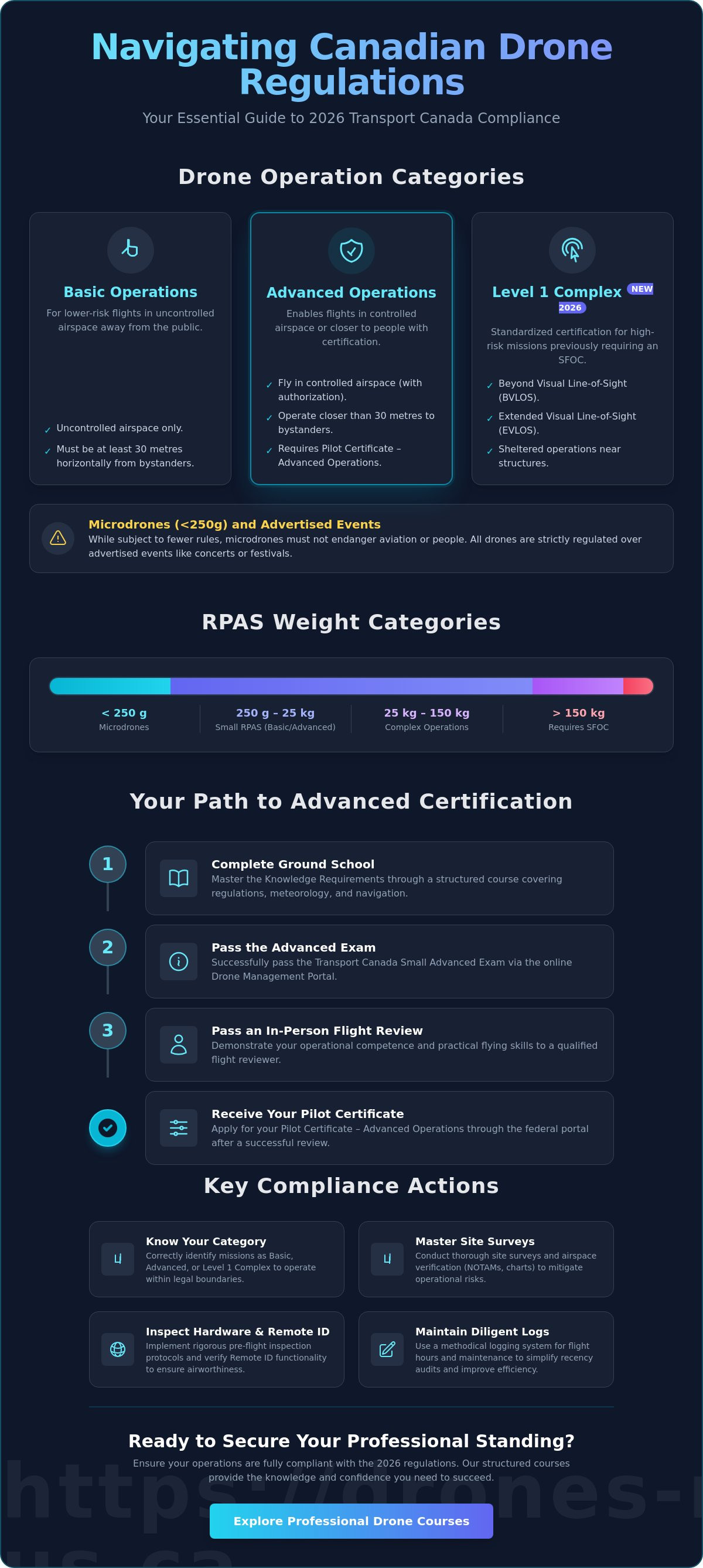
Understanding the classification of your Remotely Piloted Aircraft System (RPAS) is the foundation of Transport Canada compliant drone operations. The regulatory framework separates flights into categories based on operational risk rather than just the hardware you fly. Basic operations occur in uncontrolled airspace and maintain a horizontal distance of at least 30 metres from bystanders. Advanced operations allow you to fly in controlled airspace or closer to people, provided you have the correct certification and a safety declaration from the manufacturer.
Weight thresholds remain a critical factor for compliance. Drones under 250 grams are microdrones, while those between 250 grams and 25 kilograms fall under the standard small RPAS rules. The 2026 updates introduced a 150 kilogram limit for certain complex operations. While many tasks now fall under standard certificates, a Special Flight Operations Certificate (SFOC) is still required for drones over 150 kilograms or for specialized missions like flight beyond 400 feet. You can find a detailed history of these Canadian drone regulations to see how these tiers evolved over the last decade.
The Shift to Level 1 Complex Operations
The introduction of the Level 1 Complex category marks a significant change in how professional pilots operate. Previously, missions involving Beyond Visual Line-of-Sight (BVLOS) or Extended Visual Line-of-Sight (EVLOS) required a lengthy SFOC application. These are now being integrated into standardized certifications. Sheltered operations, which allow for flight close to structures in complex environments, also fall under this new tier. Pilots must ensure their equipment meets specific technical standards for reliability and command link stability before attempting these missions. If you are preparing for this transition, online drone courses can provide the technical grounding needed for these advanced scenarios.
Microdrones and Advertised Events
Microdrones are often perceived as being exempt from all rules, but the 2026 regulations clarify their limits. You cannot fly a microdrone in a manner that endangers aviation safety or people on the ground. Specifically, operating any drone over an advertised event is strictly regulated. An advertised event includes outdoor concerts, festivals, or sporting competitions where the public is invited. Maintaining Transport Canada compliant drone operations requires respecting these boundaries even when the hardware is small. You must maintain a safe distance and follow local bylaws to avoid significant fines.
The Certification Checklist: Training and Flight Reviews
Maintaining Transport Canada compliant drone operations requires a methodical approach to certification. It is a four-step process that moves from theoretical knowledge to practical demonstration. You cannot skip these stages if you intend to fly in controlled airspace or near bystanders. Professionalism in the cockpit begins with a thorough understanding of the regulations that govern Canadian skies. For those beginning this journey, the official Transport Canada drone safety guidelines provide the baseline for legal flight in Canada.
To secure your standing as a professional pilot, follow this sequence:
- Step 1: Complete a structured ground school course to master the Knowledge Requirements.
- Step 2: Pass the Transport Canada Small Advanced Exam via the Drone Management Portal.
- Step 3: Book and pass a professional in-person Flight Review with a qualified reviewer.
- Step 4: Apply for your Pilot Certificate through the federal portal after a successful review.
Ground School Requirements for Level 1 Complex
The 2026 regulations introduced more rigorous standards for higher-risk missions. Pilots seeking a Level 1 Complex certificate must now complete a mandatory 20 hours of ground school. This training isn't just a suggestion; it's a prerequisite for the safety of the national airspace. You will need to master complex topics including meteorology, aeronautical charts, and NOTAM reporting. We recommend Caswell Aviation Ltd’s online drone courses for pilots who require a flexible, self-paced learning environment that doesn't compromise on technical depth.
Preparing for Your Advanced Flight Review
The flight review is your opportunity to demonstrate operational competence to a third-party evaluator. You must arrive prepared with your drone registration and a valid piece of government-issued photo ID. The reviewer will expect to see specific flight manoeuvres, including emergency procedures and precise hover control. If you feel unprepared, our Professional Guide to Drone Flight Reviews offers a deeper look at the evaluation criteria. If you are ready to move from theory to practice, our Advanced & Level 1 Complex Flight Reviews provide a steady, professional environment to prove your skills and finalize your certification.
Operational Planning: Airspace and Site Surveys
Success in the field is determined long before the propellers start spinning. Operational planning is the bridge between having a certificate and executing Transport Canada compliant drone operations with precision. A pilot’s first responsibility is to verify the airspace classification for their intended mission area. While Class G airspace is uncontrolled, operating within Classes C, D, or E requires explicit authorization from NAV CANADA. Industry organizations like the Aerial Evolution Association of Canada emphasize that professional planning reduces liability and ensures the continued growth of the RPAS sector.
Mastering Airspace Authorizations
Distinguishing between uncontrolled and controlled airspace is a fundamental skill. Class G airspace allows for more flexibility, but entering controlled zones requires a formal request through the NAV Drone app or the NAV CANADA corporate portal. You should account for lead times when planning missions in busy corridors. While some authorizations are near-instant, complex zones may require 48 hours or more for review. Always check for active NOTAMs (Notices to Airmen) that could restrict flight in your specific window due to temporary hazards or VIP movements.
The Professional Site Survey Workflow
A digital map is no substitute for a physical site survey. You must document the environment to identify hazards that apps might miss. Your survey should include:
- Obstacle Identification: Locate power lines, radio towers, and tall trees.
- Bystander Density: Assess the likelihood of people entering the 30-metre horizontal buffer required for basic operations.
- Aerodrome Proximity: Confirm distances from airports (5.6 km) and heliports (1.9 km).
- Zone Designation: Clearly mark your take-off and landing areas to maintain a sterile flight deck.
Your planning must culminate in a written emergency plan. This document should outline specific actions for a "fly-away" event, a loss of command link, or a communication failure. Establishing these protocols ensures you can act decisively if a technical failure occurs. If your mission involves complex deliverables, our team provides professional drone aerial photography and video services that adhere to these rigorous safety standards.
Safety Systems and Pilot Ergonomics in the Field
Operational safety extends beyond regulatory knowledge; it requires a physical commitment to precision during every flight. Maintaining Transport Canada compliant drone operations involves a rigorous pre-flight inspection of your hardware. You must examine propellers for stress fractures, verify sensor calibration, and ensure battery levels are sufficient for the mission. A critical step often overlooked is matching your fail-safe settings to the specific environment. Setting an appropriate Return-to-Home (RTH) altitude prevents the aircraft from striking obstacles during an automated recovery, especially in urban or forested areas. This setting must be adjusted for every new site to account for the tallest local obstruction.
The Role of Ergonomics in Flight Safety
Pilot fatigue is a primary contributor to common drone pilot errors in Canada. Commercial sessions often last several hours, requiring sustained concentration and steady hand movements. When a pilot becomes physically tired, their reaction times slow and their ability to perform delicate manoeuvres diminishes. This physical degradation can lead to accidents that result in fines of up to $3,000 for endangering people or property. Using a professional support system can mitigate these risks significantly. An ergonomic drone harness for smart controllers redistributes the weight of the hardware from your wrists to your shoulders. This setup allows for finer control and reduces the physical strain that leads to operational mistakes. For professionals seeking to optimize their field workflow, Fitek Gear drone harnesses for smart controllers provide a stable platform for precision flight.
Hardware Compliance and Remote ID
Hardware standards are evolving to include Remote ID capabilities as outlined in the 2026 Notice of Proposed Amendment (NPA 2026-005). While the full implementation for standard certificate operations is scheduled for 2030, many professional operators are adopting these modules now to ensure future-proof Transport Canada compliant drone operations. You must verify that your Remote ID module is functioning and transmitting the required telemetry before take-off. Additionally, Canadian operations require specific attention to battery health. Cold temperatures can cause sudden voltage drops in lithium-polymer cells. You should track battery cycle counts and maintain them at room temperature until the moment of flight to prevent power failure. Always verify that your firmware is updated to the latest manufacturer version to ensure all safety patches and compliance features are active.
Maintaining Compliance: Logs, Recency, and Reviews
Professionalism in aviation is defined by what happens when the cameras aren't rolling. Long-term Transport Canada compliant drone operations rely on a meticulous approach to record-keeping and recency. Compliance is a continuous cycle that requires you to document every flight and maintain your technical knowledge as regulations evolve. You should keep digital copies of your pilot certificate and drone registrations on a mobile device or cloud storage to ensure they are immediately accessible for inspection by a peace officer or Transport Canada inspector during field operations.
A pilot logbook serves as your official record of experience. You must update this log after every flight, tracking the date, total flight time, and the specific aircraft used. Similarly, a maintenance log is required for every RPAS in your fleet. This log should document every repair, firmware update, and hardware modification. Tracking battery health and motor hours helps you anticipate equipment failures before they occur in the field, protecting both your investment and public safety.
Tracking Pilot Recency Requirements
Your pilot certificate does not expire, but your legal right to fly depends on maintaining current knowledge. Transport Canada requires pilots to engage in a recency activity every 24 months. There are three primary ways to fulfill this requirement:
- Flight Review: Complete a practical evaluation with a qualified reviewer.
- Pilot Exam: Pass a Transport Canada Small Basic or Advanced exam.
- Safety Seminar: Attend an authorized safety session or training seminar.
Most professionals choose the Advanced exam as their primary path because it reinforces the technical knowledge required for complex missions. For more detailed renewal strategies and tips, consult our Complete Guide to Transport Canada Drone Certification.
Professional Record Keeping for Small Businesses
Small business owners must treat their drone logs with the same rigour as their financial accounts. A professional log should include the location of the flight and any specific hazards encountered. It's also vital to document incidents or near-misses for internal safety reviews. While no pilot wants to record a mistake, these entries are essential for improving your operational safety over time. If you're ever selected for an audit, having organized, comprehensive records demonstrates a commitment to Transport Canada compliant drone operations that can prevent significant legal complications. Maintaining these standards ensures your business remains a stable and reliable partner in the Canadian aviation industry.
Securing Your Professional Standing in the 2026 RPAS Landscape
Success in the modern aviation sector is defined by a pilot's commitment to precision and safety. By utilizing the 2026 categories and maintaining thorough site surveys, you position your business to thrive while ensuring Transport Canada compliant drone operations. The checklist provided throughout this guide serves as your operational baseline, moving you from basic flight to complex missions with a clear, legal framework. Professionalism is a continuous practice that relies on accurate logging and a steady awareness of evolving standards.
Whether you are seeking to master the new Level 1 Complex requirements or simply need to renew your credentials, having a knowledgeable partner makes the process efficient. We offer a comprehensive online ground school and access to qualified flight reviewers who understand the nuances of Canadian law. Additionally, our Fitek Gear ergonomic harnesses provide the physical stability required for high-stakes commercial sessions. Book Your Advanced Flight Review or Drone Training with Caswell Aviation Ltd to solidify your certification and fly with confidence. Your dedication to these standards ensures a safer, more professional airspace for everyone.
Frequently Asked Questions
Do I need a license to fly a drone for fun in Canada?
You need a pilot certificate for any drone weighing between 250 grams and 25 kilograms, regardless of whether you fly for fun or work. Microdrones weighing less than 250 grams are exempt from this requirement. However, you must still operate microdrones in a way that doesn't endanger people or other aircraft. Failing to fly safely can still result in fines even for the smallest drones.
What is the difference between Basic and Advanced drone operations?
The primary difference lies in the proximity to bystanders and the type of airspace involved. Basic operations are restricted to uncontrolled airspace and must maintain a horizontal distance of at least 30 metres from people. Advanced operations allow you to fly in controlled airspace and closer than 30 metres to bystanders, provided you have the correct certificate and a drone with a manufacturer safety declaration.
How much does it cost to get a Transport Canada drone certificate?
Transport Canada charges a $10 fee for both the Small Basic and Small Advanced exams. Additionally, registering your drone costs $5 per aircraft. These fees are paid directly to the government through the Drone Management Portal. Costs for professional ground school and flight reviews are separate and are determined by the training provider you choose.
Can I fly my drone in a park without a permit?
You must verify both federal airspace rules and local municipal bylaws before flying in a park. National parks are restricted and require a specific permit that is rarely granted for recreational use. Many municipalities also have bylaws that prohibit drone take-offs and landings in city parks. Always include a check of local bylaws as part of your professional site survey.
What happens if I fly a drone without a license in Canada?
Flying without a valid pilot certificate is a regulatory violation that carries significant financial penalties. Individuals can face a $1,000 fine for flying without a certificate or for operating an unregistered drone. For corporations, these fines can increase to $15,000. If your flight endangers people or other aircraft, fines for individuals can reach up to $3,000.
How do I register my drone with Transport Canada?
Registration is a straightforward process completed through the online Drone Management Portal. You will need to provide the drone's make, model, serial number, and weight. After paying the $5 fee, you will receive a registration number. This number must be clearly marked on the aircraft before you begin Transport Canada compliant drone operations.
What are the new rules for Level 1 Complex operations in 2026?
The Level 1 Complex category, which came into effect in late 2025, standardizes higher-risk missions like Beyond Visual Line-of-Sight (BVLOS) and sheltered operations. Pilots must complete 20 hours of specialized ground school to qualify for this certificate. This update helps maintain Transport Canada compliant drone operations while expanding the possibilities for commercial applications in complex environments.
How long is a drone flight review valid for?
A flight review is a one-time requirement to earn your Advanced Pilot Certificate and it doesn't expire. However, your legal authority to fly depends on meeting recency requirements every 24 months. You can satisfy this rule by completing another flight review, passing a pilot exam, or attending an authorized safety seminar within that 24-month window.
Leave a comment