
Professional Drone Training for Small Business in Alberta: A 2026 Guide
The Canadian drone market has reached a valuation of 6.1 billion dollars in 2026, yet many entrepreneurs still hesitate to launch their own flight operations. You likely realize that aerial technology could modernize your workflow, but the fear of Transport Canada fines or the confusion between Advanced and Basic certificates keeps your equipment on the ground. It's difficult to find the time for drone training small business Alberta owners need while managing daily operations, and the regulatory environment can feel like a barrier rather than an opportunity.
This guide provides a clear, professional path to legal commercial flight. You'll learn how to navigate the 2026 regulatory updates, including the current registration fees and new requirements for medium drones, without the guesswork. We will outline the most efficient training paths, explain how to prepare for a successful flight review, and show you how to scale your business safely using professional drone technology.
Key Takeaways
- Understand why professional certification is a strategic asset for Alberta sectors like agriculture and energy to avoid costly non-compliance penalties.
- Identify the specific Transport Canada requirements for your operations and how to choose the right drone training small business Alberta provider to secure an Advanced Pilot Certificate.
- Evaluate the benefits of hybrid training models that combine the efficiency of online theory with the hands-on precision of in-person flight reviews.
- Learn to standardize your flight operations using pre-flight checklists and ergonomic gear to ensure long-term safety and equipment reliability.
- Discover how customized training solutions can help your small business team transition from hobbyist flying to professional-grade aerial data collection.
The Strategic Value of Drone Training for Small Business in Alberta
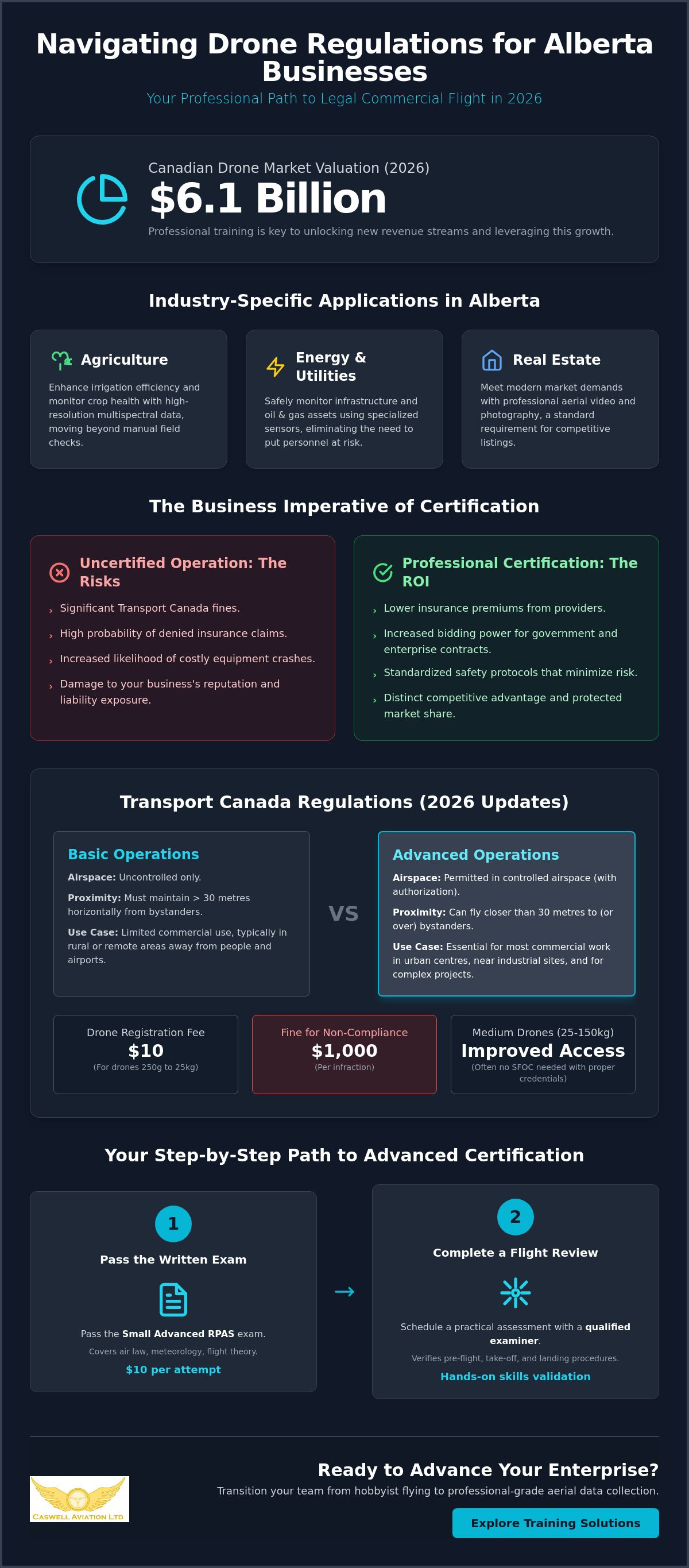
The Canadian drone market has reached a valuation of approximately 6.1 billion dollars in 2026. This growth isn't just about hardware; it's about how local firms use data to solve complex problems. Investing in drone training small business Alberta operators rely on allows you to transition from basic flight to advanced data acquisition. This shift is critical as industries like energy and utilities show the highest increase in demand for professional aerial services. When you treat a drone as a professional tool rather than a gadget, you unlock new revenue streams that were previously out of reach.
Operating without a proper pilot certificate is a significant business risk. Beyond the obvious Transport Canada fines, there's the issue of liability. If an uncertified pilot causes property damage on a job site, insurance providers will likely deny the claim. Professional training builds a culture of discipline. It ensures your team understands the mechanics of their unmanned aerial vehicle (UAV), which significantly reduces the likelihood of costly crashes or technical failures. It's about protecting your investment and your reputation.
Industry-Specific Applications in the Alberta Market
Alberta's economy provides a unique landscape for drone integration. In the agricultural sector, precision monitoring allows farmers to realize significant gains in irrigation efficiency and crop health. Instead of checking fields on foot, drones provide high-resolution multispectral data in minutes. In the energy sector, specialized sensors allow for the safe monitoring of infrastructure and oil and gas assets without putting personnel at risk. Even in real estate, professional aerial video has moved from a luxury to a standard requirement for competitive listings. These applications require more than just flight skills; they require a deep understanding of data quality and regulatory boundaries, often necessitating custom software solutions from developers like API Pilot to integrate aerial data into existing business systems.
The ROI of Professional Certification
The financial return on drone certification is measurable and immediate. Many insurance providers offer lower premiums for businesses that employ pilots with an Advanced certificate. This is because certified pilots follow standardized safety protocols that minimize risk. Additionally, having a certified team increases your bidding power. Most government and large enterprise contracts now mandate that all drone contractors hold valid Transport Canada credentials. Professional certification creates a distinct competitive advantage that casual hobbyists cannot replicate, effectively protecting your market share. By training your team now, you ensure your business is ready to scale as the Alberta aerospace sector continues to expand. This commitment to professional-grade standards is a hallmark of success in any field, including property renovation; for example, you can find out more about selecting high-quality basement flooring from BCR Basements.
Transport Canada Requirements: A Roadmap for Alberta Operators
As of April 2026, Transport Canada has updated several fee structures and operational categories for Remotely Piloted Aircraft Systems (RPAS). Every drone weighing between 250 grams and 25 kilograms must be registered for a $10 fee. While the registration process is straightforward, the operational requirements depend entirely on where and how you fly. For most entrepreneurs, the primary decision involves choosing between Basic and Advanced certification. Basic operations are restricted to uncontrolled airspace and must maintain a 30 metre distance from bystanders. If your business requires flying in urban centres or near industrial sites in controlled zones, you must hold a Transport Canada drone pilot certificate for Advanced operations.
The 2026 regulatory environment also introduces more accessibility for medium drones weighing between 25 and 150 kilograms. In many cases, these larger platforms can now operate without a Special Flight Operations Certificate (SFOC-RPAS), provided the pilot holds the correct credentials. Investing in the right drone training small business Alberta owners require ensures you don't just pass an exam, but actually understand how to integrate these complex rules into your daily workflow without risking a $1,000 fine for non-compliance.
The Step-by-Step Path to Advanced Certification
To secure an Advanced certificate, you must first pass the Small Advanced RPAS written exam, which currently costs $10 per attempt. This exam covers air law, meteorology, and flight theory. Once you pass the written component, you must schedule a flight review with a qualified examiner. This practical assessment verifies your ability to conduct pre-flight checks, manage emergencies, and operate safely in a controlled environment. After successfully completing the review, you can apply for your certificate through the Drone Management Portal. To keep your certificate valid, you must maintain pilot recency by completing a recurrent training activity every 24 months and keeping a detailed pilot logbook.
Managing Complex Operations
For businesses looking to scale beyond standard visual line-of-sight work, the new Level 1 Complex exam is now the industry benchmark. This exam costs $125 and is a prerequisite for many Beyond Visual Line-of-Sight (BVLOS) tasks. Understanding the nuances of Level 1 Complex drone certification Canada is essential if you plan to operate in congested urban areas or conduct long-range inspections. Additionally, operations in controlled airspace require coordination with NAV CANADA. If your project falls outside standard rules, you may still need an SFOC-RPAS; fees for these range from $75 for low complexity to $475 for high complexity applications. If you find these requirements overwhelming, our professional instructors can help you organize a compliance strategy that fits your specific business goals.
Evaluating Drone Training Formats: Online vs. In-Person
Selecting the right educational framework is a pivotal step in deploying aerial technology. For most entrepreneurs, the choice between online and in-person instruction depends on their specific operational timeline and the complexity of their intended missions. While some academic institutions offer long-term programmes spanning several months, a business-first approach to drone training small business Alberta operators prefer focuses on efficiency and regulatory compliance. You must balance the need for deep technical knowledge with the reality of maintaining your daily business revenue.
A hybrid model often yields the best results. This involves using online resources to master the rigorous theoretical requirements of Transport Canada's exams, followed by targeted in-person sessions to refine practical flight skills. This structure ensures that your team is not just prepared to pass a test, but is capable of managing a multi-thousand dollar aircraft in unpredictable Alberta weather conditions.
Benefits of Online Drone Courses
Online training provides the flexibility required to educate a workforce without disrupting service delivery. It allows your staff to study during off-hours or between project tasks, making it a highly scalable solution for businesses training multiple pilots. These courses offer comprehensive coverage of essential topics, including:
- Airspace Classification: Understanding the boundaries between controlled and uncontrolled zones.
- Meteorology: Interpreting aviation weather reports to avoid atmospheric hazards.
- Navigation and Theory: Mastering the physics of flight and emergency procedures.
This format is particularly cost-effective for firms looking to establish a baseline of knowledge across their entire organization before investing in specialized hardware training.
The Necessity of In-Person Flight Reviews
Regardless of how much theory a pilot learns online, they cannot bypass the physical assessment required for an Advanced certificate. You need to understand what is a drone flight review Canada requires before you book your session. This is a mandatory, in-person evaluation where a qualified reviewer observes your ability to operate safely and follow legal protocols. It's the final hurdle in the certification process and serves as a critical safety check for your business.
During a professional flight review, you'll be expected to demonstrate proficiency in site surveys, emergency coordination, and precise aircraft control. At Caswell Aviation Ltd, we focus on preparing pilots for these real-world challenges by simulating industrial scenarios. This hands-on mentorship ensures that your pilots move beyond basic hovering and develop the confidence to execute complex missions in high-stakes environments. Professional drone training small business Alberta teams utilize these sessions to standardize their flight culture and reduce the risk of equipment damage during field operations.
Optimizing Operations: Safety, Gear, and Ergonomics
Establishing a successful commercial drone programme requires more than just passing a written exam. High-quality drone training small business Alberta providers emphasize that long-term profitability is tied to operational discipline. This begins with standardizing your fleet. When you use identical aircraft models, you simplify your internal training requirements and streamline your maintenance inventory. Your pilots don't have to learn different flight dynamics for every job, which reduces the chance of pilot error during high-pressure missions. This level of technical discipline is mirrored in other precision-based industries; for instance, specialized maintenance firms like airliftconcreteexperts.com utilize advanced polyurethane injection techniques to achieve exact results in concrete levelling and raising.
Risk management is the foundation of professional aviation. You must implement rigorous pre-flight checklists to ensure every component, from battery health to propeller integrity, is verified before takeoff. These checklists aren't just safety tools; they're essential business records. In the event of an incident, having a documented history of safety checks protects your business from liability and demonstrates a commitment to Transport Canada's safety standards.
The Importance of Pilot Ergonomics
Commercial operations often involve multi-hour site surveys or complex industrial inspections that require sustained concentration. Pilot fatigue is a significant risk factor that directly impacts both flight safety and the quality of the data you collect. If a pilot is struggling with the physical weight of their equipment, their precision will inevitably suffer. Professional accessories are designed to mitigate these physical demands and keep the pilot focused on the mission at hand.
Using a specialized drone harness for smart controller systems is a practical way to improve field efficiency. Fitek Gear drone harnesses distribute the weight of the controller across the shoulders rather than the neck. This setup improves control precision by stabilizing the remote and significantly reduces the chronic neck strain often associated with long-duration flights. When your team is comfortable, they can maintain a high level of situational awareness throughout the entire work day.
Maintaining Equipment and Compliance
Maintaining a strict maintenance schedule is a requirement for staying compliant with Transport Canada audit protocols. You should track flight hours for every aircraft and perform scheduled inspections of motors, sensors, and airframes. Detailed record-keeping is not optional; you must maintain logs that show when maintenance was performed and by whom. Proper gear organization ensures your team can deploy in minutes while keeping all sensitive components protected from the elements during transport. If you want to upgrade your operational efficiency, explore our professional drone gear and harnesses designed for the Alberta climate.
Advancing Your Enterprise with Caswell Aviation Training
Caswell Aviation Ltd operates with the discipline of a veteran practitioner, bringing the rigour of traditional aviation to the modern drone sector. We don't just teach you how to fly; we mentor you on how to integrate technology into a professional workflow. This grounded approach is why our drone training small business Alberta programmes are designed for efficiency and long-term reliability. We understand that as a business owner, your time is your most valuable asset. Our training is structured to move you through the regulatory hurdles of Transport Canada without unnecessary delays, ensuring your operations remain compliant and profitable.
Our mentorship extends beyond the classroom. We provide customized solutions tailored to the specific industries that drive the Alberta economy, from oil and gas to large-scale agriculture. Whether you are a solo operator or managing a fleet of pilots, we help you establish a culture of safety and precision. By focusing on technical authority and practical application, we ensure your team is equipped to handle the high-stakes environments common in industrial flight operations.
A Holistic Resource for Alberta Drone Pilots
We serve as a comprehensive centre for all your aerial needs, offering support that goes far beyond a single training session. If your business requires high-end marketing materials but your team is still building their flight hours, you can access our professional aerial photography and video services to meet your clients' needs. We also act as a trusted Canadian retailer for Fitek Gear drone harnesses, providing the ergonomic tools your pilots need for sustained field work. By leveraging a deep understanding of Transport Canada drone certification, we help you identify new opportunities to expand your service offerings as the 2026 regulations continue to evolve.
Get Started with Caswell Aviation Ltd
Choosing the right path for your business shouldn't be a guessing game. We offer consulting services to help you determine which certification level aligns with your specific commercial goals. If you've already completed your online theory and are ready for the final step, we provide professional flight reviews that focus on real-world preparedness. Our instructors guide you through the Advanced Small RPAS requirements with a focus on building confidence and technical proficiency. We are here to ensure your transition into professional drone operations is seamless, safe, and strategically sound.
Visit Caswell Aviation Ltd to explore our online courses and in-person training options.
Scaling Your Alberta Operations with Professional Flight Standards
The transition from basic flight to professional commercial operation requires a commitment to safety and technical excellence. You have seen how navigating the 2026 Transport Canada landscape is simpler when you prioritize structured education and the correct ergonomic equipment. By standardizing your fleet and investing in the right drone training small business Alberta provides, you protect your enterprise from liability while opening doors to lucrative industrial contracts. You don't have to navigate these regulatory complexities alone, and for those who want to maintain a professional workspace that matches their operational standards, you can discover Advance Cleaning Services Inc..
Caswell Aviation Ltd offers the veteran mentorship necessary to master Advanced and Level 1 Complex certifications. We provide professional flight reviews for commercial pilots and serve as a specialized retailer for Fitek Gear ergonomic harnesses to ensure your team remains focused and comfortable in the field. Establishing these high standards now will position your business at the forefront of Alberta's growing aerospace sector.
Book your professional drone training or flight review with Caswell Aviation Ltd to begin your path toward legal, efficient, and scalable commercial operations. We look forward to helping you reach new heights.
Frequently Asked Questions
Do I really need a drone license for my small business in Alberta?
You must have a pilot certificate if you operate any drone weighing between 250 grams and 25 kilograms for business purposes. Transport Canada requires all commercial pilots to follow the same safety regulations regardless of the size of their enterprise. Obtaining the correct drone training small business Alberta operators need ensures you're legally protected and fully compliant with current aviation laws.
What is the difference between Basic and Advanced drone certification?
Basic certification is restricted to uncontrolled airspace and requires you to stay at least 30 metres away from bystanders. Advanced certification allows you to fly in controlled zones, such as near airports or in urban centres, and permits flight closer to people. Most professional applications in Alberta require the Advanced certificate to access industrial sites or municipal project areas where controlled airspace is common.
How long does it take to get a Transport Canada Advanced drone certificate?
The timeline depends on your study pace and examiner availability, but most pilots complete the process within two to four weeks. You can take the online written exam immediately after preparing. Once you pass, you must schedule an in-person flight review. After the reviewer uploads your results, you can download your certificate from the Drone Management Portal the same day.
Can I take my drone flight review online?
No, you cannot conduct a flight review online. Transport Canada mandates that a flight review must be performed in person by a qualified reviewer. This ensures that you can demonstrate practical flight skills, emergency procedures, and site survey accuracy in a real-world environment. These sessions are essential for verifying that you can safely manage an aircraft in the field.
How much does professional drone training for a small business cost?
Costs vary based on the depth of instruction and the number of staff members being trained. You should budget for the mandatory Transport Canada fees, which include $10 for drone registration and $10 for each exam attempt. Professional training programmes are a strategic investment that reduces the risk of equipment loss and operational downtime, making them a vital part of your business's technology budget.
What happens if I fly a drone commercially without a certificate?
Flying commercially without a certificate exposes your business to significant financial and legal liabilities. Individuals can face fines of $1,000, while corporations can be fined up to $5,000 for unauthorized operations. Beyond these penalties, your insurance provider will likely deny any claims related to an incident involving an uncertified pilot, potentially resulting in catastrophic out-of-pocket expenses for your firm.
Does my business need a Special Flight Operations Certificate (SFOC)?
Most small businesses don't need an SFOC if they operate within standard Basic or Advanced rules. You only require an SFOC for specialized tasks like flying a drone over 25 kilograms, operating beyond visual line-of-sight, or during high-complexity events. Transport Canada fees for these certificates range from $75 for low-complexity to $475 for high-complexity applications, depending on the mission's risk profile.
How do I maintain my drone pilot recency in Canada?
You must complete a recurrent training activity every 24 months to maintain your pilot recency. This can be achieved by passing another exam, attending a safety seminar, or completing a professional flight review. Keeping an accurate pilot logbook is also required to prove you've met these requirements during a Transport Canada audit. Professional drone training small business Alberta providers can help you track and manage these essential milestones.
Leave a comment