

Drone Pilot Recency Requirements in Canada: The 2026 Professional Guide
An RPAS pilot certificate in Canada never expires, yet thousands of pilots are technically grounded because they've overlooked a single date in their logbooks. While your certificate remains valid for life, your right to use it depends entirely on meeting the drone pilot recency requirements Canada enforces every 24 months. If you haven't completed a recurrent training activity within that window, your next flight could lead to significant regulatory penalties or grounded operations.
We understand that deciphering the Canadian Aviation Regulations (CARs) can feel like a complex hurdle. It's common to feel uncertain about which study program to use or whether your flight logs would stand up to a Transport Canada audit. You've worked hard to earn your wings; you shouldn't have to worry about a paperwork technicality ending your mission. This guide simplifies the process, promising a clear path to maintain your compliance and keep your professional standing secure.
We will break down the five approved methods for recurrent training, including the 2026-2027 self-paced study program and safety seminars. You'll also learn how to properly document these activities to ensure your logs are legally protected and ready for inspection at a moment's notice.
Key Takeaways
- Understand the mandatory 24-month recurrent training cycle required by Transport Canada to maintain your flight privileges under CAR 901.56 and 901.65.
- Discover the primary methods to satisfy drone pilot recency requirements Canada mandates, ranging from flight reviews to endorsed self-paced study programs.
- Learn how to navigate the 2026-2027 questionnaire, including the specific general aviation and certificate-based sections required for compliance.
- Master essential record-keeping protocols to ensure your digital or physical proof of recency is audit-ready for the required 24-month period.
- Identify how professional equipment and ergonomic harnesses contribute to flight safety and operational proficiency during extended missions.
What are the Drone Pilot Recency Requirements in Canada?
The 24-month recurrent training cycle is the foundation of safe flight operations in our country. Under the Canadian Aviation Regulations (CARs), specifically CAR 901.56, 901.65, and 901.91, every pilot must complete a recurrent training activity every two years. This rule applies to every individual holding a certificate for Basic or Advanced operations. While your actual certificate doesn't expire, your legal authority to act as a crew member does. Meeting the drone pilot recency requirements Canada mandates is not just about avoiding a fine; it's about maintaining the discipline required for professional aviation. A master practitioner views these rules as a baseline for safety rather than a bureaucratic hurdle. You can find more details on the broader landscape of Drone Pilot Certification in Canada to understand how these requirements fit into the national aviation system.
The 24-Month Clock: How to Calculate Your Deadline
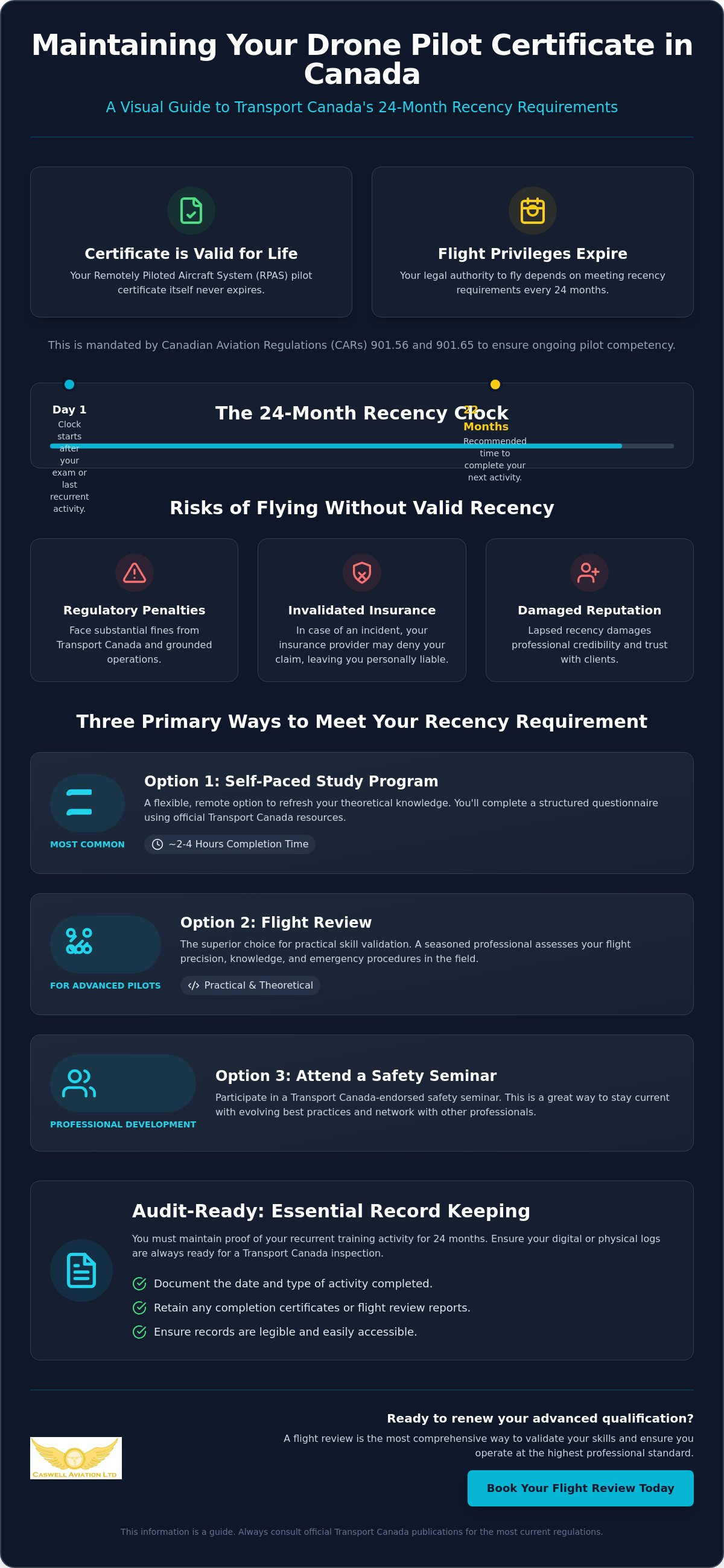
Your recency clock starts the day you pass your original online exam or your most recent flight review. If you passed your Advanced exam on June 15, 2024, your recency remains valid until June 15, 2026. We recommend completing your chosen recurrent activity at the 22-month mark. This buffer prevents unexpected gaps in your flight operations if a seminar is delayed or a flight review takes longer to schedule than anticipated. There's a distinct difference between certificate validity and recency status. Your certificate is permanent; however, your status is only active when your recency is current.
Consequences of Flying Without Valid Recency
Operating an RPA without valid recency carries significant risks. Transport Canada can issue substantial fines for non-compliant flights, which can disrupt your business operations. Beyond legal penalties, your drone insurance policy likely requires you to be a qualified pilot as defined by the CARs. If you have an incident while your recency is lapsed, your provider may deny your claim. This leaves you personally liable for all damages. For those providing drone aerial photography and video services, a lapsed status also damages your professional reputation. Clients expect their contractors to be fully compliant with all drone pilot recency requirements Canada enforces to protect their own liability. Maintaining your status is a simple way to demonstrate that you prioritize professional standards over shortcuts.
Staying compliant ensures you can continue to utilize your training without fear of grounded operations. Whether you are a hobbyist or a commercial operator, the 24-month rule is a non-negotiable part of the Canadian aviation landscape.
Three Ways to Meet Your 24-Month Recurrent Training Requirement
Transport Canada provides flexibility in how you maintain your status. To stay compliant with the Canadian Aviation Regulations (CARs) Part IX, you have three primary options. Choosing the right path depends on your current certification level and your long-term career objectives. Every method serves the same legal purpose, but some offer more professional development value than others. Mastering the drone pilot recency requirements Canada enforces ensures you remain a safe, capable operator in increasingly crowded airspace.
Option 1: The Self-Paced Study Program (Most Common)
The self-paced study program is the most frequent choice for pilots who want a flexible, remote option. For the 2026-2027 period, this involves a structured questionnaire that tests your current knowledge of flight rules and safety protocols. You'll need to reference the Transport Canada Aeronautical Information Manual (TC AIM) and current CARs to find the answers. Expect to spend approximately two to four hours on this review to ensure you've thoroughly grasped any recent regulatory shifts. It's a methodical way to refresh your theoretical foundation from the comfort of your home or office.
Option 2: Booking a Flight Review for Advanced Pilots
For Advanced pilots, a flight review is often the superior choice. While the study program checks theoretical knowledge, a review provides a practical validation of your field skills. It's an opportunity to have a seasoned professional assess your emergency procedures and flight precision. You can book your Professional Flight Review to satisfy your drone pilot recency requirements Canada mandates while simultaneously building your operational confidence. This method is particularly valuable if you haven't flown complex missions in several months and want to ensure your skills haven't diminished.
Option 3: Retaking the Exam
You can also reset your 24-month clock by retaking and passing either the Basic or Advanced exam. This makes sense if you're looking to upgrade your certificate from Basic to Advanced. Passing a higher-level exam automatically satisfies the recency requirement for your existing certificates. If you choose this path, you can use our Online Drone Courses to prepare for the test and ensure a successful first attempt. This approach is efficient for those who want to advance their qualifications while checking the box for legal compliance. It turns a mandatory requirement into a step toward professional growth.
Regardless of the method you select, the goal is the same: stay current, stay safe, and keep your business moving forward. If you're unsure which path fits your current operation, a quick review of your recent flight logs will often reveal where you need the most sharpening.
Navigating the Transport Canada Self-Paced Study Program
The 2026-2027 questionnaire is the most accessible path for pilots to satisfy the drone pilot recency requirements Canada mandates. It's structured as a modular knowledge check rather than a high-pressure exam. The Self-Paced Study Program is a non-proctored, open-book exercise designed to refresh regulatory knowledge. This format allows you to consult official documentation while you work, ensuring that your understanding of the current rules is accurate. The first 15 questions focus on general aviation topics that apply to every pilot, regardless of their certificate level. These cover fundamental safety protocols, weather minimums, and basic flight rules that are critical for maintaining safe Canadian airspace. You'll then progress to sections specific to your certificate type to ensure your specialized knowledge remains sharp.
Specific Requirements for Level 1 Complex Pilots
For those operating in high-stakes environments, the requirements are more stringent. Level 1 Complex pilots must complete additional mandatory questions, specifically numbers 31 through 35. These focus on the intricacies of operating in controlled airspace and the specific coordination required with Nav Canada. It's not just a matter of knowing the rules; it's about understanding the communication protocols that prevent incidents in busy industrial or urban areas. If you're preparing for these missions, reviewing our Guide to Level 1 Complex Certification will provide the necessary context for these advanced questions. Mastering these coordination procedures is what separates professional operators from casual flyers.
Referencing the TC AIM and CARs
Success in the study program depends on your ability to navigate official resources effectively. The Transport Canada Aeronautical Information Manual (TC AIM) is your primary tool. When using digital versions, utilize the search function to locate specific keywords like "RPA" or "controlled airspace" to find relevant sections quickly. It's vital to ensure your references are from the current 2026 release. Regulations evolve, and using an outdated manual or a non-Canadian flight blog can lead to incorrect answers. Failing to verify your data against the source text means you won't meet the drone pilot recency requirements Canada expects of its certified pilots. Many pilots fall into the trap of trusting general internet searches, which often conflate American FAA rules with Canadian CARs. Always verify your data against the source text to maintain professional standards and ensure your flight operations remain fully compliant.
Completing this program is a professional responsibility. It ensures that every pilot in the sky is operating from the same current playbook, which is the only way to maintain the high safety standards of the Canadian aviation industry.
Essential Record Keeping for RPAS Pilots
Documentation is the final step in the compliance chain. You've completed your training, but without proof, you're legally grounded. Transport Canada requires pilots to keep proof of their recurrent training for exactly 24 months from the date of completion. This record must include your full name, the date of the activity, your pilot certificate number, and a clear indication of which recency method you used. If you completed the self-paced study program, you must keep the completed questionnaire. If you attended a seminar, you need the attendance certificate. Integrating these logs into your Transport Canada Compliant Checklist ensures that you never miss a detail during pre-flight preparations. Keeping these records organized isn't just a legal necessity; it's a hallmark of a professional operator who understands the drone pilot recency requirements Canada mandates.
What to Carry in the Field
A pilot must have their documentation available every time they fly. According to CAR 901.66, your certificate and proof of recency must be "readily accessible" during operations. This doesn't mean you need a briefcase of paperwork. Digital copies are perfectly acceptable and often more practical for field use. We recommend saving a PDF of your completed self-study questionnaire or flight review certificate on your smartphone or smart controller. Ensure these files are available offline in case you're working in a remote area without cellular service. If you prefer physical copies, keep them in a weather-resistant folder within your drone case. Having your documents organized allows you to present them immediately if an inspector approaches your flight line. This readiness reflects your commitment to professional standards and operational discipline.
Audits and Enforcement
Transport Canada inspectors or local law enforcement officers have the authority to request your pilot credentials at any time. An audit can happen during a routine field inspection or following a reported incident. If you can prove you passed an exam but have lost your specific recency documentation, you may still face enforcement action. The burden of proof lies entirely with the pilot. This is why we suggest maintaining both a digital backup and a physical copy of your latest recurrent training results. Maintaining a professional flight logbook alongside your drone pilot recency requirements Canada records demonstrates a deep-seated culture of safety. It shows that you treat every mission with the discipline of a commercial aviator. If you need assistance organizing your documentation or want to ensure your training is up to date, explore our drone training resources to stay ahead of the regulatory curve.
Safe operations depend on more than just stick skills. They require a methodical approach to every aspect of the mission, including the administrative tasks that keep you legal. By treating your record keeping with the same precision as your flight path, you protect your certificate and your professional reputation.
Professional Development and Maintaining Flight Proficiency
Adhering to the drone pilot recency requirements Canada mandates is a legal necessity, but it shouldn't be the ceiling for your professional skills. A master practitioner understands that "legal" is merely the baseline for safe operation. Aviation proficiency is a perishable skill that requires constant refinement through practical experience. Relying solely on a 24-month questionnaire can leave significant gaps in your operational readiness, especially as technology and airspace complexity evolve at a rapid pace. True safety comes from a commitment to lifelong learning and the physical discipline required for long-duration, high-stakes missions. By treating recency as an ongoing process rather than a biennial task, you ensure that your reactions remain sharp and your knowledge remains current.
Ergonomics and Safety in the Field
Professional operations often involve hours of focused flight time in challenging environments. Physical fatigue is a significant but often overlooked risk factor in RPAS safety that can lead to lapses in judgment. Using specialized gear like a drone harness for smart controllers allows you to distribute the weight of your equipment across your shoulders rather than straining your neck and upper back. This reduction in physical stress enables you to maintain better control precision and focus on the regulatory environment. Professional-grade harnesses improve pilot stability and endurance during complex aerial photography sessions. When you aren't fighting physical discomfort, you can dedicate more cognitive resources to airspace monitoring, telemetry data, and mission objectives. This ergonomic approach is a critical component of a professional safety management system.
The Mentorship Mindset
The most successful pilots in the industry don't wait for a regulatory deadline to seek expert feedback. They adopt a mentorship mindset, occasionally booking flight reviews even when not legally required to identify and eliminate bad habits before they become ingrained. This proactive approach ensures you stay ahead of the technology shifts and regulatory updates anticipated for 2026 and beyond. If you have already mastered Advanced operations, the next logical step is pursuing Level 1 Complex training to expand your capabilities in industrial and urban environments. Caswell Aviation supports pilots throughout their entire journey, from their initial certification through to expert-level complex operations. Participating in professional workshops and staying connected with a community of veteran mentors transforms the drone pilot recency requirements Canada enforces from a chore into a genuine competitive advantage.
Maintaining your status is about more than just checking a box on a government form. It's about demonstrating to your clients and the aviation community that you hold yourself to the highest standards of safety and technical mastery. As the Canadian drone industry continues to mature, those who prioritize continuous improvement will be the ones who lead the way.
Secure Your Standing in the Canadian Aviation Industry
Maintaining your status as a certified pilot requires a methodical approach to both recurrent training and meticulous documentation. You now have the tools to navigate the 24-month cycle with confidence, whether you select the self-paced study program or a practical validation of your skills. Meeting the drone pilot recency requirements Canada enforces is the primary way to protect your operations from legal liability and ensure your flight logs remain audit-ready. Professionalism in this sector isn't just about passing a test; it's about a sustained commitment to safety and operational discipline.
As a specialized Fitek Gear retailer and provider of Transport Canada compliant training, we're dedicated to supporting your long-term success. Our professional flight reviewers are available to help you sharpen your field skills and verify your proficiency. Book Your Professional Flight Review or Advanced Training with Caswell Aviation to ensure your next mission is fully compliant and professionally executed. Safe flying is a continuous journey of improvement. We look forward to seeing you in the air.
Frequently Asked Questions
Do I need to pay Transport Canada to update my recency status?
No, you don't need to pay a fee to Transport Canada to update your status. While the initial exam involves a government fee, the 24-month recurrent training is a self-administered requirement. If you choose to complete the self-paced study program, it is free to download and complete. You only pay if you select a paid flight review or a commercial training course from a flight school.
Can I still fly if I have completed the study program but have not received a new certificate?
Yes, you can fly immediately because Transport Canada doesn't issue a new certificate after you complete a recency activity. Your original pilot certificate is valid for life and never expires. To stay legal, you simply need to keep your proof of completion, such as your 2026-2027 questionnaire, with you during every flight. This document proves you meet the drone pilot recency requirements Canada enforces.
Is the 2026-2027 self-paced study program different for Basic and Advanced pilots?
The study program uses a single questionnaire but features different sections based on your certificate level. All pilots must complete the general aviation questions 1 through 15. Advanced pilots and those with Level 1 Complex certification must then complete additional specialized sections. These extra questions ensure you understand the higher safety standards and coordination protocols required for complex flight environments.
How often should I check for changes in the Canadian Aviation Regulations (CARs)?
You should review the CARs and the TC AIM at least once every six months. While your recency is a 24-month cycle, regulatory updates can occur at any time, such as the significant changes seen in March 2026. Professional pilots stay informed by monitoring the Transport Canada Drone Zone and official aeronautical manual updates to ensure their ground school knowledge stays current between recency cycles.
Does my drone flight review count as recency for both Basic and Advanced certificates?
Yes, a successful flight review resets the 24-month clock for every certificate you hold. If you possess both Basic and Advanced certificates, completing an Advanced flight review satisfies the drone pilot recency requirements Canada mandates for both levels simultaneously. This is often the most practical method for professional pilots to validate their skills while ensuring full legal compliance for all their operations.
What happens if I miss my 24-month recency deadline?
You must stop all flight operations as a crew member immediately if your 24-month window closes. There's no grace period for recency in Canada. Once you complete a valid recurrent training activity, such as the self-paced study program or a flight review, your flight privileges are restored. Operating with an expired recency status can result in significant fines and will likely void your drone insurance policy.
Are there specific recency requirements for flying in controlled airspace?
There isn't a separate recency requirement for controlled airspace, but you must maintain your Advanced certificate recency to operate there. The 2026-2027 study program includes specific questions regarding Nav Canada coordination and controlled airspace protocols. Mastering these sections is essential for pilots who regularly fly in urban centres or near aerodromes where precise communication and situational awareness are mandatory for safety.
Can I use a US-based recurrent training course for Canadian recency?
No, you cannot use FAA-approved courses or other foreign training to satisfy your requirements in Canada. Transport Canada only recognizes recency activities that are specifically endorsed under the Canadian Aviation Regulations. You must use the official TC study program, a Canadian safety seminar, or a flight review with a Canadian-qualified instructor to ensure your status remains valid and recognized by domestic authorities.
Leave a comment