

Level 1 Complex Drone Certification Canada: The Professional’s Guide for 2026
With the Canadian commercial drone market projected to reach nearly $10 billion by 2033, the gap between basic flight and high-value industrial service is widening rapidly. You've likely felt the pressure of the 2025 regulatory shifts and the operational fatigue that comes with demanding professional missions. Securing your Level 1 complex drone certification Canada is the definitive way to move beyond standard operations and access high-stakes industrial contracts. It is the essential bridge to autonomous and beyond-visual-line-of-sight (BVLOS) flight in low-risk areas.
We recognize that navigating new Transport Canada frameworks can be a daunting task for even the most seasoned pilots. This guide simplifies the transition by outlining the exact steps needed to master the 2026 regulations. You'll learn about the mandatory 20-hour ground school requirement, the specific 50-question online exam, and the flight review criteria. By the end of this article, you'll have a clear roadmap to upgrade your credentials, organize your compliance documentation, and realize the full potential of your professional career.
Key Takeaways
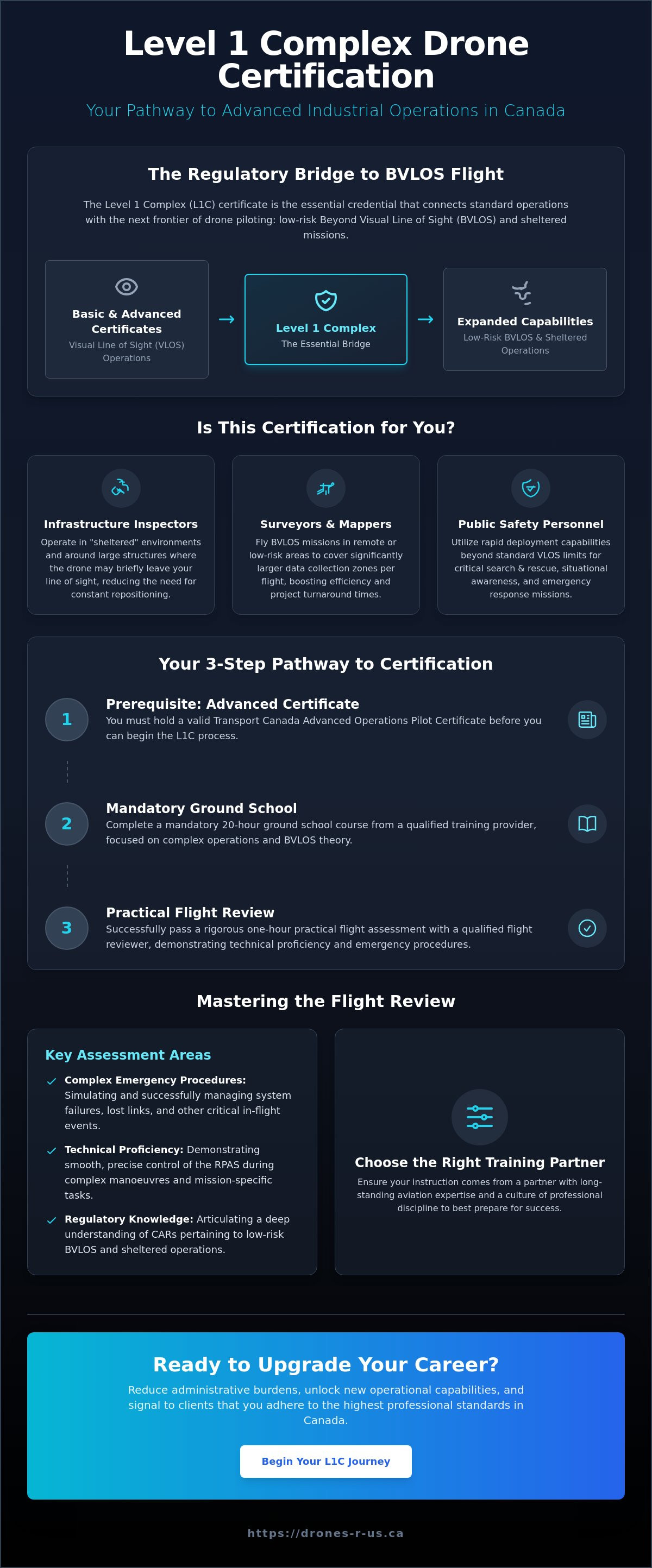
- Understand how the Level 1 Complex (L1C) certificate serves as the vital regulatory bridge between standard visual line of sight operations and expanded BVLOS capabilities.
- Identify the specific operational privileges gained, including the authorization to fly in sheltered environments and conduct low-risk missions beyond visual line of sight.
- Master the step-by-step pathway to your Level 1 complex drone certification Canada by completing the mandatory 20-hour ground school and maintaining a valid Advanced Operations certificate.
- Prepare for the rigorous one-hour practical flight assessment by focusing on complex emergency procedures and technical proficiency under the guidance of a qualified reviewer.
- Learn how to evaluate training partners to ensure your instruction is rooted in long-standing aviation expertise and professional discipline.
Understanding the Level 1 Complex Drone Certification in Canada
The Level 1 Complex (L1C) certificate is the newest professional tier within the Canadian Remotely Piloted Aircraft System (RPAS) framework. It was designed to fill a specific operational gap that previously forced many commercial pilots into a cycle of repetitive paperwork. Before this category existed, pilots were often limited to Visual Line of Sight (VLOS) under an Advanced certificate or had to apply for a Special Flight Operations Certificate (SFOC) for every mission that ventured even slightly beyond their view.
Transport Canada introduced this tier to provide a standardized, scalable pathway for professional-grade missions. While the Advanced category focuses on flight in controlled airspace and near bystanders, the Level 1 Complex certification addresses the technical and safety requirements for low-risk Beyond Visual Line of Sight (BVLOS) operations. This certification serves as a bridge, allowing pilots to realize greater operational efficiency while maintaining the high safety standards inherent in Canadian drone regulations. Obtaining your Level 1 complex drone certification Canada is now the professional standard for those moving beyond the limitations of basic and advanced certificates.
The 2025 Regulatory Shift
The implementation of these new rules on November 4, 2025, marked a turning point for the industry. This update officially integrated the Level 1 Complex category into the CARs, moving away from the temporary nature of many SFOCs. For existing Advanced pilot certificate holders, this shift doesn't invalidate their current credentials; rather, it offers a logical next step for career advancement. Pilots currently operating under specific BVLOS SFOCs must transition to the L1C framework as their current certificates expire. This transition period ensures that all professional operators meet the standardized 2026 requirements for ground school and practical reviews.
Who Should Pursue Level 1 Complex Certification?
This certification is not for the hobbyist. It's a professional tool for those managing enterprise-level flight departments. If you are an industrial inspector, a surveyor, or a member of a public safety team, the L1C is likely essential for your workflow. It is particularly valuable for:
- Infrastructure Inspectors: Who need to operate in "sheltered" environments or around large structures where the drone might briefly leave the line of sight.
- Surveyors and Mappers: Working in remote or low-risk areas where BVLOS allows for much larger data collection areas per flight.
- Public Safety Personnel: Requiring rapid deployment capabilities that exceed standard VLOS limits during search and rescue or situational awareness missions.
By obtaining the Level 1 complex drone certification Canada, commercial operators can significantly reduce the frequency of SFOC applications. This leads to more predictable project timelines and lower administrative costs. It signals to clients that your operation adheres to the most rigorous safety and compliance standards in the country. To begin your professional transition, you can explore the specialized training resources available at Drones-R-Us.ca.
Expanded Privileges: What a Level 1 Complex Certificate Allows
Obtaining your Level 1 complex drone certification Canada is a career-scaling milestone that fundamentally changes how you approach professional missions. While an Advanced certificate is suitable for many urban tasks, it remains tethered to the pilot's direct line of sight. The Level 1 Complex (L1C) tier removes this tether in specific, low-risk environments. This allows you to act as Pilot-in-Command (PIC) for more sophisticated Remotely Piloted Aircraft Systems (RPAS) that require higher levels of automation and safety redundancy. These expanded privileges are designed for the modern professional who needs to maximize the utility of their hardware without the administrative burden of constant SFOC applications.
BVLOS and Sheltered Operations Explained
The most significant privilege granted by this drone pilot certificate is the authorization to conduct Beyond Visual Line of Sight (BVLOS) operations in low-risk areas. Transport Canada classifies these areas based on low population density and uncontrolled airspace. Additionally, the L1C allows for "sheltered operations." This refers to flying within 100 feet of a structure or a natural obstacle, such as a building or a dense tree line, where the drone is shielded from other aircraft. In these scenarios, the drone might be obscured from your view, but the certification provides the legal framework to continue the mission safely. Maintaining "low-risk" status requires strict adherence to technical requirements, including the use of specific link loss procedures and robust flight planning.
It is important to distinguish this from Level 2 Complex operations. While Level 1 focuses on low-risk BVLOS, Level 2 covers high-risk missions in more congested areas. For most industrial pilots, Level 1 provides the perfect balance of operational flexibility and achievable compliance standards. If you are preparing for this transition, our Level 1 Complex flight reviews can help ensure your procedures meet these new national standards.
Commercial Applications and Scaling
Efficiency is the primary driver for pilots seeking the Level 1 complex drone certification Canada. In sectors like linear infrastructure inspection, such as pipelines or power lines, the ability to fly BVLOS is transformative. You can cover significantly more ground in a single flight session. In large-scale agricultural mapping, this allows for the collection of high-resolution data over vast acreages without the logistical headache of relocating your ground station every ten minutes. Perhaps most importantly, the L1C status reduces the need for multiple visual observers on site. A single qualified pilot can manage complex missions that previously required a full team. This lean operational model allows your business to scale while maintaining a high standard of safety and precision.
The Pathway to Certification: Prerequisites and Requirements
Transitioning to complex operations is a methodical process that builds upon your existing skills. Unlike the self-study path often taken for Basic or Advanced certificates, the Level 1 complex drone certification Canada follows a strictly regulated syllabus. This structure ensures that every pilot operating in the new sheltered or low-risk BVLOS environments has been vetted through both academic and practical lenses. The pathway is divided into four distinct phases that you must complete in sequence to satisfy Transport Canada standards.
The first prerequisite is holding a valid Pilot Certificate - Advanced Operations. You cannot skip directly to the complex tier; you need the foundational knowledge of controlled airspace and bystander safety protocols first. Once this is established, you must follow the specific Transport Canada Level 1 Complex Exam requirements which mandate a higher score and more technical ground school hours than previous certifications. After passing the online exam, the final step is a successful flight review tailored to complex emergency procedures.
Ground School Standards
Transport Canada now requires a minimum of 20 hours of ground school from a recognized provider. This is a legal requirement for the L1C certificate, not just a recommendation. The curriculum covers advanced meteorology, complex navigation, and updated air law specific to the 2025 CARs implementation. Choosing a recognized training provider like Caswell Aviation ensures your ground school hours meet the federal standard. Professional pilots often choose Online Drone Courses to balance these 20 hours with their existing work schedules. Whether you choose online or in-person instruction, the goal is to move beyond basic flight and into a mindset of professional aviation discipline.
Examination and Fees
The financial commitment for the certificate itself is standardized across the country. Each attempt at the Level 1 Complex online exam costs $50.85 CAD. This exam consists of 50 multiple-choice questions that you must complete within 90 minutes. You need a score of 80% or higher to pass, which is a significant step up from the 70% required for the Advanced exam. After passing the exam and your flight review, there is a final issuance fee of $127.13 CAD paid to Transport Canada. To keep your certificate valid, you must meet recency requirements every 24 months. This usually involves completing a flight review or an approved recurrent training activity to ensure your knowledge of Canadian drone law remains current.
Preparing for the Level 1 Complex Flight Review
The flight review for the Level 1 complex drone certification Canada is a rigorous, one-hour practical assessment. It is not a test of your ability to perform basic manoeuvres; it is an evaluation of your command over complex systems and risk mitigation strategies. Before meeting your reviewer, you must ensure your documentation is impeccable. This includes detailed pilot logs, comprehensive maintenance records, and an operational manual that reflects the latest 2026 regulatory standards. A disciplined approach to record-keeping is often the first thing a reviewer looks for to establish your professional credibility.
During the assessment, you'll be expected to demonstrate proficiency in complex emergency procedures. This isn't just about handling a simple battery failure. You must show how you manage a command and control (C2) link loss while the aircraft is potentially beyond your visual line of sight or operating in a sheltered environment. Your ability to execute a site survey and develop a risk mitigation plan for complex industrial environments is a critical component of the review. The reviewer needs to see that you can anticipate hazards before they become incidents.
Critical Skills Assessed
The reviewer will focus heavily on your ability to maintain C2 link integrity during distance flights. You must demonstrate a disciplined adherence to Standard Operating Procedures (SOPs) even when under simulated stress. Conflict avoidance is another high-priority area. You need to show how you coordinate with local air traffic and monitor radio frequencies to ensure your mission doesn't interfere with manned aviation. These are the technical skills that separate enterprise-level pilots from basic operators. Precision in communication and flight path management is essential to pass this stage.
Common Pitfalls to Avoid
One of the most frequent reasons for failure is an inadequate pre-flight briefing or a superficial site assessment. You must be able to articulate the specific hazards of your flight volume and how you intend to neutralize them. Another common error is failing to correctly interpret weather data for BVLOS operations. Looking at a basic forecast isn't enough; you must understand how wind gradients and visibility changes at different altitudes will affect your specific RPAS. If you don't have a clear plan for weather contingencies, you aren't ready for complex operations.
If you're still working on your foundational knowledge, it's helpful to review What is a Drone Flight Review in Canada? for a refresher on the core requirements. When you're ready to demonstrate your proficiency at the complex level, you can book your Level 1 Complex Flight Review with our experienced instructors to ensure you meet the national standard.
Choosing the Right Training Partner for Complex Operations
Selecting a training provider is the final strategic decision in your journey toward a Level 1 complex drone certification Canada. This choice should not be based solely on proximity or price. It requires an evaluation of the instructor's background and their ability to provide mentorship that extends beyond a basic syllabus. A veteran instructor who has managed high-stakes aviation environments provides insights that a standard online module simply cannot replicate. They bring a culture of discipline and precision, helping you transition from a drone operator to a professional aviator.
Integrating professional hardware into your training programme is equally vital. When you prepare for complex missions, you should train with the same systems you intend to deploy in the field. This ensures that your muscle memory and procedural habits are aligned with the technical requirements of your specific RPAS. Your training partner should be a master practitioner who is equally comfortable explaining regulatory frameworks as they are repairing complex hardware. This holistic approach ensures you are prepared for the technical and administrative challenges of 2026 and beyond.
Beyond the Certificate: Professional Ergonomics
Complex missions often involve long-duration flights that place significant physical demands on the pilot. As you move into low-risk BVLOS operations, the time spent at the ground station increases. This shift makes pilot comfort and control a safety-critical factor rather than a luxury. Specialized Fitek Gear harnesses are designed to distribute the weight of smart controllers across the torso, which significantly reduces pilot fatigue during multi-hour missions. Using ergonomic neck straps and harnesses improves your precision by stabilizing the controller, allowing for smoother stick inputs and better situational awareness. A fatigued pilot is more prone to errors; therefore, ergonomic gear is a fundamental component of a professional safety management system.
The Caswell Aviation Advantage
Caswell Aviation supports the full lifecycle of a drone pilot by providing expert-led online courses and professional flight reviews. We offer comprehensive support for both Advanced and Level 1 complex drone certification Canada, ensuring your operation remains compliant with the latest Transport Canada standards. Our instructors are seasoned professionals who value standards and compliance over flashy marketing, positioning themselves as long-term partners in your career advancement. Whether you need an initial ground school session or a recurrent flight review, we provide the technical authority required for complex operations. You can begin your professional upgrade by booking your next course through Caswell Aviation.
Advancing Your Career in Complex Operations
The transition to complex operations represents a significant shift in the Canadian RPAS landscape. By securing your Level 1 complex drone certification Canada, you move beyond the limitations of standard visual line of sight missions. You gain the legal authority to conduct low-risk BVLOS operations and navigate sheltered environments near structures. This certification is not just a badge; it's a commitment to a higher standard of safety and operational efficiency.
Success in this new tier requires a blend of academic discipline and practical proficiency. As a Transport Canada recognized training provider, Caswell Aviation is uniquely positioned to guide you through this process. Our expert flight reviewers bring deep aviation backgrounds to every assessment, ensuring you're prepared for the technical demands of 2026. We also support your long-term operational health as a specialized Fitek Gear retailer, providing the ergonomic tools needed for extended missions.
When you're ready to take the next step in your professional journey, Book your Level 1 Complex Flight Review with Caswell Aviation. We look forward to helping you realize your full potential as a master practitioner in the drone industry.
Frequently Asked Questions
What is the difference between Advanced and Level 1 Complex certification?
The primary difference lies in the operational environment and the required knowledge base. Advanced certification is limited to Visual Line of Sight (VLOS) operations, whereas the Level 1 complex drone certification Canada allows for low-risk Beyond Visual Line of Sight (BVLOS) and sheltered operations. The complex tier also requires a higher 80% pass mark on the online exam, compared to the 70% required for the Advanced level.
Can I fly BVLOS immediately after getting my Level 1 Complex certificate?
Possession of the pilot certificate is only one part of the legal requirement. You must also ensure the mission is conducted under a Remotely Piloted Aircraft System (RPAS) Operator Certificate (RPOC) that authorizes complex operations. The individual pilot holds the technical qualification, but the organization provides the documented operational framework for BVLOS missions.
How much does the Level 1 Complex drone certification cost in Canada?
Transport Canada charges a total of $177.98 CAD for the regulatory portion of the certification. This includes a $50.85 fee for each attempt at the Level 1 Complex online exam and a $127.13 fee for the issuance of the certificate itself. These government fees are standardized and don't include the costs for mandatory ground school or your practical flight review.
Do I need to redo my Advanced exam to get the Level 1 Complex certificate?
You don't need to retake the Advanced exam if your current certificate is valid. However, passing the Advanced exam is a mandatory prerequisite that must be completed before you can attempt the Level 1 complex drone certification Canada process. It serves as the foundational requirement for the more technical complex-tier ground school and examination.
What drones are eligible for Level 1 Complex operations?
Drones must have a specific manufacturer declaration for complex operations to be eligible. These aircraft typically feature redundant command and control links and advanced safety systems to manage the inherent risks of BVLOS flight. You should always verify your system's status on the Transport Canada list of declared systems before planning a complex mission.
How long is the Level 1 Complex ground school requirement?
Transport Canada mandates a minimum of 20 hours of ground school for this certification. This training must be delivered by a recognized provider and covers specialized subjects like advanced navigation, meteorology, and air law. The curriculum is designed to ensure pilots can safely manage the technical challenges of operating beyond their direct line of sight.
Is an SFOC still required for complex operations if I have this certificate?
A major benefit of this certificate is the reduction in administrative paperwork. For missions that meet the predefined low-risk BVLOS or sheltered criteria, you can operate without a specific Special Flight Operations Certificate (SFOC). If your mission parameters fall outside these standardized categories, a separate SFOC application is still necessary.
What happens if my drone certification recency expires?
If your 24-month recency period expires, you're no longer legally permitted to act as Pilot-in-Command for complex missions. You must regain your operational standing by completing a recurrent training program or a new flight review. Keeping detailed pilot logs is the most efficient way to track your expiry dates and maintain continuous professional compliance.
Leave a comment