
How to Get Your Advanced Drone Certificate in Canada: A Professional 2026 Guide
Is your drone operation a hobby, or are you ready to be recognized as a professional aviator? Moving into advanced operations requires a disciplined pilot-in-command mindset and a thorough understanding of Canadian airspace. Understanding how to get advanced drone certificate Canada is the first step toward a career in professional aviation, yet the path is often obscured by complex regulations. It's natural to feel some anxiety about the 80% pass mark on the written exam or the uncertainty of the in-person flight review.
We understand these hurdles and have built this guide to replace confusion with a clear, professional roadmap. You'll find a step-by-step breakdown for mastering your certification, from initial exam preparation to the successful completion of your flight review. This guide covers the essential requirements for 2026, including registration fees and recency rules, to ensure you feel confident and prepared. By the end of this article, you'll have the knowledge needed to transition from a basic operator to a fully certified advanced pilot.
Key Takeaways
- Understand the specific regulatory requirements for operating in controlled airspace and why the Advanced RPAS certificate is a legal necessity for professional pilots.
- Master the step-by-step process of how to get advanced drone certificate Canada by preparing for the rigorous 80% pass mark on the Transport Canada written exam.
- Identify the mandatory prerequisites for booking your in-person flight review and learn what to expect during this practical assessment of your technical skills.
- Develop a professional approach to record-keeping and recency requirements to ensure your certification remains valid and compliant over the long term.
- Discover how integrating online theory with professional in-person training can streamline your journey toward becoming a certified drone operator.
Understanding the Transport Canada Advanced Drone Certificate Requirements
The Advanced Pilot Certificate for Small Remotely Piloted Aircraft Systems (RPAS) is the professional standard for drone operations in Canada. It's designed for pilots who need to operate in environments where safety and precision are paramount. If you're looking into how to get advanced drone certificate Canada, you're likely transitioning from a hobbyist mindset to a commercial one. This certificate isn't just a legal formality; it represents a commitment to aviation safety and technical proficiency.
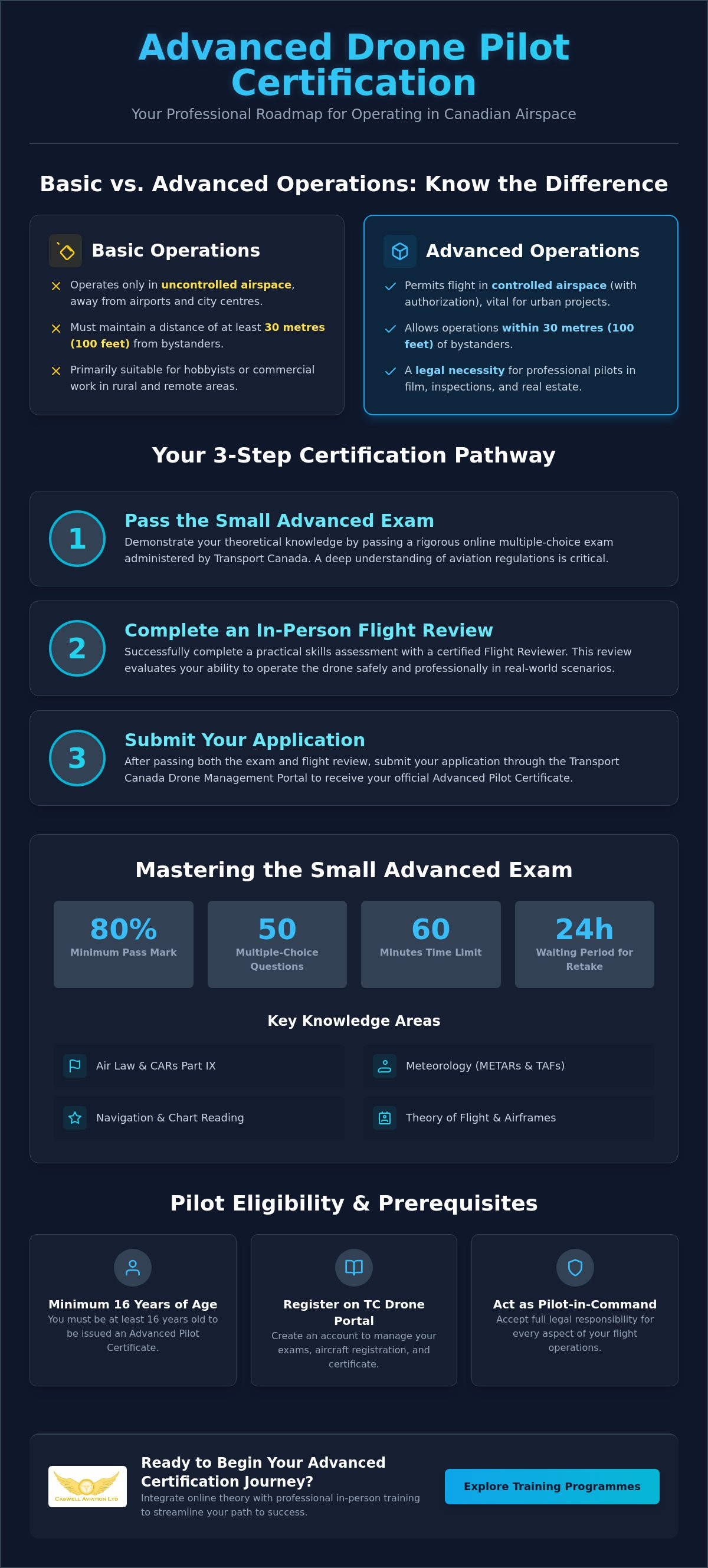
Holding an Advanced certificate grants you several critical operational privileges. The most significant is the authority to fly within controlled airspace, such as areas near airports or within busy city centres. Without this certification, these zones are strictly off-limits. Additionally, it allows you to fly within 30 metres (100 feet) of bystanders, which is essential for real estate, inspections, and film production. The certification process is methodical and consists of three primary steps: passing the online Small Advanced Exam, completing an in-person flight review, and submitting your final application to Transport Canada.
Basic vs. Advanced Operations: Knowing the Difference
The distinction between Basic and Advanced operations is defined by where you fly and how close you get to people. Basic operations are limited to uncontrolled airspace and require you to stay at least 30 metres away from bystanders. This often limits work to rural or remote areas. If your business goals involve urban infrastructure or crowded events, the Advanced certificate is necessary. For those pursuing specialized commercial needs, Level 1 Complex operations provide even greater flexibility, allowing for flight in more challenging environments with specific safety-assured equipment.
Pilot Eligibility and Legal Prerequisites
Before you begin your training, you must meet certain legal requirements. You must be at least 16 years of age to hold an Advanced certificate. Your first practical step is to register on the Transport Canada Drone Management Portal. This platform is where you'll manage your exams, register your aircraft, and eventually receive your digital certificate. As a pilot, you must realize that you are the "pilot-in-command" under Part IX of the CARs. This role demands a deep understanding of Canadian drone regulations. You are legally responsible for every aspect of the flight, including pre-flight planning, weather assessment, and emergency procedures. You can find more resources on professional training paths at drones-r-us.ca to help organize your study plan.
Mastering the Small Advanced Exam: Preparation and Strategy
Passing the Small Advanced Exam is the first rigorous hurdle in your journey to become a professional pilot. Unlike the Basic exam, which requires a 65% score, the Advanced version demands a minimum of 80% to pass. You'll face 50 multiple-choice questions with only 60 minutes to complete the session. If you don't meet the threshold, Transport Canada imposes a mandatory 24-hour waiting period before you can attempt a retake. Mastering this exam is a key part of learning how to get advanced drone certificate Canada while maintaining a high standard of aviation safety.
We strongly advise completing a structured ground school programme before paying the $10 exam fee. Ground school provides the context that raw regulations often lack, helping you understand the "why" behind the rules. When you're ready to take the test, ensure your internet connection is stable and your browser is updated. Technical difficulties can be frustrating; if the system crashes, contact the Transport Canada support desk immediately to preserve your attempt and avoid an unnecessary lockout.
Key Knowledge Areas for the Written Test
The exam isn't just about flying; it's about aviation theory and legal compliance. You must be fluent in Transport Canada's official drone safety guidelines and Part IX of the Canadian Aviation Regulations (CARs). Key topics include meteorology, where you'll decode METARs and TAFs to assess flight conditions, and navigation, which involves interpreting VNC and VTA aeronautical charts. You'll also need to understand radiotelephony protocols for communicating with air traffic control and other aviators.
Effective Study Techniques for Success
Use mock exams to realize where your knowledge is weakest before you sit for the actual test. Many pilots find that a structured online drone certification Canada course provides the necessary depth to handle complex exam scenarios. Organize your study material around the official Knowledge Requirements for Pilots of RPAS. This methodical approach ensures you aren't just memorizing answers but actually understanding the principles of flight. If you're feeling overwhelmed by the technical jargon, consider enrolling in our online drone courses to build a solid foundation for your professional career.
Passing Your Advanced Flight Review with Confidence
The flight review is the final practical hurdle before you receive your Transport Canada drone pilot certificate. Unlike the online exam, which tests theoretical knowledge, the review is a hands-on assessment of your ability to manage a safe flight operation. You must pass the Small Advanced Exam before you're eligible to book this session. It's a critical component of learning how to get advanced drone certificate Canada, as it validates that you can apply regulatory theory in a real-world environment. Understanding the practical nuances of how to get advanced drone certificate Canada requires more than just stick skills; it requires an aviator's mindset.
Your flight reviewer is an authorized evaluator, not an instructor. During the session, they won't provide coaching or tips on how to fly. Their role is to observe your decision-making and technical execution against a set of standardized criteria. To ensure the process begins smoothly, bring your government-issued photo identification and a digital or printed copy of your successful exam results. Arriving prepared shows the reviewer that you respect the professional nature of the aviation industry and the safety of the national airspace.
What to Expect During the Practical Assessment
The review typically begins on the ground with a comprehensive site survey. You'll need to identify potential hazards, establish a safety perimeter, and deliver an emergency procedure briefing. Once the reviewer is satisfied with your planning, you'll move to manual flight manoeuvres. You'll demonstrate precise control of the aircraft through various patterns, showing you can handle the drone without relying solely on automated features. The session concludes with post-flight procedures, including a final inspection of the hardware and the completion of necessary logbook entries.
Common Mistakes and How to Avoid Them
Many candidates fail because they overlook the basics. Forgetting to check NOTAMs (Notices to Airmen) or current weather data before the review is a common oversight that can lead to an immediate failure. Communication is another frequent stumbling block. If you can't clearly articulate your emergency plan or fail to notify "air traffic" during a simulated incident, it shows a lack of situational awareness. We recommend you read our guide on common drone pilot errors in Canada to identify and correct these habits before your assessment date. Taking the time to rehearse your verbal briefings can make the difference between a pass and a retake.
Optimizing Your Professional Flight Operations for Success
Transitioning to a professional role means adopting a rigorous approach to every flight. Once you have mastered how to get advanced drone certificate Canada, your focus must shift toward long-term operational health. A professional operator maintains a disciplined logbook, documenting every flight hour and maintenance action. This isn't just a suggestion; it's a requirement under Part IX of the CARs. Regular firmware updates and hardware inspections are vital to ensure your drone meets safety assurance standards for operations near people. These habits distinguish a casual flyer from a serious aviator who prioritizes reliability and safety. You must treat your aircraft as a registered vehicle that requires consistent oversight.
Ergonomics and Pilot Comfort in the Field
Professional missions often involve long periods in the field, which can lead to physical exhaustion. Using an ergonomic drone controller neck strap harness is a practical solution to manage the weight of modern smart controllers. Fitek Gear harnesses offer superior weight distribution compared to standard straps, preventing the neck strain that often leads to lapses in concentration. When you're comfortable, you're more likely to execute precise manoeuvres and maintain situational awareness. This level of comfort is essential for complex flights where precision is the difference between a successful mission and a safety incident. High-end gear reduces physical strain, allowing you to focus entirely on the technical aspects of the flight.
Maintaining Recency and Regulatory Compliance
Your certification remains valid only if you meet the 24-month recency requirement. This ensures that every pilot stays current with the latest Transport Canada drone certification standards. You can satisfy this by completing a flight review, attending an industry seminar, or passing a recurrent training exam. Failing to document these activities can result in fines or the suspension of your operational privileges. We recommend setting a calendar reminder six months before your recency date to organize your training. For high-stakes commercial work, having the right support gear is just as important as your license. You can find professional-grade equipment like our Fitek Gear drone harnesses to ensure you're prepared for the physical demands of the job. Consistent record-keeping is the hallmark of a veteran mentor in this industry.
Starting Your Advanced Certification Journey with Caswell Aviation Ltd
Caswell Aviation Ltd serves as a comprehensive resource for pilots navigating the complexities of the Canadian aviation landscape. We provide a structured path that bridges the gap between regulatory theory and practical field operations. Our approach ensures you don't just pass a test but actually develop the technical authority required for commercial success. By integrating online ground school with professional in-person sessions, we offer a streamlined method for understanding how to get advanced drone certificate Canada. This modular training style reflects our commitment to industry-leading safety standards and professional discipline. We view ourselves as veteran mentors, helping you transition from basic operations to high-stakes commercial work with confidence.
Our support extends through the entire certification lifecycle. We recognize that obtaining your certificate is only the beginning of your professional journey. That's why we offer specialized Advanced and Level 1 Complex flight reviews that go beyond simple checklists. Much like how individuals pursuing other types of professional exams might learn more about specialized booking services to secure their testing slots, we prioritize a seamless scheduling experience for our pilots. We evaluate your decision-making and technical execution to ensure you're prepared for the realities of the national airspace. When you train with us, you're gaining access to years of industry expertise and a culture of precision that defines professional aviation in 2026. Learning how to get advanced drone certificate Canada shouldn't be a process of trial and error; it should be a methodical progression guided by experts.
Comprehensive Training Solutions for Professional Pilots
Our tailored drone certification course options are designed to prepare you for the most demanding environments. Whether you're conducting industrial inspections or capturing high-end aerial photography and video, our expert-led sessions provide depth that basic self-study cannot match. We focus on real-world scenarios, ensuring you're ready for the precision required in Advanced operations. These programmes are built to help you realize your potential as an aviator, focusing on safety-critical skills that protect your equipment and your reputation.
Booking Your Flight Review and Finalizing Certification
Scheduling your professional flight review is a straightforward process through our training centre. Once you've successfully demonstrated your skills in the field, the final step involves applying for your certificate through the Transport Canada Drone Management Portal. We'll guide you through the necessary documentation to ensure your application is processed without delay. After your review is uploaded by our evaluator, you'll pay the required fee to Transport Canada and receive your digital credentials. If you're ready to advance your career and join the ranks of certified professionals, you can get started on your Advanced drone certificate today with Caswell Aviation Ltd.
Advancing Your Career as a Certified RPAS Professional
You now have a structured understanding of the technical precision required to operate in Canada's controlled airspace. Professionalism in this industry is built on a foundation of rigorous study, disciplined flight planning, and a commitment to long-term safety. Successfully navigating the process of how to get advanced drone certificate Canada requires a methodical approach that balances regulatory theory with hands-on skill and proper record-keeping.
Caswell Aviation Ltd provides the resources you need to succeed, including comprehensive online and in-person training syllabi alongside specialized Fitek Gear ergonomic solutions to reduce pilot fatigue. Our Transport Canada Qualified Flight Reviewers are ready to help you validate your expertise and secure your professional credentials. Taking this step sets you apart as a dedicated aviator ready for high-stakes commercial missions. Book Your Advanced Flight Review or Training with Caswell Aviation Ltd today and join the ranks of Canada's elite drone operators. Your future in professional aviation is within reach.
Frequently Asked Questions
How long does it take to get an Advanced drone certificate in Canada?
The timeline varies based on your preparation, but most pilots complete the process within two to four weeks. This includes time for ground school, passing the online exam, and scheduling an in-person flight review with an authorized evaluator. Once the reviewer uploads your results, you can apply for the digital certificate through the portal immediately.
What is the cost of the Transport Canada Advanced drone exam?
The online Small Advanced Exam requires a $10 CAD fee for each attempt. You must also pay a $25 CAD fee when you apply for your official Pilot Certificate; Advanced Operations, after passing both the exam and the flight review. These government fees are separate from any costs associated with training courses or third-party flight review services.
Can I fly a drone in controlled airspace with a Basic certificate?
No, you cannot fly in controlled airspace with a Basic certificate. Controlled airspace operations are strictly reserved for pilots who have mastered how to get advanced drone certificate Canada. Basic operations are limited to uncontrolled airspace and must maintain a distance of at least 30 metres from bystanders. Attempting to enter controlled zones without the proper certification can result in significant regulatory fines.
Is a flight review required every time I renew my certificate?
You don't need to renew the certificate itself because it doesn't expire, but you must meet a 24-month recency requirement. A flight review is one way to satisfy this rule, though you can also choose other activities like attending a safety seminar or completing a recurrent training exam. Maintaining a log of these activities is essential to prove your compliance during a Transport Canada inspection.
What happens if I fail the Advanced drone flight review?
If you fail the flight review, you cannot apply for your Advanced certificate until you successfully pass a subsequent assessment. The reviewer will provide a briefing on the specific areas where you didn't meet the required standards. You're allowed to book another review once you've practiced the necessary manoeuvres, though the evaluator may suggest a waiting period to ensure you've addressed your skill gaps.
Do I need a separate certificate for Level 1 Complex operations?
You don't need a separate certificate, but you must hold an Advanced certificate and use a drone that meets specific safety assurance standards. Level 1 Complex operations allow for flight in more challenging environments, such as over people, provided the equipment is rated for that specific risk. Understanding how to get advanced drone certificate Canada is the foundational step required before you can perform these specialized commercial missions.
Can I use my Advanced certificate for commercial drone work in Canada?
Yes, the Advanced certificate is the standard requirement for most professional and commercial drone work in urban or controlled environments. It allows you to operate in areas where Basic pilots are restricted, making it essential for industries like real estate, construction, and cinematography. As long as you follow Part IX of the CARs and maintain your recency, you can legally perform commercial operations.
What documents must I carry while flying under an Advanced certificate?
You must carry your valid Pilot Certificate; Advanced Operations, and proof of your drone's registration at all times. Additionally, you're required to have a copy of the drone's operating manual and your site survey documentation. These can be kept in digital or physical format, but you must be able to produce them immediately if a peace officer or Transport Canada official requests an inspection.
Leave a comment