

Preventing Drone Crashes in Canada: A Professional Pilot’s Guide to Safety and Compliance
A single moment of distraction or a misunderstood regulation can end a professional flight in an expensive pile of carbon fibre and broken electronics. For many pilots, the fear of equipment damage is a constant companion, especially when navigating the strict requirements of controlled airspace. You likely understand that maintaining a zero-incident record requires more than just steady hands; it demands a disciplined approach to every mission. This article focuses on the essential strategies for preventing drone crashes in Canada, ensuring your operations remain safe, legal, and efficient.
We agree that the pressure of long professional flights often leads to physical fatigue and mental lapses. To help you overcome these challenges, we've developed a comprehensive framework that balances technical proficiency with ergonomic readiness. You'll learn how to master complex Canadian regulations, optimize your pre-flight checklists, and use professional gear to reduce physical strain. This guide previews the exact steps needed to build a faster workflow without compromising safety, positioning you as a reliable practitioner in the evolving aviation sector.
Key Takeaways
- Identify the statistical causes of RPAS incidents to develop a more proactive and disciplined safety strategy for every mission.
- Understand how strict adherence to Transport Canada Part IX regulations serves as a primary tool for preventing drone crashes Canada.
- Implement professional site survey protocols and weather monitoring to manage the unique challenges of the Canadian climate and battery performance.
- Use ergonomic solutions like Fitek Gear harnesses to minimize physical fatigue and maintain precision control during long, high-stakes flights.
- Recognize the value of Advanced Certification and professional flight reviews as essential audits for maintaining a zero-incident record.
Understanding the Landscape of Drone Safety and Incident Prevention
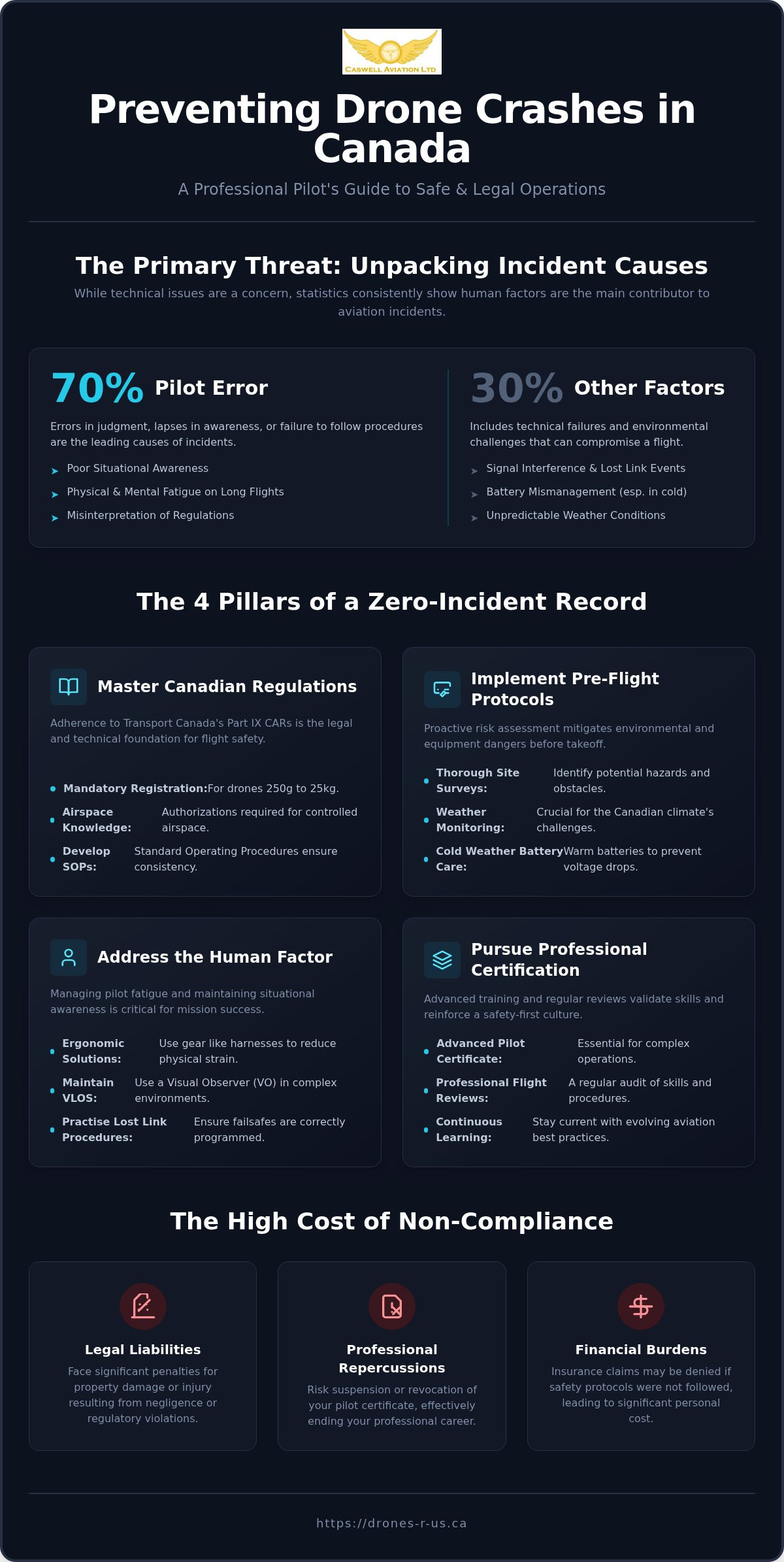
In Canadian aviation law, incident prevention isn't just about avoiding a collision; it's a systematic approach to identifying and mitigating risks before they manifest as physical damage. A professional pilot views every flight through the lens of safety management systems. This disciplined mindset is the primary foundation for preventing drone crashes Canada across all operational environments. According to the Transportation Safety Board (TSB), there were 1,141 air occurrences in 2025, with 204 resulting in accidents. While these figures include all aircraft types, the inclusion of Remotely Piloted Aircraft Systems (RPAS) highlights the growing need for vigilance. Adhering to Transport Canada regulations for drones provides the legal framework necessary for maintaining order in the national airspace. Developing a safety-first culture is mandatory for anyone operating commercially. It transforms a pilot from a mere operator into a disciplined aviation professional who prioritizes the protection of people and property above mission speed.
Common Technical Failures vs. Pilot Errors
Technical failures often involve signal interference or battery mismanagement. Cold Canadian winters significantly impact battery chemistry, leading to sudden voltage drops if the cells aren't properly warmed and monitored. However, statistics consistently show that human factors remain the primary threat to flight safety. Pilot error is the primary contributor to approximately 70% of aviation incidents, often stemming from poor situational awareness or physical fatigue. Implementing robust lost link procedures is a critical skill for preventing drone crashes Canada. When a drone loses its connection to the controller, a pre-programmed failsafe, such as an automated return-to-home at a safe altitude, prevents a minor technical glitch from escalating into a total loss of the airframe.
The Consequences of Non-Compliance
Non-compliance carries heavy burdens beyond simple repair costs. If a crash occurs due to negligence or a violation of Part IX of the Canadian Aviation Regulations (CARs), you face significant legal liabilities for any resulting property damage or injury. Transport Canada maintains strict oversight. An incident can lead to the suspension or revocation of your pilot certificate, effectively ending your professional career. Insurance providers often deny claims if the operator failed to follow established safety protocols or flew in restricted airspace without authorization. Professional training through Caswell Aviation ensures you understand these risks and possess the skills to avoid them. Maintaining a clean record is essential for securing future contracts and keeping insurance premiums manageable.
Navigating Transport Canada Regulations to Ensure Flight Safety
Part IX of the Canadian Aviation Regulations (CARs) serves as more than just a legal requirement; it's a technical framework designed for preventing drone crashes Canada. These rules establish the boundaries of safe operation by defining where, when, and how an aircraft can be flown. Mandatory registration for drones weighing between 250g and 25kg is a vital safety tool. It ensures every pilot is accountable for their equipment. By marking your drone with its unique registration number, you acknowledge your responsibility to the broader aviation community. Understanding Transport Canada Drone Flight Regulations is the first step in identifying where you can fly without risking a mid-air collision. Airspace classification adds a layer of complexity to professional missions. Flying in controlled airspace requires an Advanced Pilot Certificate and specific authorization from NAV CANADA. Professional pilots must develop rigorous Standard Operating Procedures (SOPs) to manage these high-stakes environments. These procedures ensure that every mission follows a predictable and safe pattern.
Visual Line of Sight (VLOS) and Beyond
Maintaining Visual Line of Sight (VLOS) remains the most effective method for preventing drone crashes Canada. It allows you to sense and avoid other aircraft and obstacles in real-time. In complex environments, such as busy urban centres or industrial sites, using a Visual Observer (VO) is a professional best practice. The VO focuses on the surrounding airspace while you maintain control of the flight path. This team-based approach is a hallmark of professional-grade safety. When operating in controlled airspace, clear and concise communication with Air Traffic Control (ATC) is non-negotiable. It ensures your drone is integrated safely into the national airspace system.
Staying Current with Regulatory Changes
The regulatory landscape in Canada is evolving. Transport Canada is currently moving toward the 2026 RPAS amendments, which focus on Remote Identification and operations within designated airspaces. The deadline for providing feedback on these proposed changes is September 9, 2026. Staying compliant means more than just passing your initial exam. You must use the Drone Management Portal to track your recency requirements every 24 months. Failing to keep your knowledge current can lead to the cognitive lapses that cause accidents. For a deeper dive into these updates, review our Drone Regulations in Canada: The 2026 Professional Reference Guide. If you need to upgrade your skills to meet these new standards, our Online Drone Courses provide the technical depth required for modern compliance.
Operational Risk Assessment and Pre-Flight Safety Protocols
A successful mission begins long before the propellers start spinning. Operational risk assessment is a methodical process that identifies potential hazards and implements controls to mitigate them. By integrating Transport Canada's drone safety guidelines into your daily routine, you create a repeatable system for preventing drone crashes Canada. Professional pilots rely on the "IMSAFE" checklist to evaluate their own readiness: Illness, Medication, Stress, Alcohol, Fatigue, and Emotion. If you aren't at your best, the flight shouldn't proceed. This self-assessment is as critical as checking the aircraft itself. A robust equipment inspection routine should follow, focusing on propeller integrity, motor smoothness, and sensor cleanliness. Every component must be verified as airworthy before every takeoff.
The Professional Site Survey Workflow
A thorough site survey is your primary defence against environmental hazards. You must identify physical obstacles like power lines, overhanging trees, and communication towers that could obstruct your flight path or cause signal degradation. Assessing bystander safety is equally vital. Establish a "sterile" launch zone where only essential personnel are permitted. In urban centres, check for electromagnetic interference (EMI) from large metal structures or high-voltage lines, as these can disrupt the drone's internal compass. Documenting these findings in a site survey report ensures you remain compliant with your Standard Operating Procedures (SOPs).
Weather monitoring in Canada requires specialized attention to temperature and wind. Cold weather significantly reduces battery performance; Lithium Polymer (LiPo) batteries often experience voltage drops when operated below 15°C. You should pre-warm batteries and monitor their voltage closely during flight to avoid a mid-air power failure. High-altitude winds often differ from surface conditions, so use aviation-specific weather apps to verify wind speeds at your planned flight altitude. This data-driven approach is essential for preventing drone crashes Canada during the winter months.
Emergency Response Planning
Preparation for the unexpected is what separates a professional from a hobbyist. You must develop a "What If" plan for every failure scenario, including lost link, GPS loss, and motor failure. Define your "Home Point" carefully and set your "Return to Home" (RTH) altitude higher than the tallest obstacle in the vicinity. If an emergency occurs, follow established communication protocols to alert bystanders or local air traffic. For those looking to refine these technical skills, Caswell Aviation offers advanced training that focuses on real-world emergency management and risk mitigation.
The Human Factor: Ergonomics, Training, and Pilot Preparedness
While technical systems and regulations provide the structure for flight, the human operator remains the most variable factor in the safety equation. Pilot fatigue is a primary cause of cognitive lapses, leading to missed warnings or delayed reactions during critical flight phases. Maintaining a high level of preparedness is central to preventing drone crashes Canada, especially during complex aerial photography missions that require intense concentration for hours. Stress management and mental clarity are as important as battery levels. A pilot who is physically uncomfortable or mentally drained cannot exercise the precision required for professional operations. Building muscle memory through repetitive training ensures that your response to a sudden equipment failure is instinctive rather than hesitant.
Ergonomics and Precision Control
Physical strain is a hidden risk factor that accumulates over the course of a work day. Supporting the weight of a controller for several hours leads to neck and back fatigue, which directly impacts the fine motor skills needed for smooth flight inputs. This is why many professional pilots invest in a drone harness for smart controller systems. Using a specialized harness transfers the load from your arms and neck to your shoulders and torso. Fitek Gear harnesses are designed to provide this stability, ensuring your hands remain free to focus entirely on the control sticks without the distraction of physical discomfort. This ergonomic setup is a practical strategy for preventing drone crashes Canada by keeping the pilot alert and ready throughout multi-hour field operations. Precise control is impossible if you're fighting physical pain.
Advanced Training as a Safety Investment
Certification is the baseline, but true safety comes from advanced training that builds muscle memory. Basic knowledge allows you to fly; advanced skills allow you to survive an emergency. Mastering emergency maneuvers through in-person training ensures your reactions are automatic when a motor fails or a signal drops. For those moving beyond hobbyist levels, understanding The Complete Guide to Transport Canada Drone Certification in 2026 is essential for career progression. Advanced certification signals to clients and regulators that you possess a higher standard of technical proficiency and risk management. If you're ready to eliminate bad habits and verify your skills, you can book a professional flight review to ensure your operations meet the highest industry standards.
Professional Certification: The Path to Zero Incidents
Professional certification represents the definitive standard for any pilot committed to preventing drone crashes Canada. While a Basic Pilot Certificate allows for simple operations, the Advanced and Level 1 Complex certifications signify a deeper mastery of aviation safety. As of May 2026, Transport Canada has issued 21,472 Advanced Pilot Certificates, a small fraction of the total registered pilots. This discrepancy highlights the elite level of discipline required for advanced operations. Moving into this tier means you've moved beyond theory and can demonstrate technical precision in high-pressure environments. Caswell Aviation Ltd supports this transition by providing the rigorous training and flight reviews necessary to meet these elevated standards. This structured path ensures that safety is a measurable outcome of your professional development rather than a matter of luck.
Passing Your Advanced Flight Review
A professional flight review should be viewed as a safety audit rather than a simple test. It is an opportunity for an experienced evaluator to identify hidden habits that could lead to future incidents. Reviewers prioritize your ability to conduct a thorough site survey, maintain situational awareness, and execute emergency procedures with calm precision. You must demonstrate a complete understanding of the Canadian Aviation Regulations and show that you can integrate your drone safely into the national airspace. Common errors that lead to failed reviews include:
- Failure to use a physical or digital checklist during pre-flight.
- Inadequate bystander safety briefings or poorly defined sterile zones.
- Loss of Visual Line of Sight (VLOS) during complex manoeuvres.
- Incorrect programming of "Return to Home" altitudes relative to nearby obstacles.
Preparation is the key to success. For a detailed breakdown of the evaluation criteria, read our guide on What is a Drone Flight Review in Canada? A Professional Guide for 2026. Correcting these minor technical lapses during a review is a vital step in preventing drone crashes Canada during actual commercial missions.
Building a Safe Drone Career
Certification is a powerful tool for career growth. High-tier commercial contracts often require pilots to hold an Advanced or Level 1 Complex certificate to ensure insurance compliance and risk mitigation. By maintaining these certifications, you signal to clients that you prioritize professional-grade safety and reliability. Continuous learning is essential in an industry where technology and regulations change rapidly. You must stay updated on the latest firmware safety features and ergonomic advancements to maintain your edge. If you're ready to validate your skills and secure your professional standing, you can book your Advanced Flight Review or Drone Course with Caswell Aviation today. Investing in your certification is the most direct way to ensure a long, incident-free career in the Canadian skies.
Securing Your Future in the Canadian Airspace
Achieving a zero-incident record is a continuous commitment to professional standards. You've seen how integrating Part IX regulations with rigorous site surveys creates a foundation for safety. By addressing the human factor through ergonomic gear like Fitek harnesses, you significantly reduce the risk of fatigue-driven errors. These strategies are the most effective methods for preventing drone crashes Canada while maintaining a high-speed professional workflow.
True proficiency requires a balance of technical knowledge and hands-on experience. Whether you're seeking Advanced or Level 1 Complex certification, expert guidance ensures you develop the discipline needed for high-stakes missions. We offer comprehensive online and in-person training options designed to meet Transport Canada's highest standards. Master your flight safety with Caswell Aviation’s professional drone courses and build the confidence required for controlled airspace operations. Your journey toward becoming an elite pilot starts with a commitment to excellence and a steady focus on precision.
Frequently Asked Questions
What are the most common causes of drone crashes in Canada?
Pilot error, signal interference, and battery failure in cold weather are the leading causes. Pilot error contributes to approximately 70% of aviation incidents. Loss of situational awareness often leads to collisions with obstacles like power lines or trees. Technical failures like "lost link" events can also cause crashes if failsafes aren't set. Understanding these risks is the first step in preventing drone crashes Canada and maintaining a safe record.
How can a drone harness help prevent accidents during long flights?
A harness redistributes the controller's weight across your shoulders and torso. This prevents neck and back strain that leads to physical fatigue. Fatigue is a major cause of cognitive lapses and slow reaction times. By using ergonomic gear like Fitek Gear harnesses, you maintain precision control over the flight sticks. This ensures you remain alert and capable of executing emergency manoeuvres during multi-hour professional missions.
Do I need a special permit to fly in controlled airspace in Canada?
You require an Advanced Pilot Certificate and specific authorization from NAV CANADA to operate in controlled airspace. This is a standard requirement for advanced operations under Part IX of the Canadian Aviation Regulations. You must submit a flight authorization request via the NAV Drone app or portal. Flying without this authorization is illegal and can result in fines up to $3,000 for individuals and $15,000 for corporations.
What should I do immediately after a drone crash occurs?
Secure the area to ensure bystander safety and power down the aircraft if possible. You must document the site, take photos of any damage, and record the flight logs. Certain incidents, such as fires or flyaways into controlled airspace, must be reported to the Transportation Safety Board (TSB) or NAV CANADA. Professional pilots should conduct a thorough post-incident analysis to identify the root cause and prevent future occurrences.
How does cold weather affect drone safety and battery life?
Low temperatures reduce the chemical efficiency of Lithium Polymer batteries, leading to sudden voltage drops. Batteries operated below 15°C are at high risk of failure mid-flight. You should pre-warm batteries and monitor their levels more frequently than in summer. Cold weather also makes plastic components more brittle. Managing these environmental factors is a critical part of preventing drone crashes Canada during the winter season and shoulder months.
Is an Advanced Drone Certificate required for all commercial work?
No, the requirement depends on the complexity of the operation rather than its commercial nature. You can perform commercial work with a Basic Certificate if you fly in uncontrolled airspace, at least 30 metres from bystanders, and away from airports. However, most professional contracts in urban or industrial areas require an Advanced Certificate. This certification allows you to fly closer to people and within controlled airspace safely and legally.
How often should I update my drone’s firmware for safety?
You should check for firmware updates before every mission but avoid installing them immediately before a flight. New updates often include critical safety patches or updated "No Fly Zone" databases. It's best practice to test the drone in a controlled environment after an update to ensure stability. Consistent maintenance of your software and hardware ensures that the aircraft's safety systems and failsafes function as intended by the manufacturer.
Can I use a visual observer to fly beyond my own visual line of sight?
No, the use of a Visual Observer (VO) does not allow you to fly Beyond Visual Line of Sight (BVLOS) under standard Part IX rules. The pilot-in-command must always maintain a direct, unaided visual line of sight with the aircraft. The VO assists by scanning the airspace for other aircraft or hazards. Flying BVLOS requires a Special Flight Operations Certificate (SFOC) and specialized equipment, training, or certifications.
Leave a comment