
Online Drone Certification in Canada: A 2026 Professional Comparison Guide
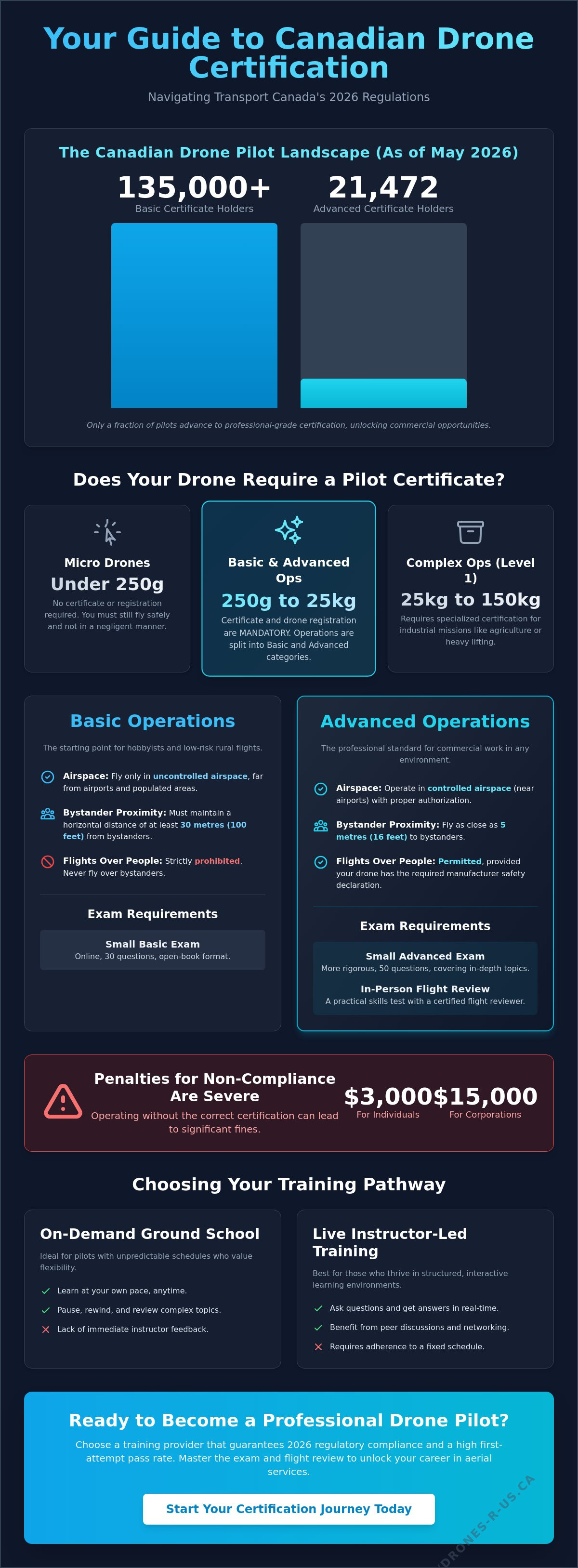
As of May 2026, Transport Canada reports that while over 135,000 pilots hold a Basic certificate, only 21,472 have successfully bridged the gap to Advanced status. It's understandable why many professionals hesitate; the Transport Canada website often feels like a maze of regulatory jargon that leaves you more confused than when you started. You likely want to move beyond simple backyard flights to operate in controlled airspace, yet the fear of failing a high-stakes exam or choosing the wrong certification level remains a common concern.
This guide simplifies your journey toward obtaining an online drone certification Canada by breaking down the newest 2026 regulations and comparing the most effective training pathways available. We'll examine the specific requirements for Basic and Advanced operations, clarify the impact of the November 2025 rule changes, and help you select a curriculum designed to help you pass your exam on the first attempt. We've organized this information to help you move past the theory and into a compliant, professional aerial services career with precision and confidence.
Key Takeaways
- Identify the specific certification tier required for your operations based on drone weight categories and proximity to bystanders.
- Compare self-paced and live instruction formats to determine which online drone certification Canada pathway best prepares you for professional flight.
- Master the technical requirements of the Advanced exam and the practical flight review to secure legal access to controlled airspace.
- Evaluate training providers based on instructor credentials and 2026 regulatory compliance to ensure a high first-attempt pass rate.
- Learn how to scale your aerial services business by integrating specialized training and professional-grade ergonomic equipment.
Understanding Transport Canada Drone Certification Categories
The legal framework for Remotely Piloted Aircraft Systems (RPAS) in Canada is built upon the weight of the aircraft and the proximity of the flight to bystanders. Under the Transport Canada Drone Regulations, any drone weighing between 250 grams and 25 kilograms requires the pilot to hold a valid certificate. This 250 gram threshold is the definitive entry point for the industry. If your aircraft weighs 249 grams or less, it's considered a microdrone and is exempt from most registration and certification requirements, provided it isn't flown at advertised public events or in a negligent manner.
For those pursuing an online drone certification Canada provides, understanding the Canadian Aviation Regulations (CARs) is essential. These rules dictate whether you operate under Basic or Advanced rules. While a Basic certificate allows for operations in uncontrolled airspace, professional aerial service providers generally require the Advanced certificate to access the lucrative opportunities found in urban centres and controlled airspaces. Choosing the wrong tier can lead to significant fines, which can reach $3,000 for individuals and $15,000 for corporations.
Basic Operations: The Entry Level
A Basic certificate is often the starting point for hobbyists or photographers working in rural, low-risk environments. To operate under these rules, you must meet three specific criteria:
- You fly in uncontrolled airspace.
- You maintain a horizontal distance of at least 30 metres from any bystanders.
- You never fly your drone over bystanders.
The Small Basic exam is an online, open-book test that covers flight safety and basic theory. Once you pass the 30-question exam and pay the required fee, Transport Canada issues the certificate immediately. It's a straightforward way to begin, but it severely limits where you can legally fly for commercial purposes.
Advanced and Complex Operations: The Professional Standard
The Advanced certificate is the industry standard for commercial pilots. It grants the legal right to fly in controlled airspace, such as near airports, and allows you to operate as close as 5 metres to bystanders. You can even fly over people if you use a drone with the appropriate manufacturer safety declaration. Obtaining this level requires passing a more rigorous 50-question exam and completing a practical flight review with a qualified reviewer.
As of November 4, 2025, specialized industrial missions involving drones between 25 kg and 150 kg now require a Level 1 Complex certification. This tier was introduced to manage the increased risk of heavier platforms used in agriculture or heavy lifting. Whether you're aiming for a standard Advanced rating or a Complex designation, choosing the right online drone certification Canada pathway ensures your training aligns with the specific operational privileges you need to build a viable business.
Comparing Online Training Formats: Self-Paced vs. Live Instruction
Selecting the right path for your online drone certification Canada depends largely on how you absorb technical information. While the core curriculum remains standardized by federal rules, the delivery method can be the difference between passing the Advanced exam on your first try or facing multiple expensive re-attempts. Most candidates choose between self-paced video modules and live, instructor-led webinars to bridge the gap between hobbyist knowledge and professional mastery.
When you begin the process of Getting a drone pilot certificate, you'll find that the material covers everything from air law to meteorology. Free resources exist; however, they often lack the depth required for current 2026 exam standards. Premium bundles usually prove more cost-effective by consolidating exam prep with practical flight review readiness, ensuring you don't waste time on outdated information.
On-Demand Ground School: Flexibility First
On-demand ground schools are ideal for pilots with unpredictable schedules. These courses allow you to pause, rewind, and review complex topics at your own pace. When selecting a provider, prioritize those offering lifetime access and curricula updated for 2026 regulatory changes. A significant downside is the lack of immediate feedback. If you struggle to understand the nuances of weather charts or radio frequencies, you're often left to find answers on your own. This can lead to knowledge gaps that become apparent during the Transport Canada exam.
Live Online Training: The Mentorship Advantage
Live instruction offers a structured environment that mirrors traditional aviation training. You gain direct access to veteran instructors who can clarify complex sections of the Canadian Aviation Regulations (CARs) in real time. This format ensures you complete the curriculum efficiently without the temptation to procrastinate. This interactive approach prepares students more effectively for the rigours of a professional flight review by fostering a deeper understanding of operational safety. It's an excellent choice for those who value accountability and expert guidance.
Your choice should align with your personal learning style. Visual learners often thrive with high-quality video production in self-paced courses. Conversely, those who prefer dialogue and inquiry will find more value in live sessions. Regardless of the format, investing in a professional course is a strategic move for your career. If you're ready to start your journey, exploring our online drone courses provides a clear roadmap to success. High-quality training builds the technical foundation necessary for a reliable aerial services business.
Mastering the Advanced Drone Certificate and Flight Review
The transition from a Basic to an Advanced certificate represents a significant shift in technical responsibility. While the Basic exam focuses on fundamental safety, the Advanced written exam requires a comprehensive grasp of the Transport Canada drone pilot certificate requirements, including complex airspace classifications and human factors in aviation. For those pursuing an online drone certification Canada offers, this stage is often the most challenging hurdle. As of 2026, the exam consists of 50 questions that must be completed within 60 minutes, demanding both speed and accuracy from the applicant.
Professional mastery in this field requires more than just passing a test; it involves understanding the practical application of the Canadian Aviation Regulations. The Advanced exam is intentionally difficult to ensure that pilots operating in controlled airspace or near bystanders possess the discipline of a traditional aviator. Candidates often fail because they underestimate the depth of the meteorology and navigation sections, which are far more rigorous than the entry-level Basic version.
Preparing for the Advanced Written Exam
Success on the Advanced exam requires an operational understanding of how to fly safely in high-stakes environments. You should prioritize studying METAR and TAF weather reports, as well as the specific nuances of Class C and D airspaces. Using practice exams allows you to identify knowledge gaps before you pay the $10 Transport Canada attempt fee. To pass the Small Advanced exam, you must achieve a minimum score of 80%, and if you fail, you must wait 24 hours before attempting the exam again.
The Flight Review: What to Expect
Passing the written exam is only the first half of the process. To finalize your Advanced status, you must complete a practical skills demonstration with a certified reviewer. This evaluation confirms you can safely manage a flight from pre-flight planning to landing. Understanding What is a Drone Flight Review in Canada? is essential for preparation, as it details the specific manoeuvres and emergency procedures you'll need to perform.
A common mistake during the review is neglecting the importance of Standard Operating Procedures (SOPs). Your reviewer will look for a disciplined approach to site surveys and emergency checklists. For pilots moving into heavy industrial work, remember that operations involving drones between 25 kg and 150 kg now require the Level 1 Complex certificate. This involves a separate exam with a $50.85 fee, highlighting the increasing specialization within the Canadian regulatory framework. Maintaining your status also requires completing a recurrent training activity every 24 months to ensure your knowledge remains current with evolving safety standards.
Selecting an Online Drone Certification Course: 5 Key Criteria
Choosing an online drone certification Canada program is a strategic business decision that requires careful vetting. With 280 self-declared drone flight schools currently operating across the country, the quality of instruction varies significantly. A professional curriculum must do more than help you memorize test answers; it should instill the discipline required to manage a complex aerial operation safely. To find a provider that aligns with industry standards, you should prioritize these five essential criteria:
- Instructor Credentials: Verify that the educators have a background in manned aviation or significant commercial RPAS experience.
- Regulatory Alignment: The course must reflect the 2026 regulatory environment, including the recent November 2025 updates and proposed Remote ID mandates.
- Operational Assets: Look for programs that include professional Standard Operating Procedure (SOP) templates and site survey forms.
- Flight Review Integration: Ensure the training bridges the gap between written theory and the practical skills required for a field evaluation.
- Advanced Scope: The curriculum should provide clear guidance on Level 1 Complex operations for those planning to use heavier aircraft.
Instructor Expertise and Industry Reputation
Learning from a veteran mentor provides insights that a generic video course cannot replicate. An instructor with deep roots in the Canadian aviation sector understands how to interpret CARs in a practical, field-based context. This level of expertise is particularly valuable when you're preparing for high-stakes missions in controlled airspace. Before you commit, investigate the history of the training centre to ensure they have a proven track record of student success. For a detailed breakdown of what to look for, consult our Professional Drone Certification Course Guide to ensure your training meets Transport Canada standards.
Curriculum Depth: Beyond the Exam
A high-quality course prepares you for the realities of the job, not just the 60-minute exam window. This includes in-depth training on emergency procedures, such as lost-link scenarios or fly-aways, which are critical for maintaining safety. You should also look for courses that provide ready-to-use templates for maintenance logs and site surveys. These tools are the foundation of a compliant business. Furthermore, as the industry moves toward heavier platforms, having a curriculum that addresses the "Complex" side of the industry ensures your skills remain relevant as your business scales.
Investing in the right education is the first step toward a sustainable career in aerial services. If you're ready to gain the technical authority needed to operate professionally, you can explore our online drone courses to find a program that fits your specific career goals. Our training is designed by practitioners who value precision and regulatory compliance above all else.
Equipping for Success: Professional Gear and Advanced Training
Securing your online drone certification Canada validates your theoretical knowledge, but professional execution requires more than just a certificate. As you transition from a student to a practitioner, your physical setup and safety protocols become critical components of your operational success. Professionalism in the field is defined by how you manage the physical demands of long missions and how you maintain your skills over time. A holistic approach to pilot development ensures that you remain a reliable asset to your clients while operating within the strict boundaries of Canadian aviation law.
The equipment you choose must support the high standards established during your training. While hobbyists may rely on basic setups, professional pilots invest in tools that enhance their situational awareness and endurance. This shift in mindset is what separates a casual flyer from a dedicated service provider. Precision in controlled airspace isn't just about software; it's about the pilot's ability to remain focused and comfortable throughout the entire flight window.
Pilot Ergonomics and Field Performance
Fatigue is a silent risk. During complex industrial inspections or long-form cinematography, holding a heavy smart controller for hours can lead to physical strain and a loss of fine motor control. Using specialized Fitek gear drone harnesses for smart controllers allows you to distribute the weight of the interface across your shoulders. This ergonomic support is essential for maintaining safety and precision in demanding environments. Beyond comfort, wearing a professional harness projects a disciplined image to clients and bystanders, signaling that you take your role as a certified pilot seriously. It allows you to focus entirely on the telemetry and the mission at hand rather than fighting the weight of your equipment.
Next Steps: From Certified Pilot to Industry Professional
Once you hold an Advanced certificate, you gain the legal authority to offer specialized drone aerial photography and video services in urban centres. This is where your business begins to scale. However, your education doesn't end with the initial exam. Transport Canada mandates that pilots complete a recurrent training activity every 24 months to keep their certificates valid. Staying current with the 2026-27 edition of the self-paced study program is a straightforward way to meet this requirement. For a comprehensive look at maintaining your status, consult The Complete Guide to Transport Canada Drone Certification. This resource helps you stay compliant as regulations evolve, ensuring your business remains operational and legally protected over the long term.
Building a career in this industry requires a commitment to continuous improvement and high-quality gear. By combining the technical depth of an online drone certification Canada with the right ergonomic tools, you position yourself as a leader in the Canadian RPAS sector. Professionalism is a practice, not just a credential. We are here to support that journey through rigorous training and the specialized gear needed to succeed in the field.
Launching Your Professional Aviation Career
Success in the Canadian drone industry requires a commitment to safety and technical precision. Obtaining your online drone certification Canada is the first step in a larger journey toward operational excellence. By selecting a training pathway that balances regulatory theory with practical field execution, you ensure that your business is built on a compliant and professional foundation. It's important to remember that maintaining your recency requirements and investing in ergonomic gear are just as vital as passing your initial flight review.
A sustainable career in aerial services depends on the quality of your early training. We provide the technical authority you need through Transport Canada compliant training and expert-led flight reviews. Our focus extends beyond the exam to include specialized gear designed to support the physical demands of professional pilots. When you prioritize thorough preparation, you gain the confidence to operate in the most challenging airspaces with absolute reliability.
If you're ready to move beyond the basics and establish a specialized business, start your journey with Caswell Aviation Ltd’s Professional Drone Courses. We are here to guide you through every stage of the certification process. Safe flying is the hallmark of a true professional, and we look forward to helping you reach that standard.
Frequently Asked Questions
Do I need a drone license in Canada for 2026 if I only fly for fun?
You require a pilot certificate if your drone weighs between 250 grams and 25 kilograms, regardless of whether you fly for fun or profit. Transport Canada does not distinguish between recreational and commercial use for certification purposes. Only microdrones under 250 grams are exempt from this rule, provided they are operated safely and not at advertised public events. Flying without a certificate can result in individual fines of up to $3,000.
How long does it take to get an online drone certification in Canada?
Obtaining a Basic certificate can take as little as a few hours to complete a preparation course and pass the online exam. The Advanced certificate takes longer because it requires a practical flight review after passing the written test. Depending on your study pace and the availability of a reviewer, most professional candidates finalize their online drone certification Canada requirements within two to four weeks of starting their studies.
What is the difference between Basic and Advanced drone certificates?
The primary difference lies in the airspace classification and the proximity to bystanders allowed during flight. A Basic certificate limits you to uncontrolled airspace and requires you to maintain a 30-metre horizontal distance from bystanders. An Advanced certificate allows operations in controlled airspace, such as near airports, and permits flying as close as 5 metres to bystanders, or even over them if using a safety-declared aircraft.
Can I fail the Transport Canada drone exam, and what happens if I do?
Yes, you can fail the exam if you do not meet the minimum passing grade. For the Small Basic exam, the pass mark is 65%, while the Small Advanced exam requires a higher score of 80%. If you fail, you must wait 24 hours before you are permitted to attempt the exam again. Each attempt requires a $10 payment to Transport Canada, so thorough preparation is essential to avoid unnecessary costs.
Is an online drone course mandatory, or can I self-study?
Formal training is not legally mandatory for Basic or Advanced certificates, but it is the professional standard for those entering the industry. Self-study is possible using government manuals, but many candidates find the technical aviation theory difficult to master alone. A structured course ensures you cover all required knowledge areas, such as meteorology and human factors, which prepares you more effectively for the rigours of the 2026 exam standards.
How much does it cost to get a drone pilot certificate in Canada?
Government fees include a $10 registration fee per drone and a $10 fee for each exam attempt. If you are applying for an Advanced Pilot Certificate, there is an additional $25 issuance fee. These costs do not include the price of third-party training courses or the mandatory practical flight review required for Advanced operations. Those pursuing Level 1 Complex certification face a higher exam fee of $50.85 per attempt.
How long is my Canadian drone pilot certificate valid for?
Your pilot certificate does not expire, but you must maintain recency to keep your flight privileges valid. Transport Canada requires you to complete a recurrent training activity every 24 months to ensure your knowledge remains current. You can satisfy this requirement by completing a self-paced study program, attending a safety seminar, or passing a flight review. You must carry proof of your recency whenever you are operating a drone.
What is a Level 1 Complex drone operation?
Level 1 Complex operations involve drones weighing between 25 kilograms and 150 kilograms. This category was introduced in November 2025 to manage the risks associated with heavier aircraft used in industrial or agricultural applications. Pilots in this tier must pass a specific Level 1 Complex exam and must follow more stringent maintenance and operational requirements than standard Advanced pilots. This certification is essential for those scaling their business into heavy-lift aerial services.
Leave a comment