
Professional Drone Certification Course: Your Guide to Transport Canada RPAS Training
A drone is no longer just a high-tech camera; it is a regulated aircraft that demands the same discipline as any manned flight operation. With the Canadian drone market generating approximately C$5.503 billion in revenue in 2024, the transition from hobbyist to professional pilot has become a high-stakes career move. If you are looking for a professional drone certification course, you likely realize that the technical requirements are only half the battle.
We understand that Transport Canada's regulatory framework often feels like a maze of confusing terminology and strict compliance standards. It's natural to feel some pressure regarding the Advanced exam or the potential for a failed flight review after investing your time and capital. This guide provides a clear, efficient path to mastering these requirements and passing your exams on the first attempt. We will examine the specific steps to legal compliance, the nuances of the Advanced Operations certificate, and the professional-grade flight skills needed to operate safely in complex environments.
**REQUIREMENTS:**
Key Takeaways
- Understand the clear distinctions between Basic and Advanced Pilot Certificates to ensure full legal compliance with current Transport Canada regulations.
- Learn how to determine if your specific operations require an Advanced Pilot Certificate or the specialized Level 1 Complex certification for high-risk urban environments.
- Discover the benefits of a hybrid training model when selecting a drone certification course Calgary pilots use to bridge the gap between theory and professional flight skills.
- Identify the essential documentation and operational safety procedures required to pass your flight review and maintain professional logbooks.
- Establish an efficient path to becoming a professional drone pilot by balancing flexible online ground school with expert-led practical training.
Navigating the Transport Canada Drone Certification Landscape
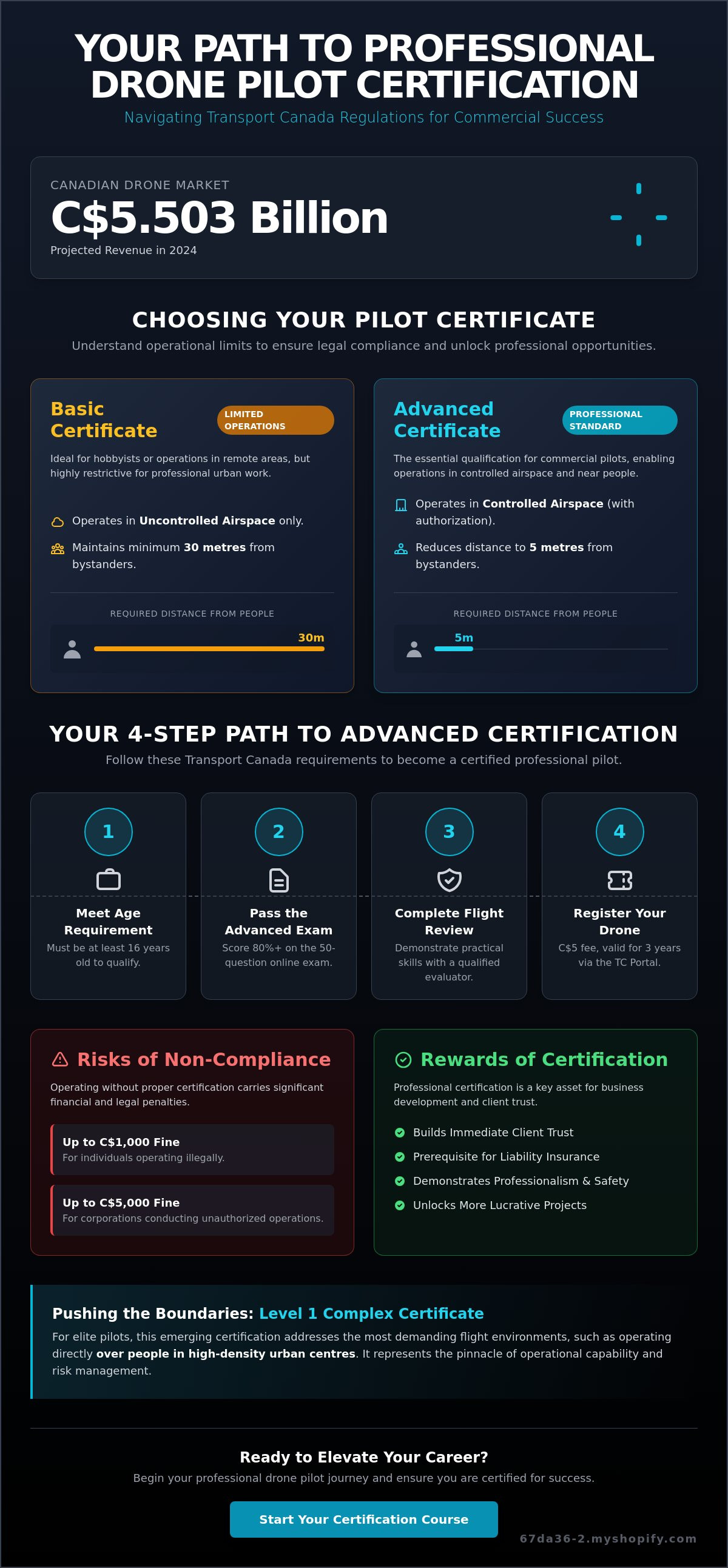
Operating a Remotely Piloted Aircraft System (RPAS) in Canada requires more than technical skill; it necessitates a formal legal standing. Every pilot operating a drone between 250g and 25kg must hold a Pilot Certificate - Small Remotely Piloted Aircraft (RPAS). This requirement is managed through the Transport Canada Drone Management Portal. It is here that pilots must register their aircraft for a C$5 fee, which remains valid for three years, and complete their mandatory online examinations. While the registration process is straightforward, choosing the right certification level defines your operational boundaries and commercial potential. When selecting a drone certification course Calgary professionals should prioritize training that covers both the technical exam and the practical requirements of the flight review.
Basic vs. Advanced Operations: Which Do You Need?
Transport Canada categorizes operations based on three primary safety pillars: distance from bystanders, the type of airspace, and whether the flight occurs over people. A Basic certificate limits you to uncontrolled airspace and requires you to maintain a horizontal distance of at least 30 metres from bystanders. These restrictions often make professional work in urban areas or near busy infrastructure nearly impossible. For those seeking a drone certification course Calgary offers, the goal is typically the Advanced certificate. This qualification allows for operations in controlled airspace and reduces the required distance from bystanders to as little as 5 metres. Professional aerial media and industrial inspections almost exclusively require Advanced certification to remain legally viable.
Regulatory Compliance and Safety Standards
Transport Canada serves as the primary authority for maintaining safety within the national airspace. Their oversight ensures that all pilots understand the complexities of Canadian Drone Regulations and the risks associated with flight operations. Operating without the correct certificate is not just a safety risk; it carries significant legal consequences. Fines for individuals can reach C$1,000, while corporations may face penalties up to C$5,000 for unauthorized operations. Beyond avoiding fines, certification is a critical tool for business development. Professional-grade certification builds immediate trust with clients who require proof of competency before allowing flights on their property. It is also a prerequisite for obtaining comprehensive liability insurance. By adhering to these standards, you demonstrate a commitment to the discipline and safety of the Canadian aviation industry.
Deciding Between Advanced and Level 1 Complex Certificates
Selecting the appropriate certification level is a strategic business decision that dictates the scope of your professional capabilities. While the Basic certificate serves recreational users, the professional sector focuses on the Advanced and Level 1 Complex designations. Choosing a drone certification course Calgary professionals rely on involves understanding where your business will operate and the level of risk your missions entail. The Advanced certificate is the current industry benchmark, but the Level 1 Complex certificate is emerging as the necessary standard for high-density urban operations.
The Advanced Certificate: The Industry Standard
The Advanced certificate serves as the backbone of the Canadian commercial drone industry. It provides the legal authority required to operate within controlled airspace and maintain a horizontal distance of five metres from bystanders. This level of certification is essential for projects in real estate, industrial inspections, and standard aerial photography where uncontrolled environments are rare. To qualify, pilots must be at least 16 years old and achieve a passing grade of 80% or higher on the Small Advanced Exam. According to the official requirements for a Transport Canada Drone Pilot Certificate, this exam consists of 50 multiple choice questions. Following the exam, a successful flight review with a qualified evaluator is mandatory to validate practical flight skills.
Level 1 Complex: Pushing Operational Boundaries
Level 1 Complex certification addresses the most demanding flight environments, specifically those requiring flight over people with zero metres of horizontal distance. This designation is becoming the primary requirement for public safety sectors and large scale construction firms operating in congested city centres. The training for this level is significantly more rigorous than standard Advanced prep. It typically requires 20 hours of specialized ground school to master the intricacies of risk mitigation and advanced hardware reliability. Transitioning from Advanced to Complex is a logical progression for pilots who intend to scale their operations into high-risk urban sectors. For those ready to validate their skills, booking Advanced & Level 1 Complex Flight Reviews is the final step toward achieving these professional capabilities.
Determining your path requires an honest assessment of your three year business plan. If your work remains limited to open construction sites or suburban real estate, the Advanced certificate provides ample flexibility. However, if your roadmap includes municipal infrastructure inspections or emergency response, the Level 1 Complex certificate ensures you are not grounded by regulatory limitations. Both paths require a commitment to ongoing education, as Transport Canada requires a recurrent training activity every 24 months to maintain your certificate's validity. This structured approach to certification ensures that Canadian airspace remains safe while allowing the commercial sector to expand into new technological frontiers.
Evaluating Online and In-Person Training Options for Canadian Pilots
Selecting the right instructional format is a pivotal step in your professional development. While some academic institutions offer lengthy 15-week programs, most professionals require a more efficient path to certification. A high-quality drone certification course Calgary providers offer should balance rigorous technical theory with practical application. The goal isn't just to pass a test; it's to develop the decision-making skills required for complex flight operations. This involves a commitment to understanding the aircraft as a tool within a broader aviation system.
A professional curriculum must go beyond basic flight controls. It should dive deep into meteorology, the theory of flight, and human factors. Understanding how weather systems affect aircraft performance or how pilot fatigue impacts safety is essential for commercial viability. When evaluating providers, ensure they have a background in traditional aviation. This expertise is often reflected in their involvement with industry bodies like the Aerial Evolution Association of Canada, which advocates for safety and professional standards across the sector. Choosing a mentor with real-world experience ensures you learn the practical realities of the field, not just the text in a manual.
The Benefits of Online Ground School
Online ground school offers the flexibility required for those balancing training with a full-time career. These programs allow you to progress through the Transport Canada Knowledge Requirements at your own pace. You can revisit complex topics like air law or navigation multiple times until the concepts are fully realized. This method is typically more cost-effective than institutional programs, as it eliminates travel time and allows for a modular approach to learning. It's an ideal solution for pilots who are self-disciplined and prefer a structured, digital environment for their theoretical studies.
When to Choose In-Person Instruction
In-person training remains the gold standard for mastering practical flight skills and complex regulatory nuances. This environment provides direct access to veteran instructors who can clarify difficult concepts in real-time. For pilots new to RPAS technology, hands-on guidance ensures that safe habits are established from day one. Additionally, in-person sessions provide valuable networking opportunities with other industry professionals. These connections often lead to future partnerships or job opportunities in the growing Canadian market. Learning in a group environment also exposes you to different perspectives and operational challenges you might not encounter alone.
Most successful candidates find that a hybrid approach yields the best results. By completing the theoretical ground school online and then attending in-person sessions for practical training, you maximize both efficiency and competency. This strategy ensures you are fully prepared for the Small Advanced Exam while building the professional-grade flight skills that clients and insurers demand. It creates a balanced foundation that supports long-term career growth in the aviation industry.
For those who see drone operations as a stepping stone toward a broader career in the cockpit, 2FLY Airborne provides the necessary training pathways to transition into the global airline industry.
Preparing for Success: Flight Reviews and Operational Safety
The Advanced flight review is the final practical hurdle before you can legally operate in controlled Canadian airspace. While a drone certification course Calgary candidates attend provides the theoretical foundation, the flight review is a live validation of your competency. It is not merely a test of your ability to move the control sticks; it is an assessment of your decision-making, risk management, and adherence to aviation discipline. To succeed, you must approach the review with the mindset of a professional pilot who prioritizes safety over every other operational goal.
Advanced Flight Review Checklist
Success during the review starts long before the aircraft leaves the ground. You must demonstrate proficiency in several key areas to satisfy a qualified evaluator. The process begins with a comprehensive site survey. This document must identify all potential hazards, including power lines, nearby structures, and relevant airspace boundaries. During the flight, you will be expected to handle emergency procedures with calm precision. This includes demonstrating lost-link protocols and responding to simulated fly-away scenarios. Many candidates fail because they overlook the importance of clear communication or fail to maintain a proper visual line of sight. By treating the review as a professional mission, you ensure all regulatory boxes are checked before the first propeller turns.
Professional Gear: Harnesses and Pilot Ergonomics
Maintaining flight precision during long, complex missions requires more than just skill; it requires the right physical support. Many professional pilots overlook the impact of fatigue on safety. When you are conducting a three-hour industrial inspection or a high-stakes photography session, the weight of a smart controller can lead to neck strain and reduced hand stability. This is why specialized equipment like Fitek Gear Drone Harnesses for Smart Controllers has become an industry standard. These harnesses redistribute the weight of the controller across your shoulders and back, allowing for smoother, more precise stick movements. Ergonomic gear is not a luxury; it is a safety tool that allows you to maintain focus on the aircraft and the surrounding environment for the duration of the flight. If you are ready to professionalize your setup, you can explore our range of Fitek Gear Drone Harnesses for Smart Controllers today.
A disciplined operational rhythm is built on consistent documentation. You must maintain detailed logbooks for both your pilot hours and the maintenance history of your aircraft. This habit of record-keeping ensures you stay compliant with Transport Canada's recency requirements and provides a clear audit trail for clients or insurance providers. Combining these administrative habits with the right physical gear and a thorough drone certification course Calgary preparation creates a foundation for a long, safe, and profitable aviation career.
Advancing Your Aviation Career with Caswell Aviation Ltd
Caswell Aviation Ltd functions as a holistic centre for drone professionals, moving beyond simple test preparation to provide a comprehensive aviation ecosystem. Transitioning from a hobbyist to a certified pilot requires a partner who understands the nuances of the Canadian regulatory environment. We provide the steady, professional guidance necessary to navigate the complexities of Transport Canada requirements. Our approach ensures that every student builds a foundation of technical authority and operational safety that lasts throughout their entire career.
When selecting a drone certification course Calgary pilots often look for a provider that understands the practical realities of the field. Caswell Aviation Ltd offers a seamless path from initial ground school to the final flight review. This continuity is essential for maintaining a high standard of discipline and ensuring that the habits learned during theory are correctly applied in the field. By choosing a partner with deep roots in both aviation and safety-critical training, you align yourself with a culture of precision and reliability.
The Caswell Aviation Ltd Advantage: Expertise You Can Trust
Our training is led by industry veterans who bring a "Master Practitioner" perspective to every session. Caswell Aviation Ltd doesn't just teach the curriculum; we share insights gained from years of high-stakes operations. This holistic approach integrates professional training, high-end aerial media services, and specialized pilot gear. We prioritize student success through clear, organized, and technical instruction that avoids unnecessary jargon. This ensures that whether you are learning about airspace coordination or aircraft maintenance, the information is practical and immediately applicable to your work. For students interested in expanding their horizons within the aviation industry, we recommend you check out Aero Global Aviation Academy for their structured career-oriented programs.
Next Steps: Starting Your Certification Journey
Beginning your professional journey is a modular process that starts with the right education. You can enrol in our Advanced or Level 1 Complex courses to gain the theoretical knowledge required for the Transport Canada exams. Once you've mastered the ground school material, the next step is booking your professional flight review. Caswell Aviation Ltd provides certified reviewers who offer a fair, thorough assessment that validates your skills and prepares you for real-world missions. This structured path removes the confusion often associated with the certification process.
Equipping yourself for success also involves selecting the right tools for the job. Beyond certification, we provide access to professional-grade Fitek Gear harnesses to ensure your operational kit is ergonomic and safe. This combination of knowledge and equipment is what separates a standard operator from a professional aviation practitioner. Taking the first step today ensures you're ready to capitalize on the growth of the Canadian drone market. Enrol in a Caswell Aviation Ltd drone certification course today to secure your place in the next generation of professional pilots.
Taking Command of Your Professional Aviation Path
Becoming a professional drone pilot in Canada requires a deep commitment to safety and a thorough understanding of federal regulations. You've now got a clear roadmap for differentiating between Advanced and Level 1 Complex operations. It's clear that the right training model and ergonomic gear prevent fatigue and ensure operational precision. Selecting a drone certification course Calgary pilots trust is the first step toward building a sustainable career in this expanding sector.
Caswell Aviation Ltd provides the technical authority and practical support you need to succeed. Our Transport Canada compliant training and expert-led flight reviews ensure you meet every regulatory standard with confidence. As a specialized Fitek Gear retailer, we also provide the ergonomic tools necessary for high-stakes missions. By prioritizing discipline and compliance today, you position yourself as a leader in the Canadian aviation community.
Begin your professional drone pilot training with Caswell Aviation Ltd and take the next step in your career. We're ready to help you master the skies.
Frequently Asked Questions
How much does a drone certification course cost in Canada?
Certification costs vary based on the depth of the program and the level of instruction provided. Industry rates for professional ground school typically range from C$195 to over C$1,500 depending on whether the curriculum covers basic exam preparation or comprehensive professional training. You must also account for the C$5 drone registration fee paid directly to Transport Canada.
What is the difference between a Basic and Advanced drone certificate?
The primary differences involve airspace access and proximity to bystanders. A Basic certificate restricts operations to uncontrolled airspace and requires a 30-metre horizontal distance from bystanders. An Advanced certificate allows for flight in controlled airspace and reduces the bystander distance to 5 metres. This makes the Advanced level the standard for a drone certification course Calgary pilots use for urban projects.
Do I need a flight review for a Basic drone certificate?
No, a flight review is not required for the Basic Operations certificate. You only need to pass the 35-question online exam with a score of 65% or higher. While this is a lower barrier to entry, most professional pilots choose to complete the Advanced requirements immediately to avoid the significant operational limitations of a Basic certificate.
How long does it take to get an Advanced drone certificate?
The timeline depends on your study pace and evaluator availability. Most pilots complete their ground school within two to three weeks of dedicated study. After passing the 50-question Advanced exam, you can book your flight review. The entire process is often completed in less than a month when following a structured, professional syllabus.
Can I fly my drone in a city with an Advanced certificate?
Yes, an Advanced certificate provides the legal framework to operate in urban environments. Most Canadian cities are located within controlled airspace, which requires an Advanced certificate and NAV CANADA coordination. You must also ensure your aircraft has the manufacturer safety assurance required for operations near or over people as defined by Transport Canada.
What happens if I fail my Transport Canada drone flight review?
If you do not meet the required standards, you must wait at least 24 hours before attempting the review again. Your evaluator will provide a debriefing that identifies the specific competencies where you failed to demonstrate proficiency. It's advisable to use this period for additional practice or targeted instruction before rescheduling your next attempt.
Is the Level 1 Complex certificate mandatory for commercial pilots?
The Level 1 Complex certificate is not mandatory for all commercial work, but it's required for specific high-risk operations. If your missions involve flying directly over people with no horizontal buffer, this specialized qualification is necessary. Many industrial and public safety agencies now require this level of certification to meet their internal risk management standards.
Why should I use a drone harness for my smart controller?
A harness functions as a critical safety tool by redistributing the weight of the smart controller across your shoulders and back. This prevents neck strain and hand fatigue during long inspections or complex media shoots. By stabilizing the controller, you maintain higher precision over the control sticks and can focus more effectively on the aircraft's flight path.
Leave a comment