

How to Become a Licensed Drone Pilot in Canada: A 2026 Professional Guide
What if the difference between a legal commercial flight and a $15,000 corporate fine is simply knowing which of the three certificate levels your mission actually requires? Learning how to become a licensed drone pilot Canada doesn't have to be a process defined by regulatory jargon or exam anxiety. Many professionals feel overwhelmed by the technical language within the Canadian Aviation Regulations, especially with the 2026 introduction of Level 1 Complex certifications. It's natural to feel uncertain about whether you need a Basic, Advanced, or Complex certificate for your specific goals.
We understand these challenges and provide the steady, technical guidance you need to move forward. This guide offers a professional roadmap to help you navigate Transport Canada requirements, pass your exams, and secure your pilot certificate. We will break down the mandatory registration steps, exam fees, and flight review processes. By the end of this article, you will have a clear checklist to help you organize your training and start your career in the Canadian drone industry with total confidence.
Key Takeaways
- Identify the critical 250-gram weight threshold that determines your legal obligations under Part IX of the Canadian Aviation Regulations.
- Compare the operational limits of Basic, Advanced, and Level 1 Complex certificates to select the certification level that aligns with your specific mission goals.
- Follow a professional roadmap on how to become a licensed drone pilot Canada by mastering the technical knowledge required for Transport Canada written exams.
- Understand the practical steps for completing a mandatory flight review with an authorized reviewer to secure Advanced or Complex flight privileges.
- Learn the essential recency requirements to keep your Pilot Certificate valid while exploring opportunities for specialized career growth in the drone industry.
Understanding Transport Canada Drone Licensing Requirements
The legal landscape for remotely piloted aircraft systems (RPAS) in Canada is governed by the Canadian Aviation Regulations, specifically Part IX. This framework ensures that all flight operations maintain a high standard of safety for both the public and other aircraft. Understanding these Transport Canada drone regulations is the first step for any aspiring pilot. The system is designed to be scalable; the rules become more stringent as the risk to people on the ground or in the air increases.
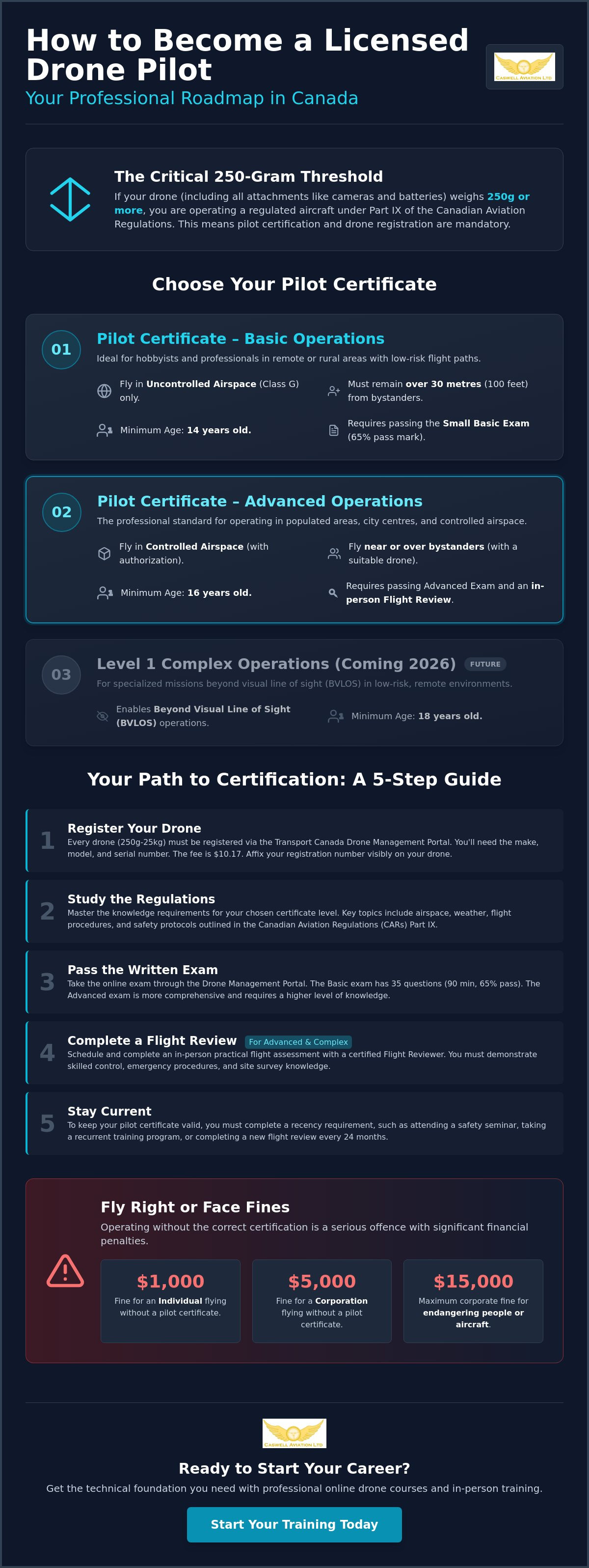
The 250-gram threshold is the most important metric in Canadian drone law. If your drone weighs 250 grams or more, it's considered a regulated aircraft. This weight includes everything attached to the drone, such as cameras, landing gear, or batteries. For drones in this category, you must follow specific rules regarding registration and pilot certification. Learning how to become a licensed drone pilot Canada requires you to choose a path based on where you intend to fly and the weight of your equipment.
Transport Canada categorizes operations into three distinct tiers. Basic operations occur in uncontrolled airspace and away from bystanders. Advanced operations allow for flight in controlled airspace or near people. The newest tier, Level 1 Complex, covers beyond visual line of sight (BVLOS) missions in low-risk environments. Operating without the correct certificate is a serious legal risk. Individuals can face fines up to $1,000 for flying without a certificate, while corporations may be fined up to $5,000 for the same offence. Endangering people or other aircraft can result in fines as high as $15,000 for corporations.
Basic Eligibility and Age Requirements
To hold a Pilot Certificate for Basic Operations, you must be at least 14 years old. For Advanced operations, the minimum age increases to 16, and the Level 1 Complex certificate requires you to be at least 18. You'll need to provide proof of identity through the Drone Management Portal. Accepted documents include a Canadian passport, birth certificate, or permanent resident card. If you're a non-resident or non-citizen, you generally cannot obtain a standard certificate and must apply for a Special Flight Operations Certificate (SFOC) instead.
Registering Your Drone with Transport Canada
Every drone weighing between 250g and 25kg must be registered before it takes flight. This process is handled through the Drone Management Portal. You'll need to provide the make, model, and serial number of your aircraft. The registration fee is $10.17 per drone. Once registered, you'll receive a unique registration number that must be clearly marked on your drone in a permanent, visible location. You must complete this registration before attempting a flight review, as reviewers are required to verify the aircraft's status. For those preparing for these requirements, Online Drone Courses and InPerson Training can provide the necessary technical foundation.
Choosing the Right Certificate: Basic vs. Advanced vs. Level 1 Complex
Selecting the correct certification is a strategic decision based on your specific operational environment. When researching how to become a licensed drone pilot Canada, you must evaluate where your missions will take place and who will be nearby. Transport Canada has structured these tiers to match the level of risk involved in the flight. Choosing a path that is too limited may restrict your business growth, while over-certifying for simple rural flights could lead to unnecessary training costs. The Advanced Operations category serves as the professional baseline for urban flight and missions within controlled airspace.
The Basic Certificate: For Hobbyists and Rural Pros
The Pilot Certificate for Basic Operations is designed for low-risk environments. You are restricted to flying in uncontrolled airspace (Class G) and must maintain a horizontal distance of at least 30 metres from any bystanders. This certificate is often used by hobbyists or professionals working in remote agricultural or forestry sectors. To obtain it, you must pass the Small Basic Exam, which consists of 35 multiple-choice questions. You have 90 minutes to achieve a passing grade of 65%. For many, the Basic certificate is a stepping stone; as soon as a project requires entering a city centre or flying near a construction crew, an upgrade becomes necessary.
The Advanced and Level 1 Complex Certificates
If your work requires flying within 30 metres of people or entering controlled airspace (Classes C, D, or E), the Advanced certificate is mandatory. Getting a drone pilot certificate at this level involves a 50-question exam with a higher passing threshold of 80%. For those looking toward the future of the industry, the Level 1 Complex certificate is the 2026 standard for high-risk operations. This includes Beyond Visual Line of Sight (BVLOS) missions in low-risk environments. To earn this, you must pass both the Advanced and the Complex written exams. Utilizing a Professional Drone Certification Course is the most efficient way to prepare for these technical requirements.
Assessing your business goals early allows you to choose the most cost-effective path. If you intend to offer commercial services like real estate photography or industrial inspections, starting with Advanced training is usually the most logical choice. We recommend reviewing our Online Drone Courses and InPerson Training to ensure you select the curriculum that matches your intended certificate tier. This proactive approach prevents the need for redundant testing and ensures you're fully compliant from your very first professional flight.
Preparing for and Passing the Transport Canada Exams
The written exams are the primary gatekeepers for anyone learning how to become a licensed drone pilot Canada. These assessments aren't just a formality; they ensure you possess the technical knowledge required to operate safely within the national airspace. The curriculum covers four core pillars: Air Law, Meteorology, Navigation, and Flight Theory. While a hobbyist might find the Small Basic exam manageable, the professional tiers require a much deeper level of discipline and technical understanding. It's essential to realize that the leap from Basic to Advanced is significant, both in the volume of information and the precision required to pass.
The difficulty gap between these tiers is defined by the passing standards. The Basic exam consists of 35 questions with a 65% passing grade. In contrast, the Advanced and Level 1 Complex exams feature 50 questions and demand a strict 80% passing grade. Relying solely on self-study often leads to failure at the Advanced level because the questions are designed to test application, not just memorization. Many candidates find that Online Drone Certification in Canada provides the structured environment needed to master these complex regulatory and technical topics before sitting for the actual test.
Study Strategies for the Advanced Written Exam
The foundation of your preparation should be the Transport Canada Knowledge Requirements (TP 15263). This document outlines every topic you might be tested on, but its density can be overwhelming for those without an aviation background. A beginner should plan to dedicate at least 20 to 30 hours of focused study to feel truly confident for the Advanced tier. We recommend using practice exams to identify specific weak spots, particularly in meteorology and airspace classifications. Focusing your efforts on these technical areas ensures you don't waste time on concepts you've already mastered. Consistently scoring above 90% on practice tests is a reliable indicator that you're ready for the official exam.
Taking the Online Exam: Logistics and Tips
You'll take your exam online through the Drone Management Portal. These are timed sessions, so maintaining a steady pace is vital. If you don't pass on your first attempt, Transport Canada requires a 24-hour wait period before you can try again. Each attempt at the Small Basic exam costs $10, while the Advanced exam is $10.17. The new Level 1 Complex exam carries a higher fee of $50.85 per attempt. To avoid technical disqualification, ensure you have a stable internet connection and a quiet, distraction-free environment. Before you begin, verify that you meet all current Transport Canada drone pilot certificate requirements to ensure a smooth administrative process.
Completing the Flight Review: The Final Practical Hurdle
Passing the written exam unlocks your eligibility for the practical assessment. This stage is where technical theory meets operational reality. For those pursuing Advanced or Level 1 Complex privileges, the flight review is the final mandatory step in learning how to become a licensed drone pilot Canada. You cannot skip this hurdle; it is a face-to-face evaluation with a Transport Canada-approved reviewer who will verify your ability to manage a safe flight environment. This process ensures that pilots possess the physical coordination and situational awareness required for high-stakes missions.
The process follows a modular sequence to ensure all safety standards are met:
- Step 1: Successfully complete your Advanced or Complex written exam to appear in the Transport Canada system as eligible.
- Step 2: Locate and book an appointment with a certified flight reviewer who is authorized for your specific certificate level.
- Step 3: Compile your operational documentation, including your drone registration certificate and a completed site survey for the review location.
- Step 4: Demonstrate your proficiency through a series of flight manoeuvres and emergency responses under the reviewer's supervision.
- Step 5: Once the reviewer submits a "pass" in the portal, pay the application fee to Transport Canada. This fee is $25 for Advanced certificates, while the Level 1 Complex certificate application fee is $125.00.
What to Expect During Your Flight Review
The review begins with a verbal briefing where you must demonstrate a deep understanding of the Canadian Aviation Regulations (CARs). You'll be asked to explain local airspace classifications and how they impact your mission. During the practical portion, you must execute precise manoeuvres such as station keeping, figure-eights, and landing within a designated area. The reviewer will also simulate emergency scenarios, such as a "lost link" event or a battery fire. You must respond with the correct technical procedures without hesitation to prove you can maintain safety under pressure.
Preparing Your Flight Logs and Site Surveys
Professional record-keeping is not optional; it's a graded component of your review. You must present a site survey that identifies nearby obstacles, radio interference, and emergency landing zones. Reviewers look for discipline in your logs, ensuring you've accounted for weather conditions and equipment health. For a deeper look at these requirements, read our guide on What is a Drone Flight Review in Canada. If you're ready to schedule your assessment, we offer expert Advanced & Level 1 Complex Flight Reviews to help you finalize your certification with confidence.
Beyond the Licence: Professional Growth and Ergonomics
Obtaining your certificate is a major milestone, but professional mastery involves more than just passing an initial assessment. Once you understand how to become a licensed drone pilot Canada, your focus must shift toward maintaining your legal standing and optimizing your field operations. Continuous learning and physical readiness are what separate a certified hobbyist from a seasoned industry professional. Caswell Aviation supports this transition by providing both the technical training and the specialized equipment needed for long-term success in the Canadian drone industry.
Maintaining Pilot Recency and Safety Standards
Transport Canada requires all pilots to prove their recency every 24 months. This ensures that your knowledge of the Canadian Aviation Regulations remains current as technology and laws evolve. You don't want your skills to stagnate while the industry moves forward. There are three primary ways to meet this requirement:
- Successfully completing a flight review with an authorized reviewer to refresh your practical skills.
- Attending a Transport Canada-sanctioned safety seminar or specialized training session.
- Completing a recurrent drone pilot training activities list provided by the government.
Keeping a detailed personal pilot logbook is essential for this process. It provides the necessary evidence of flight hours and training for insurance providers and potential safety audits. Staying informed through Transport Canada drone certification updates is a critical habit for any professional looking to expand into aerial photography, videography, or mapping.
Ergonomics for the Professional Pilot
Professional flight operations often involve 8-hour days in the field, where physical fatigue becomes a genuine safety hazard. Standard neck straps often fail during these long-duration missions because they distribute the weight of a smart controller unevenly across the neck and shoulders. This leads to chronic strain that can compromise your flight precision and situational awareness during critical mission phases.
Using a specialized drone harness for smart controller systems, such as those from Fitek Gear, allows for better weight distribution across the torso. This ergonomic adjustment reduces pilot fatigue and ensures you maintain steady control during complex manoeuvres. We offer Fitek Gear Drone Harnesses for Smart Controllers to help professionals maintain peak performance throughout their careers. By prioritizing your physical comfort and technical currency, you ensure that your journey of how to become a licensed drone pilot Canada results in a sustainable and safe career.
Advancing Your Professional Aviation Career
Navigating the path to certification is a modular process that requires attention to detail and a commitment to safety standards. By understanding the weight thresholds and selecting the appropriate certificate level, you've already simplified the process of how to become a licensed drone pilot Canada. Success in this industry depends on more than just passing a written exam; it requires a combination of technical precision, practical flight proficiency, and the right ergonomic support for long field operations.
We are committed to guiding you through every stage of this journey. Our team provides expert-led Advanced and Level 1 Complex training designed to meet the rigorous requirements of Transport Canada. With our Transport Canada Approved Flight Reviewers and specialized Fitek Gear for professional pilots, we ensure you're prepared for both the exam and the physical demands of commercial work. This structured approach helps you build a stable, compliant, and successful career in aviation.
Start your journey with Caswell Aviation’s Online Drone Courses to secure your professional future in the Canadian airspace. We look forward to helping you reach your operational goals with confidence and discipline.
Frequently Asked Questions
Do I need a licence to fly a drone under 250 grams in Canada?
You don't need a pilot certificate to operate a drone weighing less than 250 grams. These aircraft are classified as micro-drones and are exempt from registration and licensing requirements under Part IX of the Canadian Aviation Regulations. Despite this exemption, you must operate in a manner that doesn't endanger aviation safety or people on the ground. You should avoid flying near airports or in restricted airspace unless you've confirmed it's safe to do so.
How much does it cost to get a drone licence in Canada in 2026?
The total cost depends on your certification level. Mandatory government fees include a $10.17 drone registration fee and exam fees ranging from $10 for Basic to $50.85 for Level 1 Complex. Advanced and Complex certificates also require a flight review, which typically costs between $250 and $440 depending on the provider. Finally, you must pay a certificate application fee of $25 for Advanced or $125.00 for a Level 1 Complex Operations Certificate.
What is the difference between a Basic and Advanced drone certificate?
The primary difference lies in the operational environment and proximity to bystanders. A Basic certificate restricts you to uncontrolled airspace and requires a 30-metre horizontal distance from people. An Advanced certificate allows you to fly in controlled airspace and within 30 metres of bystanders, provided you use a drone with a manufacturer safety declaration. Advanced operations also permit flying over people if your equipment is specifically rated for that purpose.
Can I use my Canadian drone licence in the United States?
You cannot use a Canadian drone certificate to fly commercially in the United States. The Federal Aviation Administration (FAA) doesn't have a reciprocity agreement with Transport Canada for Part 107 certifications. To fly in the U.S., you must follow FAA regulations. This typically involves passing their specific written exam and obtaining a separate American Remote Pilot Certificate. Temporary permits for foreign operators are sometimes available for specific missions.
How long does it take to become a licensed drone pilot?
The timeline varies based on your chosen certification tier and study habits. Obtaining a Basic certificate can take as little as a few days for study and exam completion. However, learning how to become a licensed drone pilot Canada at the Advanced level usually takes several weeks. This allows for thorough exam preparation and the time needed to schedule and complete a mandatory flight review with an authorized reviewer.
What happens if I fly my drone without a licence in Canada?
Operating a regulated drone without a valid certificate results in significant financial penalties. Individuals can face fines up to $1,000 for flying without a certificate. Corporations face higher penalties; fines reach up to $5,000 for the same offence. Additional charges apply if you fly an unregistered drone or enter restricted airspace. Fines for endangering people or other aircraft can reach $3,000 for individuals and $15,000 for corporations.
Is the Transport Canada drone exam open-book?
The Transport Canada exams are technically open-book, but they are strictly timed sessions. You have 90 minutes for the Basic exam and 60 minutes for the Advanced and Complex exams. Because of these time constraints, you won't have enough time to look up every answer during the test. You must have a firm grasp of the material before starting to ensure you can complete all questions within the allotted period.
How do I renew my drone pilot certificate after two years?
You don't need to renew the certificate itself because it doesn't expire, but you must maintain recency. Every 24 months, you must complete a recurrent training activity to keep your certificate valid. This can include passing a flight review, attending a safety seminar, or completing a recurrent training course. Failure to meet these recency requirements means you are no longer legally allowed to exercise the privileges of your certificate.
Leave a comment