

Common Drone Pilot Errors in Canada: 5 Dangerous Myths Debunked
What if the very technology designed to make flying easier is actually the biggest threat to your pilot certificate? Modern drones are remarkably stable, yet this ease of use often creates a competence trap where pilots overlook their complex regulatory responsibilities. Understanding common drone pilot errors Canada is not just about safety; it's about protecting yourself from significant financial penalties. Many operators feel a justified sense of anxiety regarding Transport Canada fines, especially when trying to decipher the nuances of controlled airspace or the 250g weight threshold.
We recognize that the Canadian Aviation Regulations can feel overwhelming, whether you're a hobbyist or preparing for a career in the industry. This article will help you move past the confusion and build the professional confidence required for safe operations. You'll learn the most frequent mistakes that lead to enforcement action and discover how to navigate the legal landscape with precision. We're going to debunk five dangerous myths and provide a clear roadmap to help you prepare for a professional flight review.
Key Takeaways
- Understand that sub-250g aircraft remain subject to reckless and negligent clauses under CAR 901.02 to avoid potential fines.
- Learn why manufacturer geofencing is not a substitute for NAV CANADA authorization and how this ranks among common drone pilot errors Canada.
- Define the strict requirements of Visual Line of Sight to ensure you are not illegally relying on FPV goggles or controller screens.
- Master the 30-metre lateral distance rule for Basic Operations and clarify who legally qualifies as a person involved in your flight.
- Discover how professional flight reviews and certification identify hidden bad habits before they result in Transport Canada enforcement action.
Myth #1: Micro-drones Under 250g Are Exempt from All Canadian Regulations
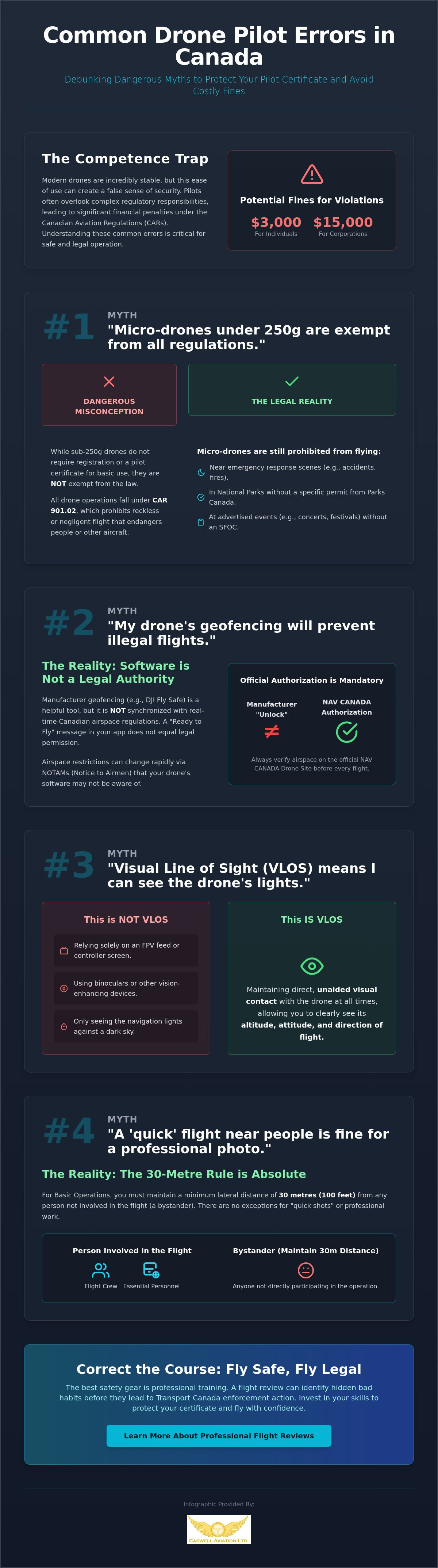
A micro-drone is defined by Transport Canada as any aircraft weighing less than 250 grams. This weight includes everything on board, such as the battery, propellers, and any aftermarket accessories like ND filters or strobe lights. Many operators believe that staying under this weight limit grants them total freedom from the Canadian drone regulations. This is a significant misunderstanding. While you don't need to register the drone or carry a pilot certificate for basic recreational use, you're still operating an aircraft within the national airspace system.
Falling into the "under 250g" trap is one of the most common drone pilot errors Canada sees today. The ease of purchasing a micro-drone leads many to ignore the fundamental safety requirements that protect the public. Even if your drone is small, your responsibility as a pilot remains absolute. You're expected to maintain control and awareness at all times to prevent interference with other aircraft or people on the ground.
The Legal Reality of CAR 901.02
The Canadian Aviation Regulations (CARs) include a specific provision, section 901.02, which prohibits any person from operating an RPAS in a reckless or negligent manner. Transport Canada interprets this as any action that endangers aviation safety or the safety of any person. If you fly a 249g drone into a crowd or near a low-flying helicopter, you can face an individual fine of up to $3,000. These penalties are often triggered by common drone pilot errors Canada enforcement officers identify during routine monitoring. For corporations, these fines can reach $15,000. Beyond government penalties, you face significant civil liability. If your drone causes property damage or personal injury, the lack of a registration requirement won't protect you in a courtroom.
Where Micro-drones Still Cannot Fly
Weight doesn't grant access to restricted areas. Micro-drones are strictly prohibited from flying near emergency response scenes, such as traffic accidents or active forest fires. This is classified as Class F restricted airspace, and entering it is a serious offence. Additionally, many people don't realize that National Parks and certain municipal bylaws create "no-fly zones" that apply regardless of weight. Consider these specific restrictions:
- Parks Canada prohibits take-off and landing in National Parks without a specific permit.
- Proximity to airports still requires extreme caution, as you must never interfere with manned aircraft.
- New rules effective April 1, 2025, require a Special Flight Operations Certificate (SFOC) for micro-drones at advertised events.
Safety logic must always override technical loopholes. Just because a micro-drone is legal to fly in 40 km/h winds doesn't mean it's safe to do so. High winds can easily carry a light aircraft into people or structures, leading directly back to the reckless operation charges mentioned above. A professional approach means knowing the limits of your gear and the law.
Myth #2: Your Drone’s Internal Geofencing Will Prevent Illegal Flights
A frequent misconception among new operators is that their drone's built-in software acts as a digital police officer. If the controller displays a "Ready to Fly" message, the pilot assumes they have the legal right to take off. This reliance on proprietary geofencing is one of the most common drone pilot errors Canada sees, particularly in urban areas. Manufacturer systems like DJI Fly Safe or Autel’s geofencing are designed to reduce liability for the manufacturer; they aren't synchronized with the actual Canadian Aviation Regulations.
Realizing that an "unlocked" zone in your app doesn't equal legal authorization is critical. You might successfully apply for a manufacturer unlock code to fly in a specific area, but this doesn't grant you permission from NAV CANADA or Transport Canada. Flying without official authorization, even if the drone allows it, can lead to fines ranging from $3,000 for individuals to $15,000 for corporations. The software is a secondary safety layer, not a legal authority.
Why Hardware Geofencing Fails
Software updates often lag behind the rapid changes in Canadian airspace. For instance, a temporary restriction might be issued via a NOTAM (Notice to Airmen) that your drone's internal map hasn't downloaded yet. Additionally, some manufacturers create "ghost" geofences in areas that are actually legal to fly, while failing to block off sensitive Class F restricted zones. Relying on a green light on your screen is a dangerous habit. The pilot is always the final authority for compliance, and "the app let me do it" is never a valid defence during a Transport Canada audit.
Steps for Proper Airspace Verification
To fly legally, you must use official Canadian tools rather than manufacturer software. Always consult Transport Canada's drone safety guidelines and the NAV Drone app for real-time airspace status. Before you power on your aircraft, verify the class of airspace you're entering. Class C, D, and E airspaces require specific authorizations that a drone's internal geofencing won't manage for you.
Checking for NOTAMs is another essential step in your pre-flight checklist. These notices provide information on temporary hazards or restrictions that aren't visible on static maps. If you're feeling overwhelmed by the complexity of airspace classes, investing in professional drone training can help you master these technical requirements with ease. Understanding the "why" behind these boundaries ensures you stay on the right side of the law while protecting your equipment and your professional reputation.
Myth #3: Visual Line of Sight (VLOS) Means "If I Can See the Lights"
Many pilots mistakenly believe that as long as they can see the blinking LEDs of their aircraft against a dark sky, they are maintaining Visual Line of Sight (VLOS). This is one of the most common drone pilot errors Canada regulators identify during field inspections. Transport Canada defines VLOS as the ability to see the aircraft with your own eyes, unaided by any technology other than corrective lenses, to manage its flight path and avoid obstacles or other aircraft. If you are relying on your screen or FPV goggles to know where the drone is, you have technically lost VLOS.
The "Return to Home" (RTH) function is another source of confusion. Some operators assume that because the drone can find its own way back, flying beyond the horizon is acceptable. This is incorrect. RTH is an emergency fail-safe, not a tool for extending operational range. Losing sight of the drone means you can no longer fulfill your primary duty: seeing and avoiding other traffic. If you intend to use FPV goggles, you must employ a Visual Observer who maintains constant VLOS with the aircraft and can communicate hazards to you immediately.
The Limits of Human Vision in Aviation
Human eyes have natural limitations that affect flight safety. Atmospheric conditions like haze, sun glare, or even the "blue-on-blue" effect of a clear sky can make a drone vanish from view at surprisingly short distances. Depth perception also degrades significantly as distance increases, making it difficult to judge how close your aircraft is to a power line or a tree. Transport Canada's rules require the "unaided eye" for primary flight, meaning you can't use binoculars to maintain your legal VLOS. Binoculars should only be used briefly to identify a potential hazard, not to pilot the craft.
Maintaining Situational Awareness
Professional pilots use a 360-degree scan technique, looking away from the controller to check the entire horizon for incoming manned aircraft. Target fixation occurs when a pilot stares at the screen for too long, losing track of the physical environment. Fatigue often accelerates this breakdown in awareness. To mitigate this, many professionals use a drone harness for smart controller to keep the screen positioned at an optimal angle. This ergonomic setup allows for quick eye-shifts between the aircraft and the telemetry data without straining the neck or losing focus. Understanding these requirements is vital for staying within Transport Canada's drone operation categories and ensuring every flight remains compliant.
Myth #4: Professional Photography Justifies "Quick" Breaches of the 30m Rule
The pressure to capture a perfect cinematic shot often leads to one of the most persistent common drone pilot errors Canada regulators encounter. In the pursuit of a unique angle, pilots frequently overlook the 30-metre lateral distance rule. For those operating under Basic certificate rules, you must maintain a minimum horizontal distance of 30 metres (100 feet) from any bystander. This rule is absolute. It doesn't matter if the flight only lasts ten seconds or if you're flying over your own property; if a bystander is within that 30-metre radius, you're in violation of the CARs.
A common mistake is believing that verbal consent from a neighbour or a passerby exempts you from this requirement. It doesn't. Transport Canada is very specific: "consent" is not the same as being "involved" in the operation. To fly closer than 30 metres, or directly over people, you must hold an Advanced Pilot Certificate and use a drone with the appropriate safety declaration. Public complaints regarding privacy and "trespass by drone" are the leading cause of inspections. Even if you aren't breaking a specific privacy law, the 30-metre rule gives enforcement officers a clear technical violation to cite.
Defining "Participants" vs. "Bystanders"
To legally classify someone as a participant, they must be briefed on the safety protocols and have a specific role in the flight operation, such as a visual observer. A client, a real estate agent, or a homeowner might be interested in the footage, but they're legally considered bystanders unless they're actively assisting with the safety of the flight. When operating near moving vehicles or occupied buildings, you should maintain a safety buffer that exceeds the minimums. This accounts for sudden gusts of wind or technical failures that could push the aircraft into a hazard before you can react.
Managing Public Interactions
Professionalism in the field reduces the likelihood of public complaints. Cordoning off your takeoff and landing zone with cones or professional signage creates a clear physical boundary. If a curious bystander approaches you during a flight, don't lose situational awareness. Briefly explain that you're conducting a flight and will speak with them once the aircraft is safely on the ground. Wearing a high-visibility vest and having your pilot certificate ready demonstrates a level of discipline that reassures the public. For those looking to move beyond these restrictions, our advanced drone training programs provide the path to legal operations within 30 metres of people.
Correcting the Course: Why Professional Training is the Best Safety Gear
Modern drone technology often automates the mechanics of flight, but it cannot replace the critical thinking required to prevent common drone pilot errors Canada regulators monitor. Professional training transforms an operator from someone who simply follows app prompts into a disciplined pilot who understands the underlying principles of aviation. Obtaining your Transport Canada drone certification is not merely a box-ticking exercise for legal compliance. It is a comprehensive process that forces you to internalize the "why" behind the rules, such as weather theory, human factors, and complex airspace management.
Moving from a hobbyist mindset to a professional standard requires a shift in how you perceive risk. While a software failure might be a nuisance in a park, it becomes a liability in a commercial environment. Structured education provides the framework to manage these risks effectively. A professional flight review is a vital part of this journey. It serves as an objective audit where an experienced reviewer can identify dangerous habits, such as poor battery management or inadequate site surveys, before they result in Transport Canada enforcement action.
Preparing for Success
Success in the field requires more than just passing a multiple-choice test. Utilizing a structured advanced drone flight review checklist ensures that every pre-flight procedure and emergency protocol is second nature. Mock exams and professional reviews are essential for building the confidence needed to operate in high-pressure environments. A veteran mentor provides insights into local Canadian airspace nuances that you cannot find in a software manual. This expert guidance helps you identify and correct bad habits before they manifest as costly fines or equipment loss.
The Caswell Aviation Advantage
Caswell Aviation provides a holistic training environment that bridges the gap between theory and practical application. We offer both online drone courses for foundational knowledge and hands-on in-person training for technical skill development. Getting a flight review from an experienced aviation professional allows you to receive objective feedback on your situational awareness and decision-making. This structured education is the most effective way to eliminate common drone pilot errors Canada pilots often make during complex missions. Learn more about our Advanced & Level 1 Complex Flight Reviews to ensure your operations meet the highest standards of safety and professionalism.
Master the Skies with Professional Compliance
We've explored how misconceptions regarding weight limits and hardware geofencing create significant legal risks for operators. True proficiency isn't just about technical flight skills; it's about understanding the regulatory framework that keeps our national airspace safe. By moving beyond common drone pilot errors Canada, you protect your equipment and your professional standing from unnecessary Transport Canada fines. Transitioning to a professional standard means prioritizing safety and compliance over convenience.
Caswell Aviation supports your commitment to excellence with industry-leading resources. As Transport Canada Authorized Flight Reviewers, we provide comprehensive online and in-person training options designed for real-world applications. We're also a specialized Fitek Gear retailer, offering the high-quality equipment professional pilots need for long days in the field. Our goal is to ensure you possess the knowledge and gear required for every mission.
Take the next step in your aviation career and Book Your Professional Flight Review with Caswell Aviation Today. We look forward to helping you fly with discipline, safety, and professional confidence.
Frequently Asked Questions
What is the most common fine for drone pilots in Canada?
Transport Canada issues fines based on the severity of the violation and whether the pilot is an individual or a corporation. For individuals, flying in restricted airspace or endangering people and aircraft can result in fines up to $3,000 per violation. Corporations face significantly higher penalties, reaching up to $15,000. Operating a micro-drone at an advertised event without a Special Flight Operations Certificate (SFOC) can now result in a $1,000 fine for individuals.
Can I fly my drone in a public park in Canada?
Permission depends entirely on the park's jurisdiction and local bylaws. Parks Canada prohibits the use of drones in all National Parks without a specific, pre-approved permit, which is rarely granted for recreational use. Many municipal and provincial parks also have specific bylaws that restrict or ban drone take-offs and landings. You must consult the local park authority and check for any "No Fly Zone" signs before you power on your aircraft.
Do I need a license to fly a drone for my own business?
You require a Pilot Certificate if your drone weighs 250 grams or more, regardless of whether the flight is for business or pleasure. Transport Canada does not distinguish between commercial and recreational flight rules based on intent; the regulations are based on the weight of the aircraft and the complexity of the environment. If you operate a drone between 250g and 25kg, you must pass the Small Basic or Small Advanced exam and register your aircraft.
How far away from an airport do I need to be in Canada?
Standard regulations require you to remain at least 5.6 kilometres (3 nautical miles) away from certified airports and 1.9 kilometres (1 nautical mile) from certified heliports. Flying within these boundaries without specific NAV CANADA authorization is a serious offence. Advanced pilots may fly closer only if they have the proper certification, a safety-declared drone, and explicit permission from the air traffic control provider for that specific zone.
What happens if I accidentally fly my drone into controlled airspace?
Entering controlled airspace without authorization is a critical safety breach that can lead to an immediate investigation by Transport Canada. If you realize you've crossed a boundary, you must exit the area immediately and land your aircraft safely. Failure to plan your flight path properly is one of the most common drone pilot errors Canada enforcement officers cite. Documentation of the incident and a proactive report to the authorities may be required to explain the deviation.
Is it legal to fly a drone at night in Canada?
Night flight is legal in Canada provided your drone is equipped with sufficient position lights to maintain Visual Line of Sight (VLOS) at all times. These lights must be bright enough for you to discern the aircraft's orientation and position relative to other hazards. You must still follow all other standard regulations, including staying away from bystanders and restricted airspace, unless you hold an Advanced certificate and meet specific safety requirements.
Do I need insurance for my drone even if it is just a hobby?
Transport Canada does not currently mandate liability insurance for recreational drone pilots, but it is highly recommended for all operators. Even a small drone can cause significant property damage or personal injury if a technical failure occurs. Many professional flight reviewers and training centres require proof of liability insurance before you can participate in a flight review or advanced training session. It provides essential protection against civil litigation.
How often do I need to renew my drone pilot certificate?
Your Pilot Certificate does not have an expiry date, but you must meet "recency" requirements every 24 months to keep your privileges active. You can maintain recency by completing a flight review, attending a recognized safety seminar, or finishing a Transport Canada recurrent training self-paced study program. You must carry proof of your recency, such as a dated certificate or a training record, whenever you are operating your drone.
Leave a comment