
Commercial Drone Pilot Requirements in Canada: The 2026 Professional Guide
Flying a drone for a living in Canada isn't just about owning a piece of high-tech hardware; it's about adopting the disciplined mindset of a professional aviator. Many aspiring pilots realize quickly that the gap between hobbyist flight and commercial operations is wider than expected. It's common to feel overwhelmed by technical jargon or anxious about the high stakes of a mandatory flight review. Understanding the commercial drone pilot requirements Canada enforces in 2026 is the first step toward building a stable, compliant career in this rapidly evolving industry.
We've designed this guide to clear the fog surrounding Transport Canada's latest framework, specifically the transition from Basic to Advanced certifications. You'll gain a methodical roadmap to help you master the regulatory landscape and technical prerequisites needed to launch your career with confidence. This professional guide provides the clarity you need to pass your Advanced exam and flight review on your first attempt, while also identifying the ergonomic gear essential for those performing long-duration commercial missions.
Key Takeaways
- Understand why the Advanced Pilot Certificate is the necessary standard for professional operations in controlled airspace or near bystanders.
- Master the technical syllabus for the Small Advanced Exam to meet the 80% pass mark requirement on your first attempt.
- Prepare for the three phases of a professional flight review to ensure full compliance with the commercial drone pilot requirements Canada mandates in 2026.
- Establish a rigorous maintenance and registration system to maintain operational compliance and pass potential Transport Canada audits.
- Discover how specialized training and ergonomic harnesses can improve flight performance and safety during long-duration commercial missions.
The Fundamentals of Commercial Drone Certification in Canada
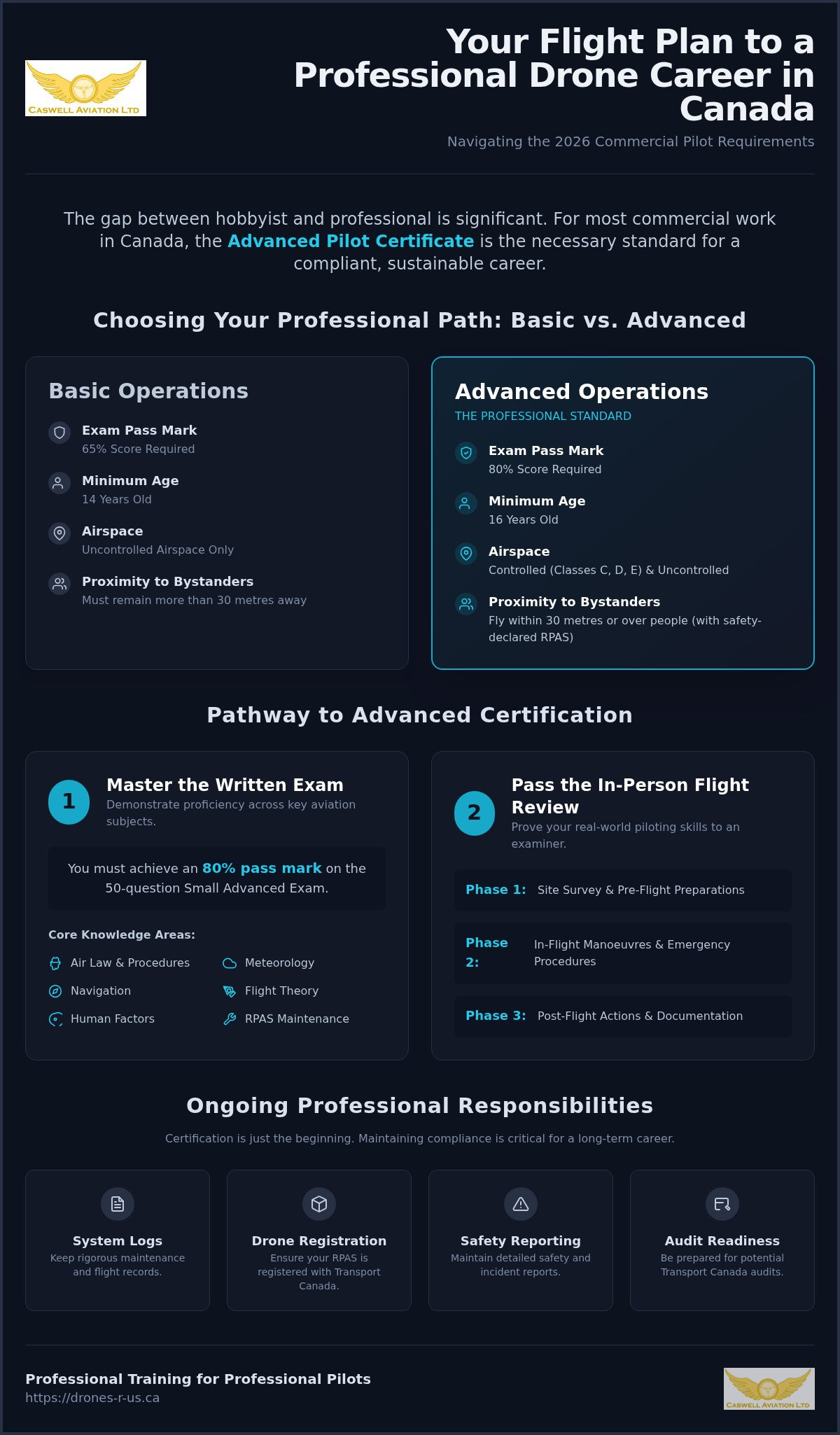
Transport Canada regulates all Remotely Piloted Aircraft Systems (RPAS) weighing between 250 grams and 25 kilograms. To fly commercially, you must hold a valid pilot certificate. While some startups begin with a Basic certificate, the commercial drone pilot requirements Canada mandates for most professional contracts usually demand an Advanced qualification. You must be at least 14 years old for Basic and 16 for Advanced. A Canadian Pilot Licensing Overview shows that drone certifications are now integrated into the broader aviation framework; this requires a high level of discipline and technical knowledge. Entering the industry without a clear understanding of these rules can lead to significant fines. For most, the Advanced certificate serves as the true baseline for a sustainable career.
Basic vs. Advanced: Choosing Your Professional Path
The distinction between Basic and Advanced operations isn't about the pilot's skill; it's about the mission's environment. Basic pilots must stay 30 metres away from bystanders and remain within uncontrolled airspace. Most urban or industrial job sites don't offer that luxury. Professional pilots frequently need to operate within controlled airspace, requiring coordination with NAV CANADA. If your work involves real estate, industrial inspections, or film sets where people are nearby, the Advanced certificate is your only legal path. This qualification allows you to fly within 30 metres of bystanders or even over them, provided you use a drone with a manufacturer's safety declaration for those specific distances.
The 2026 Role of Level 1 Complex Operations
As the industry matures, specific high-risk environments now require Level 1 Complex certification. This designation is for pilots who operate in environments that demand higher safety margins and more rigorous oversight. Many large-scale industrial contracts now stipulate this level of training to mitigate corporate risk. Moving from a standard Advanced certificate to Complex operations involves more than just passing another test. It requires a transition from 20 hours of formal ground school to actual operational reality on the flight line. At Caswell Aviation Ltd, we help pilots bridge this gap through Online Drone Courses and InPerson Training that focus on these sophisticated requirements. This training ensures you are prepared for the technical and legal complexities of modern Canadian flight operations.
Advanced Operations: The Professional Standard for 2026
Achieving the status of a professional pilot requires meeting the stringent commercial drone pilot requirements Canada has established for Advanced operations. Unlike the Basic exam, which requires a 65% score, the Small Advanced Exam demands an 80% pass mark across 50 multiple-choice questions. This higher threshold reflects the increased responsibility of flying in complex environments. Candidates must demonstrate proficiency in air law, meteorology, navigation, and flight theory. While some believe training is a brief process, true mastery of the Transport Canada Drone Pilot Certificate syllabus is essential for building a foundation of technical authority.
Mastering the Advanced Written Exam
The technical density of the Advanced exam often catches newcomers off guard. It covers critical areas such as human factors, which addresses the psychological and physiological limitations of the pilot. Maintenance requirements for Remotely Piloted Aircraft Systems (RPAS) are also a major focus; this ensures that every professional can identify potential hardware failures before they occur. Our The Complete Guide to Transport Canada Drone Certification provides a roadmap for navigating these subjects. Utilizing online courses allows for flexible study, enabling you to absorb complex meteorological charts and navigation protocols at your own pace.
Navigating Controlled Airspace and NAV CANADA
Advanced certification is the key to unlocking Classes C, D, and E controlled airspace. Professional missions in these zones require an RPA Flight Authorization from NAV CANADA. This process is not just a formality. It requires the pilot to submit detailed Standard Operating Procedures (SOPs) that prove they can operate safely alongside manned aircraft. Maintaining rigorous safety logs and incident reports is a mandatory part of commercial compliance. These records act as a professional audit trail, demonstrating your commitment to aviation safety standards. If you are ready to move beyond the basics, our Online Drone Courses and InPerson Training offer the structured mentorship needed to master these operational hurdles.
The Flight Review: Preparation and Performance
Passing the written exam is only half the battle. To satisfy the practical commercial drone pilot requirements Canada enforces, you must complete an in-person flight review with a Transport Canada approved reviewer. This isn't just a test of your thumb skills on the sticks; it's an assessment of your entire safety culture. Selecting a reviewer through a recognized training provider ensures that you're being evaluated by someone who understands the nuances of professional operations. The Drone Pilot Association of Canada often emphasizes that a pilot's professionalism is just as important as their technical ability during these sessions.
The review follows a structured, three-phase process. It begins with a ground briefing where you present your documentation, including drone registration, your pilot certificate, and a detailed site survey. Next is the flight demonstration, where you perform specific manoeuvres and simulate emergency responses. Finally, the debriefing provides an opportunity for the reviewer to offer feedback on your performance. Adopting a veteran-led approach means treating this review like a professional job site rather than a school test. Your goal is to demonstrate that you are a disciplined aviator who prioritizes risk mitigation over flashy flying.
How to Prepare for Your Advanced Flight Review
Preparation starts long before you arrive at the flight field. You must create a comprehensive site survey and an emergency plan tailored to the specific location of the review. These documents prove you've identified potential hazards like power lines, nearby schools, or local aerodromes. Systematic pre-flight checklists are your best tool for demonstrating safety to the reviewer. For a deeper look at the specific requirements, read our article on What is a Drone Flight Review in Canada? to ensure your paperwork is flawless.
Common Errors That Lead to Review Failure
Many candidates fail because of avoidable mistakes. A common error is the failure to identify local airspace boundaries or obstacles during the ground briefing. If you can't accurately describe the class of airspace you're in, the review will likely end there. Meeting the commercial drone pilot requirements Canada mandates involves more than just stick time; it requires a deep understanding of your equipment's operating limits. Poor communication during emergency procedure simulations is another frequent pitfall. Reviewers look for clear, concise verbalization of your actions. Finally, a lack of familiarity with your specific RPAS manufacturer's manual shows a lack of discipline. You're expected to know your aircraft's limitations, including battery temperature ranges and maximum wind resistance, without hesitation.
Operational Compliance Beyond the Pilot Certificate
Obtaining your certificate is a significant milestone, but maintaining it requires ongoing administrative discipline. The commercial drone pilot requirements Canada mandates extend into the lifecycle of your hardware and your personal flight record. Every Remotely Piloted Aircraft System (RPAS) weighing over 250 grams must be registered through the Drone Management Portal. Once registered, you must mark your aircraft with its unique registration number in a permanent, legible way. This is not just a label; it's the foundation of your professional accountability and the first thing an inspector will check during a field audit.
Professionalism also demands rigorous maintenance logs. Unlike recreational flyers, commercial operators must keep detailed records of every flight, battery cycle, and hardware modification. These logs prove your aircraft is airworthy and that you follow manufacturer-specified service intervals. While Transport Canada does not strictly mandate liability insurance for all standard operations, most commercial contracts require it. Professional liability coverage protects your business from the financial risks of property damage or personal injury during complex missions. Treating these requirements as a professional syllabus rather than a chore ensures your business remains stable and compliant.
Maintaining Your Professional Pilot Status
To keep your certificate valid, you must complete an authorized recency activity every 24 months. Failure to do so renders your certificate invalid for flight operations. Authorized activities include attending safety seminars, passing a new online exam, or completing a fresh flight review with a qualified expert. Our Drone Regulations in Canada: 2026 Reference Guide details exactly how to track these milestones. Keeping your skills sharp through advanced professional development ensures you remain a safe and competent aviator in a changing regulatory landscape.
Scaling to Level 1 Complex Operations
For those looking to secure top-tier industrial contracts, Level 1 Complex certification is the next logical step. This qualification allows you to operate in high-risk environments, such as near critical infrastructure or in restricted zones where standard Advanced certificates may not suffice. This transition requires specific ground school training that goes beyond the standard syllabus. By positioning your business as a Level 1 Complex operator, you demonstrate a higher tier of risk management and technical proficiency. If you are ready to scale your operations, our Online Drone Courses and InPerson Training provide the technical depth required to succeed in these challenging industrial environments.
Professional Training and Gear with Caswell Aviation Ltd
Our curriculum balances the theoretical depth of the Transport Canada syllabus with the practical realities of the flight line. Whether you are preparing for your first Advanced certificate or scaling your business toward Level 1 Complex operations, our resources provide a structured path to compliance. We focus on building a culture of thoroughness, ensuring that every pilot we train carries the discipline of traditional high-stakes industries into the modern RPAS sector.
We provide a comprehensive ecosystem for professional development that includes Online Drone Courses and InPerson Training. Our online modules offer the flexibility to master high-density technical subjects like meteorology and air law at your own pace. For those ready for the practical stage, our expert flight reviewers at Caswell Aviation Ltd conduct professional assessments that mirror real-world commercial scenarios. This preparation is essential for anyone looking to secure Drone Pilot Jobs in Canada, as top-tier employers prioritize candidates with rigorous, compliant training backgrounds.
Maximizing Efficiency with Fitek Gear Harnesses
Professional missions often involve long-duration shifts that can lead to significant pilot fatigue. In sectors like industrial mapping or aerial cinematography, maintaining precision over several hours is a commercial requirement. We address the physical demands of the job by offering specialized Fitek Gear drone harnesses. These ergonomic solutions are specifically engineered for smart controllers, distributing the weight of the hardware across the torso to prevent strain. Choosing the Best Drone Harness for Smart Controllers is a critical decision for any pilot performing extended commercial shifts. By optimizing your field gear, you improve both your personal comfort and the overall safety of the flight operation. Selecting the right harness ensures you can focus entirely on the mission at hand.
Building Your Future in Canadian Aviation
Success in the professional drone industry depends on your ability to move beyond basic flight and embrace the full scope of aviation standards. We've explored how the Advanced certificate serves as the essential baseline for controlled airspace and urban operations. Mastering the commercial drone pilot requirements Canada mandates in 2026 is a continuous process that involves registration, meticulous maintenance logs, and staying current with recency activities. These steps ensure your business remains compliant and ready for top-tier industrial contracts.
Caswell Aviation Ltd provides the stability and expertise you need to transition from a casual pilot to a professional operator. We offer veteran-led training, Transport Canada compliant flight reviews, and specialized Fitek Gear ergonomic harnesses designed to reduce fatigue on the flight line. If you're ready to secure your place in the industry, book your Transport Canada Advanced Flight Review or Online Course with Caswell Aviation Ltd. The landscape of Canadian aviation is expanding, and there's never been a better time to build your professional foundation with confidence.
Frequently Asked Questions
Do I need a drone license to make money with a drone in Canada?
Yes, any pilot operating a drone weighing between 250 grams and 25 kilograms for commercial purposes must hold a valid pilot certificate. While the term "license" is commonly used, Transport Canada officially issues Pilot Certificates for Remotely Piloted Aircraft Systems. Operating without one can result in fines of up to $1,000 for individuals or $5,000 for corporations. Holding a certificate ensures you meet the commercial drone pilot requirements Canada mandates for legal professional work.
What is the difference between Basic and Advanced drone certificates?
The primary difference lies in where you can fly and your proximity to bystanders. Basic certificates are for operations in uncontrolled airspace, at least 30 metres away from people. Advanced certificates allow you to fly in controlled airspace with NAV CANADA authorization and closer than 30 metres to bystanders. Most professional contracts require the Advanced certificate because commercial job sites are often in urban areas or near airports where Basic rules are too restrictive.
How much does it cost to get a commercial drone certificate in Canada in 2026?
The total cost includes government fees and training expenses. Transport Canada charges $10 per exam attempt and $5 for drone registration. An Advanced certificate also requires a flight review, which typically costs between $150 and $300 through a private reviewer. While these are the baseline regulatory costs, most professionals also invest in ground school courses. This investment ensures they pass the technically dense Advanced exam on their first attempt without paying for multiple retakes.
Is a flight review mandatory for all commercial drone pilots?
A flight review is only mandatory if you are seeking an Advanced Pilot Certificate. Pilots operating strictly under Basic rules only need to pass the online exam. However, because most commercial work involves controlled airspace or proximity to people, the flight review effectively becomes a requirement for a professional career. This in-person assessment verifies your ability to perform safe manoeuvres and handle emergency procedures according to national aviation standards before you begin professional missions.
Can I fly my drone in controlled airspace with an Advanced certificate?
Yes, an Advanced Pilot Certificate permits flight in controlled airspace, but you must first receive an RPA Flight Authorization from NAV CANADA. Holding the certificate proves you have the technical knowledge to coordinate with air traffic control. You must also follow specific Standard Operating Procedures and maintain a safety log. This access is critical for commercial pilots performing inspections or filming in developed areas where airspace is restricted and safety margins are thin.
What are the recency requirements for Canadian drone pilots?
To keep your certificate valid, you must complete a recency activity every 24 months. You can satisfy this requirement by passing a Transport Canada online exam, attending a safety seminar, or completing a new flight review. It's your responsibility to maintain a record of these activities in your pilot log. Failure to meet these timelines renders your certificate invalid. This makes you ineligible for commercial operations until you complete a recognized activity to prove your skills are current.
Do I need a separate certificate for Level 1 Complex operations?
Yes, Level 1 Complex operations require a specific certification beyond the standard Advanced Pilot Certificate. This level is designed for pilots working in high-risk environments or specialized industrial sectors. Obtaining this status involves completing a specific ground school syllabus and an additional flight review. At Caswell Aviation, we offer the specialized training and reviews necessary to help experienced pilots transition into these top-tier commercial contracts. This ensures you are prepared for the most challenging mission profiles.
How do I register my drone for commercial use with Transport Canada?
You register your drone through the Transport Canada Drone Management Portal by paying a $5 fee. You will need to provide the drone's make, model, serial number, and weight. Once the process is complete, you receive a unique registration number that must be clearly marked on your aircraft. This registration is mandatory for all drones between 250 grams and 25 kilograms. It serves as the foundation for your professional accountability and is required for all commercial work.
Leave a comment