

The Professional Guide to Corporate Drone Video in Alberta
In Alberta's industrial and corporate sectors, a drone is not merely a flying camera; it is a registered aircraft operating within a highly regulated aviation environment. While the visual impact of a corporate drone video in Alberta is undeniable, the liability of an uncertified flight can cost your organization thousands in Transport Canada fines. You likely realize that aerial imagery is the most efficient way to monitor site progress or showcase large-scale infrastructure, yet the fear of regulatory non-compliance often stalls these projects.
We agree that the distinction between a hobbyist with a gadget and a professional pilot is often blurred, creating unnecessary risk for your operations. This guide provides the technical clarity you need to leverage professional aerial assets to scale your Alberta-based business while ensuring total regulatory safety. We will examine the latest 2025 and 2026 Transport Canada fee structures, the importance of Level 1 Complex Operations certificates, and the practical steps to integrate high-quality drone data into your professional workflows.
Key Takeaways
- Understand the transition from high-cost manned aviation to efficient Remotely Piloted Aircraft Systems (RPAS) for industrial documentation.
- Identify the specific Transport Canada Pilot Certificates and operational categories required for legal flight on complex corporate sites.
- Learn how to leverage corporate drone video Alberta to monitor infrastructure projects and verify subcontractor progress with precision.
- Master the process of vetting service providers by auditing their Safety Management Systems and Advanced Flight Review status.
- Discover how professional training and specialized flight gear can help your organization safely internalize drone operations.
The Strategic Value of Corporate Drone Video in Alberta
Corporate drone video in Alberta has evolved from a niche marketing novelty into an essential operational tool. For decades, large-scale project documentation in our province required expensive manned helicopters or fixed-wing aircraft. Today, Remotely Piloted Aircraft Systems (RPAS) provide a more agile, cost-effective alternative that delivers higher data density. While resolution is a common selling point, the true value for a Master Practitioner lies in precision. It is the ability to repeat a flight path with centimetre-level accuracy to track volume changes or structural shifts over time. Alberta's vast geography, from the oil sands to the southern prairie wind farms, demands this level of aerial oversight to manage logistics and verify progress.
Enhancing Stakeholder Communication
Effective communication is the backbone of any major infrastructure project. Aerial progress updates allow remote investors to see real-time developments without leaving the boardroom. This visual transparency builds trust and provides a clear record of subcontractor milestones. Beyond the data, cinematic video plays a critical role in corporate storytelling. High-quality visuals help position a brand as an industry leader, and firms like Digital Content Studios demonstrate how professional post-production can showcase complex operations in a way that ground-level photography cannot achieve. Creating a consistent visual archive ensures that land development and long-term infrastructure projects are documented from inception to completion.
Safety and Risk Mitigation
The most significant benefit of implementing drone technology is the immediate reduction of workplace hazards. Drones effectively replace the need for high-risk manual inspections on communication towers, industrial roofs, and live facility equipment. By deploying a camera instead of a person, companies significantly reduce the "boots on the ground" requirement in dangerous environments. International standards and global drone regulations provide a framework for these operations, ensuring that the transition from traditional aviation to digital systems remains safe and predictable. Organizations that prioritize safety often choose to internalize these capabilities through professional training at Caswell Aviation. RPAS is the modern standard for safe site surveyance in 2026.
Navigating Transport Canada Regulations for Corporate Flight
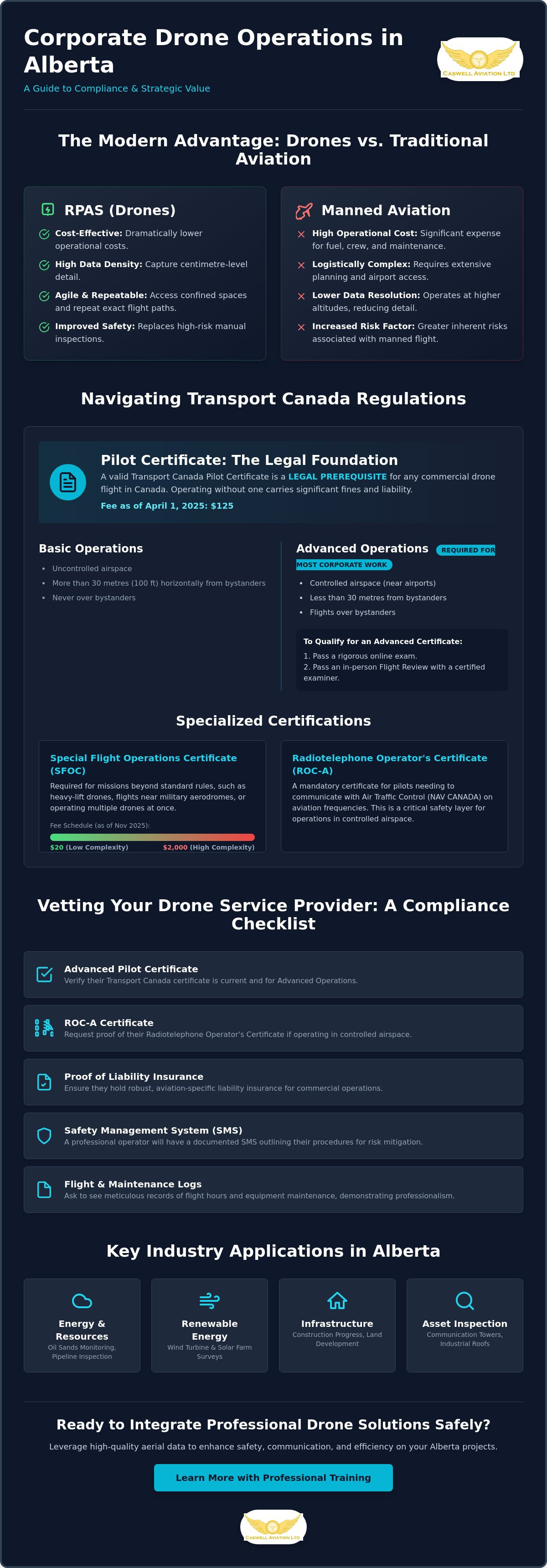
In Canada, the legal framework for Remotely Piloted Aircraft Systems (RPAS) is clear and strictly enforced. Any pilot conducting a corporate drone video in Alberta must hold a valid Pilot Certificate issued by the federal government. This is not a suggestion; it is a legal prerequisite for commercial flight. As of April 1, 2025, the fee for a Pilot Certificate is $125. Organizations must ensure their pilots or contractors are fully compliant with Transport Canada drone regulations to avoid significant liability. Beyond the certificate, professional operations require robust liability insurance and meticulous record-keeping of every flight hour and maintenance event.
Advanced Certificate vs. Basic Operations
Most corporate environments, such as urban construction sites or industrial facilities near airports, fall under Advanced Operations. This category allows flight in controlled airspace and closer to bystanders. Achieving this status requires passing a rigorous online exam and a practical in-person Flight Review. This process ensures the pilot understands the complexities of the Canadian aviation system. You can find more detail in our resource on Transport Canada drone certification. For missions exceeding standard limits, such as heavy-lift operations or complex missions, a Special Flight Operations Certificate (SFOC) is required. Under the fee schedule updated in November 2025, SFOC costs range from $20 for very low complexity to $2,000 for high-complexity missions.
The ROC-A Requirement for Professional Pilots
Professional pilots must often coordinate with NAV CANADA when operating in controlled airspace. This requires a Radiotelephone Operator's Certificate-Aeronautical (ROC-A). This certification allows pilots to communicate directly with Air Traffic Control and other aircraft on aviation frequencies. It is a critical safety layer when capturing a corporate drone video in Alberta near busy industrial corridors or municipal airports. Vetting your service provider should always include a request for their ROC-A credentials and proof of their Advanced Pilot Certificate. If your team is preparing for these requirements, we offer advanced flight reviews to help you meet professional standards.
Compliance is the foundation of every successful flight. A professional pilot does not just "fly a drone"; they manage an aviation operation. This includes conducting pre-flight site surveys, monitoring weather conditions, and maintaining communication with local authorities. By adhering to these standards, you protect your organization from fines and ensure the safety of everyone on the ground.
Industry Applications: From Energy to Infrastructure
Alberta's economic landscape is defined by large-scale projects that span thousands of hectares. In this environment, a corporate drone video in Alberta serves as more than a visual asset; it's a critical data source for decision-makers. While residential real estate often uses drones for simple aesthetics, the commercial and industrial sectors require a higher level of technical sophistication. From the oil sands in the north to the wind farms in the south, Remotely Piloted Aircraft Systems (RPAS) provide a scalable way to monitor assets that were previously difficult or dangerous to access. This transition to digital oversight is particularly evident as drones in the oil and gas industry become the standard for pipeline and facility integrity checks.
Large-scale agriculture and commercial land development also benefit from these aerial perspectives. For agricultural operations, drones assist in mapping drainage patterns and assessing crop health across vast acreages. In the commercial sector, developers use these tools for site selection and investor presentations. High-quality imagery is essential here, and professionals often utilize advanced aerial photography techniques for real estate to capture the full scope of a property's potential. These techniques ensure that every frame provides both marketing value and actionable information for land assessment.
Construction and Engineering Documentation
Multi-year construction projects rely on consistent documentation to track progress and verify subcontractor milestones. Drones allow project managers to create precise time-lapse videos that show the evolution of a build from ground-breaking to completion. High-resolution still imagery helps engineers identify structural anomalies or deviations from the plan before they become costly problems. By integrating this aerial data into Building Information Modeling (BIM) workflows, teams can compare real-world progress against digital twins with remarkable accuracy. This level of detail is why a professional corporate drone video in Alberta is now a standard requirement for major infrastructure builds.
Industrial Inspection and Asset Management
Industrial facilities utilize specialized drone payloads to manage assets more efficiently. Thermal imaging cameras can detect heat leaks in pipelines or electrical faults in substations that are invisible to the naked eye. In environmental sectors, drones play a vital role in monitoring land reclamation projects, providing a bird's-eye view of vegetation regrowth and soil stability. This comprehensive visual record is invaluable for regulatory reporting or litigation support. Using drones for these tasks minimizes downtime and ensures that facility managers have a clear, documented scope of their entire operation at all times.
How to Evaluate a Professional Drone Service Provider
Hiring a service provider for a corporate drone video in Alberta requires a structured vetting process that goes beyond reviewing a highlight reel. You are hiring an aviation partner, not just a photographer. The first step is to verify their Pilot Certificate. As established in previous sections, an Advanced certificate is mandatory for most corporate sites. You should also confirm they have successfully completed a Flight Review, which validates their practical competency in complex environments. A pilot who cannot produce these credentials is a liability to your project.
Professional operators maintain a Safety Management System (SMS) and detailed operational manuals. These documents outline how the pilot manages risk, handles emergencies, and maintains equipment. You must also confirm their liability insurance coverage. While a hobbyist might carry no insurance, a professional provider should offer a minimum of $1 million in coverage. Many corporate contracts in the energy or construction sectors require $5 million or more to mitigate potential site risks. When reviewing a portfolio, look for work that mirrors your specific industry needs. A collection of scenic landscapes does not demonstrate the ability to capture technical inspection data or manage a busy industrial site. Finally, enquire about their data security protocols. Corporate clients often deal with sensitive site information, so understanding how footage is stored and delivered is essential for maintaining project confidentiality.
The Importance of Professional Equipment
High-end post-production requires high-end source material. Professional-grade aircraft offer 4K resolution at 60 frames per second and 10-bit colour depth, providing the dynamic range needed for professional colour grading. Reliability is equally important. Professional drones feature redundancy systems for batteries, sensors, and flight controllers to prevent accidents on site. Precision flight also depends on the pilot's control interface. Many professionals utilize specialized gear, such as an ergonomic drone harness for smart controller, to maintain steady inputs during long duration missions. These tools allow for the smooth, cinematic movements required for high-quality corporate drone video in Alberta.
Post-Production and Final Delivery
The value of a corporate video is often realized in the editing suite. Raw aerial footage is merely a data point; a polished video uses motion graphics, professional branding, and a clear narrative structure to communicate a message. Establish clear expectations regarding revision cycles and delivery dates at the start of the project. A structured workflow ensures that the final product meets your technical and marketing requirements on schedule. If you are looking to elevate your internal capabilities or require professional execution, you can book our drone aerial photography and video services to see these professional standards in action.
Implementing Drone Solutions with Caswell Aviation
Caswell Aviation provides a comprehensive framework for organizations looking to integrate Remotely Piloted Aircraft Systems into their daily operations. Whether you require a one-time corporate drone video in Alberta or want to establish a full internal flight department, we offer the technical expertise to ensure your success. Our approach is rooted in the discipline of traditional aviation; we prioritize safety protocols and regulatory adherence above all else. This methodical focus allows our partners to scale their aerial capabilities without the risk of non-compliance or operational failure.
A significant part of our mission involves equipping pilots for the physical demands of industrial work. Long days in the field require gear that supports precision and reduces fatigue. We utilize and provide Fitek Gear drone harnesses for smart controllers to ensure that our pilots can maintain steady, cinematic control during extended missions. This attention to detail in ergonomics is often overlooked by hobbyist-level providers but is essential for maintaining the high standards required for a professional corporate drone video in Alberta. By focusing on the pilot's physical stability, we ensure more consistent data collection and safer site operations.
Corporate Training and Certification
Transitioning to in-house drone operations requires a structured training syllabus. We provide customized online and in-person courses designed to take your team from the initial registration phase to achieving an Advanced Pilot Certificate. Our programmes focus on the practical realities of flying in Alberta's challenging weather and industrial environments. We prepare your staff for successful Level 1 Complex Flight Reviews by simulating real-world scenarios and emphasizing the importance of a robust Safety Management System. Caswell Aviation serves as a veteran mentor in the Canadian drone industry, bridging the gap between complex aviation regulations and practical field application.
Professional Aerial Imagery Services
For companies that prefer to outsource their aerial needs, we deliver bespoke photography and video solutions tailored to your specific project. Every flight we conduct is a planned aviation mission, executed with the highest regard for legality and data quality. We understand the nuances of Alberta’s diverse industrial landscape, from the precision required for energy sector inspections to the cinematic flair needed for corporate branding. By partnering with us, you gain access to a team that values reliability and precision as much as you do. Contact Caswell Aviation to realize your project’s aerial potential today.
Securing the Future of Your Aerial Operations
Implementing professional drone technology is a strategic investment in safety and data precision. As Alberta's industrial sectors continue to evolve, the requirement for total regulatory compliance remains the baseline for all flight missions. You've learned that a high-quality corporate drone video in Alberta is the result of rigorous planning, Advanced Pilot Certification, and a commitment to professional-grade equipment.
Caswell Aviation stands as your partner in this transition, offering veteran aviation industry mentorship and specialized Fitek Gear to support your pilots in the field. Our expertise in Transport Canada Advanced and Level 1 Complex certification ensures that your operations remain legal and efficient, even as regulations shift. Don't leave your site safety to chance or uncertified operators. A disciplined approach to flight is the only way to protect your organization's liability while capturing the data you need.
Book a Professional Flight Review or Training Session with Caswell Aviation to standardize your internal flight protocols and elevate your project documentation. We are ready to help you navigate the complexities of modern aviation with confidence and realize the full potential of your aerial assets.
Frequently Asked Questions
Is it legal to use drone video for corporate purposes in Alberta?
Yes, it is entirely legal to use drones for corporate purposes provided the operation adheres to Transport Canada’s Part IX of the Canadian Aviation Regulations. The pilot must hold a valid Pilot Certificate and the aircraft must be registered. For a corporate drone video in Alberta, the pilot must also conduct a thorough site survey and follow all safety protocols to remain compliant with federal law.
Do I need a special permit to fly a drone over my company's industrial site?
You generally do not need a specific "permit" for every flight, but you must operate within the correct certificate category. If your site is in controlled airspace, the pilot needs an Advanced Certificate and must secure a flight authorization from NAV CANADA. For missions that fall outside standard rules, such as flying a heavy drone over 25 kg, a Special Flight Operations Certificate (SFOC) is required.
What is the difference between an Advanced and Basic drone certificate in Canada?
The primary difference lies in where you can fly and how close you can get to bystanders. A Basic Certificate is limited to uncontrolled airspace and requires staying at least 30 metres away from people. An Advanced Certificate is the professional standard for corporate drone video in Alberta because it allows for flight in controlled airspace and within 30 metres of bystanders, provided the drone meets specific safety declarations.
How much does a professional corporate drone video session typically cost in Alberta?
Service rates in the province vary based on the project's scale and technical requirements. Industry data from 2026 indicates that single-site construction monitoring flights often range between $250 and $350 per visit. Professional hourly rates for experienced pilots typically fall between $105 and $210, with additional costs for travel or specialized data processing. Complex industrial missions requiring high-resolution thermal sensors or specialized equipment will command higher premiums.
Can drones be used for indoor inspections of warehouses or plants?
Drones are highly effective for indoor inspections of large facilities, but they operate under different rules. Transport Canada’s airspace regulations do not apply to indoor flight since it's not considered "airspace." However, these missions require specialized "caged" drones and pilots with high technical proficiency to manage the lack of GPS and the presence of metallic interference. It is a safer, faster alternative to using scaffolding or ladders for structural checks.
What kind of insurance should a drone service provider carry for corporate work?
Professional providers must carry specialized aviation liability insurance rather than standard commercial general liability (CGL). Most CGL policies specifically exclude aviation activities. For corporate and industrial sites, a minimum of $1 million in coverage is standard, though many Alberta-based energy and construction firms now require $5 million in liability coverage to meet their internal risk management and subcontractor compliance standards.
How do I verify if a drone pilot is actually certified by Transport Canada?
You should request a copy of the pilot's "Pilot Certificate – Small Remotely Piloted Aircraft (VLOS)." This document contains a unique certificate number and specifies whether the pilot holds Basic or Advanced privileges. You can also ask for their ROC-A credentials if they are operating in controlled airspace. A professional operator will have these documents readily available as part of their standard project onboarding or safety briefing process.
What happens if a drone pilot operates illegally on my corporate property?
Illegal drone operations expose both the pilot and the hiring corporation to significant financial and legal risk. Transport Canada can issue fines of up to $15,000 for corporations and $3,000 for individuals per infraction. More importantly, if an accident occurs during an uncertified flight, your insurance provider will likely deny the claim due to the illegal nature of the activity, leaving your company fully liable for any damages or injuries.
Leave a comment