

ROC-A Drone Certification: Professional Guide for 2026
You're hovering at 350 feet when a manned aircraft enters the local circuit unexpectedly. You reach for your radio, but the fear of saying the wrong thing to Air Traffic Control or stumbling over your call sign causes a moment of hesitation. This anxiety is common among pilots who feel caught between the differing regulations of Transport Canada and ISED. If you're wondering how to get ROC-A drone certification without the stress, you've come to the right place.
It's understandable to feel uncertain about managing a radio while operating a complex drone controller. We've helped many operators bridge this gap by focusing on technical precision and practical safety. You don't have to face the regulatory overlap alone. This guide provides a methodical roadmap for Canadian drone pilots to obtain their Restricted Operator Certificate-Aeronautical (ROC-A) and master aeronautical radio communications.
We'll walk you through the RIC-21 study guide, show you how to organize your preparation, and provide tips to pass your oral exam on the first attempt. You'll realize the benefits of clear communication as you gain the confidence to talk to ATC and ensure your operations remain fully compliant with current aviation standards.
Key Takeaways
- Identify the regulatory role of Innovation, Science and Economic Development (ISED) Canada and why this lifetime certificate is essential for advanced drone operations.
- Follow a methodical roadmap on how to get ROC-A drone certification by mastering the RIC-21 study guide and scheduling an exam with an accredited examiner.
- Develop professional radio etiquette, including the discipline to listen before transmitting and the ability to use standardized aviation phraseology.
- Understand the practical steps for integrating radio communications into your pre-flight planning to maintain safety in both controlled and uncontrolled airspace.
- Realize how obtaining your ROC-A serves as a critical prerequisite for Advanced Flight Reviews and expands your eligibility for professional drone pilot jobs in Canada.
Understanding the Restricted Operator Certificate-Aeronautical (ROC-A)
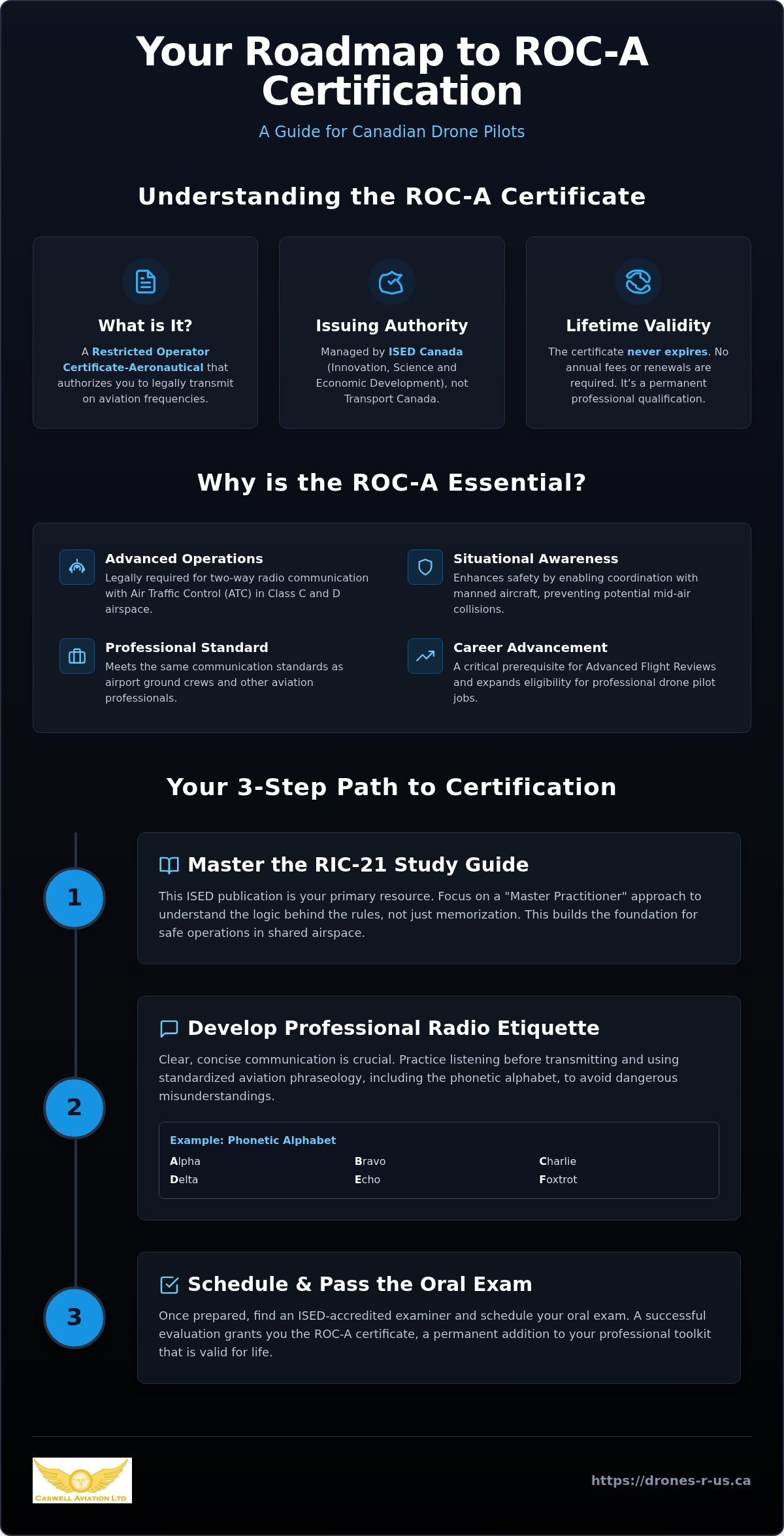
The ROC-A is a federal requirement for any individual operating a radio within the aeronautical frequency band. While your drone pilot certificate confirms your ability to fly, the ROC-A serves as a specialized radiotelephone operator license that authorizes you to transmit on aviation frequencies. This certificate is managed by Innovation, Science and Economic Development (ISED) Canada, rather than Transport Canada. Learning how to get ROC-A drone certification is a critical step for pilots moving from basic hobbyist flights into serious commercial operations.
Many new pilots confuse their flight credentials with their radio credentials. You must realize these are two distinct legal documents. Your pilot certificate allows you to be the pilot-in-command of a Remotely Piloted Aircraft System (RPAS). In contrast, the ROC-A permits you to use the tools necessary to coordinate with other users of the sky. If you plan to conduct Advanced operations or fly in proximity to airports, this radio qualification is mandatory.
Legal Requirements for Drone Operators
Operating in Class C or Class D airspace requires constant, two-way radio communication with Air Traffic Control (ATC). This requirement isn't optional. The ROC-A provides the legal standing to make these transmissions. By using a radio, you maintain situational awareness with manned aircraft that may be operating at low altitudes. This communication protocol is a cornerstone of the Transport Canada drone certification framework. It ensures that every pilot, whether in a cockpit or on the ground, speaks the same technical language to prevent mid-air collisions.
Who Else Uses an ROC-A?
Drone pilots are now part of a much larger aviation ecosystem. The same ROC-A qualification is held by airport ground crews, fuel truck operators, and snow removal teams at major Canadian airfields. Holding this certificate means you've met the same standards as these industry professionals. Once you successfully navigate how to get ROC-A drone certification and pass the exam, the certificate is valid for life. It doesn't expire, and you won't need to pay annual renewal fees. It remains a permanent fixture of your professional toolkit, reflecting your commitment to safety and regulatory standards.
Essential Knowledge: Mastering the RIC-21 Study Guide
The RIC-21 document is the primary resource for anyone learning how to get ROC-A drone certification. Published by ISED, this study guide outlines the standardized procedures required for all aeronautical radio operators. Taking a "Master Practitioner" approach to this material means prioritizing discipline over simple memorization. You must understand the logic behind the rules to remain calm during high-stakes flight operations. Clear and concise communication is the only way to avoid pilot errors that could lead to dangerous misunderstandings in shared airspace.
Our online drone courses help you apply these theoretical radio rules to real-world flight scenarios. By treating the RIC-21 as a professional syllabus rather than a hurdle, you build the foundation needed for Advanced RPAS operations.
The Phonetic Alphabet and Standard Phrases
Standardized language ensures that critical information is understood despite engine noise or poor signal quality. The phonetic alphabet is the most basic tool in your kit. Use the following table as a quick reference during your study sessions.
| Letter | Word | Letter | Word |
|---|---|---|---|
| A | Alpha | N | November |
| B | Bravo | O | Oscar |
| C | Charlie | P | Papa |
| D | Delta | Q | Quebec |
| E | Echo | R | Romeo |
| F | Foxtrot | S | Sierra |
| G | Golf | T | Tango |
| H | Hotel | U | Uniform |
| I | India | V | Victor |
| J | Juliett | W | Whiskey |
| K | Kilo | X | X-ray |
| L | Lima | Y | Yankee |
| M | Mike | Z | Zulu |
Beyond the alphabet, you must use specific procedural words. "Roger" means you have received the transmission. "Wilco" indicates you have received the message and will comply with the instructions. If you did not understand a transmission, "Say Again" is the professional way to request a repetition. The "Read Back" procedure is the act of repeating a clearance or instruction back to the controller to confirm your understanding, which is a vital safety check in aviation.
Emergency and Urgency Procedures
Recognizing the difference between a distress call and an urgency call is essential for maintaining order on the airwaves. A "MAYDAY" call signals immediate danger to life or the aircraft and requires immediate assistance. A "PAN PAN" call indicates a very urgent message concerning the safety of a person or vehicle but does not imply an immediate threat to the aircraft itself. In all cases, distress traffic has absolute priority over all other transmissions, followed by urgency and then safety messages. When you transmit an emergency call, follow the international structure: state the signal three times, identify your station, describe the nature of the distress, state your intentions, and give your current position.
The Certification Process: Steps to Getting Your ROC-A
The roadmap for how to get ROC-A drone certification is straightforward but requires technical discipline. You begin with a period of self-study focused on the RIC-21 guide. Many pilots supplement this reading with practice exams to build familiarity with the specific phrasing used by examiners. Once you feel confident in your knowledge of radio theory and emergency procedures, the next step is to locate an accredited examiner through the official ISED online database. These examiners are private individuals authorized by the federal government to administer the test and verify your competency.
After you successfully pass both the written and oral components, the examiner submits your results to ISED Canada. You will receive your permanent, lifetime certificate via mail within two to four weeks. This physical card is a legal document that you must have accessible whenever you are operating an aeronautical radio during a flight.
Finding an Accredited Examiner
Finding the right examiner is essential for a smooth experience. The ISED online database allows you to search for accredited professionals across the country. While any accredited examiner can issue the certificate, choosing one with drone-specific experience is highly beneficial. These examiners understand the unique challenges of operating a radio while managing a remote controller and navigating the ground station interface. At Caswell Aviation Ltd, we support pilots throughout the advanced drone certification process, ensuring you possess the radio skills required for complex flight reviews.
What to Expect During the Exam
The examination is usually a closed-book session that lasts between 20 and 45 minutes. It consists of 25 multiple-choice questions followed by a practical oral demonstration. You must achieve a passing mark of at least 70% to qualify for the certificate. During the oral portion, the examiner will present specific scenarios, such as entering a mandatory frequency zone or responding to a "PAN PAN" urgency call. You will need to demonstrate the correct call structure using the phonetic alphabet and standard phrases. Many examiners now offer these sessions via secure video link, provided you are physically located in Canada during the exam. This flexibility makes it easier than ever to complete your certification without significant travel. Preparation is the key to managing any exam-day anxiety, so practice your radio calls aloud until the rhythm feels natural.
Radio Etiquette and Procedures for Drone Operations
Mastering field discipline depends on more than just understanding the theory of how to get ROC-A drone certification; it requires the ability to execute radio procedures under pressure. Before you arrive at your flight location, you must establish a clear communication plan. This involves identifying the correct Mandatory Frequency (MF) or Aerodrome Traffic Frequency (ATF) for your specific area. Knowing who to talk to and which channel to monitor ensures you aren't scrambling for information while your aircraft is already in the air.
The most critical habit for a professional operator is to listen before transmitting. Airwaves are a shared resource used by various aviation stakeholders. By pausing to listen for at least five to ten seconds, you avoid interrupting other pilots who may be in the middle of a critical transmission. This professional courtesy maintains safety and prevents the confusion that occurs when two stations transmit simultaneously. If you're still refining your approach to how to get ROC-A drone certification, practicing this "listen-first" habit is the best way to build confidence in active environments.
Making Your First Call to ATC
Your initial transmission to Air Traffic Control or other aircraft should follow a strict structure: who you are, where you are, and what your intentions are. Brevity is essential because controllers manage multiple aircraft and appreciate pilots who provide necessary data without unnecessary chatter. A typical script for a drone operator might sound like this: "Local Tower, this is RPAS operator Alpha-One. I am located two miles north of the field at 300 feet. I will be conducting aerial surveying for the next twenty minutes. Standing by for instructions." This concise format ensures your message is clear, professional, and compliant with standard aviation protocols.
Ergonomics for the Multi-Tasking Pilot
Managing radio hardware while maintaining a visual line-of-sight with your drone is a significant physical challenge. Most pilots find themselves trying to balance a smart controller, a tablet, and a handheld radio simultaneously. This "three-hand" problem can lead to fatigue or a dropped controller during a flight. Utilizing a drone harness for smart controllers allows you to distribute the weight of your gear across your shoulders. This setup provides hands-free access to your radio, ensuring it is always within reach for emergency transmissions without compromising your grip on the flight sticks.
If you're seeking to professionalize your field setup, Caswell Aviation Ltd offers in-person training and ergonomic gear designed to help you manage complex operations with confidence. Proper ergonomics ensure that your focus remains on the drone and the surrounding airspace, rather than the equipment hanging from your neck. By organizing your gear and your communication plan simultaneously, you ensure a higher standard of safety for every mission.
Advancing Your Career with Professional Certifications
Completing the steps for how to get ROC-A drone certification represents more than just checking a box on a regulatory list. It marks your transition into the professional aviation community. To maximize your marketability, you should integrate this radio qualification with Advanced and Level 1 Complex certificates. This tiered approach to licensing demonstrates to potential employers that you possess the technical discipline required for high-stakes environments. Professional credentials are the primary filter for those seeking drone pilot jobs in Canada. Caswell Aviation Ltd serves as a long-term partner in this development, helping you build a safety culture that exceeds basic compliance.
Continuous education is what separates a technician from a master practitioner. While the certificate is valid for life, your radio skills must be sharpened through regular use and ongoing recency training. Maintaining this professional standard ensures you are always ready for the complexities of modern, industrial airspace. It reflects a level of reliability that clients in safety-critical sectors demand from their contractors.
Building a Professional Portfolio
A comprehensive portfolio combines technical radio skills with high-quality aerial data delivery. Clients in industrial, construction, and resource sectors prioritize operators who can prove they understand the broader aviation ecosystem. When you present an ROC-A alongside your pilot certificate, you signal that you can safely coordinate with other site traffic, such as helicopters or heavy machinery crews. This level of professionalism is essential for securing contracts on large-scale infrastructure projects where risk management is the top priority. Your ability to communicate clearly with site supervisors and other aviators becomes a unique selling point that sets your business apart from hobbyist operators.
Next Steps: Advanced Flight Reviews
Once you have mastered how to get ROC-A drone certification, the next objective is preparing for your advanced drone flight review. This practical assessment is the final hurdle for pilots moving into the Advanced category. Your radio proficiency will directly improve your performance during the review, as it allows you to manage airspace coordination while maintaining full control of your aircraft. A confident, professional radio call often sets a positive tone for the entire evaluation. If you are ready to validate your skills, you can book your training or formal reviews with Caswell Aviation Ltd to ensure you meet all federal standards for 2026 and beyond.
Mastering Your Professional Aviation Profile
Obtaining your radio qualification is a permanent investment in your safety and career. It bridges the gap between basic drone operation and sophisticated aeronautical communication. By following the steps on how to get ROC-A drone certification, you demonstrate a commitment to the standards that govern our shared Canadian airspace. Proficiency comes from consistent practice and utilizing the right tools. Adopting a disciplined protocol ensures you remain calm during interactions with Air Traffic Control.
Caswell Aviation is here to support your professional journey. We provide Transport Canada Advanced and Level 1 Complex certification training; our Professional Flight Reviews are conducted by accredited specialists. You can also enhance your operational focus with premium Fitek Gear harnesses for better ergonomics. Book Your Advanced Drone Training or Flight Review with Caswell Aviation to solidify your standing as a qualified pilot. Your transition into the broader aviation community is an exciting step toward long-term success.
Frequently Asked Questions
Is the ROC-A certificate mandatory for all drone pilots in Canada?
The ROC-A is not mandatory for basic hobbyist flights in uncontrolled airspace. However, it is a strict requirement for pilots conducting Advanced operations, including flights in controlled airspace or Beyond Visual Line of Sight (BVLOS). If you intend to operate at or near uncontrolled aerodromes, holding this certificate is highly recommended for safety. It ensures you can communicate with manned aircraft to prevent mid-air collisions in busy sectors.
How much does it cost to get an ROC-A radio certification?
The cost for obtaining your certification varies because fees are set by individual accredited examiners and private training providers. While ISED does not charge a federal fee for issuing the lifetime card, you will pay for the examiner's time to administer the test. When researching how to get ROC-A drone certification, expect to find different rates for self-paced study materials versus comprehensive virtual courses that include the final examination.
Does the ROC-A certificate expire, or is it valid for life?
The Restricted Operator Certificate-Aeronautical is valid for life and does not require revalidation or renewal fees. Once you have successfully passed your exam and received the card from ISED Canada, you are qualified indefinitely. You should keep this document in your flight kit at all times. If you lose your physical card, you must contact ISED directly to request a replacement to maintain your legal standing during operations.
Can I take the ROC-A exam online, or do I need to go to a testing centre?
You can take the ROC-A exam virtually from your own location, provided you are physically within Canada during the session. Many accredited examiners use secure video conferencing tools to conduct the oral and written components. This flexibility allows pilots in remote areas to complete their certification without travelling to a major urban centre. You will need a stable internet connection and a valid piece of government-issued photo identification for the verification process.
What happens if I fail the ROC-A exam on my first attempt?
If you don't achieve the 70% passing grade, you are permitted to retake the exam after further study. Most examiners suggest a waiting period to ensure you have mastered the RIC-21 material, particularly the emergency procedures and phonetic alphabet. You will likely need to pay a new examination fee for the second attempt. Taking practice exams beforehand is the best way to ensure you pass on your very first try.
Do I need a separate radio license for my drone equipment?
No, the ROC-A is an operator certificate that qualifies you as an individual to transmit on aeronautical frequencies. It is not a hardware licence for the drone or the radio itself. While your RPAS must be registered with Transport Canada, the radio you use just needs to be an approved model for aviation use. Your certificate remains with you regardless of which drone or handheld radio you choose to operate in the field.
How long does it take to study for and pass the ROC-A exam?
Most pilots find that a few days of focused study is sufficient to prepare for the test. The RIC-21 guide is approximately 30 pages long and covers technical theory, procedural words, and emergency protocols. The actual examination typically takes between 20 and 45 minutes to complete. If you are already familiar with aviation terminology, the learning curve is quite manageable; however, beginners should dedicate extra time to practicing the phonetic alphabet.
Where can I find the official RIC-21 study guide?
The official RIC-21 study guide is a public document available for download on the Government of Canada's ISED website. It is titled "Study Guide for the Restricted Operator Certificate With Aeronautical Qualification." The current version is Issue 3, which was published in February 2010. This guide contains all the technical information and procedural standards you will be tested on during your exam. It remains the primary resource for anyone learning how to get ROC-A drone certification.
Leave a comment