
Professional Drone Services for Oil and Gas in Alberta: The 2026 Guide
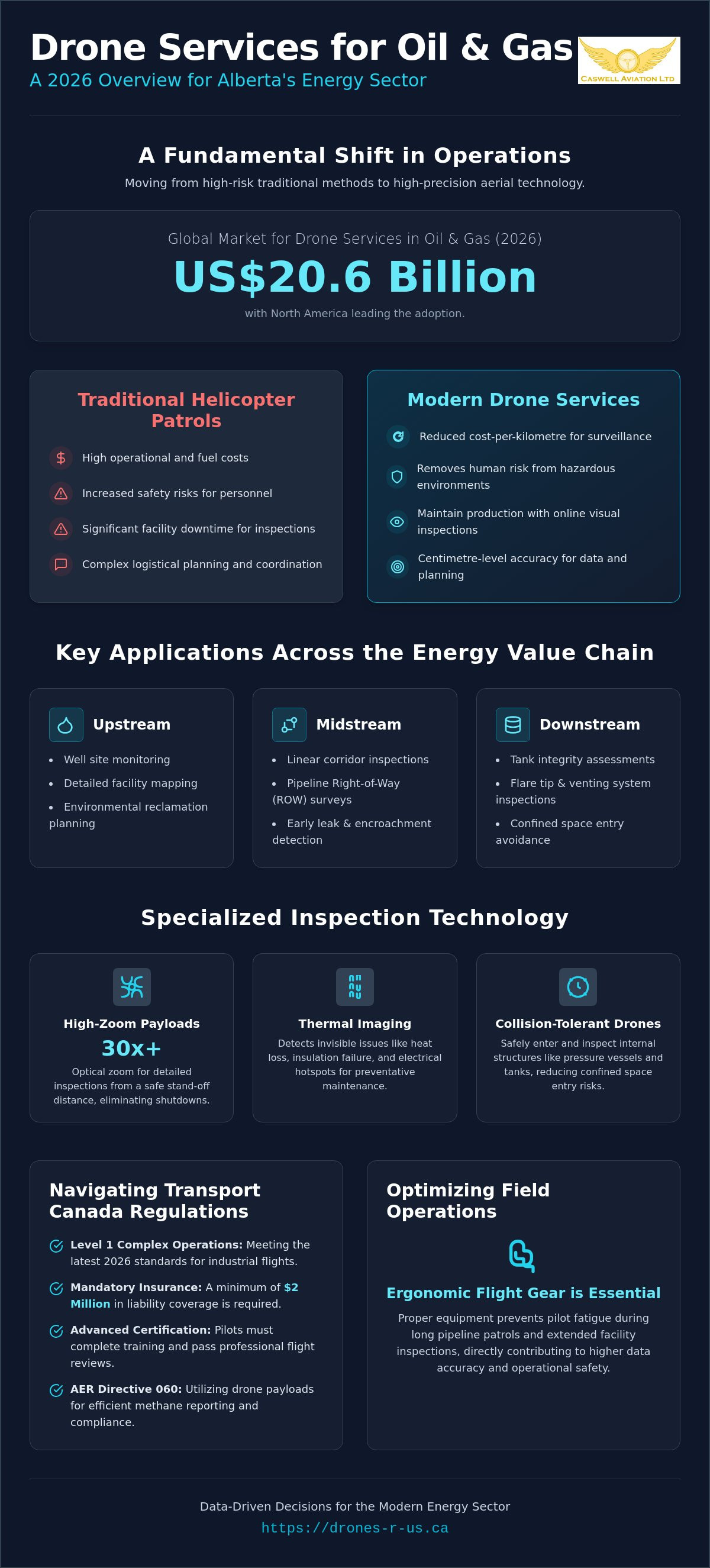
In 2026, the global market for drone services in the oil and gas sector is valued at US$20.6 billion, and North America is leading the charge. For producers in the province, utilizing drone services for oil and gas Alberta has moved from a novelty to a necessity for reducing the high costs and safety risks of traditional helicopter flyovers. You've likely felt the pressure of maintaining AER Directive 060 compliance while managing the logistical headache of facility downtime. It's a complex environment where regulatory clarity is often hard to find, especially with the recent implementation of new flight categories.
This guide explains how to integrate specialized aerial technology into your operations to optimize both safety and data quality. We'll clarify the latest Transport Canada requirements for Level 1 Complex operations, the necessity of $2 million in liability insurance, and why ergonomic gear is essential for preventing pilot fatigue during long pipeline patrols. By the end of this article, you'll understand how to bridge the gap between technical requirements and field-ready efficiency for your internal or outsourced teams.
Key Takeaways
- Learn how replacing traditional helicopter patrols with specialized drone services for oil and gas Alberta reduces facility downtime and operational costs.
- Understand the technical requirements for AER Directive 060 methane reporting and how specific drone payloads facilitate efficient emissions monitoring.
- Identify the certification pathways for Level 1 Complex operations to ensure your team meets the latest 2026 Transport Canada standards.
- Discover why ergonomic flight gear is critical for maintaining data accuracy and preventing pilot fatigue during long-duration facility inspections.
- Explore how to build a compliant internal drone program through professional flight reviews and Advanced certification training courses.
Maximizing ROI with Drone Services for Oil and Gas in Alberta
Alberta’s energy sector is undergoing a fundamental shift in how it manages infrastructure and compliance. Professional drone services for oil and gas Alberta provide more than just aerial views; they offer a systematic approach to asset integrity. Traditionally, pipeline patrols required expensive manned aircraft. Drones now perform these tasks with higher precision at a fraction of the operational footprint. Facility managers realize that aerial imagery can replace the need for complex scaffolding setups during flare stack inspections. This keeps operations running and keeps workers on the ground, effectively removing human risk from high-stakes environments.
Key Applications Across the Energy Value Chain
Upstream operations utilize remotely piloted aircraft for well site monitoring and detailed facility mapping. These digital maps assist in environmental reclamation and site planning. Midstream companies rely on linear corridor inspections and pipeline right-of-way (ROW) surveys to detect leaks or encroachment issues early. In downstream environments, refineries use specialized drones for tank integrity assessments. This prevents the need for personnel to enter confined spaces, significantly reducing the liability associated with hazardous inspections. By utilizing high-zoom payloads, teams can inspect flare tips and venting systems while the facility remains fully operational.
The Economic Impact of High-Resolution Aerial Data
The primary driver for adopting UAV technology is the bottom line. Traditional helicopter patrols involve high fuel costs and significant logistical planning. UAVs offer a streamlined alternative for pipeline surveillance that reduces the cost-per-kilometre. High-resolution orthomosaics allow plant managers to plan expansions with centimetre-level accuracy. Citing various drone applications in oil and gas, it's clear that capturing repeatable data sets is invaluable for long-term asset management. Frequent, documented flights also provide a robust audit trail. This documentation helps in negotiating lower insurance premiums by demonstrating a proactive approach to risk mitigation. By eliminating the need for shutdowns during visual inspections, companies see an immediate return on investment through maintained production levels.
Specialized Industrial Inspections: Pipelines, Flare Stacks, and Facilities
Industrial inspections in the energy sector demand a level of precision that standard consumer hardware cannot provide. Specialized drone services for oil and gas Alberta now include high-zoom payloads that allow for detailed flare stack inspections while the facility remains online. By utilizing optical zoom capabilities of 30x or greater, pilots capture high-resolution imagery of flare tips and ignition systems from a safe stand-off distance. This eliminates the need for expensive shutdowns and removes the requirement for workers to climb elevated structures. It's a pragmatic solution that maintains production while ensuring asset integrity.
Thermal imaging has become a standard tool for preventative maintenance at compressor stations and batteries. These sensors detect heat loss in steam lines, insulation failures in processing units, and electrical hotspots in substations before they lead to equipment failure. When you're managing complex assets, seeing the invisible thermal signature of a failing component provides the lead time necessary for planned repairs. Operating these advanced sensors requires a deep understanding of Transport Canada drone regulations, particularly when flying near sensitive infrastructure or in controlled airspace.
We've also seen a significant shift toward internal inspections using collision-tolerant drones. These aircraft, often protected by a protective cage, can enter pressure vessels and storage tanks to identify corrosion or weld failures. This approach drastically reduces the need for confined space entry permits and the associated safety risks for personnel. If your team isn't yet equipped for these technical flights, you can start by outsourcing professional drone imagery to establish a baseline for your asset management program.
Pipeline Integrity and Methane Detection
Methane detection is a primary focus under AER Directive 060. Modern drone platforms carry Tunable Laser Diode Absorption Spectroscopy (TDLAS) sensors to automate methane plume detection across vast pipeline networks. These systems identify leaks with high sensitivity, generating geo-tagged anomaly maps that allow maintenance crews to respond to specific coordinates. Beyond emissions, these patrols identify right-of-way issues such as soil erosion or unauthorized vegetation encroachment that could compromise pipeline safety.
Facility Mapping and Asset Management
High-accuracy mapping transforms how facility managers interact with their data. By capturing hundreds of overlapping images, we create centimetre-grade orthomosaics and 3D point clouds of entire sites. These digital twins allow for structural analysis of elevated assets and precise volume measurements of stockpiles or secondary containment areas. Integrating this data into your existing GIS or asset management workflow ensures that every stakeholder has access to the most current site conditions without leaving the office.
Effectively managing the large-scale data sets generated by these aerial surveys requires a robust digital framework. For organizations seeking to enhance their technical infrastructure, reisinformatica.com offers insights into managing complex informatics and digital workflows in industrial settings.
Navigating Transport Canada Regulations for Industrial RPAS
Operating within the regulatory framework is the first step toward effective risk management for any energy company. When selecting drone services for oil and gas Alberta, you must distinguish between Basic and Advanced operations. Most industrial sites are located in controlled airspace or near personnel, which necessitates an Advanced Pilot Certificate. Safety is non-negotiable. It defines your program. Beyond simple visual line-of-sight flights, the industry is now moving toward complex operations that allow for more efficient data collection over vast distances.
Managing liability involves more than just pilot skill. As of 2026, Transport Canada requires a minimum of $2 million in aviation liability insurance for drone operations. Additionally, any drone used for advanced or complex work must have a manufacturer's RPAS Safety Assurance declaration. This document confirms the aircraft is approved for specific operations, such as flying over people or in controlled environments. Pilots are also required to complete a recurrent training activity every 24 months to maintain their certificate validity. Following these protocols ensures that your internal or outsourced teams remain compliant and ready for the field.
The Path to Advanced & Level 1 Complex Certification
The Advanced Pilot Certificate is the baseline for industrial work, but Level 1 Complex certification is the new standard for pipeline patrols. This certification allows for lower-risk Beyond Visual Line of Sight (BVLOS) operations without a Special Flight Operations Certificate (SFOC). To qualify, pilots must be at least 18 years old and complete a minimum of 20 hours of ground school. They must also pass specific online exams and a dedicated flight review. For a detailed breakdown of these requirements, see The Complete Guide to Transport Canada Drone Certification. These expanded capabilities allow for longer patrols, which significantly reduces the cost-per-kilometre for pipeline inspections.
Professional Flight Reviews for Industry Teams
A flight review is a practical evaluation where a pilot demonstrates their ability to operate safely and follow emergency procedures. During an Advanced or Level 1 Complex flight review, expect to be tested on site surveys, fly-away protocols, and communication with air traffic control. Common errors often involve a lack of thoroughness in pre-flight checklists or failing to account for local weather variables. You can learn more about the evaluation criteria in our guide, What is a Drone Flight Review in Canada?. Ensuring your team passes these reviews with high standards is essential for maintaining a culture of discipline and safety.
Optimizing Field Operations: Ergonomics and Pilot Safety
The physical demands of industrial aviation are often overlooked during the procurement of drone services for oil and gas Alberta. An eight-hour shift performing pipeline patrols or facility inspections requires sustained concentration and physical endurance. Pilot fatigue is a legitimate safety risk that directly impacts data quality. When a pilot is physically uncomfortable, their situational awareness diminishes, and the precision of their flight paths can suffer. Maintaining a high standard of safety means providing your team with the tools necessary to stay focused during long-duration missions.
Precision during a flare stack inspection or a methane leak detection flight requires a steady hand. Standard neck straps are fundamentally insufficient for the weight of modern smart controllers, such as the DJI RC Plus. These heavy devices concentrate the entire load on the cervical spine, leading to neck strain and involuntary "controller shake." By redistributing this weight, pilots can maintain better control over the aircraft and the sensor payload. This stability is essential for capturing the clear, high-resolution imagery required for asset integrity reports.
Fitek Gear: The Professional Standard for Smart Controllers
We recommend using a modular harness system to manage the physical load of industrial equipment. The Fitek Gear harness is specifically designed to redistribute the weight of heavy controllers across the shoulders and lower back. This prevents the chronic fatigue associated with standard straps and allows for a more natural, upright posture during flight operations. A stable controller position also improves the pilot's ability to interact with the touchscreen and physical buttons without looking down. For a deeper look at equipment options, read our guide on Choosing the Best Drone Harness for Smart Controllers.
Best Practices for Extended Field Missions
Operational success in remote locations requires more than just a certified pilot. Setting up a mobile command centre at the site provides a controlled environment for monitoring telemetry and managing data. This is particularly important in the Alberta climate, where extreme temperatures can affect both hardware performance and battery life. You must establish a strict battery cycle management program to ensure you always have fresh cells ready for the next flight. Safety protocols should also include clear communication with site managers when flying in proximity to high-energy industrial assets. If you're looking to equip your team with professional-grade accessories, you can browse our selection of Fitek Gear Drone Harnesses for Smart Controllers to enhance field safety.
Partnering with Caswell Aviation for Energy Sector Solutions
Caswell Aviation Ltd acts as a steady partner for energy companies looking to operationalize UAV technology. We provide a comprehensive suite of drone services for oil and gas Alberta, moving beyond simple vendor relationships to serve as a technical mentor for your organization. Whether you're building an internal flight department or require specialized imagery for a facility audit, we provide the expertise necessary to maintain high safety standards. Our approach integrates regulatory knowledge with practical field experience. This ensures your operations remain both efficient and compliant in a highly regulated environment.
We provide a structured pathway for companies to develop internal drone capabilities. This begins with our online and in-person training courses, which prepare your staff for the rigours of industrial flight. By training your own personnel, you maintain greater control over your inspection schedules and data security. To maintain compliance, we conduct professional flight reviews that evaluate your team's readiness for real-world industrial missions. These reviews are essential for meeting Transport Canada requirements and ensuring your liability remains managed through proper certification.
For organizations that prefer to outsource their data collection, we deliver high-quality aerial imagery and video solutions tailored to industrial needs. This includes the high-zoom flare stack inspections and thermal mapping discussed in previous sections. Additionally, we are a primary retailer of Fitek Gear harnesses for smart controllers. These ergonomic systems are critical for the long flight hours required during pipeline patrols. They help your crews maintain the focus and precision necessary for safety-critical work.
Why Choose Caswell Aviation?
Our "Veteran Mentor" philosophy means we value discipline and precision. We understand the culture of safety-critical industries because we've transitioned from those high-stakes environments ourselves. Caswell Aviation serves as a one-stop resource where you can source professional training, book flight reviews, and purchase specialized gear. This holistic approach simplifies the process of navigating complex aviation frameworks. You get the reassurance of working with a local provider that holds national-level expertise in Alberta's energy regulations.
Getting Started with Your Drone Program
The first step in optimizing your drone program is a thorough assessment of your operational goals. We help you identify whether an internal team or a service-based model best fits your facility's needs. We'll look at your current pilot skill levels and the specific technical requirements of your assets. From there, we develop a custom training syllabus or a schedule for recurring imagery. Contact Caswell Aviation to elevate your drone operations and ensure your program meets the highest standards of professional aviation.
Elevating Your Operational Standards with Professional RPAS Integration
Integrating remotely piloted aircraft into your facility management strategy is no longer a futuristic concept; it's a requirement for staying competitive in 2026. By shifting from expensive helicopter patrols to precise drone services for oil and gas Alberta, you reduce operational costs and human risk simultaneously. Success depends on a foundation of regulatory compliance and pilot well-being. Ensuring your team has the correct Advanced or Level 1 Complex certification is just as important as equipping them with ergonomic tools to prevent fatigue during critical inspections.
Caswell Aviation provides the technical authority and practical training needed to build a resilient drone program. From conducting professional flight reviews to supplying specialized Fitek Gear harnesses, we act as a mentor for your internal or outsourced teams. Our Transport Canada compliant training ensures your pilots are prepared for the unique challenges of the energy sector. Contact Caswell Aviation for Professional Drone Services and Training to modernize your inspection workflows. We look forward to helping you achieve a safer, more efficient field operation.
Frequently Asked Questions
What are the specific Transport Canada requirements for oil and gas drone pilots?
As of 2026, pilots must hold an Advanced Pilot Certificate to operate near personnel or within controlled airspace. You are also required to maintain at least $2 million in aviation liability insurance and fly drones that have a manufacturer's Safety Assurance declaration. Recurrent training must be completed every 24 months to keep your certificate valid for field operations.
How do drone services help with AER Directive 060 methane reporting?
Utilizing drone services for oil and gas Alberta allows for automated methane plume detection using TDLAS sensors. These systems generate geo-tagged anomaly maps that align with AER Directive 060 reporting requirements. This approach identifies leaks with high sensitivity while significantly reducing the time spent on manual ground-based surveys.
Can drones perform flare stack inspections while the facility is still online?
Drones perform visual inspections using high-zoom payloads while the facility remains fully operational. By maintaining a safe stand-off distance, pilots capture high-resolution imagery of flare tips and ignition systems without a shutdown. This eliminates the need for costly production interruptions and removes the safety risks associated with manual climbing.
What is a Level 1 Complex drone certification and do I need it?
Level 1 Complex certification is a requirement for lower-risk Beyond Visual Line of Sight (BVLOS) operations. It requires at least 20 hours of ground school and passing specific online and practical exams. You need this certification if your drone program involves extended pipeline patrols that go beyond the pilot's direct line of sight.
Why is a specialized harness like Fitek Gear necessary for industrial pilots?
A specialized harness redistributes the weight of heavy smart controllers across the shoulders and back. Standard neck straps cause cervical strain and involuntary hand shaking during multi-hour missions. Using Fitek Gear ensures pilot comfort and maintains the steady control needed for the precise operation of industrial sensor payloads.
What kind of accuracy can I expect from drone-based facility mapping?
You can expect centimetre-grade accuracy when using high-resolution drone imagery and RTK-enabled aircraft. This data creates precise 3D point clouds and orthomosaics for structural analysis or volume measurements. These outputs integrate directly into your existing GIS and asset management workflows for highly accurate facility planning and expansion.
Does Caswell Aviation provide flight reviews for Advanced certificates?
Caswell Aviation provides professional flight reviews for both Advanced and Level 1 Complex certificates. These evaluations ensure your pilots meet Transport Canada's practical safety standards. We test for site survey proficiency, emergency procedures, and effective communication with air traffic control to ensure your team remains fully compliant.
How do I book a drone pilot training course for my corporate team?
You can book a drone pilot training course by contacting Caswell Aviation directly through our website. We offer both online and in-person training options tailored to the specific needs of corporate energy teams. Our syllabus focuses on industrial safety, regulatory compliance, and the technical operation of complex sensor payloads for the field.
Leave a comment