
Professional Drone Inspection Services: The 2026 Guide for Canadian Industry
Imagine standing at the base of a 150-foot flare stack, knowing that traditional scaffolding will take three days to build and cost your facility thousands in lost production. You likely realize that relying on manned inspections or outdated climbing methods isn't just expensive; it's a significant safety liability that's becoming harder to justify. Finding reliable drone inspection services Calgary shouldn't feel like a gamble with your site's safety or your compliance record.
You'll discover how professional aerial inspections enhance safety, slash downtime, and provide the precise imagery needed for critical decision-making. We'll guide you through the 2026 Transport Canada RPAS regulations, including the new Level 1 Complex certification requirements and Remote ID standards. This guide provides a clear roadmap for integrating advanced drone technology into your industrial workflow, ensuring your assets are protected by veteran expertise rather than amateur guesswork. We will examine the latest cost-saving strategies for industrial assets and the specific technical differences between raw footage and actionable engineering data.
Key Takeaways
- Learn how RPAS technology reduces industrial downtime and eliminates the significant safety risks associated with traditional scaffolding and high-altitude climbs.
- Understand the 2026 Transport Canada requirements for Level 1 Complex certification to ensure your projects remain fully compliant in controlled airspace.
- Identify the criteria for choosing professional drone inspection services Calgary to secure high-resolution, actionable data for asset integrity audits.
- Evaluate the strategic benefits of outsourcing to Caswell Aviation Ltd versus the long-term commitment of training and maintaining an internal drone department.
- Discover why ergonomic Fitek Gear harnesses are essential for maintaining pilot focus and data consistency during long-duration inspection missions.
Why Drone Inspection Services are Revolutionizing Industrial Maintenance
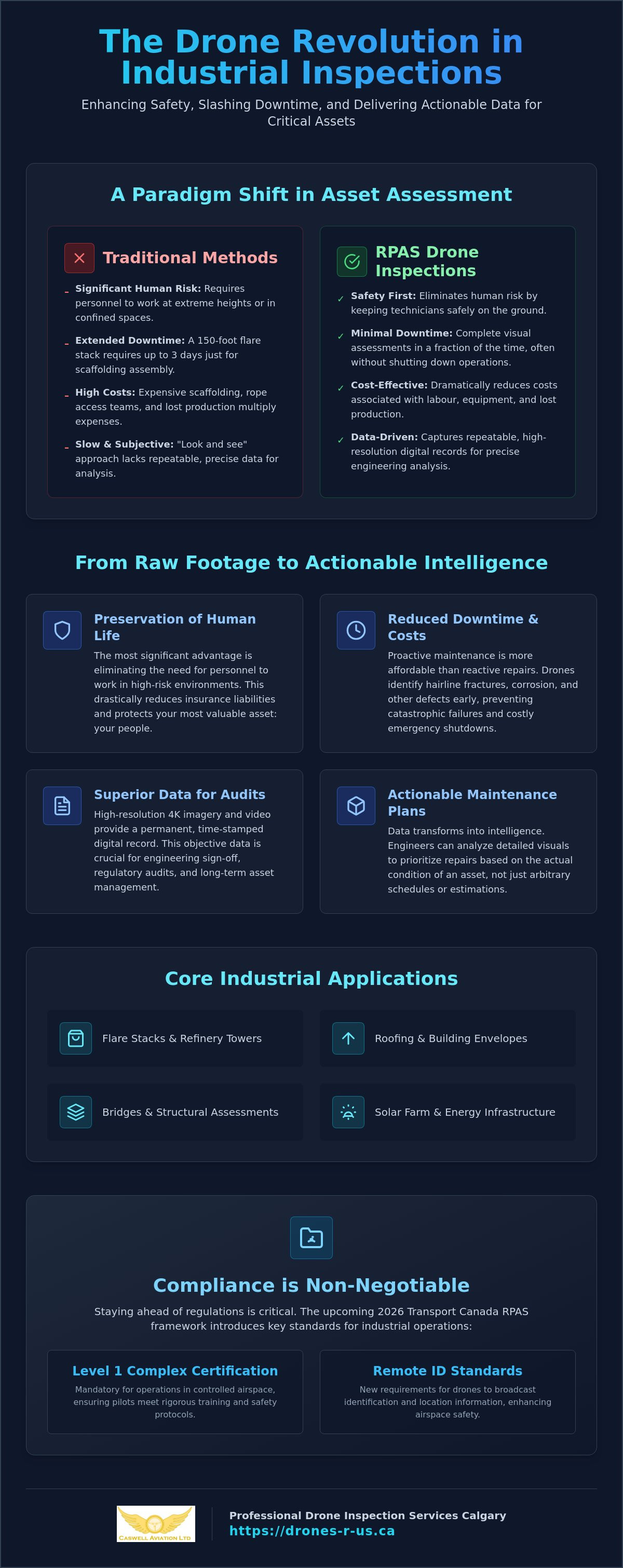
Professional drone inspections are defined as the methodical collection of high-resolution aerial data to assess the structural integrity of industrial assets. In the Calgary-Edmonton corridor, where energy and infrastructure dominate the economic landscape, drone inspection services Calgary have moved from a novelty to a core operational necessity. Unlike standard photography, these operations utilize Remotely Piloted Aircraft Systems (RPAS) to capture technical details that inform long-term maintenance schedules. This approach replaces the "look and see" method with a data-driven strategy for asset management.
For decades, inspecting a bridge, a refinery tower, or a flare stack required expensive scaffolding or specialized rope access teams. These traditional methods are inherently slow and introduce significant human risk. An unmanned aerial vehicle (UAV) can complete the same visual assessment in a fraction of the time without a single technician leaving the ground. This shift represents a fundamental change in how we manage large-scale infrastructure. It's no longer just about seeing the asset; it's about capturing a repeatable, digital record of its condition over time.
Industrial drone operations require a disciplined, safety-first culture. This discipline isn't about flying a hobbyist craft. It's about following rigorous aviation protocols rooted in years of traditional flight experience. Professional pilots utilize pre-flight risk assessments and standardized checklists to ensure every mission meets Transport Canada standards. This methodical approach reduces the likelihood of accidents and ensures the data collected is reliable enough for engineering sign-off. Proactive maintenance is always more affordable than reactive repairs. By identifying a hairline fracture or a corroded bolt early, companies avoid the massive costs associated with emergency shutdowns and unplanned downtime.
The Shift from Visual to Analytical Data
Modern inspections produce more than just pictures. They provide a permanent, time-stamped record for regulatory audits. 4K imagery and high-definition video allow engineers to zoom in on specific components to detect structural fatigue that the naked eye might miss from a distance. This intelligence transforms raw data into actionable maintenance plans. It allows teams to prioritize repairs based on the actual condition of the asset rather than estimated lifespans or arbitrary schedules.
Safety Benefits in High-Risk Environments
The most significant advantage of RPAS technology is the preservation of human life. Professional drone services eliminate the need for personnel to work at extreme heights or enter hazardous confined spaces. By keeping technicians on the ground, companies naturally reduce their insurance liabilities and workers' compensation risks. In emergency situations, drones provide real-time monitoring, giving site managers the visual oversight needed to make safe, rapid decisions without putting a crew in harm's way.
Ensuring the safety and comfort of your team is a priority that extends beyond the job site; for corporate leaders travelling to the UK for strategic planning, you can check out JAF Executive Travels to experience the same commitment to safety and professionalism in ground transportation.
Core Applications for Aerial Imagery and Video Inspections
The versatility of Remotely Piloted Aircraft Systems (RPAS) allows for precise data collection across diverse industrial sectors. In southern Alberta, drone inspection services Calgary provide essential support for asset managers who require high-fidelity visual evidence to maintain their infrastructure. Utilizing drone inspection services Calgary allows companies to move away from subjective ground-based observations toward objective, repeatable aerial data. These services go beyond basic snapshots. They involve high-resolution photography for roofing and building envelope assessments, where every joint, seal, and fastener is documented. This level of detail is critical for identifying water ingress or structural fatigue before they lead to costly failures.
Beyond urban structures, drones are increasingly used for large-scale infrastructure mapping. Solar farms use these platforms to monitor thousands of panels efficiently. By utilizing specialized optics, operators can identify micro-cracks or debris that reduce energy output. This systematic approach ensures that every component of a facility is accounted for, creating a comprehensive digital record of the physical asset. The ability to map vast areas in a single flight session provides a level of oversight that was previously impossible without significant manual labour.
Construction and Infrastructure Progress
Modern construction sites are dynamic environments that require constant oversight to stay on schedule. Project managers utilize aerial imagery to verify site plan compliance and monitor material stockpiles with high accuracy. This data provides a clear record of progress that can be compared against original blueprints. Additionally, creating professional video walkthroughs for stakeholder reporting has become a standard practice. These videos offer a perspective that ground-level photos cannot match, allowing investors to see the project's evolution in real time. If your project requires high-quality documentation, exploring professional Aerial Photography and Video Solutions is a logical next step to ensure site transparency.
Telecommunications and Energy Assets
Inspecting telecommunications and utility infrastructure presents unique technical challenges. Cell tower inspections often involve identifying hardware damage or checking antenna alignment without the need for a dangerous manual climb. Specialized zoom optics allow pilots to remain at a safe distance while capturing serial numbers and fastener conditions. Similarly, monitoring powerline corridors for vegetation encroachment and insulator health is a primary application. These missions require stable flight platforms capable of operating in high-interference environments near electrical lines. All such operations must strictly adhere to Transport Canada standards to maintain safety in controlled or complex airspace. This methodical approach ensures that critical energy assets remain operational while minimizing the risk to ground personnel and the public.
Building an Internal Team vs. Hiring Professional Services
Deciding whether to build an internal drone department or hire drone inspection services Calgary is a strategic choice that impacts long-term operational costs. For many organizations, the ability for drones to revolutionize building inspections is clear, but the path to implementation is less obvious. Hiring a professional service provider is often the most efficient route for one-off projects or complex structural assessments that require high-tier equipment. Specialized practitioners bring their own insurance, hardware, and regulatory compliance, allowing your team to focus on interpreting the data rather than managing the flight.
If your facility requires weekly roof checks or daily progress monitoring, an in-house team might be more sustainable. You must account for the hidden costs of internal operations beyond the initial drone purchase. These include specialized aviation liability insurance, which often requires a $2 million minimum in 2026, and the ongoing maintenance of a fleet. Recency requirements are also a critical factor; pilots must complete a recurrent training activity every 24 months to maintain their certification's validity under Transport Canada rules. Many companies now adopt a hybrid model, using internal staff for routine visual checks while outsourcing advanced data collection to drone inspection services Calgary when precision is paramount.
Training Your In-House Pilot Workforce
Developing an internal team begins with proper certification. For industrial sites and urban environments, a Transport Canada Advanced Pilot Certificate is mandatory. This ensures your staff understands airspace classifications and emergency procedures. Leveraging Online Drone Courses allows for flexible employee onboarding without the need for travel. As you scale your program, it's helpful to understand the broader market, which you can explore in our guide on Drone Pilot Jobs in Canada: A Professional Career Guide for 2026.
The Role of Professional Flight Reviews
Flight reviews are the gold standard for verifying pilot competency. They aren't just a regulatory hurdle; they're a practical assessment of a pilot's ability to handle an aircraft safely in high-stakes environments. Preparing for Advanced & Level 1 Complex Flight Reviews requires discipline and a deep understanding of the 2026 regulatory framework. For a detailed breakdown of the process, refer to our resource on What is a Drone Flight Review in Canada? A Professional Guide for 2026. This methodical approach ensures your internal pilots meet the same rigorous standards as professional service providers.
Compliance and Certification: Meeting Transport Canada Standards
Compliance is the foundational element of any professional aviation operation. In Canada, drone operations are strictly categorized by the risk they pose to people on the ground and other aircraft. For the majority of industrial assets, drone inspection services Calgary must operate under the Advanced category. This requirement exists because most industrial sites in Alberta are situated within controlled airspace or near urban centres where Basic certificates are legally insufficient. Operating without the correct certification exposes your organization to significant legal liabilities and voided insurance policies.
The regulatory landscape reached a major milestone on November 4, 2025, with the introduction of Level 1 Complex certification. This new framework allows for lower-risk Beyond Visual Line of Sight (BVLOS) operations. For industrial inspections, this is a transformative shift. It allows drones to inspect long-range assets, such as pipeline corridors or extensive powerline networks, without the pilot maintaining constant visual contact. You must verify that your service provider has transitioned to these new standards to ensure your project remains compliant with the latest 2026 requirements. While most missions are covered by standard certificates, high-risk operations involving heavy aircraft or specific altitude waivers still require a Special Flight Operations Certificate (SFOC).
If you are unsure about the current standing of your internal pilots or a potential contractor, it is essential to verify their credentials against the latest 2026 framework. You can ensure your operations meet these rigorous benchmarks by scheduling Advanced & Level 1 Complex Flight Reviews with a qualified evaluator.
Navigating Controlled Airspace
Industrial inspections often occur in proximity to airports or within busy urban environments. These missions require formal coordination with NAV CANADA to ensure there is no conflict with manned aviation. Pilots must hold an Advanced Pilot Certificate to request these airspace authorizations. This process involves sophisticated flight planning and real-time communication with air traffic control. For a deeper understanding of these prerequisites, consult The Complete Guide to Transport Canada Drone Certification in 2026.
Record Keeping and Maintenance Logs
Transport Canada mandates that every flight and maintenance event be meticulously logged. This documentation must be available for inspection at any time. Professional drone inspection services Calgary manage this compliance burden for their clients, providing a clear audit trail for every mission. This includes battery cycle tracking, hardware inspections, and software versioning. Maintaining these records is not optional; it's a core safety requirement. To stay updated on the latest documentation standards, refer to Drone Regulations in Canada: The 2026 Professional Reference Guide.
Elevating Inspection Standards with Caswell Aviation
Caswell Aviation Ltd operates as a veteran-led organization, bringing a culture of discipline and thoroughness to every mission. We understand that industrial data collection is only as reliable as the pilot and the equipment behind the flight. By offering a unified suite of training, services, and specialized gear, we eliminate the inconsistencies often found when using amateur operators. Our drone inspection services Calgary are designed to deliver mission-critical reliability, providing the high-resolution imagery and technical reports required by engineers and facility managers across Alberta.
We provide customized imagery solutions tailored to the specific requirements of the Canadian industrial landscape. Whether you are managing a refinery or a large-scale construction site in an urban centre, we deliver the technical data needed for asset integrity. This includes precision mapping and structural assessments that adhere to the 2026 regulatory framework. Partnering with a seasoned provider like Caswell Aviation Ltd ensures that your data is not only high-quality but also fully compliant with the aviation standards necessary for legal and insurance audits. Our approach integrates decades of traditional aviation experience with modern RPAS technology to ensure every flight is conducted with precision.
Ergonomics and Field Endurance
A significant gap in many drone programs is the failure to account for pilot fatigue during long-duration flights. Complex inspections of large-scale infrastructure often require several hours of continuous operation. We utilize and retail Fitek Gear harnesses to address this specific field challenge. These ergonomic solutions improve pilot focus by distributing the weight of smart controllers across the torso, which reduces physical strain during complex manoeuvres. There is a direct link between pilot comfort and data accuracy; a fatigued pilot is more likely to overlook technical details or commit operational errors in high-stakes environments. For a detailed look at how to optimize your field setup, read our guide on Choosing the Best Drone Harness for Smart Controllers: A 2026 Professional Guide.
Booking Your Next Inspection or Training Session
Engaging with Caswell Aviation Ltd is a methodical and efficient process. If your organization requires drone inspection services Calgary for site progress or asset maintenance, you can request a professional aerial photography or video quote through our intake portal. For companies looking to build internal capacity, we offer enrollment in Advanced RPAS training and Level 1 Complex flight reviews for your corporate team. These programmes are designed to move your staff from basic operation to professional-grade competency. We invite you to Contact Caswell Aviation Ltd for Professional Drone Solutions to discuss your specific operational needs and regulatory requirements.
Advancing Your Industrial Asset Management with Precision
The transition toward data-driven maintenance is a present necessity for Canadian industry. Implementing professional drone inspection services Calgary ensures that your facility moves beyond visual estimations to a culture of asset integrity and safety. By prioritizing Transport Canada compliance and utilizing advanced Level 1 Complex certification, you protect your operational longevity and reduce risks associated with manual inspections. The synergy between certified training and specialized ergonomic gear remains the foundation of any reliable RPAS program.
The need for professional reliability extends to all aspects of industrial logistics, including international travel; for teams conducting infrastructure audits in North Africa, DriveCars.ai offers no-deposit car rental solutions to ensure seamless mobility across Morocco.
Caswell Aviation Ltd provides national service coverage and deep expertise in Advanced flight operations. As a veteran-led organization and specialized Fitek Gear retailer, we provide the technical authority required for high-stakes aerial missions. We stand ready to assist. Whether you are scaling an internal team or require specialized imagery, our methodical approach ensures mission-critical results. You can take the next step in securing your infrastructure by choosing to Book a Professional Flight Review or Training Session today. We look forward to helping you reach new heights in operational safety and precision.
Frequently Asked Questions
Do I need an Advanced Drone Certificate for industrial inspections in Canada?
Yes, you generally require a Pilot Certificate - Advanced Operations for industrial drone work. Most industrial facilities are located within controlled airspace or require flying within 30 metres of personnel, both of which fall under the Advanced category. Operating with only a Basic certificate in these environments is a violation of Transport Canada regulations and can lead to significant fines for the pilot and the hiring company.
What is the difference between a visual inspection and a thermal drone inspection?
A visual inspection utilizes high-resolution 4K or 60MP cameras to identify surface-level defects like cracks, corrosion, or loose fasteners. A thermal inspection uses infrared sensors to detect temperature anomalies that are invisible to the naked eye. This is essential for identifying moisture trapped under roofing membranes, electrical hot spots in substations, or heat loss in building envelopes. Many drone inspection services Calgary provide dual-sensor payloads to capture both data sets simultaneously.
How much do professional drone inspection services cost in 2026?
Market rates for professional drone operations in Alberta vary based on the complexity and risk of the mission. For industrial structural or asset inspections, starting prices in the Calgary-Edmonton corridor often begin at $750 per site. Hourly rates for professional flight operations typically average around $210 per hour in 2026. These costs reflect the pilot's expertise, specialized hardware, and the liability insurance required for high-stakes environments.
Can drones fly in controlled airspace for inspections near airports?
Drones can operate in controlled airspace provided the pilot holds an Advanced Pilot Certificate and coordinates with NAV CANADA. This process involves submitting a flight operation request through the NAV Drone platform to receive a digital authorization. Professional drone inspection services Calgary manage these technical communications to ensure the mission does not interfere with manned aviation traffic near Calgary International or other regional aerodromes.
What is a Level 1 Complex flight review, and who needs one?
A Level 1 Complex flight review is a specialized assessment for pilots seeking to conduct lower-risk beyond-visual-line-of-sight (BVLOS) operations. This certification became effective on November 4, 2025, and is required for pilots who need to inspect long-range assets like pipelines or utility lines where the drone travels beyond the pilot's view. It's a mandatory requirement for any organization looking to scale their inspection capabilities across vast distances without moving the ground crew constantly.
How do I verify if a drone inspection company is Transport Canada compliant?
You should request three pieces of documentation: the pilot's Advanced Pilot Certificate, the drone's registration certificate, and proof of recency. Transport Canada requires pilots to complete a recurrent training activity every 24 months. If the mission involves complex operations like flying over people with a specific drone model, you should also ask to see their Special Flight Operations Certificate (SFOC) to ensure every aspect of the flight is legally authorized.
What kind of insurance should a drone inspection service carry?
A professional service provider must carry aviation liability insurance specifically designed for RPAS operations. In 2026, the industry standard minimum is $2 million in coverage, though many providers for major industrial sites carry $5 million or more. Standard general liability insurance often excludes aviation activities, so it's critical to verify that the policy specifically names the unmanned aircraft and covers the specific type of inspection work being performed.
How long does a typical aerial infrastructure inspection take?
The duration of an inspection depends entirely on the size and complexity of the asset. A standard commercial roof assessment or a cell tower inspection typically takes between 60 and 90 minutes of flight time. Large-scale industrial sites or multi-kilometre pipeline corridors can take several days to complete. Using professional flight planning software allows pilots to maximize battery efficiency and minimize on-site downtime during these longer missions.
Leave a comment