
Drone Pilot Training for Calgary Operators: A Professional Roadmap to Transport Canada Certification
Holding a drone controller doesn't make you a professional pilot any more than sitting in a cockpit makes you a captain. If you are looking for professional drone pilot training, you likely realize that the gap between casual flight and commercial compliance is significant. It's understandable to feel overwhelmed by the technical density of Transport Canada regulations or the pressure of a looming flight review. You want to operate legally and safely, but the path to an Advanced certificate often feels like a regulatory maze. This guide, brought to you by Caswell Aviation Ltd, provides a clear, professional roadmap to mastering these complexities and securing your certification with confidence. We will break down the specific differences between certificate categories, provide a structured approach to the written exam, and explain how to prepare for a successful flight review. You will learn how to transition from a recreational user into a compliant professional operator equipped for the Canadian aerospace environment.
Key Takeaways
- Understand the operational thresholds between Basic and Advanced certificates to ensure your commercial projects meet all Transport Canada safety standards.
- Identify the core technical subjects required for the Small Advanced RPAS exam and how to approach them methodically through organized training.
- Learn the specific requirements for locating an authorized reviewer and preparing for a successful professional flight review.
- Professionalize your field operations by integrating specialized ergonomic gear designed to enhance control and sustain pilot endurance.
- Access a comprehensive roadmap for drone pilot training Calgary that bridges the gap between regulatory theory and practical industry success.
Navigating Transport Canada RPAS Categories: Basic vs. Advanced Operations
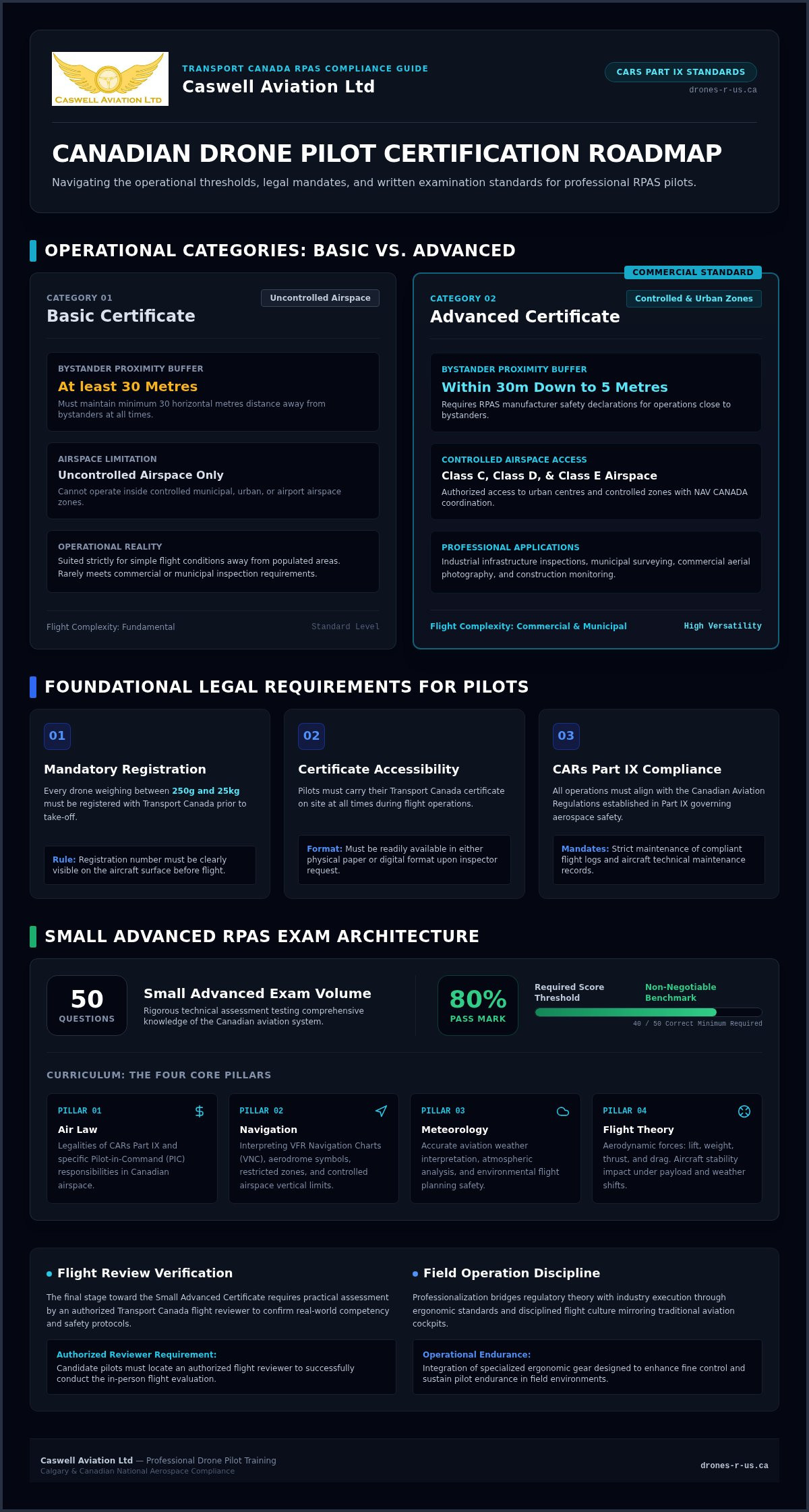
Transport Canada divides Remotely Piloted Aircraft System (RPAS) operations into two primary categories. Understanding this distinction is the essential first step for anyone seeking drone pilot training Calgary. While the Basic category allows for flight in uncontrolled airspace away from bystanders, it rarely meets the practical needs of a professional operator. Most industrial, municipal, or urban environments require an Advanced certificate to ensure legal compliance and operational safety.
The threshold between these categories depends on your proximity to people and the classification of the airspace. Basic operations require you to stay at least 30 horizontal metres away from bystanders and remain entirely within uncontrolled airspace. If your professional labour involves surveying a construction site, inspecting infrastructure, or capturing footage in a populated area, these restrictions are nearly impossible to respect. This is why the Advanced certificate has become the industry standard for commercial pilots who require versatility and reliability in their field operations.
When Do You Need an Advanced Certificate?
An Advanced certificate is required whenever an operation moves beyond the simplest flight conditions. Specifically, you need this certification for:
- Operating within 30 metres of bystanders: This includes horizontal distances down to 5 metres, provided the RPAS has the necessary safety declarations from the manufacturer.
- Flying within controlled airspace: Many urban centres fall under Class C, D, or E airspace. Accessing these zones requires an Advanced certificate and coordination with NAV CANADA.
- Professional applications: Tasks such as industrial inspection or commercial aerial photography often occur in locations where bystanders or controlled zones are present.
The Legal Requirements for RPAS Operators
Operating within the national airspace system involves strict adherence to a specific set of rules designed to protect public safety. Every pilot must prioritize these three foundational requirements:
- Mandatory Registration: Every drone weighing between 250g and 25kg must be registered with Transport Canada. The registration number must be clearly visible on the aircraft before it leaves the ground.
- Certification Accessibility: You must carry your pilot certificate at all times during flight operations. Transport Canada inspectors may request to see this document in either a digital or physical format.
- Regulatory Compliance: All flights must align with the Canadian drone regulations established in Part IX of the Canadian Aviation Regulations (CARs). These laws govern everything from flight logs to maintenance records.
Following these protocols isn't just about avoiding fines. It's about establishing a culture of discipline that mirrors traditional aviation standards. A professional pilot treats every flight with the same level of seriousness as a manned aircraft operation.
Preparing for the Small Advanced RPAS Written Exam
The Small Advanced RPAS exam serves as the formal gateway to high-stakes commercial operations. Unlike the Basic exam, which focuses on fundamental safety, the Advanced certification demands a sophisticated understanding of the Canadian aviation system. To earn a Transport Canada drone pilot certificate in this category, you must navigate 50 technical questions. The 80 percent pass mark is non-negotiable. This high threshold reflects the technical complexity and safety implications of the material. Preparation is the key. Candidates who rely solely on self-study often struggle with the specific phrasing and technical nuances of the questions. Investing in professional drone pilot training Calgary provides a structured environment where complex concepts are simplified into actionable knowledge.
The curriculum encompasses four distinct pillars: Air Law, Meteorology, Navigation, and Flight Theory. Air Law focuses on the legalities of CARs Part IX, including the specific responsibilities of the pilot-in-command. Navigation requires the ability to interpret VFR Navigation Charts (VNC) and identify restricted zones. You'll need to understand aerodrome symbols and the vertical limits of controlled airspace. Flight Theory explores the physics of lift, weight, thrust, and drag, ensuring you understand how environmental factors or payload shifts impact aircraft stability.
Mastering Aviation Theory and Meteorology
Safe flight planning relies on the accurate interpretation of aviation weather products. You must be able to decode METAR and TAF reports to anticipate cloud ceilings, visibility, and wind shear. These reports are not written in plain English. Mastering the codes is essential for passing the exam. Understanding the relationship between air density and rotor efficiency allows you to make informed decisions about flight duration and safety margins during industrial missions.
Online vs. In-Person Ground School
Working professionals across Canada frequently opt for online ground schools due to the inherent flexibility of the format. A modular approach ensures that you cover every required subject without the risk of missing critical regulatory updates. This method allows you to revisit difficult topics like airspace classification or radio protocols until they're fully understood. If you're ready to begin, you can explore Caswell Aviation for comprehensive online course details. For a broader overview of the licensing landscape, consider reading The Complete Guide to Transport Canada Drone Certification in 2026.
Mastering the Advanced Flight Review Process
Passing the written exam is a significant achievement, but it only grants you candidate status for the Advanced certificate. To fully qualify for professional operations, you must undergo a practical assessment with an authorized reviewer. This phase of drone pilot training Calgary focuses on your ability to apply regulatory theory to real-world flight operations. You must demonstrate that you can manage a complex mission from initial planning to safe landing while maintaining absolute control over the aircraft and the surrounding environment.
The process follows a logical sequence of four critical steps. First, ensure your Advanced written exam results are valid and recorded in your Transport Canada portal. Second, locate an authorized flight reviewer who holds the necessary credentials to validate your skills. Third, prepare a comprehensive site survey and emergency procedures document tailored to your assessment location. Finally, you will meet with the reviewer to demonstrate your flight proficiency and regulatory knowledge. This is not merely a test of stick skills; it's a verification of your professional discipline and safety mindset.
What to Expect During Your Flight Assessment
The review begins on the ground with a verification of your pilot identity and drone registration. Your reviewer will expect to see a disciplined pre-flight routine, including a thorough equipment inspection and a safety briefing for any crew members or observers. During the flight, you must execute specific manoeuvres to prove operational control. You may be asked to demonstrate a lost link procedure or explain how you would handle a flyaway. If your mission requires NAV CANADA controlled airspace authorization, you should be prepared to discuss the coordination process in detail.
Common Errors to Avoid During the Review
Many candidates struggle not because of poor flying, but because of inadequate preparation. A frequent pitfall is an incomplete site survey that fails to identify local hazards like power lines, nesting birds, or nearby helipads. Communication is another critical area where pilots often falter. You must demonstrate clear and assertive instructions to your visual observers to ensure the flight path remains clear of obstacles. To better understand the specific criteria used by evaluators, you can read What is a Drone Flight Review in Canada? A Professional Guide for 2026. Presenting yourself as a methodical practitioner who prioritizes risk mitigation will significantly increase your chances of success.
Transitioning from Certified Pilot to Industry Professional
Obtaining a certificate is a significant milestone, but it's merely the entry point into a competitive commercial market. True professionalization requires a shift in focus from basic flight safety to operational endurance and high-output quality. Many operators who complete drone pilot training Calgary are surprised by the physical and mental stamina required for full-day industrial missions. Transitioning to a professional role means moving beyond the minimum requirements and adopting a "Master Practitioner" mindset that prioritizes precision and reliability.
Scaling your operations often involves pursuing specialized certifications, such as the Level 1 Complex flight review. This level of training allows you to undertake more sophisticated missions in challenging environments, providing a clear competitive advantage when bidding for corporate contracts. Whether you're conducting site inspections or high-end cinematography, your ability to maintain consistent results throughout a long shift defines your professional reputation.
The Role of Ergonomics in Professional Operations
Long-duration commercial flights involve heavy smart controllers that can cause significant physical strain. Relying on a standard neck strap is often insufficient, as it concentrates the weight on the cervical spine and leads to pilot fatigue. This fatigue directly impacts your ability to execute precise manoeuvres during critical mission phases. High-quality ergonomic solutions, such as Fitek Gear harnesses, distribute the weight across the shoulders and torso to improve stability. This increased support allows for finer control over the joysticks and reduces the risk of operational errors caused by discomfort. For a deeper analysis of equipment options, consult our article on Choosing the Best Drone Harness for Smart Controllers: A 2026 Professional Guide.
Developing a Professional Aerial Photography Workflow
A professional operator must deliver results that go beyond hobbyist standards. This involves moving away from automated settings and mastering manual control of the camera sensor. Capturing high-quality RAW imagery and 4K video requires an understanding of bitrates, colour profiles, and lighting conditions. In industrial contexts, such as construction monitoring or mapping, the value lies in consistent flight paths and repeatable data sets. This level of technical discipline ensures that your deliverables meet the rigorous standards of engineering and marketing departments alike. You can explore these standards further in The Professional Guide to Corporate Drone Video in Alberta. To ensure you have the right foundation for these advanced workflows, consider enrolling in specialized drone pilot training Calgary to refine your field skills.
Why Choose Caswell Aviation for Your Drone Pilot Journey?
Caswell Aviation Ltd positions itself at the intersection of regulatory compliance and field-proven success. While many providers offer generic educational modules, our approach to drone pilot training Calgary is rooted in decades of aviation experience. We don't just help you pass a test; we prepare you for the realities of the Canadian aerospace environment. By choosing a partner that understands the nuances of Part IX regulations and the physical demands of commercial work, you ensure your training investment translates into long-term operational capability. This expertise is vital for operators who need to move beyond Basic certificates into the more versatile Advanced category.
Expert Mentorship from Veteran Pilots
Our instructors are active industry practitioners who provide high-end aerial photography and industrial inspection services themselves. This dual role as both educators and operators allows us to offer real-world insights that go beyond the standard Transport Canada syllabus. You'll learn how to manage complex site surveys, navigate difficult weather conditions, and maintain equipment to the highest safety standards. This mentorship focuses on professional excellence and risk mitigation, ensuring you leave our program with the discipline required for high-stakes missions. We emphasize a culture of safety that mirrors traditional aviation, helping you build a reputation for reliability in the field.
Your All-in-One Resource for Professional RPAS
We provide a holistic ecosystem for pilot success, serving as a single point of contact for training, certification, and specialized gear. This includes everything from initial ground school to Advanced and Level 1 Complex flight reviews. Our expertise also extends to specialized hardware solutions, such as Fitek Gear harnesses, which we've integrated into our offerings because we know how much they improve field performance and precision during long shifts. For those looking to understand the broader market, our resource on Drone Pilot Jobs in Canada: A Professional Career Guide for 2026 offers a strategic look at where your new skills can take you. We remain committed to supporting your growth as the industry evolves and regulations shift.
Whether you're just starting your journey or looking to scale an existing business, we provide the technical authority and local approachability you need. You can book your professional flight review or enroll in a comprehensive online course today to secure your place in the next generation of Canadian aviators. Let us help you bridge the gap between regulatory theory and professional field success.
Securing Your Professional Standing in Canadian Aviation
Achieving your Advanced certificate is more than a regulatory requirement; it's a commitment to the safety and discipline of the national airspace. By mastering the distinction between Basic and Advanced operations and preparing methodically for your flight review, you position yourself as a reliable practitioner. High-quality drone pilot training Calgary ensures you don't just pass the exam but gain the technical proficiency needed for long-duration commercial missions. As an authorized provider of Advanced and Level 1 Complex training, Caswell Aviation offers the expert mentorship and specialized Fitek Gear required to bridge the gap between candidate and professional.
Our authorized Transport Canada flight reviewers are ready to help you validate your skills and scale your business operations. We provide the holistic support necessary to navigate both the written requirements and the practical demands of the field. Take the final step in your certification journey and Book Your Advanced Flight Review or Enrol in an Online Course Today. The transition from a recreational user to a professional operator is a significant achievement. With the right roadmap and a focus on precision, you're well-equipped for success in this evolving industry.
Frequently Asked Questions
How much does it cost to get a drone licence in Canada in 2026?
Transport Canada charges specific fees for the Small Advanced exam and the issuance of the pilot certificate. While these regulatory costs are fixed, the total investment depends on your choice of drone pilot training Calgary. Professional ground schools provide the necessary technical depth to pass the exam on your first attempt. You should budget for government fees and the comprehensive training required to meet commercial standards.
What is the difference between a Basic and Advanced drone certificate?
The primary difference lies in the proximity to bystanders and the classification of the airspace. A Basic certificate limits you to uncontrolled airspace and requires you to remain 30 horizontal metres away from people. An Advanced certificate allows for operations within controlled airspace and closer to bystanders, provided you use an aircraft with the appropriate safety declarations. This versatility is essential for most industrial missions.
How long does an Advanced drone flight review typically take?
A professional flight review typically lasts between 60 and 90 minutes. This duration allows the authorized reviewer to verify your pilot identity, drone registration, and pre-flight documentation. The practical portion involves demonstrating specific manoeuvres and emergency procedures in a field environment. Candidates who arrive with a completed site survey and organized safety checklists often experience a more efficient and streamlined assessment process during their review.
Do I need a drone licence to take professional aerial photos in Canada?
Yes, any drone operation involving an aircraft between 250g and 25kg requires a pilot certificate under Part IX of the Canadian Aviation Regulations. Professional aerial photography often occurs in urban areas or near infrastructure, which typically necessitates an Advanced certificate. Operating without the correct licence can result in significant fines and complicates your ability to secure professional liability insurance for your commercial flight operations.
Can I take my drone ground school training online?
You can complete your entire ground school curriculum through an online platform. Caswell Aviation provides modular online courses that allow working professionals to study aviation theory at their own pace. These digital programs cover the same technical subjects as in-person training, including meteorology, air law, and navigation. Online learning is a highly efficient way to prepare for the Transport Canada written exam before booking your practical review.
How do I maintain my pilot recency requirements after certification?
Pilot recency must be updated every 24 months to keep your certificate valid. You can meet this requirement by completing a flight review, attending a safety seminar, or finishing a self-paced study program offered by Transport Canada. Keeping a detailed logbook of your flight hours and training activities is the best way to prove you meet these standards. Professional pilots prioritize these updates to remain compliant with federal regulations.
What happens if I fail my Transport Canada Advanced drone exam?
If you don't pass the Advanced exam, Transport Canada requires a mandatory waiting period before you can attempt it again. Candidates must wait 24 hours between attempts. Each retake involves a small administrative fee paid to the government. If you find the technical material challenging, enrolling in a structured drone pilot training Calgary program can help you identify knowledge gaps and improve your understanding of complex aviation subjects.
Is a Fitek Gear harness compatible with all drone smart controllers?
Fitek Gear harnesses are specifically engineered to support a wide range of smart controllers used in professional RPAS operations. These harnesses feature adjustable mounting points that accommodate different controller dimensions and weights. By distributing the weight across the pilot's torso, the harness improves stability and reduces the physical fatigue associated with long shifts. This ergonomic support is vital for maintaining the precision required during complex industrial flight missions.
Leave a comment