
Advanced Drone Pilot Training: Build Skills for Inspection Work
What if passing the exam is only the first checkpoint on the way to inspection work? For pilots considering advanced drone pilot training, regulatory knowledge matters, but confidence on a real mission also depends on disciplined flying and careful preparation. An exam result alone doesn’t show how you’ll manage an aircraft around inspection targets or respond to changing conditions.
It’s reasonable to want a clear link between certification and practical readiness. This guide explains how the Transport Canada Advanced and Level 1 Complex pathways differ, what inspection missions demand beyond exam knowledge, and why a flight review is a separate practical assessment. To earn an Advanced Operations Certificate, pilots must pass the Small Advanced Exam and complete an in-person flight review with a Transport Canada-approved reviewer.
Structured learning can connect theory with flying practice. Caswell Aviation Ltd provides online courses, optional in-person training and professional flight reviews for the relevant certification pathways. Use this overview to understand the steps ahead and choose a practical next move, while remembering that inspection readiness also depends on the requirements of each operation.
Key Takeaways
- Match your certification pathway to the type of operation you plan to conduct, and verify current Transport Canada requirements before flying.
- Advanced drone pilot training Alberta can help connect regulatory study with practical preparation for professional inspection missions.
- Online learning supports flexible exam preparation, while in-person instruction can help develop practical flying skills.
- Build a repeatable pre-flight checklist covering the mission objective, site conditions, equipment, communication and contingency planning.
- Treat the flight review as a distinct practical assessment, not as a replacement for exam preparation or mission-specific planning.
Advanced drone pilot training: what inspection work demands
Advanced drone pilot training prepares pilots for the certificate that applies to an operation and for safe, disciplined flying. Inspection work demands more than aircraft control: pilots need to understand the operating environment, plan useful coverage, maintain awareness throughout the flight and capture material that can be reviewed afterward. The Drone technology overview provides general context on drone types and applications. For operational decisions, use current Transport Canada guidance and consider the specific flight plan.
Certification establishes a regulatory foundation, not automatic competence for every assignment. The aircraft, location, airspace, people nearby and task objectives can all affect what a flight requires. Inspection readiness combines regulatory knowledge, sound planning and controlled flying, applied to the conditions of each operation.
What does advanced training prepare a pilot to do?
Advanced-level learning helps pilots understand operating rules and apply them to real decisions. Airspace awareness supports site planning: identify where a flight is proposed and determine what restrictions or authorizations may apply. Weather assessment matters just as much. Wind, visibility and changing conditions can affect whether the aircraft can hold a stable position or complete planned coverage safely.
Structured study helps pilots build and refresh this knowledge. Online courses support review of regulatory topics, while practical training helps connect those principles to aircraft handling and operational judgement. For those considering advanced drone pilot training Alberta, the aim is to prepare for the applicable certification pathway and strengthen safe operating habits. Training doesn’t guarantee employment, assignment approval or competence for every specialized task.
Why inspection work needs more than basic stick skills
Inspection flights often depend on deliberate observation and repeatable coverage. A pilot may need to hold a stable viewing position, follow a planned route, maintain suitable distance from structures and keep the subject visible. Smooth, controlled movements can help the crew collect consistent imagery instead of rushed or incomplete views. The pilot must also manage the flight while staying alert to people, property and changing site conditions.
Consider a generic building exterior inspection. The crew might need to document selected surfaces from planned viewpoints. Before flight, identify the areas to observe, note potential obstructions and agree on communication between the pilot and observer. During the mission, the pilot monitors the aircraft and surroundings while the observer watches for hazards or gaps in coverage. Afterward, clear records of the flight and captured material help the crew understand what was inspected and what may need follow-up.
- Site awareness: Identify people, structures, obstacles and changes that could affect the flight.
- Repeatability: Plan coverage deliberately so observations are organized and useful.
- Accurate records: Document relevant flight details and inspection findings according to the operation’s needs.
These habits don’t replace checking the rules for a particular operation. They help translate training into careful decisions, so pilots can recognize when conditions, scope or risk require a revised plan or a decision not to fly.
Advanced drone training and certification: how the pathway works
A useful pathway starts with the planned operation, not just a certificate name. Inspection work can vary by location, airspace, aircraft and operating conditions, so identify what the assignment may involve before deciding which requirements apply. For a broader explanation of Canadian certificate categories, consult The Complete Guide to Transport Canada Drone Certification in 2026 alongside current official guidance. Transport Canada’s drone pilot certification information is the reference point for checking the current process.
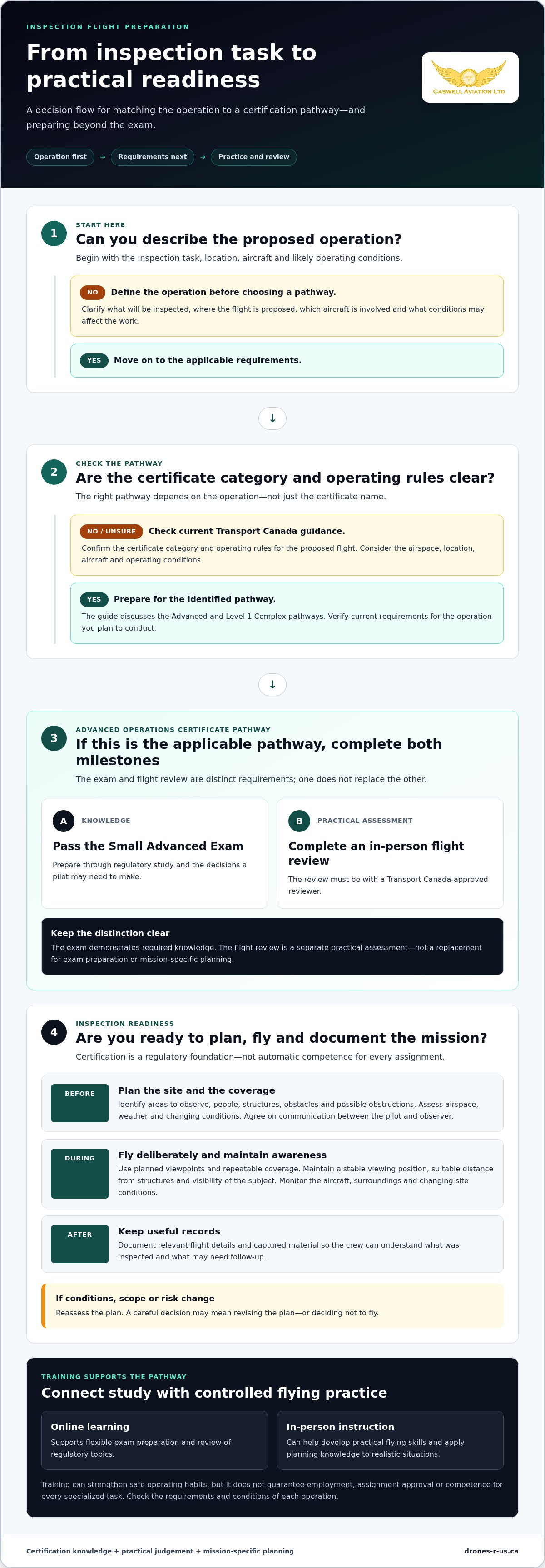
Use this sequence to turn a training goal into practical preparation:
- Identify operation needs. Describe the inspection task, location, aircraft and likely operating conditions.
- Study applicable requirements. Check the certificate category and operating rules that fit the proposed flight.
- Prepare for the exam. Organize study around regulations and the decisions a pilot may need to make.
- Practise deliberately. Use flight time to build controlled handling and apply planning knowledge to realistic situations.
- Complete the required review. Treat the flight review as a separate practical assessment, not another exam-preparation session.
This sequence connects learning to action. For example, studying airspace rules becomes more useful when you apply them to a proposed site, identify questions that need resolution and adjust the plan before flight.
Advanced certificate: exam preparation and flight review
For the Advanced Operations Certificate, the current pathway requires passing the Small Advanced Exam and completing an in-person flight review with a Transport Canada-approved reviewer. These are distinct milestones: passing the exam demonstrates required knowledge, while the review assesses practical flying against the applicable standard. Structured study can strengthen decisions about airspace, weather and operational planning, but exam preparation doesn’t replace practising those decisions in flight.
Advanced drone pilot training Alberta is most useful when study and practice reinforce each other. Work through a planning scenario, explain the decisions you would make, then practise the relevant control skills. This creates a clearer bridge between knowing a rule and applying it calmly during an inspection operation.
When to investigate the Level 1 Complex pathway
Level 1 Complex is a separate pathway to investigate when the intended operation falls within its scope under current rules. It isn’t a default requirement for every inspection. The right category depends on the operation’s details, so don’t choose a pathway based only on the industry or the word “inspection.” Review Transport Canada’s current prerequisites and exam requirements before committing to a training plan. For wider regulatory context, use Drone Regulations in Canada: The 2026 Professional Reference Guide as companion reading.
Don’t assume a ground-school duration or prerequisite based on older summaries. Confirm those details against official guidance, then map each requirement to a study, practice or assessment step. Caswell Aviation’s online drone courses and flight-review support provide a practical starting point for pilots preparing for the Advanced or Level 1 Complex pathway.
Compare training formats for practical drone inspection preparation
Training formats serve different purposes. Online study can organize regulatory knowledge and support exam preparation. Instructor-led sessions add discussion and guided practice. A flight review is different: it’s a formal practical assessment in the applicable certification process, not simply another lesson. For advanced drone pilot training Alberta, consider how each format can help turn concepts into sound decisions before an inspection flight.
Online learning for regulatory knowledge and exam preparation
Self-paced online learning gives pilots room to revisit challenging topics and connect them to operational decisions. For example, use an airspace topic to practise identifying questions about a proposed inspection site. Review weather concepts, then consider how changing conditions could affect a planned flight path or a decision to postpone. This approach supports preparation, but it doesn’t replace practical flying or guarantee an exam result.
In-person instruction and the flight-review distinction
In-person instruction can help pilots apply theory through guided flying, discuss decisions and work on control techniques. A training session and a flight review aren’t interchangeable: training develops skills, while the review assesses them against the relevant requirements. For more detail on that assessment, consult What is a Drone Flight Review in Canada? A Professional Guide for 2026.
Compare the formats
- Online study: Best for flexible review of regulations and knowledge-test preparation. It doesn’t provide direct coaching or assess flight skills.
- Optional in-person instruction: Useful for discussing operational scenarios and practising applied skills with guidance. Practice isn’t the formal flight review.
- Flight review: A practical assessment within the applicable certification pathway. It doesn’t replace broader study or mission-specific preparation.
Use the formats together when they address different needs. After studying a topic online, a pilot might explain how it affects a sample inspection plan, then use instructor-led practice to work on controlled flight and observation. The reviewer’s assessment remains a separate step. NAIT’s advanced drone training information offers an example of how formal training can support preparation.
Before choosing a learning sequence, note what feels least familiar: interpreting requirements, planning around a site, handling the aircraft or demonstrating practical skills. That list helps clarify where study, coaching or assessment fits. Caswell Aviation provides online courses and optional in-person training for Transport Canada Advanced and Level 1 Complex pathways, along with professional flight reviews. Explore drone training and flight-review support as a relevant next step.
Prepare for inspection flights with a repeatable training checklist
A consistent workflow helps pilots and crews apply training before, during and after a flight. A pre-flight checklist turns knowledge into repeatable operational decisions. It doesn’t replace sound judgement or current regulatory guidance, but it makes important planning steps easier to review and communicate.
Plan the site, task and operating conditions
Start by defining the inspection objective. What information must the flight capture, and which views or areas are needed to meet that objective? Keep the plan focused. A generic exterior inspection, for example, may call for a sequence of viewpoints rather than an improvised flight around a structure.
Next, assess the proposed site and operating conditions. Use current official resources to review relevant airspace information, and identify people, obstacles, property and weather factors that could affect the plan. The pilot must confirm current rules and any required permissions for each operation. Don’t assume site access or permission to fly.
- Mission objective: Define the inspection task, desired observations and planned coverage.
- Site assessment: Note people, obstacles, nearby property and potential changes in activity.
- Airspace and permissions: Check applicable requirements and secure any permissions needed for the operation.
- Weather: Assess conditions against the aircraft, task and safe operating plan.
- Equipment: Check the aircraft, controller, batteries and other equipment needed for the flight.
- Boundaries and contingencies: Set safe operating limits and agree on what the crew will do if conditions change, communication is interrupted or the task can’t be completed as planned.
Before takeoff, identify decision points. For example, agree when to pause and reassess if people enter the work area, wind affects stable control or the intended view can’t be obtained safely. Set clear conditions for changing the plan or ending the operation. These are operational choices, not signs of failure.
Practise controlled execution and post-flight review
Use suitable practice sessions to rehearse a planned route, steady observation and clear communication between pilot and crew. A generic training scenario can simulate coverage of selected surfaces from safe, planned positions without relying on access to a real inspection site. Keep the operating boundaries explicit, and practise stopping or repositioning when the scenario changes.
After each session, review the flight records and compare the result with the objective. Did the planned coverage capture the intended views? Were crew calls clear? Was the flight path controlled and repeatable? Record one specific improvement for the next practice flight, such as refining a turn, clarifying a callout or improving the sequence of viewpoints. This turns review into a practical learning loop.
For pilots pursuing advanced drone pilot training Alberta, a checklist connects regulatory study and flying practice without assuming every operation has identical requirements. Build these habits into your preparation with online drone courses and in-person training from Caswell Aviation.
Caswell Aviation advanced drone training and flight-review next steps
Inspection work can be a useful goal for building your skills, but your next training step should reflect the operation you intend to conduct and your current certification stage. Caswell Aviation Ltd provides online courses and optional in-person training for Transport Canada Advanced and Level 1 Complex certification pathways, along with professional flight reviews. These services connect regulatory study with practical preparation without treating a certificate as proof of readiness for every assignment.
Start by writing down what you want to be able to do: prepare for an applicable exam, strengthen practical flying or complete the review stage of a certification pathway. Then use current Transport Canada requirements to confirm which pathway applies to your intended operations. Requirements can depend on the details of the proposed flight, so don’t select a level based only on the fact that the work involves inspection.
Match training support to your certification goal
Online learning can help you organize study, revisit topics and build a clearer understanding of regulatory requirements. Optional in-person training adds instructor interaction and practical learning. Together, these formats support a structured plan that connects what you study with how you plan and conduct flights. For advanced drone pilot training Alberta, a useful measure is whether you can apply your knowledge to the decisions your intended operation requires, not simply how much material you cover.
Before beginning, note your current certificate stage and the areas where you want to build confidence. You might focus on understanding applicable rules, explaining the reasoning behind a flight plan or practising controlled aircraft handling. Keep inspection objectives in view, while recognizing that training doesn’t provide job placement or guarantee approval for a particular assignment.
Move from preparation to a professional flight review
A professional flight review is a separate practical assessment in the relevant certification pathway. It isn’t the same as exam preparation or a general practice session, and completing training doesn’t guarantee a successful result. Practise deliberately: work on controlled flying, clear communication and applying current Transport Canada knowledge to operational decisions. If a topic or manoeuvre needs more attention, include it in your preparation before the assessment.
A simple next-step plan can keep the process manageable:
- Define your goal: Identify the certificate pathway that fits your intended operation.
- Choose your learning support: Use online study and optional in-person training to address your preparation needs.
- Practise with purpose: Apply what you’ve learned and note areas for further work.
- Prepare for review: Treat the professional flight review as its own assessment milestone.
Caswell Aviation’s training and flight-review support can help you organize those steps as you prepare for professional work. Explore drone training and flight reviews to take a practical next step.
Build your next step into a professional habit
Inspection capability develops over time. Each training session can sharpen your judgement, and each operation can reveal where further learning would be useful. Keep your goals specific: identify the work you’re preparing for, note the skills you want to strengthen and let current requirements guide your plan.
With advanced drone pilot training Alberta, the aim is more than reaching a certification milestone. It’s building the discipline to prepare carefully, make sound decisions and keep learning as operational demands change. Caswell Aviation’s online courses and optional in-person training support Advanced and Level 1 Complex pathways, with professional flight reviews for the applicable certification process.
Take a measured next step by exploring the training options that fit your learning goals. Explore online drone courses and optional in-person training, then continue building the knowledge and practical confidence that professional inspection work demands.
Frequently Asked Questions
Can advanced drone training prepare me for inspection work?
Yes. Training can help develop regulatory knowledge, planning habits and aircraft control that support inspection operations. For example, a pilot preparing to document a roof might practise maintaining a stable viewpoint and organizing image coverage, then consider how site conditions affect the plan. Training alone doesn’t guarantee employment or qualify you for every assignment. Before each mission, assess its requirements, including the aircraft, location and operating conditions.
Do I need an Advanced certificate to perform drone inspections?
Not necessarily. The appropriate certificate depends on the specific operation, including where and how you plan to fly and the conditions involved. Transport Canada has Basic, Advanced and Level 1 Complex categories, but the word “inspection” alone doesn’t determine which applies. For advanced drone pilot training Alberta, describe the planned task and check current Transport Canada requirements for that operation before choosing a certification pathway.
Is a flight review the same as an advanced drone course?
No. A course helps you learn and prepare; a flight review is a separate practical assessment in the applicable certification pathway. For Advanced certification, Transport Canada requires the applicable exam and flight review. Use course learning to identify areas for practice, such as explaining operational decisions or demonstrating controlled aircraft handling. Confirm current requirements and terminology with Transport Canada rather than relying on older notes.
Can I complete drone pilot training online in Canada?
Yes. Online learning can help you organize theory and revisit topics such as air law, airspace and weather. Caswell Aviation offers online courses and optional in-person training for Transport Canada Advanced and Level 1 Complex pathways. To make online study useful, connect each topic to a planning question, such as what you need to assess before flying at a proposed site. Online learning doesn’t replace an in-person flight review where one is required.
Does an Advanced drone certificate automatically authorize every inspection flight?
No. An Advanced certificate isn’t blanket permission for every site or mission. Before a flight, assess the actual location, aircraft, people nearby and operating conditions, then verify applicable rules and permissions. For example, a change in the proposed work area or flight plan may affect what needs to be reviewed before proceeding. Certification supports eligible operations, but pilots remain responsible for planning each flight within current requirements.
How much ground school is required for Level 1 Complex certification?
The supplied Transport Canada guidance identifies 20 hours of ground school for the Level 1 Complex pathway. Requirements can change, so verify the current prerequisite directly with Transport Canada before setting your study plan. Ground school is one part of the pathway, not necessarily the only step. Check the applicable exam, review and other prerequisites as well, then use structured learning to prepare for the requirements that apply.
Leave a comment