

Drone Pilot Hourly Rate in Canada: 2026 Professional Pricing Guide
A drone pilot's value is rarely found in the flight time itself, but in the regulatory weight and technical precision they carry into the air. If you're struggling to set your fees, you aren't alone. Most operators feel a persistent uncertainty about whether they're undercharging for their expertise or overpricing themselves out of a competitive market. Establishing a sustainable drone pilot hourly rate Canada requires a firm grasp of current industry benchmarks and a clear understanding of how your specific credentials influence your bottom line.
This guide provides the clarity you need to navigate the 2026 professional landscape with confidence. You'll learn how to justify your rates based on specialized deliverables and Transport Canada certification levels. We'll examine the standard hourly and day rates for various sectors, ranging from basic imagery to complex industrial inspections. By the end of this article, you'll have a practical framework to evaluate your expertise and ensure your professional fees reflect the true value of your flight operations.
Key Takeaways
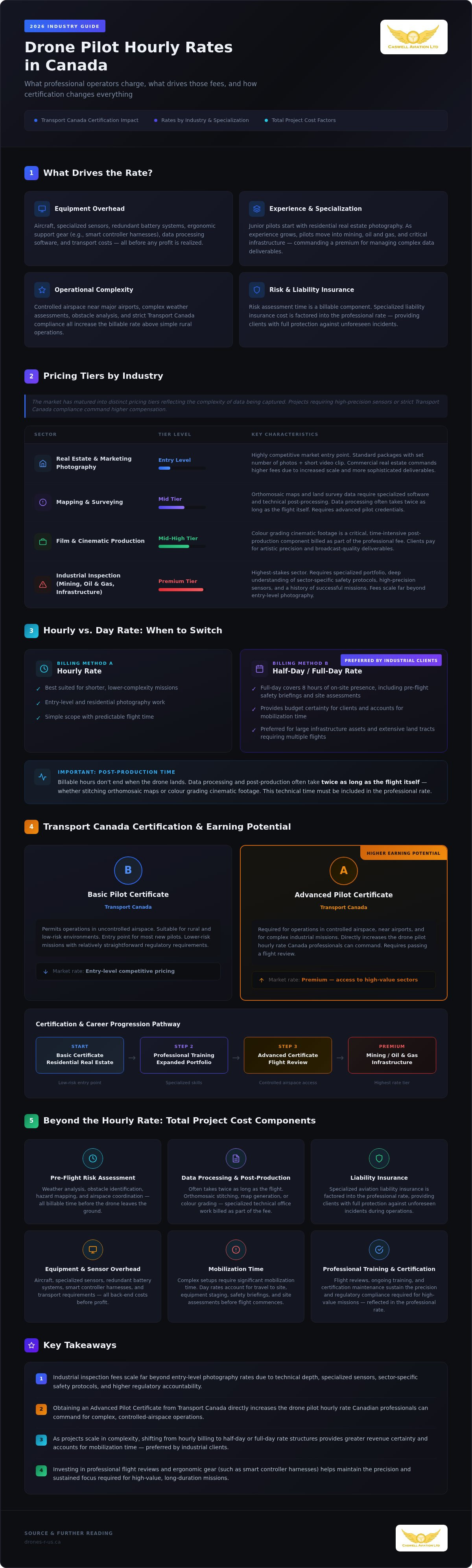
- Understand the technical and regulatory factors that cause industrial inspection fees to scale far beyond entry-level photography rates.
- Learn how obtaining an Advanced Pilot Certificate directly increases the drone pilot hourly rate Canada professionals can command for complex operations.
- Identify the specific project milestones that signal a necessary shift from simple hourly billing to more profitable day rate structures.
- Discover how investing in professional flight reviews and ergonomic gear helps maintain the precision required for high-value missions.
Factors Influencing the Drone Pilot Hourly Rate in Canada
A professional drone pilot hourly rate Canada represents more than just the time spent with a controller in hand. In the 2026 market, this rate accounts for the pilot's technical expertise, regulatory standing, and the substantial overhead required to maintain a safe flight operation. While hobbyists might offer lower prices, professional rates are built on a foundation of reliability and accountability. The rapid evolution of unmanned aerial vehicles has created a tiered pricing structure where simple visual data collection and high-precision industrial data represent two very different financial tiers.
Equipment overhead is a primary driver of these professional fees. Beyond the cost of the aircraft itself, pilots must maintain specialized sensors, redundant battery systems, and ergonomic support equipment. For instance, using professional Fitek Gear harnesses for smart controllers allows pilots to sustain the focus required for long-duration missions without physical fatigue. These operational costs, combined with data processing software and transport requirements, mean that a pilot's hourly fee must cover significant back-end expenses before any profit is realized.
Experience and Industry Specialization
Junior pilots typically enter the market through residential real estate photography. These roles often command lower rates because the technical requirements and risks are relatively low. However, as a pilot gains experience, they often transition into high-stakes sectors like mining, oil and gas, or critical infrastructure. These industries require a specialized portfolio and a deep understanding of sector-specific safety protocols. Pilots who can demonstrate a history of successful missions in these environments move beyond generic market rates, commanding a premium for their ability to manage complex data deliverables. Investing in professional drone training is often the first step toward accessing these high-value industry niches.
Operational Complexity and Risk Management
The environment where a mission takes place significantly dictates the final billable rate. Flying in controlled airspace near major airports requires a higher level of coordination, communication, and Transport Canada compliance than rural flight paths. Professional pilots also include risk assessment time as a billable component of their service. This ensures that every flight is preceded by a thorough analysis of weather, obstacles, and potential hazards. Additionally, the cost of specialized liability insurance is factored into the drone pilot hourly rate Canada professionals charge. This provides clients with the assurance that all operations are fully protected against unforeseen incidents while maintaining the high standards expected in the Canadian aviation sector.
Average Hourly Rates by Industry and Specialization
The drone pilot hourly rate Canada offers varies significantly depending on the technical depth of the mission. For 2026, the market has matured into distinct pricing tiers that reflect the complexity of the data being captured. While a standard flight might seem straightforward, the specific deliverables often dictate the final invoice. Projects that require high-precision sensors or strict adherence to Transport Canada drone certification requirements naturally command higher compensation. This reflects the pilot's responsibility for both the safety of the operation and the integrity of the collected information.
As projects scale, many professionals shift from hourly billing to half-day or full-day rates. This transition provides budget certainty for the client and accounts for the mobilization time required for complex setups. A full-day rate typically covers eight hours of on-site presence, including pre-flight safety briefings and site assessments. Pilots often find that industrial clients prefer this model for consistency, especially when multiple flights are needed to cover large infrastructure assets or extensive land tracts.
Billable hours don't end when the drone lands. Data processing and post-production often take twice as long as the flight itself. Whether it's stitching together orthomosaic maps or colour grading cinematic footage, this technical time is a critical component of the professional fee. Pilots who provide advanced aerial imagery services ensure their rates account for this specialized office work to maintain a sustainable business model.
Real Estate and Marketing Photography
This tier is highly competitive, often serving as the entry point for many new operators. Residential shoots usually involve a standard package including a set number of high-resolution photos and a short video clip. Commercial real estate commands a higher fee due to the increased scale of the property and the need for more sophisticated editing. Because this sector is saturated, pricing remains relatively stable, but pilots with superior composition skills still find ways to justify a premium for their creative output.
Industrial Inspection and Mapping
Industrial work represents the higher end of the pricing spectrum. Services involving LiDAR, thermal imaging, or structural inspections require specialized sensors and a deep understanding of the data being captured. The value here isn't just the flight; it's the pilot's ability to interpret thermal anomalies or identify structural fatigue in a bridge or power line. These missions often involve long durations in the field, making professional flight training and ergonomic support gear essential for maintaining the required precision throughout the day.
How Transport Canada Certification Impacts Earning Potential
In the Canadian drone market, certification is the most reliable predictor of earning potential. A pilot operating under a Basic Certificate is restricted to uncontrolled airspace and must maintain specific distances from bystanders. These limitations naturally cap the drone pilot hourly rate Canada operators can charge, as they're excluded from high-demand urban projects. In contrast, an Advanced Pilot Certificate signifies a mastery of Transport Canada drone safety and certification requirements. This allows for operations in controlled airspace and closer to people, which is essential for infrastructure inspections, city-based cinematography, and complex industrial missions.
Rigorous training leads directly to higher compensation. Advanced operations involve a higher degree of risk management and coordination with air traffic control. Clients are willing to pay a premium for this expertise because it ensures their projects remain compliant and safe. For high-value corporate contracts, pilots often need to demonstrate even higher levels of proficiency, such as Level 1 Complex certification. This specialized standing positions a pilot as a top-tier professional capable of managing the most technical and sensitive flight environments in the country.
Basic vs. Advanced Operations Pricing
Businesses and government agencies prioritize Advanced pilots to mitigate liability and ensure compliance in sensitive areas. While a Basic certificate might suffice for rural land surveys, it doesn't offer the flexibility required for modern corporate contracts. Professional Transport Canada drone certification is the foundation of a professional rate. Holding an Advanced certificate allows you to bid on projects that are legally off-limits to Basic operators, effectively doubling or tripling your potential market reach. This distinction is the primary reason why professional rates vary so widely across the industry.
The ROI of Professional Flight Reviews
A successful flight review is more than a one-time requirement; it's a strategic investment in a pilot's career. It serves as the formal validation of a pilot's ability to operate within the complex Canadian aviation system. For those wondering what is a drone flight review Canada, it's the practical assessment needed to bridge the gap between hobbyist and professional. Maintaining recency and upgrading certifications through these reviews allows pilots to justify professional-grade rates. As the 2026 market continues to favour specialized operators, the ability to operate legally in restricted zones remains the ultimate gateway to higher-tier billing opportunities.
Beyond the Hourly Rate: Understanding Total Project Costs
While the drone pilot hourly rate Canada provides a useful baseline for budgeting, it rarely reflects the total cost of a professional mission. In the 2026 market, many clients find that project-based pricing or day rates offer better clarity and value. A professional operation involves significant logistics that happen long before the propellers spin. From mobilizing a fleet to securing NAV CANADA authorizations, the actual flight is often the shortest part of the contract. Understanding these hidden layers ensures that both the pilot and the client have a realistic expectation of the final invoice.
The Shift to Day Rates
Professional pilots are increasingly moving toward half-day (4-hour) and full-day (8-hour) blocks. This structure is more efficient for both the pilot and the client. It ensures the pilot is fully dedicated to the site without the pressure of a ticking clock, which is vital for safety-critical tasks. When negotiating these rates, professionals account for their total operational overhead, including insurance, software subscriptions, and hardware maintenance. This shift ensures that the pilot's availability is protected, especially for remote or high-stakes industrial projects where mobilization is a major factor in the drone pilot hourly rate Canada landscape.
Ancillary Fees and Reimbursables
Total project costs often include several ancillary fees that go beyond the basic pilot fee. Specialized sensors, such as high-resolution thermal cameras or LiDAR units, typically carry their own usage fees. Additionally, clients may be billed for the time spent on airspace coordination and obtaining the necessary permits for restricted zones. Post-production is another significant variable. Delivering raw data is one thing, but producing refined 3D models or colour-graded cinematic video requires hours of specialized labour. If you require rapid turnaround or high-resolution data processing, expect these to be reflected as distinct line items.
Maintaining a professional fleet involves continuous investment in safety and performance. This includes everything from battery cycle management to the use of professional-grade Fitek Gear harnesses that ensure pilot comfort and control during complex missions. These equipment costs are baked into the professional fee to ensure the pilot arrives with reliable, well-maintained gear every time. For those seeking the highest standard of data capture and project management, exploring professional drone aerial photography and video services ensures all logistical and technical costs are handled with precision.
Advancing Your Career and Increasing Your Market Value
The path to a premium drone pilot hourly rate Canada is paved with continuous specialization and a commitment to operational excellence. Simply holding a certificate is no longer enough to command top-tier fees in the 2026 market. Pilots must transition from generalists to "Master Practitioners" who offer deep technical insights alongside their flight skills. This evolution requires a strategic approach to education, gear selection, and market positioning. By consistently delivering high-quality aerial imagery services Canada, you build the reputation necessary to shift from competing on price to being selected for your unique expertise.
Investing in Professional Training
Structured certification courses are the primary tool for transitioning from a hobbyist mindset to a professional career. Specialized training in high-growth areas like 3D mapping, multispectral analysis, or thermal imaging can effectively double your billable rate. These skills transform you from a camera operator into a data analyst, providing the high-level deliverables that industrial clients demand. To understand where these skills are most valued, reviewing current drone pilot jobs Canada provides a clear roadmap of high-value career paths and the specific technical requirements needed to secure them.
Efficiency and Safety with Professional Gear
Professional presentation and the right equipment do more than just facilitate a flight; they instill client confidence and support higher fees. For long-duration shifts, experienced pilots utilize specialized Fitek Gear harnesses for smart controllers. This ergonomic gear is essential for maintaining the focus required during high-stakes missions where even a minor lapse in concentration can have significant safety implications. There is a direct link between pilot comfort and the ability to maintain rigorous safety standards over an eight-hour day. Reducing physical fatigue through proper support allows you to perform at a higher level, justifying a premium drone pilot hourly rate Canada while ensuring every mission is executed with the precision of a seasoned veteran.
Strategic networking and positioning yourself as a Master Practitioner within the Canadian aviation community further solidifies your market value. This involves more than just finding work; it's about becoming a holistic resource for your clients. Whether you are providing complex data for infrastructure projects or high-end aerial imagery services Canada, your goal is to be viewed as a partner in their success. This level of professional integration ensures that your fees are seen as a necessary investment rather than a discretionary expense.
Securing Your Professional Future in Canadian Aviation
Success in the 2026 drone market depends on more than just flight hours. It requires a commitment to the standards that define a true aviation professional. Establishing a competitive drone pilot hourly rate Canada requires a balance of technical skill, regulatory compliance, and the right equipment. By moving from basic operations to advanced industrial specializations, you position yourself as a high-value partner for corporate and infrastructure clients. This transition is built on a foundation of recognized certification and specialized training.
Your ability to command premium fees is directly linked to your investment in excellence. Whether you're seeking Transport Canada Advanced Certification Training, preparing for professional flight reviews, or optimizing your field efficiency with Fitek Gear ergonomic harnesses, every step you take builds your market authority. Maintaining these standards ensures you remain a leader in a rapidly evolving industry. You can upgrade your skills and earning potential with Caswell Aviation Ltd to ensure your operations are safe, compliant, and highly profitable. The market rewards those who treat drone piloting as a disciplined profession.
Frequently Asked Questions
How much does a drone pilot make per hour in Canada?
A professional drone pilot hourly rate Canada varies significantly based on the operator's specialization and certification level. Entry-level pilots focusing on residential photography typically occupy the lower end of the pricing spectrum. Conversely, pilots performing high-stakes industrial inspections or complex mapping missions command much higher fees. These rates reflect the technical expertise required to deliver precise data and the regulatory responsibility of operating in complex environments across the country.
Do I need an Advanced certificate to charge for drone services?
You don't strictly need an Advanced certificate to charge for services, but holding one is essential for most high-value commercial contracts. A Basic certificate limits your operations to uncontrolled airspace and requires you to stay 30 metres away from bystanders. To operate in urban centres or near people, Transport Canada requires an Advanced certificate. This credential allows you to bid on a wider range of profitable projects in controlled airspace.
What is the difference between an hourly rate and a day rate for drones?
An hourly rate covers the specific time spent on-site, while a day rate is a flat fee for a four-hour or eight-hour block. Day rates have become the industry standard for 2026 because they provide budget certainty for the client. This model also accounts for the mobilization time, safety briefings, and equipment setup required for professional missions. Most experienced pilots prefer day rates to ensure all operational costs are covered effectively.
How do equipment costs affect the drone pilot hourly rate?
Professional rates must account for significant equipment overhead, including the aircraft, specialized sensors, and redundant battery systems. Maintenance and depreciation are ongoing expenses that the pilot must recover through their fees. Additionally, investments in ergonomic support gear, such as Fitek Gear harnesses, ensure pilot focus during long shifts. These costs are baked into the drone pilot hourly rate Canada to ensure the pilot can maintain a reliable and safety-compliant fleet.
What is a typical day rate for industrial drone inspections in 2026?
Industrial day rates are significantly higher than those for standard marketing photography due to the specialized sensors and technical knowledge required. Missions involving LiDAR or thermal imaging demand a high degree of data precision and regulatory coordination. These projects often involve complex risk assessments and long hours in the field. Clients pay a premium for industrial inspections because the resulting data is critical for infrastructure maintenance and safety monitoring.
Can I charge for travel time as a drone pilot in Canada?
Charging for travel time is a standard practice for professional drone pilots in Canada. This is typically handled through a mobilization fee or a specific hourly rate for transit. For national services, pilots also include per diems for meals and overnight accommodation if the project site is outside their local area. Clear communication regarding these reimbursable expenses ensures that both the pilot and the client understand the total project investment before work begins.
Is there a minimum rate for professional drone photography?
There is no legally mandated minimum rate, but sustainable professional photography requires a baseline that covers insurance, licensing, and equipment. Charging too little often signals a lack of professional certification or inadequate liability coverage. Most established pilots set a minimum call-out fee to ensure that even short missions remain profitable. This floor protects the pilot's business health and ensures they can continue providing high-quality imagery and reliable service.
How does post-production impact the total billable hours for a drone project?
Post-production often accounts for more billable hours than the flight operation itself. Processing raw data into usable deliverables, such as 3D models or edited video, requires specialized software and technical labour. Whether it's stitching orthomosaic maps or colour grading cinematic footage, this office-based work is a vital component of the total project cost. Professional pilots ensure their quotes clearly distinguish between on-site flight time and the hours dedicated to data processing.
Leave a comment