
Advanced Drone Flight Review Checklist: A Professional Canadian Guide for 2026
Why do seasoned pilots with hundreds of logged hours still feel a knot in their stomach when they book an advanced drone flight review in Calgary? It is a common experience because the transition to professional operations requires more than just stick skills; it demands a disciplined commitment to aviation safety and regulatory compliance. You likely understand the pressure of the Transport Canada oral exam and the frustration of managing complex documentation while maintaining situational awareness. We recognize that physical discomfort and technical anxiety can compromise even the most experienced pilot's performance during a field assessment.
This guide provides a comprehensive preparation checklist and professional pilot guidance to help you master your advanced flight review with confidence. You'll learn exactly how to organize your site survey, which specific flight manoeuvres to practice, and how to professionalize your entire flight operation. We will walk through the mandatory documentation requirements for 2026 and the ergonomic tools that keep you sharp and focused during every phase of the evaluation process.
Key Takeaways
- Understand the mandatory requirements for the Small Advanced Exam as the essential first step toward your Pilot Certificate.
- Prepare a comprehensive site survey and all required government identification to ensure a seamless advanced drone flight review Calgary session.
- Master the professional pre-flight briefing to demonstrate your command over crew coordination and safety protocols.
- Learn how pilot ergonomics and specific field gear choices directly impact your ability to remain precise during flight manoeuvres.
- Select a flight reviewer who utilizes a mentor-based approach to help you transition into professional RPAS operations.
Prerequisites for the Advanced RPAS Flight Review
The flight review serves as the final practical assessment before you can secure your Pilot Certificate – Advanced Operations. In the context of Canadian drone regulations, this step confirms that a pilot possesses the technical skills and safety knowledge to operate in controlled airspace or near bystanders. It is also a mandatory requirement for those seeking Level 1 Complex certification. Unlike the written exam, the review is an in-person evaluation of your ability to manage a flight from pre-flight planning to post-flight shutdown. It is a test of judgment as much as it is a test of skill.
This assessment must be conducted by a Transport Canada-approved reviewer. These individuals are experienced pilots authorized to verify your competency through a standardized set of criteria. When booking an advanced drone flight review Calgary pilots should ensure their reviewer is currently listed in the Transport Canada Drone Management Portal. To maintain your certificate status once obtained, you must keep your knowledge requirements current every 24 months. If you allow this period to lapse without completing a recurrent training activity, your certificate effectively becomes invalid for advanced operations. This cycle ensures that all professional pilots remain updated on changing airspace rules and safety protocols.
The Advanced Written Exam Milestone
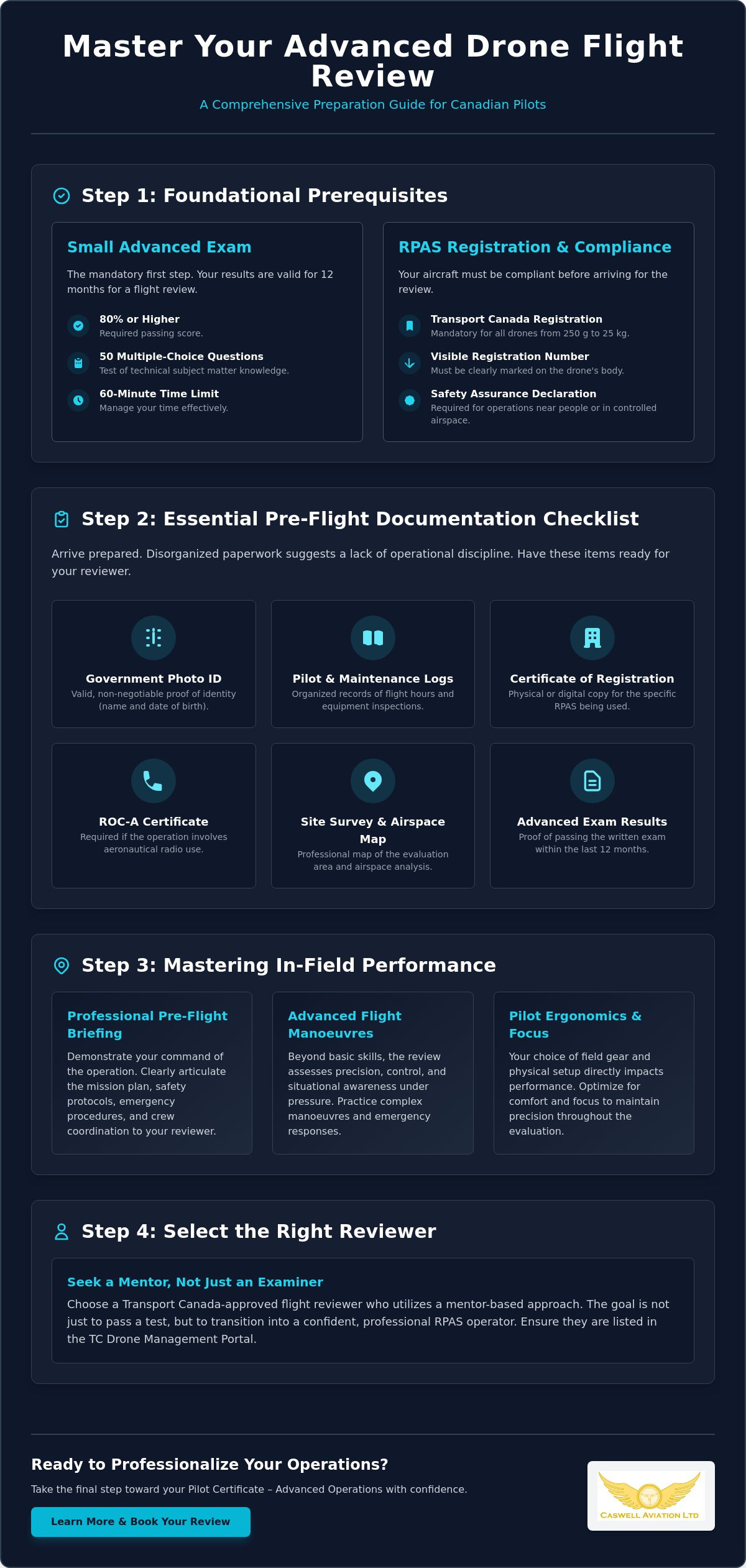
You cannot book a flight review until you have successfully passed the Small Advanced Exam with a score of 80% or higher. This exam consists of 50 multiple-choice questions that must be completed within 60 minutes. It's essential to have a digital or physical copy of your exam results ready for your reviewer to verify during the administrative portion of the day. For those still preparing for the test, reviewing The Complete Guide to Transport Canada Drone Certification provides critical insights into the technical subject matter. Your exam results must be dated within the last 12 months to be eligible for the practical review. If more than a year has passed since your exam, you'll need to retake the written portion before proceeding to the field assessment.
Drone Registration and Compliance
Your aircraft must be fully prepared before arriving at the evaluation site. Every drone weighing between 250 grams and 25 kilograms must be registered with Transport Canada. Ensure the registration number is clearly visible on the drone's body using a permanent method. During an advanced drone flight review Calgary examiners will check that your RPAS meets the safety assurance standards for the specific operational environment, such as flying near people or in controlled airspace. You must carry a physical or digital copy of your Certificate of Registration during the review. If your drone lacks the necessary safety declaration for advanced operations, the reviewer cannot proceed with the assessment. This registration process is a fundamental part of establishing a professional flight culture.
The Essential Pre-Flight Documentation Checklist
The administrative portion of an advanced drone flight review Calgary sets the professional tone for the entire assessment. If your paperwork is disorganized or incomplete, the reviewer may question your operational discipline before the aircraft even leaves the ground. You must present a valid government-issued photo identification that clearly displays your full name and date of birth. This is a non-negotiable requirement for identity verification and certificate processing. Beyond identity, you are expected to produce organized pilot logbooks and comprehensive maintenance records. These documents should provide a clear history of your flight hours and routine inspections, proving that your equipment is airworthy and your experience is documented.
If your operation requires communication with air traffic control or other aviators, ensure you have your Restricted Operator Certificate with Aeronautical Qualification (ROC-A) available. This demonstrates your competency in radio communications, which is a core element of drone safety best practices. For pilots who want to ensure their documentation meets every regulatory standard, our online drone courses offer detailed templates and guidance to streamline this process. Thorough preparation in the office prevents stressful delays in the field.
Site Survey and Airspace Analysis
A professional site survey is the cornerstone of your pre-flight planning. You must provide a map of the evaluation area that identifies flight boundaries, take-off zones, and potential hazards like power lines or nearby structures. Document the nearest aerodromes, including their specific frequencies and contact information. For example, your survey should explicitly state the local airspace class, such as: this operation takes place in Class D controlled airspace as defined in the Canada Flight Supplement for the Calgary terminal area. You must also include current weather data and a check for any active NOTAMs that might affect your flight path.
Emergency Procedure Protocols
Your emergency plan must be tailored to your specific RPAS rather than a generic template. You need to outline clear, actionable steps for scenarios like a lost command link, a fly-away, or a lithium-polymer battery fire. These protocols must align perfectly with your manufacturer's operating handbook to be considered valid. Practice reciting these steps until they are second nature. The reviewer will often ask you to explain your response to an emergency mid-flight. Hesitation during these oral exercises can indicate a lack of situational readiness, so memorization of key steps is essential for success.
Mastering Advanced Flight Maneuvers and Oral Exercises
Once the administrative inspection is complete, the focus shifts to your operational performance. During an advanced drone flight review Calgary pilots are expected to transition into a professional mindset immediately. Successfully navigating an advanced drone flight review Calgary requires more than just basic flight skills; it demands a display of total aircraft command. You should begin by delivering a comprehensive pre-flight briefing to the reviewer, treating them as a member of your flight crew. This briefing must cover the mission objectives, emergency landing zones, and specific roles in the event of a technical failure. Demonstrating this level of command shows the reviewer that you prioritize safety and coordination over simply operating the controls.
The flight portion starts with a controlled takeoff and a steady hover at a pre-determined altitude. This initial phase allows you to verify the aircraft's stability and sensor accuracy before proceeding to more complex tasks. You'll then be asked to perform specific manoeuvres, such as circles and figure-eights, while maintaining a consistent height and radius. These exercises test your ability to compensate for wind drift and maintain orientation when the drone is at various angles. A key component of this stage is the simulated emergency landing. The reviewer may trigger a lost-link or battery failure scenario without warning, requiring you to execute your rehearsed protocols instantly and safely.
The Oral Knowledge Assessment
The oral portion of the review tests your ability to apply theoretical knowledge to real-world situations. You must be prepared to answer detailed questions regarding the Canadian Aviation Regulations (CARs) Part IX. The reviewer will often ask you to explain how to pass the Transport Canada drone exam concepts when faced with unexpected airspace changes or equipment glitches in the field. You should also have a firm grasp of your drone's technical limitations, including maximum wind resistance and operating temperature ranges, to prove you can make safe "go or no-go" decisions.
Precision Flight Maneuvers
Precision is the hallmark of an advanced pilot. You're required to maintain your altitude within a strict 2-metre variance throughout all movements. Every input on the controller should be smooth and deliberate, avoiding erratic motions that could indicate a lack of confidence. According to the Transport Canada Flight Reviewer's Guide, you must keep the RPAS within Visual Line-of-Sight (VLOS) at all times. If you lose sight of the aircraft or fail to maintain the required altitude tolerances, it can result in an immediate failure of the assessment. Professional pilotage requires constant vigilance and micro-adjustments to ensure the flight remains within the defined safety margins.
Optimizing Pilot Performance: Ergonomics and Field Gear
A successful advanced drone flight review Calgary assessment depends heavily on your physical readiness. While technical knowledge is paramount, your ability to execute precise manoeuvres degrades quickly if you are battling environmental stressors or physical fatigue. Professional pilots treat themselves as a critical component of the aviation system. This means selecting clothing that accounts for Calgary's unpredictable weather patterns, ensuring that neither shivering nor overheating distracts you from the task at hand. When your body is comfortable, your focus remains entirely on the aircraft and the surrounding airspace. If you are distracted by frozen fingers or intense sun glare, your reaction times and precision will inevitably suffer.
The Role of a Drone Harness for Smart Controllers
Modern smart controllers are significantly heavier than standard remotes, often leading to neck and shoulder strain during a multi-hour field session. Using a drone harness for smart controllers allows you to distribute this weight evenly across your torso. This stabilization is not just about comfort; it provides a steady, fixed platform for your hands, which leads to more fluid and precise stick movements. Professionals realize that reducing physical tension in the upper body directly prevents the "jittery" inputs that can lead to a failed review. During an advanced drone flight review Calgary pilots often find that a harness allows them to maintain a relaxed posture, which is essential for passing the more technical flight sequences.
Manage your power resources with the same discipline as your flight path. Arrive at the site with all batteries fully charged and clearly labeled for rotation. This simple organizational step prevents the confusion of accidentally inserting a partially depleted cell during a critical phase of the evaluation. Labeling your batteries also allows you to track their health and cycle counts over time, which is a key part of professional maintenance. A pilot who fumbles with disorganized gear does not project the confidence that reviewers look for in an advanced operator.
Field Maintenance and Tool Kit
Your field kit should reflect the persona of a master practitioner. Pack a dedicated toolkit containing spare propellers, a lens cleaning kit, and basic hand tools for minor adjustments. A landing pad is essential for protecting sensitive gimbal sensors from dust and debris during take-off and landing, especially in dry, prairie environments. Finally, wear a high-visibility vest to clearly signal your role as the Pilot in Command to any bystanders or site visitors. This gear establishes immediate authority and helps prevent unauthorized people from approaching you while the drone is in flight. To equip yourself with the same gear used by industry veterans, explore our selection of Fitek Gear drone harnesses designed for long-duration professional missions.
Booking Your Advanced & Level 1 Complex Flight Review
Selecting the right examiner for your advanced drone flight review Calgary represents the final strategic decision in your path to professional certification. You don't just need someone to watch you fly; you need a reviewer who provides a mentor-based approach to the assessment. This professional perspective ensures that the evaluation becomes a constructive experience rather than just a stressful test. Coordination is key. When you reach out to book, select a date and time that accounts for Calgary's variable wind conditions. You must ensure the forecast remains within your aircraft’s specific operating limits. Confirm the review fee and ask exactly what is included, such as any preparation materials or site survey templates that might be provided ahead of the session.
Successfully completing an advanced drone flight review Calgary session requires careful logistical planning. Arrive at the site early to conduct a final walk-through of your flight area. This allows you to identify any temporary hazards, such as new construction or local wildlife, that weren't present during your initial survey. Your reviewer will appreciate this attention to detail, as it demonstrates a commitment to active safety management. Being fully prepared for the administrative and physical demands of the day allows you to perform with the calm precision required of an advanced pilot.
What to Expect from Caswell Aviation Ltd
Our approach is rooted in steady, professional confidence and decades of industry expertise. We believe that a flight review should be a gateway to higher standards of safety and precision. When you book our Advanced & Level 1 Complex Flight Reviews, you receive a comprehensive evaluation that mirrors real-world commercial requirements. We provide the technical authority you expect from a veteran practitioner, offering feedback that helps you transition from a hobbyist to a master practitioner. Our goal is to ensure you feel like a partner in the aviation community, grounded in a culture of discipline and thoroughness.
Once the field session concludes, your reviewer will upload the results to the Transport Canada Drone Management Portal. You can typically expect to see your results within 24 hours of the assessment. If you've met the required standards, you'll be eligible to complete the final administrative steps to secure your certificate. This digital process is efficient and allows you to move into professional operations without unnecessary delays.
Next Steps After Passing
After a successful review, you must apply for your Pilot Certificate – Advanced Operations through the portal and pay the $25 government application fee. Your certificate doesn't expire, but you're required to maintain recency by completing a training activity every 24 months. This ensures you stay current with evolving regulations and safety standards. With your advanced certificate in hand, you can pursue professional opportunities in aerial photography, video, and industrial inspections. This milestone isn't just a legal requirement; it's the foundation of a professional career in the Canadian RPAS industry.
Elevate Your Professional RPAS Career
Transitioning into professional RPAS operations requires a commitment to safety and technical precision. By prioritizing thorough pre-flight documentation and mastering complex flight manoeuvres, you establish yourself as a competent pilot in the eyes of Transport Canada. Success in the field is built on a foundation of disciplined preparation and a deep understanding of the regulatory framework. Physical comfort and ergonomics are not just luxuries; they are essential tools for maintaining the focus needed to pass your evaluation under pressure.
When you are ready to schedule your advanced drone flight review Calgary pilots can rely on Caswell Aviation Ltd to provide a stable and professional assessment environment. We offer a comprehensive online and in-person training path to ensure you are fully prepared for every oral and practical challenge. As a specialized Fitek Gear harness retailer with Transport Canada Certified Flight Reviewers on staff, we provide the tools and mentorship necessary for your success. Our methodical approach ensures that you feel like a partner in the aviation community, grounded in industry standards.
Book Your Advanced Flight Review with Caswell Aviation Ltd today. We are committed to helping you reach this professional milestone with confidence and technical skill. Safe flying starts with the right preparation.
Frequently Asked Questions
How long does a Transport Canada flight review usually take?
A standard flight review session typically lasts between 60 and 90 minutes. This timeframe encompasses the administrative documentation check, the oral knowledge assessment, and the practical flight manoeuvres. The duration can vary slightly depending on the complexity of the site and the pilot's efficiency in executing the required safety protocols.
Can I fail the flight review, and what happens if I do?
You can fail the assessment if you do not meet the safety or technical standards defined by Transport Canada. If you're unsuccessful, the reviewer will provide a detailed debriefing on the areas requiring improvement. You are eligible to book a subsequent advanced drone flight review Calgary session once you've addressed these deficiencies through further practice or study.
Do I need to bring my own drone for the advanced flight review?
Pilots are expected to provide their own RPAS for the evaluation. The aircraft must be registered with Transport Canada and meet the specific safety assurance requirements for advanced operations. It is essential to use a drone you're intimately familiar with to ensure you can perform emergency procedures and precise manoeuvres without hesitation.
Is a site survey mandatory for the flight review location?
A comprehensive site survey is a mandatory requirement for the review. You must demonstrate that you have analyzed the airspace, identified physical hazards, and checked for relevant NOTAMs. This document proves your ability to conduct professional pre-flight planning and ensures the safety of the assessment area before the aircraft leaves the ground.
What is the difference between an Advanced and a Level 1 Complex flight review?
The Advanced Pilot Certificate allows for operations in controlled airspace and near bystanders. A Level 1 Complex flight review is a more specialized assessment tailored for pilots operating heavier or more technically demanding aircraft. Both pathways require a high degree of technical command and a thorough understanding of the Canadian Aviation Regulations.
Can I use a harness during the flight review maneuvers?
Using a harness is permitted and often encouraged during the flight portion of the assessment. A harness stabilizes the controller and reduces physical fatigue, which directly improves your stick precision. For an advanced drone flight review Calgary pilots often find that ergonomic gear helps them maintain the required altitude tolerances and smooth control inputs.
How much does an advanced flight review cost in Canada?
The cost for a flight review varies across the country depending on the provider and the level of preparation materials included in the session. While Transport Canada charges a $25 fee for the certificate issuance, the reviewer's fee is a separate professional service charge. Pilots should check with their selected reviewer to confirm the total investment for the assessment and any associated training materials.
Leave a comment