
Retaking Your RPAS Flight Review in Canada: A Professional 2026 Guide
What if the reason for a failed flight review isn't a lack of stick-and-rudder skill, but a gap in professional discipline? It's deeply frustrating to walk away from the field without your certification, especially when emergency simulations or the complex 24-month recency requirements feel like moving targets. You've likely felt the anxiety of a looming retest while worrying about the legal compliance of your commercial operations. We understand that the transition from a casual flyer to a certified professional requires a shift in both mindset and preparation.
If you're focused on retaking drone flight review Canada to secure your Advanced Pilot Certificate, this guide provides the precise roadmap you need. We'll outline the mandatory 24-hour waiting period and the specific technical standards required under the Phase 2 regulations introduced in late 2025. You will learn how to master emergency manoeuvres, organize your pre-flight checklists, and demonstrate the manual precision that Transport Canada examiners expect. By following this structured approach, you can move past previous errors and maintain a professional standing in the Canadian aviation industry.
Key Takeaways
- Understand the legal requirements for retaking drone flight review Canada, including the mandatory 24-hour waiting period and Phase 2 regulatory standards.
- Learn how to align your flight performance with TP 15263 standards by focusing on Pilot-in-Command authority and professional pre-flight briefings.
- Distinguish between Advanced Operations and Level 1 Complex certifications to select the correct path for your specific industrial applications.
- Improve manual flight precision by adopting a Master Practitioner approach that utilizes methodical checklists and professional ergonomic gear.
- Secure your Advanced Pilot Certificate by learning how to eliminate previous errors through a structured and disciplined review process.
Navigating the RPAS Flight Review Retake Process in Canada
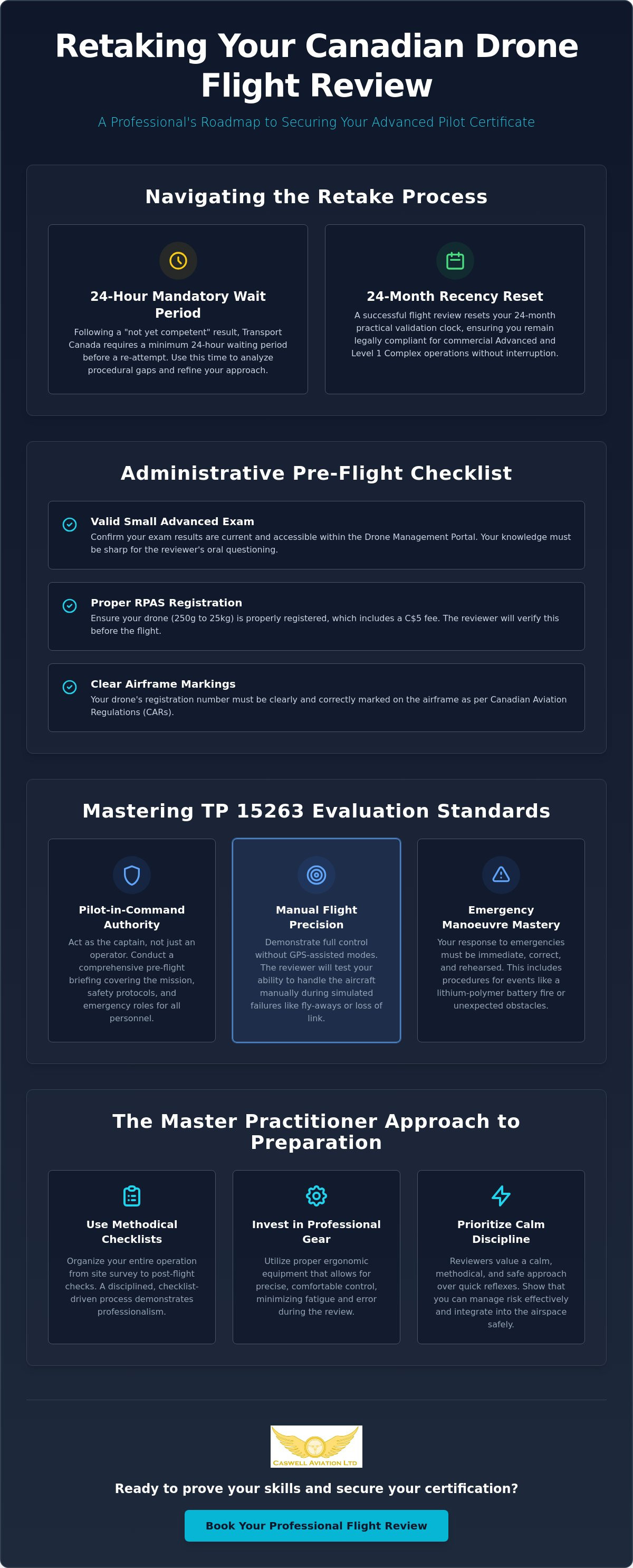
The process of retaking drone flight review Canada often begins with a moment of reflection. Whether you received a "not yet competent" result or your 24-month recency window is closing, a retake is a structured opportunity to prove your mastery of Canadian airspace. Under CARs Part IX, a flight review isn't just a hurdle; it's a regulatory necessity for anyone conducting Advanced or Level 1 Complex operations. Successfully completing this practical assessment does more than just earn you a certificate. It resets your 24-month recency clock, ensuring you remain legally compliant for commercial work. This "reset" is vital for professionals who need to maintain their standing without gaps in their operational authority.
A professional flight reviewer acts as more than an examiner. They serve as a mentor who verifies you can safely organize complex flights within the broader framework of Canadian drone regulations. This ensures that every pilot in controlled airspace possesses the discipline to manage risk effectively. Your reviewer will look for a calm, methodical approach to safety, rather than just quick reflexes. They want to see that you can integrate your aircraft into the national airspace system without compromising the safety of other aviators or the public.
When is a Retake Necessary?
If your previous attempt resulted in a "not yet competent" mark, don't be discouraged. Transport Canada requires a minimum waiting period of 24 hours before you can attempt the review again. Use this time to realize where gaps in your procedures exist. Beyond failures, many professionals seek a retake to maintain their status. Your Advanced Pilot Certificate requires practical validation every 24 months. If you've been operating under Basic rules and now need to fly in controlled airspace or near people, moving to an Advanced certificate requires this same practical milestone. Retaking drone flight review Canada is the only way to bridge that gap and expand your operational capabilities.
Administrative Prerequisites for Your Second Attempt
Before booking your second attempt, you must ensure your administrative standing is current. Confirm that your Small Advanced Exam results are still valid within the Drone Management Portal. While the exam results don't expire, your knowledge must remain sharp to satisfy the reviewer's oral questioning. Preparation is the difference between a stressful attempt and a successful one.
Your equipment must also be ready for inspection. Ensure your RPAS is properly registered, which involves a C$5 fee for drones between 250g and 25kg, and that your registration numbers are clearly marked on the airframe. For a detailed breakdown of current technical standards, consult our Transport Canada Drone Certification Guide. This preparation ensures that the administrative portion of the review is seamless, allowing you to focus entirely on your flight performance and emergency procedures.
Mastering the Skills That Reviewers Evaluate During a Retake
To pass when retaking drone flight review Canada, you must align your performance with the TP 15263 standards. This document serves as the definitive guide for evaluating pilot competency in the field. Reviewers use these criteria to grade your ability to manage a flight safely from the moment you arrive on site until the aircraft is powered down. Central to this evaluation is your Pilot-in-Command (PIC) authority. You aren't just a technician operating a remote; you are the captain of an aircraft in the national airspace. This role begins with a comprehensive pre-flight briefing that clearly explains the mission, safety protocols, and emergency roles to everyone involved in the operation.
Professionalism is further demonstrated through manual flight precision. While modern drones offer sophisticated GPS-assisted modes, a reviewer may ask you to fly without these aids to test your fundamental skills. You must show that you can maintain control during a simulated fly-away or a sudden loss of link without hesitation. If a lithium-polymer battery fire occurs, your response must be immediate and rehearsed. This level of mastery proves you can handle the unexpected, which is why emergency procedure mastery is a non-negotiable part of the advanced certification process.
Common Failure Points and How to Fix Them
Many pilots struggle because of inadequate site surveys. You must identify every potential hazard, including power lines, nearby bystanders, and local obstacles that could interfere with your flight path. Airspace awareness is equally critical. You must verify NOTAMs via NAV CANADA before the propellers even turn. Another frequent error is weak communication. Treat your reviewer as a crew member during the safety briefing. Clear, concise verbal commands demonstrate that you are in total control of the operation and the environment.
Precision Maneuvers and Manual Control
Reviewers look for steady hand-eye coordination during specific flight manoeuvres. You should be able to execute a rectangular pattern and 360-degree turns while maintaining a consistent altitude and heading. Simulating a "lost link" scenario is a common test during the process of retaking drone flight review Canada. You need to show that you can manage the aircraft safely even when telemetry data disappears or automated systems fail. These manual inputs are the hallmark of a professional pilot who has moved beyond hobbyist habits. If you feel your skills need sharpening before your next attempt, consider enrolling in InPerson Training to refine your technique under professional guidance.
Advanced vs. Level 1 Complex: Choosing the Right Certification Path
Determining which certification path aligns with your operational needs is a critical step when retaking drone flight review Canada. While most commercial pilots require a standard Advanced Operations certificate, certain industrial sectors demand the more rigorous Level 1 Complex certification. Caswell Aviation Ltd supports both pathways, providing professional assessments across the country to ensure pilots are qualified for their specific mission profiles. The primary difference lies in the level of risk management and technical complexity the pilot must demonstrate during the evaluation. Choosing the wrong path can lead to operational limitations or the need for additional reviews later.
The transition between these two levels of certification reflects the growing professionalization of the Canadian drone industry. As regulations evolve, the distinction between standard commercial work and high-risk industrial applications has become more defined. You must decide if your business model requires the flexibility of flying near people or the specialized authority needed for heavy-lift and long-range missions. Each path requires a different set of technical knowledge and practical skills that will be tested during your second attempt.
Advanced Operations (TP 15263)
The Advanced Operations certificate is the industry standard for pilots who need to fly in controlled airspace or within 30 metres of bystanders. This certification is essential for the majority of commercial photography, video production, and residential real estate professionals. The evaluation focuses on your ability to coordinate with NAV CANADA and maintain safety in populated areas. To ensure you are fully prepared for this specific assessment, we recommend reviewing our Advanced Drone Flight Review Checklist. This resource aligns with the TP 15263 standards and helps you organize your pre-flight procedures effectively.
Level 1 Complex Operations (TP 15530)
Pilots involved in industrial inspections, heavy-lift RPAS operations, or Beyond Visual Line of Sight (BVLOS) missions require the Level 1 Complex certification. This pathway involves a much higher degree of technical scrutiny under the TP 15530 standards. You must demonstrate a deep understanding of complex safety management systems (SMS) and the ability to interpret advanced aircraft telemetry. These operations often take place in highly restricted environments or involve specialized payloads that change the flight characteristics of the aircraft.
Because of the high stakes involved in Level 1 Complex reviews, many professionals find that self-study is insufficient. The assessment requires you to prove you can manage systemic risks and handle multi-layered emergency scenarios. We strongly recommend completing professional in-person training before attempting this high-level review. This structured preparation ensures you can meet the stringent requirements for industrial applications and heavy-lift operations with confidence.
Preparation Strategies: The Master Practitioner Approach
Adopting a Master Practitioner approach is the most effective way to ensure success when retaking drone flight review Canada. Professionalism in aviation is built on a foundation of disciplined checklists and methodical preparation. You should arrive at your review site with a clear plan, treating the environment as a controlled workspace rather than a casual flying field. This mindset begins with your field kit. Every tool, document, and spare component must be organized and immediately accessible. When a reviewer sees a pilot who can produce a site survey or a maintenance log without searching through a disorganized bag, they recognize a professional who respects the standards of the industry.
Your professional judgment is evaluated long before the aircraft leaves the ground. The "go/no-go" decision is perhaps the most critical demonstration of your authority as Pilot-in-Command. You must actively monitor local weather conditions and be prepared to postpone the review if wind speeds or visibility do not meet safety margins. Making the difficult call to cancel a flight due to environmental risks actually demonstrates higher competency than pushing through unsafe conditions. It shows the reviewer that you prioritize safety and regulatory compliance over convenience. This level of discipline is what separates a certified professional from a hobbyist.
The Role of Ergonomics in Flight Precision
Physical stability translates directly to flight accuracy. We recommend using a Fitek Gear drone harness to reduce pilot fatigue and stabilize your smart controller during the assessment. When your hands are free from the weight of the hardware, you can provide more precise manual inputs; this is essential during the 360-degree turn and rectangular pattern manoeuvres. A proper harness allows you to maintain a steady posture and better mental focus, preventing the physical strain that often leads to jittery stick movements during high-stakes evaluations. Comfort isn't just about luxury; it's a functional requirement for precision flight.
Final Study and Practice Tips
Even if you've already passed the written portion of your certification, your technical knowledge must be current for the oral component of the flight review. Review the Transport Canada Drone Exam Guide to refresh your understanding of airspace classifications and weather theory. Conduct mock reviews with a colleague to practice your safety briefings and emergency calls out loud. Finally, ensure all firmware is updated and your batteries are balanced 24 hours before your appointment. Arriving with a technically sound aircraft and a rehearsed procedure will significantly reduce your anxiety. To ensure you have the best possible setup for your retake, explore our range of Fitek Gear Drone Harnesses for Smart Controllers.
Booking Your Professional Flight Review with Caswell Aviation
Caswell Aviation Ltd provides a steady, professional environment for your assessment, focusing on aviation excellence and regulatory compliance. We understand that retaking drone flight review Canada can feel high-pressure; therefore, we prioritize a grounded atmosphere where safety and standards take precedence over flashy marketing. Our team integrates years of industry expertise with practical training and ergonomic gear to ensure you are fully prepared for the field. We serve as a holistic partner for pilots, guiding you from the initial consultation through to the final submission of your results in the Transport Canada portal.
Our national presence makes Caswell Aviation the preferred choice for professionals who require consistency and high-level technical authority. Whether you are operating a standard commercial airframe or a heavy-lift industrial system, our reviewers maintain a culture of discipline. We don't just observe your flight; we verify that your entire operational workflow meets the rigorous demands of Canadian aviation. This methodical approach ensures that you aren't just passing a test, but are truly prepared for the complexities of professional flight operations.
What to Expect from Our Professional Reviewers
Our reviewers function as veteran mentors who value education as much as evaluation. They use a structured, modular approach that mirrors actual commercial field operations, ensuring that the review feels like a standard day on the job rather than a clinical test. We offer national availability for both Advanced and Level 1 Complex certification reviews, accommodating pilots in various regions across the country. This consistency ensures that no matter where you are in Canada, you receive the same high standard of professional scrutiny and guidance during the process of retaking drone flight review Canada.
Finalizing Your Advanced Pilot Certificate
Once you have successfully demonstrated your competency, your reviewer will upload the results directly to the Drone Management Portal. You will then need to log in to pay the C$25 application fee to claim your Pilot Certificate - Advanced Operations. Maintaining your professional status requires ongoing discipline; you must keep your knowledge current and satisfy recency requirements every 24 months. By choosing a partner that values precision and compliance, you ensure your commercial operations remain legally sound and technically proficient. Schedule your professional RPAS flight review with Caswell Aviation today to secure your standing in the industry.
Advancing Your Professional Aviation Career
Transitioning from a previous setback to a successful certification requires a commitment to professional standards. By focusing on manual flight precision, adopting methodical pre-flight checklists, and utilizing ergonomic gear, you demonstrate the competency Transport Canada expects from a Master Practitioner. Whether you are aiming for standard Advanced operations or industrial applications, your preparation defines your results. Success is not just about stick skills; it's about proving you can manage a complex aircraft within the national airspace system safely and reliably.
When you are retaking drone flight review Canada, choosing a partner who understands the nuances of the 2026 Phase 2 regulations is essential. Our team provides the structured environment needed to reset your 24-month recency window and secure your professional standing. As Transport Canada approved Flight Reviewers and specialists in Level 1 Complex and Advanced certifications, we offer national service coverage for professional drone pilots. We invite you to book your professional RPAS flight review with Caswell Aviation today. You have the skills to succeed; we are here to help you prove them with confidence.
Frequently Asked Questions
Do I need to pass the Advanced written exam again before retaking my flight review?
No, you don't need to retake the written exam if you've already passed it. Once you successfully complete the Small Advanced Exam, the result remains valid in the Drone Management Portal indefinitely. However, you must ensure your theoretical knowledge is sharp, as the reviewer will conduct an oral assessment to verify you understand the current regulations and safety protocols before the flight begins.
How long must I wait to retake my RPAS flight review if I did not pass the first time?
You must wait a minimum of 24 hours before attempting a second flight review. Transport Canada mandates this waiting period to ensure pilots have sufficient time to reflect on their previous performance and correct any procedural errors. Use this interval to review the TP 15263 standards and practice the specific manoeuvres that led to the "not yet competent" result during your initial attempt.
Can I use a different drone for my retake than I used for my first attempt?
Yes, you're permitted to use a different aircraft for your second attempt. The drone must meet the safety assurance requirements for the specific operational category, such as flying in controlled airspace or near people. Ensure the new RPAS is registered for C$5 and that you've practiced its specific emergency procedures, as handling characteristics vary significantly between different models and manufacturers.
What is the cost of a professional flight review in Canada for 2026?
Flight review costs are determined by the individual flight school or reviewer, as Transport Canada doesn't regulate these service fees. Prices generally vary based on the level of certification, such as Advanced versus Level 1 Complex, and the reviewer's geographic location. In addition to the reviewer's fee, you must pay a C$25 application fee directly to Transport Canada to issue your certificate after passing.
Does a flight review retake satisfy the 24-month recency requirement?
Yes, successfully completing a flight review is a valid method for meeting the 24-month recency requirement under CARs Part IX. When you're retaking drone flight review Canada, a passing grade resets your recency window. This allows you to maintain your legal standing for commercial operations and ensures you're up to date with the Phase 2 regulatory changes introduced in late 2025.
Will the reviewer ask me technical questions from the written exam during the flight review?
Yes, the reviewer will conduct an oral knowledge test as part of the practical assessment. You must demonstrate a working knowledge of airspace classifications, NOTAMs, and weather theory. This ensures you can apply theoretical concepts to real-world flight decisions. Reviewers look for clear, confident answers that prove you can manage the responsibilities of a Pilot-in-Command without hesitating or searching through manuals.
Can I perform my flight review retake in controlled airspace?
Yes, you can perform your review in controlled airspace, provided the location is coordinated with the reviewer and all necessary authorizations are in place. Many pilots prefer this environment because it accurately reflects the conditions of professional commercial work. You'll need to demonstrate your ability to communicate effectively and comply with any NAV CANADA requirements or local air traffic control instructions during the session.
How soon will I receive my results after completing the review with Caswell Aviation?
You'll receive a verbal debrief immediately following the flight portion of the assessment. Our reviewers typically upload the official results to the Transport Canada portal on the same business day. Once the digital entry is complete, you can log in to your account, pay the required C$25 fee, and download your updated Advanced Pilot Certificate to resume your professional operations without delay.
Leave a comment