

How to Pass the Transport Canada Drone Exam: A Professional Guide for 2026
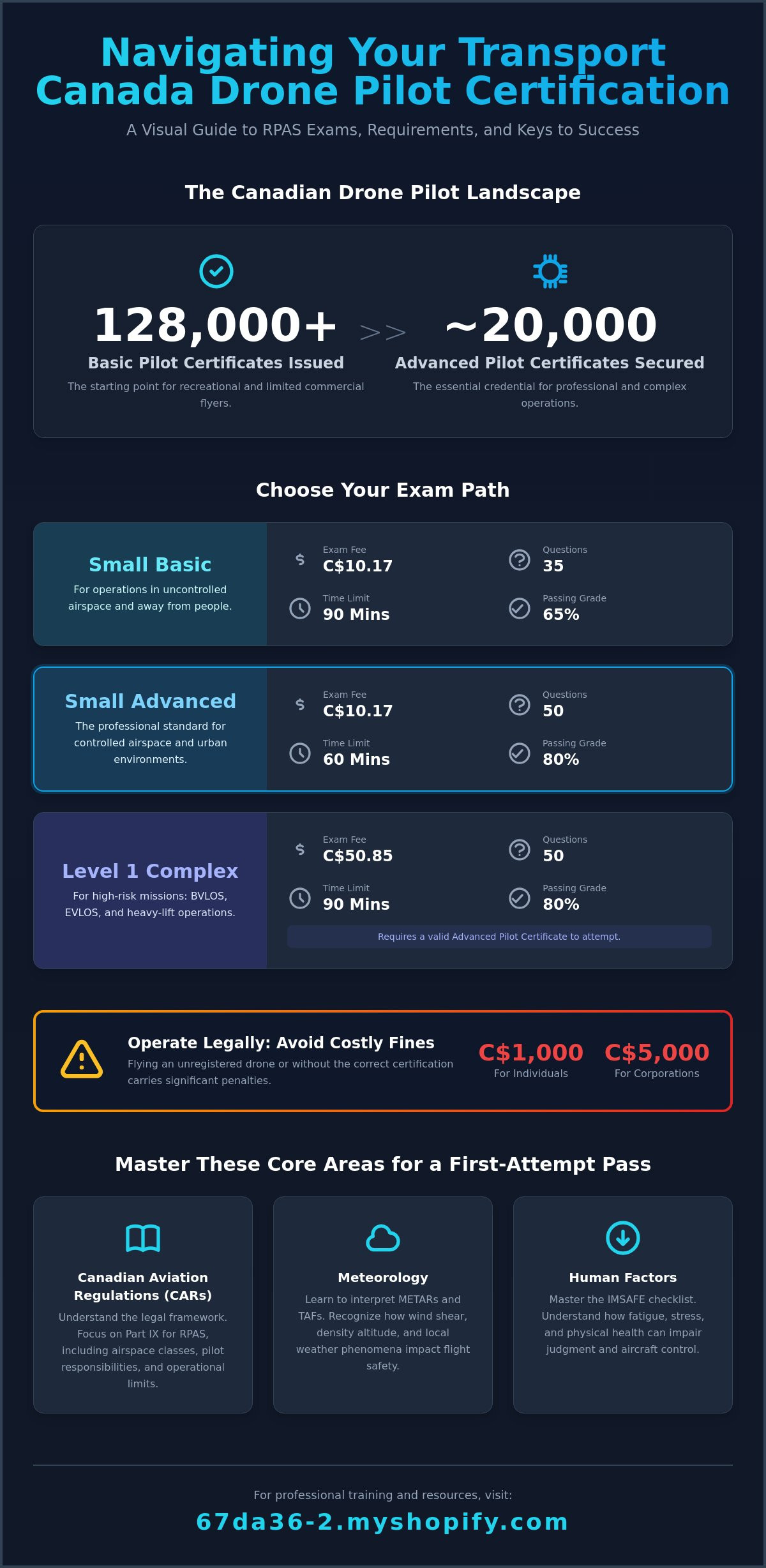
As of late 2025, Transport Canada had issued over 128,000 Basic Pilot Certificates, yet only about 20,000 pilots successfully obtained their Advanced certification. This disparity highlights a common challenge: the transition from recreational flying to professional operations is often hindered by technical jargon and a misunderstanding of the regulatory framework. If you're concerned about failing the exam or paying multiple C$10.17 re-take fees, you're not alone. Mastering how to pass Transport Canada drone exam is about more than just passing a test; it's about building a foundation for safe, compliant flight in a rapidly evolving industry.
We understand that the path to certification can seem complex, particularly with the 2026 updates regarding Level 1 Complex Operations and Remote ID. This guide provides a clear roadmap to help you master the RPAS exam using professional study strategies and technical insights. You'll learn how to distinguish between Basic and Advanced requirements, achieve a high score, and prepare for a successful Flight Review. By focusing on the Canadian Aviation Regulations (CARs) as a functional toolkit, you can move past the confusion and toward a successful career in the skies.
Key Takeaways
- Identify the specific requirements for Small Basic, Advanced, and Level 1 Complex operations to ensure you select the correct exam path for your professional goals.
- Learn how to pass Transport Canada drone exam by following a methodical study plan that prioritizes the TP 15263 knowledge requirements and structured training.
- Master the nuances of Canadian Aviation Regulations (CARs) and meteorology, including how to interpret METARs and TAFs for safe flight operations.
- Avoid frequent errors like misinterpreting distance-from-people rules or overlooking specific regulatory terminology that often leads to exam failure.
- Prepare for the transition from the written exam to the practical Flight Review by organizing professional site surveys and emergency procedure documentation.
Understanding the Transport Canada RPAS Exam Landscape
Obtaining a Pilot Certificate - Remotely Piloted Aircraft System (RPAS) is a mandatory legal requirement under the Canadian Aviation Regulations (CARs). This certification places you within the broader Canadian pilot licensing framework, establishing your professional status as a certified operator in national airspace. Transport Canada categorizes drone operations into three distinct tiers: Small Basic, Small Advanced, and the specialized Level 1 Complex certification. Each tier reflects a different level of operational risk and requires a specific set of technical competencies.
Success in this field begins with understanding the logistics and standards of the testing process. Every attempt at an exam requires a fee, and failing to meet the passing threshold triggers a mandatory 24-hour waiting period. When you are researching how to pass Transport Canada drone exam, you must account for these specific parameters:
- Small Basic Exam: C$10.17 fee, 35 multiple-choice questions, 90-minute time limit, and a 65% passing grade.
- Small Advanced Exam: C$10.17 fee, 50 multiple-choice questions, 60-minute time limit, and an 80% passing grade.
- Level 1 Complex Exam: C$50.85 fee, 50 multiple-choice questions, 90-minute time limit, and an 80% passing grade.
The legal weight of these certificates is significant. Flying an unregistered drone or operating without the correct certification can result in fines of C$1,000 for recreational users and up to C$5,000 for commercial entities. Professionals must treat these exams with the same discipline as traditional aviation training.
Basic vs. Advanced: Which Exam Should You Take?
The choice between Basic and Advanced depends entirely on your intended flight environment. Basic operations are limited to uncontrolled airspace and require you to maintain a horizontal distance of at least 30 metres from bystanders. If you plan to fly in controlled airspace or near people, you must obtain an Advanced certificate. We recommend that professional pilots aim for the Advanced level from the start. It provides the operational flexibility needed for urban photography, construction site monitoring, and most commercial contracts. It's a more rigorous path, but it prevents the need for future re-certification when your business needs evolve.
The Level 1 Complex Certification
Introduced in late 2025, the Level 1 Complex certification is designed for high-risk missions that were previously restricted. This tier covers operations such as Beyond Visual Line of Sight (BVLOS) and Extended Visual Line of Sight (EVLOS). To qualify, a pilot must pass both the Advanced written exam and the Level 1 Complex written exam. This certification is essential for industrial inspectors and heavy-lift drone operators who work in complex environments where standard Advanced rules are insufficient. Mastering how to pass Transport Canada drone exam at this level requires a deep understanding of manufacturer safety declarations and advanced navigation procedures.
Core Knowledge Areas: What You Must Master
To succeed on the exam, you must move beyond simple drone operation and adopt a professional aviation mindset. The syllabus is broad. However, focusing on core competencies is the most efficient way to understand how to pass Transport Canada drone exam. Many candidates struggle because they treat the test as a memory exercise rather than a professional certification. True proficiency requires a systematic approach to technical data and regulatory frameworks.
Weather theory is a frequent stumbling block for new pilots. You don't need to be a professional meteorologist, but you must be able to interpret Meteorological Aerodrome Reports (METARs) and Terminal Aerodrome Forecasts (TAFs). Transport Canada expects you to understand how local weather effects, such as wind shear, density altitude, or microbursts, impact flight safety. Mastering these codes is essential for passing the meteorology section of the exam.
Aviation safety also includes the pilot's physical and mental state. Fatigue, stress, and even a common cold can impair your decision-making and reaction times. The exam tests your ability to recognize these "Human Factors" and apply the IMSAFE checklist before every flight. Understanding how your own physiology affects the aircraft is a critical component of the professional pilot's toolkit.
Navigating the CARs (Canadian Aviation Regulations)
Part IX of the CARs is the legal foundation for all RPAS operations in Canada. It defines your responsibilities regarding drone registration, flight logs, and maintenance records. A critical area of study is the "Right of Way" rule. You must demonstrate an absolute commitment to yielding to manned aircraft in all scenarios. Additionally, while Transport Canada regulates the airspace, you remain responsible for respecting privacy and trespassing laws. Referencing the official Transport Canada guide will help you align your study habits with current legal expectations and regulatory standards.
Airspace Classification and Charts
You must be able to decode Class A through G airspace. Class F (Special Use) and Class C (Control Zones) are particularly critical for the Advanced exam. Identifying "Built-up Areas" on VFR Navigation Charts (VNC) or VFR Terminal Area (VTA) charts is essential for compliance. These charts use specific colours and symbols to denote hazards, altitudes, and communication frequencies. Always check NOTAMs (Notices to Airmen) to ensure your flight path isn't restricted by temporary hazards, such as forest fires or VIP movements. If these technical requirements feel overwhelming, consider enrolling in structured online drone courses to simplify the complex theory.
A Step-by-Step Study Plan to Pass on Your First Attempt
Success on the RPAS exam requires a methodical approach. Relying on random forum advice or outdated video tutorials often leads to confusion, as these sources rarely reflect current Canadian regulations. If you want to know how to pass Transport Canada drone exam efficiently, you must treat your preparation like a professional flight training syllabus. A structured plan ensures you cover every required competency without wasting time on irrelevant material.
- Step 1: Download the TP 15263 Knowledge Requirements document. This is your primary syllabus. It outlines every topic Transport Canada can test you on, from air law to radiotelephony.
- Step 2: Enrol in a structured Transport Canada drone certification course. Professional ground school provides the context that raw documents lack, helping you understand the logic behind the rules.
- Step 3: Create a "Cheat Sheet" for weather codes and airspace classes. Summarizing METAR abbreviations and the specific dimensions of Class C or D airspace into a single visual reference helps solidify your memory.
- Step 4: Take timed practice exams. The Advanced exam only gives you 60 minutes for 50 questions. You must realize your pace early to ensure you don't run out of time on the actual test day.
- Step 5: Review the Drone Management Portal interface. Familiarize yourself with how to navigate the portal before you pay your fee to avoid technical stress during the exam.
Utilizing the official study resources provided by the government is a good starting point, but these documents are often dense and technical. Supplementing them with professional guidance is often the difference between a passing grade and a failed attempt.
The Value of Professional Ground School
Self-study often leads to significant gaps in safety-critical knowledge. While the regulations are public, they're written in complex legal language that's difficult to apply to real-world flight. Professional instructors serve as mentors who translate aviation jargon into plain English. At Caswell Aviation Ltd, our approach focuses on simplifying complex concepts like weight and balance or longitudinal stability. We provide the technical authority you need to feel confident, ensuring you don't just memorize answers but actually understand the principles of flight.
Active Recall and Spaced Repetition
Passing the exam is easier when you focus on the "why" behind each regulation. For example, understanding why you must stay 30 metres from bystanders helps you remember the rule better than rote memorization. Use flashcards for high-frequency topics like emergency procedures and radio communication codes. This technique, known as active recall, is highly effective for technical certifications. If you don't succeed on your first try, remember the 24-hour rule. You must wait one full day before paying the C$10.17 fee to attempt the exam again. Use that time to review your weakest areas as identified in your exam feedback. Mastering how to pass Transport Canada drone exam is a process of refinement and discipline.
Avoid These Common Mistakes That Lead to Exam Failure
Many candidates approach the RPAS testing process as a standard academic hurdle. However, Transport Canada designs these questions to test your "Aviation Mindset," which requires precise interpretation of regulatory language. Understanding how to pass Transport Canada drone exam involves recognizing that the most common causes of failure aren't a lack of knowledge, but rather a lack of attention to detail. Small errors in reading a chart or a regulation can lead to a cascading series of incorrect answers.
A frequent error involves misinterpreting the "Distance from People" rules. In the Basic category, you must maintain a 30-metre horizontal distance from bystanders. In the Advanced category, this distance can be reduced to 5 metres, provided you're using a drone with the appropriate manufacturer safety declaration. Pilots often fail because they confuse these horizontal limits with vertical ones, or they apply Advanced distance rules to Basic operations. Always verify the operation category and the specific equipment requirements before selecting your answer.
Ignoring the "small print" on aviation charts is another critical pitfall. When reviewing Class C or D airspace, candidates often miss the vertical limits. Airspace boundaries are rarely uniform. They often change at different altitudes or locations. If you spend too much time on a single complex navigation or math question, you risk rushing the final section of the test. With only 60 minutes for the 50-question Advanced exam, effective time management is as important as technical knowledge.
Decoding Transport Canada Question Logic
The exam often presents multiple answers that seem plausible. Your task is to identify the "most correct" option based on the Canadian Aviation Regulations. Professional pilots use a process of elimination to remove "distractors"-answers designed to look correct to an untrained eye but containing a slight technical flaw. While "shall" and "must" signify a mandatory legal obligation, "may" indicates that an action is permitted but not required under the regulations. To ensure you are fully prepared for these nuances, consider our comprehensive online drone courses which break down regulatory logic into manageable lessons.
Technical and Environmental Preparation
The environment where you take your exam can impact your performance. Organize your physical study centre to be free of distractions during the 90-minute window. A simple technical glitch, such as a drop in your internet connection, can reset your progress or cause the portal to time out. If you encounter a technical issue on the Drone Management Portal, document the error immediately. Ensure your computer is updated and you're using a supported browser to minimize the risk of technical failure during your attempt. Success is built on a foundation of both technical proficiency and environmental control.
From Written Success to the Practical Flight Review
Achieving a passing grade on the written test is a significant milestone, but for those pursuing professional certification, it's only the first half of the journey. For Advanced or Level 1 Complex operations, your written results are a prerequisite for the practical assessment. To receive your official Pilot Certificate, you must demonstrate your technical proficiency to a qualified reviewer. While your study habits taught you how to pass Transport Canada drone exam, the Flight Review proves you can apply that knowledge in a real-world operational environment.
Booking your Advanced & Level 1 Complex Flight Review with a veteran mentor ensures that your assessment is conducted with a focus on industry standards. This practical stage is not merely a flight test; it's a comprehensive audit of your safety culture and decision-making abilities. You'll be expected to manage the flight area, coordinate with bystanders, and handle simulated emergencies with steady, professional confidence. Transitioning from a student to a certified professional requires a commitment to these high-stakes operational requirements.
The Flight Review Preparation Checklist
Preparation for the practical review begins long before you arrive at the flight centre. You must have your documentation organized and ready for inspection. A reviewer will verify your basic pilot certificate, drone registration, and maintenance logs. Performing a professional site survey is the most effective way to impress a reviewer. This document should identify all potential hazards, including power lines, obstacles, and nearby controlled airspace. Demonstrating command and control is essential. A steady hand is required during manoeuvres to prove you can maintain the aircraft's position even in challenging conditions. If you've completed structured in-person training, you'll likely feel more prepared for these technical demands.
Professional Gear for Field Operations
Ergonomic readiness is a frequently overlooked aspect of the practical assessment. Using professional equipment, such as a Fitek Gear drone harness for smart controllers, significantly improves stability and pilot comfort during long missions. These harnesses redistribute the weight of the controller, allowing you to focus entirely on the flight rather than physical strain. Good ergonomics reduce fatigue, which is critical during the high-pressure environment of a Flight Review or a long commercial inspection. As you transition from a student pilot to a professional aerial media specialist, your gear should reflect your commitment to precision and safety. Maintaining a professional toolkit is just as important as mastering the regulations when building a successful career in the Canadian drone industry.
Advancing Your Professional Drone Career in 2026
The landscape of RPAS operations in Canada is more rigorous than ever, particularly with the integration of Level 1 Complex operations and Remote ID. Navigating these requirements demands a shift from simple memorization to a functional understanding of aviation standards. By following a structured study plan and avoiding the common pitfalls of regulatory interpretation, you've established the foundation for a successful career. Mastering how to pass Transport Canada drone exam is the critical first step that separates recreational flyers from professional aerial specialists.
Once you've secured your written results, the focus shifts to the practical application of these rules during your Flight Review. Master your exam with Caswell Aviation Ltd’s Professional Drone Courses. Our team features Transport Canada Advanced and Level 1 Complex specialists who bring a veteran mentor instruction style to every lesson. We also provide expert flight reviewers to ensure you are fully prepared for the field. The Canadian drone industry offers significant opportunities for those who prioritize discipline, safety, and technical proficiency. We look forward to seeing you in the airspace.
Frequently Asked Questions
How many questions are on the Transport Canada Advanced drone exam?
The Small Advanced exam consists of 50 multiple-choice questions. You have a strict 60-minute time limit to complete the session. This requires a steady pace of just over one minute per question. Because the passing threshold is 80%, you must have a firm grasp of the material to avoid spending too much time on any single technical problem.
Can I use my notes during the Transport Canada drone exam?
Yes, the exam is technically open-book, which means you can reference your notes or the Canadian Aviation Regulations during the test. However, relying on external documents is a common mistake. The time constraints are designed to test your actual knowledge. If you stop to look up every answer, you will likely run out of time before completing the 50 questions required for the Advanced certification.
What happens if I fail the Transport Canada drone exam?
If you do not achieve a passing grade, you must wait 24 hours before you can attempt the exam again. There is no limit to the number of retakes permitted by Transport Canada. However, you must pay the exam fee for every attempt. We suggest using the waiting period to review your results and refine your strategy on how to pass Transport Canada drone exam by focusing on the specific sections where you lost marks.
How long is the Transport Canada drone pilot certificate valid for?
A drone pilot certificate does not expire once issued. To keep your certificate valid for flight, you must meet a recency requirement every 24 months. You can satisfy this by retaking an exam, passing a flight review, or completing a recognized recurrent training program. Maintaining these records in your pilot logbook is a mandatory requirement for all professional operators in Canada.
Do I need a radio licence (ROC-A) for the Advanced drone exam?
You are not required to hold a Restricted Operator Certificate-Aeronautical (ROC-A) to take the written exam. However, a radio licence is mandatory if your flight operations require communication with air traffic control or other aircraft. Most professional pilots obtain their ROC-A as part of their certification stack to ensure they can legally operate in controlled airspace or near busy aerodromes.
Is the Small Basic exam a prerequisite for the Advanced exam?
No, the Small Basic exam is not a prerequisite. You can choose to challenge the Advanced exam directly if your operational needs involve flying in controlled airspace or within 30 metres of bystanders. Skipping the Basic tier is a common path for professionals. However, you should realize that the Advanced exam is much more difficult, featuring a higher passing grade and more complex technical questions.
How much does it cost to take the Transport Canada drone exam in 2026?
In 2026, the fee for both the Small Basic and Small Advanced exams remains C$10.17 per attempt. The Level 1 Complex exam is more expensive at C$50.85 per attempt. Additionally, you must account for the C$10 registration fee for each drone you operate. These costs are paid directly through the Drone Management Portal. Understanding how to pass Transport Canada drone exam on your first try will help you avoid paying these fees multiple times.
What is the passing grade for the Level 1 Complex drone exam?
The passing grade for the Level 1 Complex exam is 80%. This test includes 50 multiple-choice questions and provides a 90-minute window for completion. The higher stakes of complex operations, such as Beyond Visual Line of Sight (BVLOS), mean the technical standards are very high. You must demonstrate a mastery of manufacturer safety declarations and advanced navigation procedures to pass this tier successfully.
Leave a comment