
Transport Canada Drone Certification Course: The Professional Pilot’s Path for 2026
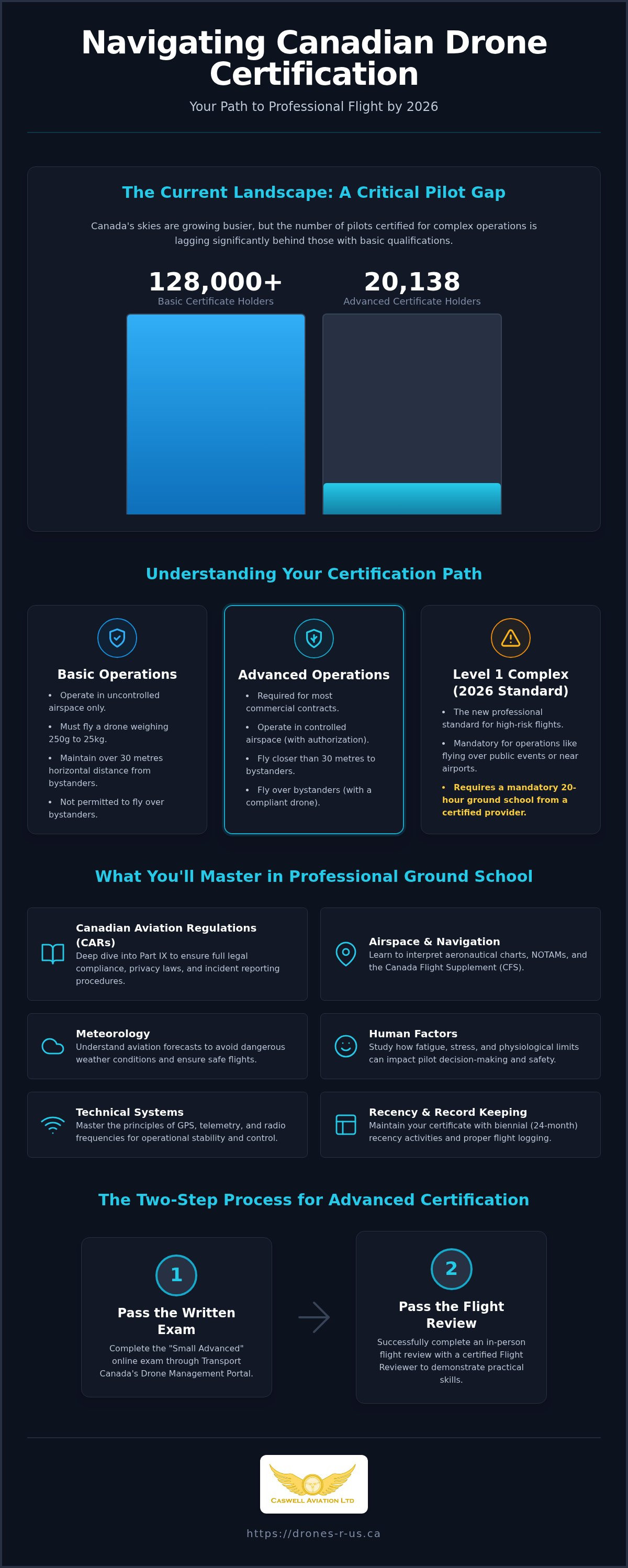
By 2045, Canada’s skies are projected to handle over 19 million drone operations annually, yet today, only 20,138 pilots hold an Advanced certificate compared to more than 128,000 at the Basic level. This gap highlights a common challenge in the industry. Mastering the Canadian Aviation Regulations (CARs) is a technical task, and the specific demands of the 20-hour ground school for Level 1 Complex operations can feel like a significant barrier to your professional growth. It is natural to feel some anxiety about the Advanced Flight Review or the rigour of Transport Canada drone exam preparation when your commercial reputation is on the line.
We believe that professional training acts as a bridge between reading the rules and mastering the flight. This guide outlines the exact path to earning your certificate in 2026, ensuring you meet every legal requirement for high-value contracts. You will gain a clear understanding of the latest regulatory updates, the practical skills needed to pass on your first attempt, and the disciplined mindset required to operate safely in controlled airspace.
Key Takeaways
- Identify whether your flight operations fall under Basic, Advanced, or the new Level 1 Complex category to ensure full legal compliance for your commercial contracts.
- Learn to navigate the Canadian sky by mastering airspace classifications, meteorology, and the technical requirements taught in professional ground schools.
- Optimize your Transport Canada drone exam preparation by following a proven two-step process for passing written exams and the mandatory Advanced Flight Review.
- Understand the 2026 standards for Level 1 Complex operations, including the mandatory 20-hour ground school requirement for high-risk drone flights.
- Discover how bridging the gap between theory and practice with veteran-led training builds the operational confidence needed for professional aviation.
Understanding the Transport Canada Drone Certification Landscape
Under the 2026 Canadian Aviation Regulations (CARs), a Remotely Piloted Aircraft System (RPAS) is defined as a set of configurable elements. This includes the remotely piloted aircraft, its control station, and the command and control links required for flight. This technical definition reflects the shift toward a more regulated and professional aviation environment. Effective Transport Canada drone exam preparation begins with a clear grasp of this landscape and the specific legal obligations attached to your pilot certificate.
Transport Canada evaluates your flight requirements based on a "where, how, and what" framework. This logic determines which of the three primary categories you fall into: Basic, Advanced, or the newly implemented Level 1 Complex Operations. The Transport Canada Drone Regulations establish that you're legally required to carry a valid pilot certificate during every flight operation. Whether you carry a digital copy or a physical card, failing to produce this document during an inspection can result in significant individual or corporate fines. Compliance is not optional for professional pilots.
Basic vs. Advanced Operations: Which Path to Choose?
Basic operations are restricted to uncontrolled airspace. You must maintain a horizontal distance of at least 30 metres from bystanders at all times. While these rules suit many hobbyists, most professionals find these limits too restrictive for commercial work. Urban centres and industrial sites are often located within controlled airspace or require flying in closer proximity to people. This necessitates an Advanced certificate. Transitioning from a recreational mindset to a professional one requires a disciplined approach to certification. Most commercial contracts in Canada now specify an Advanced certificate as a minimum prerequisite for insurance and liability purposes.
The Legal Framework: Why a Professional Course Matters
Enrolling in a professional course is the most reliable way to mitigate the risk of non-compliance. Your certification journey is managed through the Drone Management Portal. This is where you register your aircraft, pay fees, and track your certificates. It's also where you'll verify your biennial recency requirements. Your certificate remains valid only if you complete a flight review or an approved training activity every 24 months. Professional training at Caswell Aviation Ltd ensures you don't just pass the test, but also establish the record-keeping habits necessary for long-term legal standing. Staying current is a core part of aviation culture.
What You Will Learn in a Professional Drone Ground School
Professional ground school provides the technical depth required to operate safely in complex environments. This training covers more than just the basics of flight. It introduces you to the structured world of aviation. You will learn to navigate the Canadian sky by understanding airspace classifications from Class A to Class G. This knowledge is a cornerstone of Transport Canada drone exam preparation, as it allows you to interpret NOTAMs and aviation forecasts with precision. This ensures you never fly into restricted areas or dangerous weather conditions.
Interpreting aeronautical charts and the Canada Flight Supplement (CFS) is a vital skill. These documents provide the data needed for pre-flight planning and site surveys. Ground school also addresses the "Human Factors" of flight. You will study how fatigue, stress, and physiological limits impact your decision-making. A pilot's mental state is as critical as the drone's hardware. Maintaining a disciplined mindset helps prevent the errors that lead to accidents.
Mastering Canadian Aviation Regulations (CARs)
A significant portion of Getting a drone pilot certificate involves a deep dive into Part IX of the CARs. These are the specific rules governing drone operations in Canada. You must memorize these regulations to avoid legal liability. Training also covers privacy laws and trespassing. Professional aerial photography requires an understanding of where your rights end and another person's privacy begins. If an incident occurs, you will know the exact reporting procedures required by Transport Canada.
Navigation and Technical Systems
Technical mastery is essential for operational stability. You will study how GPS, telemetry, and radio frequency interference affect your RPAS. Ground school provides rigorous safety protocols for high-capacity LiPo battery packs. These packs require specific storage and charging habits to prevent fires. Finally, you will learn to maintain a detailed maintenance log. Keeping your system airworthy is a legal requirement under the 2026 standards. Detailed Transport Canada drone exam preparation focuses on these practical technicalities to ensure you pass the written test and the flight review. If you're ready to start your journey, consider our online drone courses designed for the modern professional.
Preparing for the Advanced Flight Review and Written Exams
Obtaining an Advanced certificate requires a disciplined, two-step approach. You must first pass the Advanced online exam, which carries a $10 fee. Only after receiving your results are you eligible to book your practical assessment. This sequence ensures every pilot has a firm grasp of aviation theory before operating in controlled airspace or near bystanders. Effective Transport Canada drone exam preparation involves more than just memorizing facts. It requires understanding how those facts apply to real-world safety. Once you clear the written hurdle, you can schedule an in-person session with an authorized Transport Canada Flight Reviewer.
Study Strategies for the Advanced Online Exam
The Advanced online exam consists of 50 multiple-choice questions. You have a 60-minute time limit to finish and must achieve a passing grade of at least 80%. To prepare, treat the Transport Canada Aeronautical Information Manual (AIM) as your primary textbook. It's the authoritative source for the technical data you'll encounter. We recommend using practice exams to simulate the pressure of the timed environment. This helps you manage your pace and identifies areas where your knowledge might be thin. The Aerial Evolution Association of Canada often highlights that professional standards in our industry begin with this level of academic rigour. Success on the first attempt saves time and allows you to move quickly toward your practical flight review.
The In-Person Flight Review: A Practical Walkthrough
The flight review is where theory meets practice. A reviewer evaluates your ability to manage a safe flight operation from start to finish. This begins with your documentation. You must provide a professional site survey, a detailed emergency response plan, and accurate pilot logs. Many candidates fail because they treat these documents as secondary. In reality, they're the first thing a reviewer examines. If your site survey doesn't account for nearby obstacles or local airspace restrictions, the review may end before the drone even leaves the ground.
During the technical portion, you'll demonstrate command and control through a series of flight manoeuvres. You're expected to handle simulated emergencies, such as a lost-link scenario or a sudden equipment failure, with calm precision. Reviewers look for a pilot who remains in control of the situation at all times. For a complete breakdown of the specific assessment criteria, you can consult our professional guide on What is a Drone Flight Review in Canada?. Avoiding common mistakes, like poor situational awareness or incomplete checklists, is the key to securing your certificate on your first attempt.
Level 1 Complex Operations: The 2026 Professional Standard
The Level 1 Complex category represents the highest tier of standard drone operations in Canada. It was introduced to manage the risks associated with flying larger aircraft or operating in densely populated environments. If your business requires drones weighing 25kg or more, or if you intend to fly in high-risk zones, this certification is mandatory. Unlike Basic or Advanced paths, the Level 1 Complex certificate requires an online exam with a C$50.85 fee and a passing score of at least 80%. This level of certification is the primary gateway for heavy-lift industrial applications, such as agricultural spraying or large-scale infrastructure inspections.
Self-study is no longer sufficient for this category. Transport Canada now mandates a 20-hour ground school delivered by a qualified training provider. This requirement ensures that pilots operating heavy-lift systems possess a depth of knowledge comparable to traditional aviators. Your Transport Canada drone exam preparation at this level must be rigorous and structured. Beyond the pilot certificate, complex missions often require an RPAS Operator Certificate (ROC-C). This document establishes your organization as a professional aviation entity capable of managing complex safety risks.
The 20-Hour Ground School Curriculum
The curriculum for Level 1 Complex operations focuses on the physics and logistics of high-stakes flight. You will study advanced aerodynamics specifically for heavy-lift RPAS, where weight and balance calculations become critical for stability. Coordination with NAV CANADA is another core component. You'll learn the protocols for entering complex controlled airspace and communicating with air traffic control. Advanced risk management strategies are also a priority. These modules teach you how to implement multi-layered mitigations when operating near high-population areas or critical infrastructure. Professional Transport Canada drone exam preparation ensures you can navigate these technical requirements while maintaining full legal compliance.
Scaling Your Drone Business with Complex Certification
Holding a Level 1 Complex certificate provides a significant competitive advantage. Many corporate and government contracts now require this specific credential to ensure the highest level of safety and reliability. It allows you to manage a fleet of drones and multiple pilots under a single ROC-C, streamlining your operations. This certification is the foundation for long-term growth in the industrial sector. For a broader look at the path ahead, read The Complete Guide to Transport Canada Drone Certification.
Transitioning into these high-stakes operations requires a partner who understands the regulatory nuances. If you're ready to expand your capabilities, explore our Advanced and Level 1 Complex training programs to secure your professional future.
Maximizing Operational Success with Caswell Aviation Ltd Training
Caswell Aviation Ltd serves as the bridge between regulatory theory and operational mastery. Our veteran-led approach focuses on establishing a disciplined aviation culture rather than just checking boxes. For professionals, Transport Canada drone exam preparation is about more than passing a test. It's about building the confidence to handle high-stakes commercial contracts. We combine the flexibility of an online training platform with the technical depth of in-person practical sessions. This synergy ensures that students understand the logic behind the regulations before they take the controls. Our goal is to transition every student from a basic operator into a master practitioner.
Professional Gear for Professional Pilots
Safety-critical missions often require hours of sustained concentration. This is where professional gear becomes a necessity. We retail Fitek Gear harnesses for smart controllers to address the physical demands of long-duration flights. These ergonomic systems distribute weight across the shoulders and back, which significantly reduces pilot fatigue. When you aren't fighting the physical weight of a controller, your focus remains on the mission and the surrounding airspace. Comfort is a functional component of flight safety. For a detailed look at selecting the right equipment for your specific setup, see our guide on Choosing the Best Drone Harness for Smart Controllers.
Start Your Certification Journey Today
Enrolling in our online Advanced or Level 1 Complex courses is the first step toward your professional goals. Our curriculum is updated for 2026 standards, ensuring your Transport Canada drone exam preparation remains accurate and effective. Once you complete the theory, you can schedule a national flight review with our authorized reviewers. We guide you through the site survey and emergency planning phases to ensure you're ready for the assessment. The 2026 drone industry demands a high level of aviation discipline. By choosing a partner that values compliance and precision, you position yourself as a reliable leader in the Canadian field.
- Enroll in comprehensive online ground school modules tailored for professional success.
- Access expert mentorship to navigate complex CARs and NAV CANADA requirements.
- Schedule your Advanced or Level 1 Complex flight review with authorized Transport Canada reviewers.
- Equip your team with Fitek Gear harnesses to maintain focus during industrial missions.
Success in the modern drone industry requires a commitment to lifelong learning. Beyond the initial certificate, we provide ongoing support and mentorship to help you scale your operations. Whether you are managing a single drone or a corporate fleet, our training programmes provide the stability and knowledge needed to operate safely in Canada's evolving airspace. Explore our Advanced and Level 1 Complex training programs to secure your professional future.
Advancing Your Aviation Career in 2026
The transition toward high-stakes drone operations requires a commitment to safety and regulatory precision. Mastering the Canadian Aviation Regulations and completing the mandatory 20-hour ground school for Level 1 Complex operations are essential steps for any pilot seeking commercial success. Your Transport Canada drone exam preparation should focus on establishing a disciplined aviation culture that ensures long-term compliance. This foundation allows you to secure high-value contracts and operate with complete operational confidence.
Caswell Aviation Ltd provides the technical authority and veteran-led professional pilot mentorship you need to succeed. Our curriculum includes a comprehensive Level 1 Complex 20-hour ground school and access to authorized Transport Canada Flight Reviewers. We don't just help you pass a test; we prepare you for the realities of professional flight. Enroll in a Transport Canada Drone Certification Course at Caswell Aviation Ltd to bridge the gap between reading the rules and mastering the sky. The Canadian drone industry is evolving quickly, and we're ready to help you lead the way.
Frequently Asked Questions
Do I need a drone license to fly for fun in Canada?
You need a pilot certificate if your drone weighs 250 grams or more. Drones between 250g and 25kg require at least a Basic certificate, even for recreational use. Micro-drones under 250g are exempt from registration and licensing but must be operated safely. If you're flying for fun with a larger drone, you must follow the same Part IX regulations as commercial pilots to avoid fines or legal issues.
How long does a Transport Canada drone certification course take to complete?
Completion times vary by the level of certification you seek. Basic and Advanced online courses can often be finished in 10 to 15 hours of study. However, the Level 1 Complex path includes a mandatory 20-hour ground school curriculum. Your total Transport Canada drone exam preparation time depends on your familiarity with aviation charts and regulations. Dedicated students usually move from enrollment to their flight review within two to four weeks.
What is the difference between an Advanced and a Level 1 Complex certificate?
An Advanced certificate permits flight in controlled airspace and within 30 metres of bystanders. The Level 1 Complex certificate is the standard for high-risk operations, including drones weighing 25kg or more. This tier requires a harder written exam and a mandatory 20-hour ground school. It's designed for industrial professionals who need to manage heavy-lift systems or coordinate with NAV CANADA for complex missions in densely populated urban environments.
Can I fail a drone flight review? What happens if I do?
You can fail a flight review if you don't meet the assessment criteria or demonstrate unsafe flying habits. If this happens, your reviewer will explain the reasons for the failure and identify specific areas for improvement. You can re-attempt the review once you've practiced the necessary manoeuvres. You'll need to schedule a new session and pay the reviewer's fee again. Thorough practice and a professional site survey help ensure success.
How much does it cost to get a drone pilot certificate in 2026?
Certification involves several government fees. The Basic and Advanced online exams cost C$10 each. The Level 1 Complex exam fee is C$50.85. You must also pay C$5 to register each drone you own. In-person flight reviews for Advanced pilots generally cost between C$200 and C$400, depending on the reviewer. These figures don't include the cost of professional ground school training, which varies by the depth of the course and mentorship provided.
Is the Transport Canada drone exam available in French and English?
All Transport Canada drone exams and portal resources are available in both English and French. You can select your language of choice within the Drone Management Portal before starting your exam. This ensures that every pilot in Canada can accurately demonstrate their understanding of the Canadian Aviation Regulations. Professional training materials from private schools are also frequently offered in both languages to support a diverse national pilot community.
Do drone pilot certificates expire in Canada?
Drone pilot certificates don't expire, but your right to fly depends on maintaining recency. You must complete a recency activity every 24 months to keep your certificate valid. This can include passing a flight review, completing a Transport Canada-approved training course, or attending a safety seminar. If you can't provide proof of recency during an inspection, your certificate isn't considered valid. It's your responsibility to track these biennial requirements in your logs.
What drones require a Level 1 Complex certification?
Drones weighing 25kg or more always require a Level 1 Complex certification. This category is also mandatory for certain high-risk operations involving smaller drones, such as flying in specific types of restricted airspace. These systems are common in sectors like agriculture and heavy industry. Proper Transport Canada drone exam preparation for this level focuses on advanced aerodynamics and risk mitigation strategies. This ensures you can safely manage the significant kinetic energy of larger aircraft.
Leave a comment