

The Essential Pre-Flight Checklist for Commercial Drone Pilots in Canada (2026)
In professional aviation, a checklist isn't just a memory aid; it's a legal document and the foundation of flight safety. You likely understand the pressure of arriving at a job site with a paying client watching your every move. The anxiety of a potential equipment failure or the threat of a $5,000 corporate fine can be overwhelming if you don't have a disciplined routine. Implementing a rigorous pre-flight checklist for commercial drone pilots is the only way to transition from a basic operator to a master practitioner who commands respect on the field.
We agree that keeping up with Transport Canada's evolving CARs Part IX requirements can feel like a moving target. This guide will help you master the professional protocols required to ensure every mission is safe, legal, and efficient. You'll learn how to build a repeatable workflow that provides legal protection through proper documentation while reducing the risk of mid-flight incidents. We will break down the essential three-phase checklist architecture, covering everything from NAV Drone authorizations to the mandatory site survey requirements under CAR 901.27. By the end, you'll have the tools to organise your flight deck with the same precision we teach in our advanced certification courses at Caswell Aviation Ltd.
Key Takeaways
- Understand the legal necessity of a documented site survey to meet Transport Canada's CAR 901.27 requirements and avoid significant administrative penalties.
- Implement a structured, three-phase pre-flight checklist for commercial drone pilots to manage everything from initial mission planning to final launch protocols.
- Learn to identify critical environmental hazards and establish safe takeoff, landing, and emergency recovery zones during your on-site physical inspection.
- Master technical system verifications, including fail-safe settings and frequency checks, to ensure aircraft serviceability before every flight.
- Discover how professional flight logging and advanced certification training reduce the mental load of complex operations and protect your pilot certificate.
Understanding Transport Canada’s Mandatory Pre-Flight Requirements
Transport Canada doesn't view a pre-flight routine as a suggestion; it's a regulatory mandate. Under the Canadian Aviation Regulations (CARs), specifically CAR 901.23, every pilot must establish and follow normal operating procedures before launch. This includes a comprehensive review of emergency protocols by all crew members. A documented pre-flight checklist for commercial drone pilots is the only way to demonstrate compliance during a field audit. It transforms a casual flight into a professional operation that meets the highest safety standards.
The legal weight of a flight rests entirely on the Pilot-in-Command (PIC). According to CAR 901.28 and 901.29, the PIC is responsible for verifying aircraft airworthiness and ensuring all mandatory maintenance is recorded. If you operate without this discipline, the consequences are severe. Individuals can face fines up to $3,000 for endangering aviation safety, while corporations may be liable for up to $15,000. Beyond the financial impact, Transport Canada has the authority to suspend pilot certificates, effectively ending a commercial career.
Basic vs. Advanced Operations: Does the Checklist Change?
Safety requirements remain standardised across all flight categories, but the complexity of the environment dictates the depth of the survey. Basic operations require a minimum horizontal distance of 30 metres from bystanders. Advanced operations, however, often involve flying within 5 metres of people or inside controlled airspace. This necessitates additional checks, such as verifying NAV Drone authorizations for Class C, D, or E airspace. We teach these rigorous standards in our online drone courses to ensure pilots realise that professional standards don't fluctuate based on the mission type. A disciplined pilot applies the same level of scrutiny to a rural field as they do to a congested urban centre.
The Concept of 'Aviation Grade' Discipline
Transitioning from a hobbyist to a professional requires a shift in mindset. You must move away from a "power on and fly" approach toward a systematic, modular workflow. Adopting a proven aviation preflight checklist methodology helps manage the heavy cognitive load present during complex commercial missions. When you rely on a structured list, you free up mental resources to focus on the flight environment and data acquisition. This methodical approach is a hallmark of the "Master Practitioner" persona we cultivate in our training programs. A pre-flight checklist serves as the primary tool for risk mitigation in Canadian airspace.
Phase One: Mission Planning and Off-Site Preparation
Establishing a comprehensive pre-flight checklist for commercial drone pilots begins at least 24 hours before the mission. Professionalism in the field is built on the work you do in the office. You must move beyond consumer-grade weather apps and rely on aviation-specific data. Interpreting METARs and TAFs allows you to understand wind shear, cloud ceilings, and visibility thresholds that could compromise safety. This off-site phase ensures that when you arrive at the flight centre, you are ready to execute rather than troubleshoot.
Verify your pilot recency status as part of your standard preparation. Under CAR 901.65, you must have completed an approved recency activity within the last 24 months. Ensure your drone registration is current and that you have physical or digital copies of your certificates ready for inspection. This level of discipline separates the master practitioner from the hobbyist. If you're looking to upgrade your qualifications, our Advanced Drone Certification Guide provides a detailed roadmap for navigating these regulatory requirements.
Airspace and Regulatory Research
Confirming your operational volume is a legal necessity. Use official NAV CANADA drone flight planning tools to identify controlled airspace and nearby aerodromes. You must also check for NOTAMs (Notices to Airmen) that might indicate temporary flight restrictions or emergency operations in your area. If your mission requires entry into Class C, D, or E airspace, secure your digital authorization through the NAV Drone platform well in advance. Planning these logistics early prevents the frustration of being grounded by a last-minute discovery of restricted airspace.
Equipment Readiness and Firmware Management
A hardware audit the night before is critical for mission success. Charge all batteries to the appropriate levels and inspect them for signs of swelling or damage. Verify that your SD cards are formatted and have sufficient capacity for the day's data acquisition. Never update firmware on the morning of a mission. A failed update or an unexpected software bug can ground your aircraft while your client is watching. If you want to ensure your field routines meet the highest industry standards, our online drone courses offer practical training on equipment maintenance and readiness. This systematic approach to gear management reduces the cognitive load during the actual flight, allowing you to focus on capturing high-quality data safely.
Phase Two: On-Site Environmental and Physical Inspections
Arriving at the mission site marks the transition from theoretical planning to physical verification. While your off-site research identifies broad constraints, the on-site survey is where you account for the immediate reality of the flight environment. Under CAR 901.27, a physical site survey is a legal requirement. You must identify all hazards within your operational volume, including power lines, guy wires, and the presence of uninvolved bystanders. This step is the core of any pre-flight checklist for commercial drone pilots, ensuring that the safety margins you planned in the office actually exist on the ground.
Establishing a secure Take-off and Landing Zone (TLZ) is your first priority. This area must be clear of debris and sufficiently far from bystanders to meet Transport Canada's drone safety regulations regarding minimum distances. Beyond the TLZ, you must designate an emergency "dump" site. This is a predetermined location where you can safely terminate a flight if a critical system failure occurs. Having this spot cleared and identified before the rotors spin is a hallmark of a master practitioner who prioritizes risk mitigation over mission speed.
The Physical Aircraft Audit
A professional "walk-around" of the aircraft is a non-negotiable ritual. You should inspect propellers for micro-cracks, chips, or leading-edge wear that could lead to a structural failure under high RPMs. Motors must be checked for smooth rotation; any feeling of grit or resistance suggests internal debris or bearing wear. You must also verify the health of the gimbal and ensure all sensors and lenses are clean. A simple smudge on a high-resolution sensor can ruin an expensive commercial photography contract, leading to costly re-shoots and a damaged professional reputation. Finally, assess the electromagnetic environment. Large metal structures or high-voltage transformers can cause significant compass interference, requiring you to move your launch point to ensure a stable GPS lock.
Site Safety and Public Management
Managing the human element is just as critical as managing the hardware. If the mission complexity is high, you should designate a Visual Observer (VO) to maintain a constant line of sight while you focus on the telemetry. All crew members and clients must be briefed on emergency procedures and the "sterile cockpit" rule, which prohibits non-essential communication during critical flight phases. To stay comfortable and focused during these briefings and long missions, we recommend using professional field gear like Fitek Gear harnesses for your smart controllers. Lastly, evaluate the wind speeds at your intended flight altitude. Ground-level breezes are often deceptive, and a master practitioner knows that wind shear at 300 feet can quickly exceed the aircraft's operational limits. If you need to refine these field skills, our in-person training sessions provide hands-on experience in conducting these essential safety surveys.
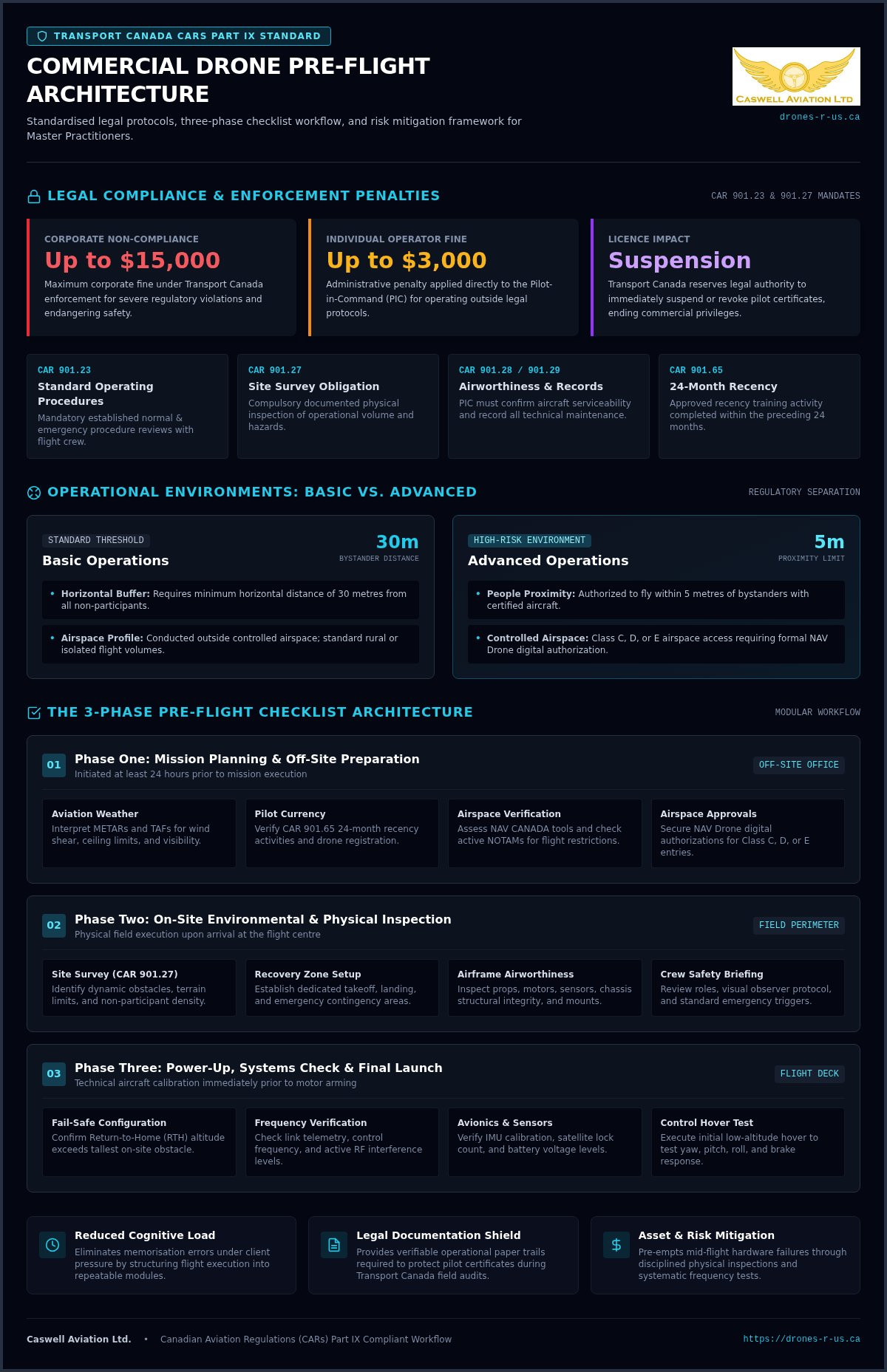
Phase Three: Power-Up, Systems Check, and Final Launch Protocol
The moment you power up the aircraft marks the transition to active flight operations. This final stage of the pre-flight checklist for commercial drone pilots requires absolute concentration and a "sterile cockpit" environment. You aren't just turning on a machine; you're initializing a complex avionics system in shared Canadian airspace. Verify your controller signal strength and confirm the transmission frequency is clear of local interference. A master practitioner knows that a stable C2 (Command and Control) link is the lifeline of the mission and must be verified before the rotors spin.
Wait for a full GPS constellation lock before attempting to take off. You should look for a minimum of 12 satellites to ensure a stable Home Point. Confirm that the flight software has recorded the Home Point coordinates accurately on your map. This ensures that in the event of a signal loss, the aircraft has a precise location for its fail-safe recovery. Rushing this step is a primary cause of fly-away incidents that can lead to significant liability or equipment loss.
Software and Failsafe Verification
Before the rotors spin, you must verify that the software parameters match the specific environment you surveyed in Phase Two. Set the Return-to-Home (RTH) altitude to clear the tallest local obstacle by at least 20 metres. If your site survey identified a 50-metre communications tower, a default 30-metre RTH setting is a critical failure. Confirm that your "Lost Link" procedure is set to "RTH," "Hover," or "Land" based on the terrain and overhead obstructions. Check your battery telemetry and ensure low-voltage warnings are configured to trigger with enough reserve for a safe recovery against prevailing winds. These digital guardrails are your final line of defence against pilot error.
Pilot Readiness and Ergonomics
A master practitioner realizes that pilot health is a critical flight safety factor. Use the "I’M SAFE" checklist to evaluate your physical and mental readiness: Illness, Medication, Stress, Alcohol, Fatigue, and Emotion. If you don't pass every metric, you don't fly. Physical ergonomics also play a significant role in mission success. A Fitek Gear drone harness is essential for maintaining precision during long commercial contracts. It offloads the weight of the smart controller, reducing fatigue and allowing for smoother stick inputs during complex manoeuvres. Perform a final radio check with your crew or Visual Observer. Arm the motors and conduct a 30-second hover at 3 metres to verify stability and control response before leaving the takeoff zone. If you want to perfect these protocols under expert guidance, book your Advanced flight review with our team today.
Maintaining Professional Standards Through Training and Documentation
Completing a successful mission is only half the battle for a professional operator. True discipline requires closing the loop through meticulous post-flight documentation. Under CAR 901.48, every RPAS owner must keep flight records, including pilot names and flight times, for at least 12 months. Maintenance records, which track repairs and modifications, must be retained for 24 months. Integrating these requirements into your pre-flight checklist for commercial drone pilots ensures that you are always prepared for a Transport Canada audit. A master practitioner realizes that documentation is not just a chore; it is the legal proof of a safe operation.
Continuous learning is essential as NAV CANADA and Transport Canada regularly update their digital platforms and regulatory frameworks. Staying current with these changes reduces the mental load during complex missions. When you have a deep understanding of the regulations, your pre-flight routine becomes second nature rather than a stressful hurdle. Our online drone courses are designed to help you build this foundational knowledge, allowing you to focus on the technical execution of your flight.
The Role of Professional Flight Reviews
A flight review serves as the ultimate validation of your operational procedures. It is the moment where an examiner verifies that your pre-flight habits meet the national standard for safety and precision. Many candidates fail their reviews not because of poor stick skills, but because of inconsistent pre-flight discipline. If you are preparing for your certification, you should Book your Advanced & Level 1 Complex Flight Review to ensure your protocols are airtight. Examiners look for a systematic approach to site surveys and emergency briefings, as these habits are the best indicators of a pilot's long-term reliability.
Digital vs. Paper Checklists: Which is Better?
The choice between digital apps and physical paper is often a matter of personal preference, but each has distinct advantages. Apps like DroneBundle or RPAS Wilco offer automated features that can pull weather data and log telemetry directly to the cloud. This efficiency is valuable for high-volume commercial departments. However, a master practitioner always maintains a physical backup. A paper checklist or a cockpit kneeboard does not suffer from battery failure or screen glare in direct sunlight. Having a laminated physical copy in your flight case is a professional best practice that ensures you can always complete your safety protocols. A professional pilot is only as good as their last pre-flight check, and redundancy is the key to maintaining that standard.
Mastering the Future of Canadian RPAS Operations
Adopting a systematic three-phase approach turns a regulatory requirement into a distinct professional advantage. By integrating off-site planning, physical site surveys, and rigorous power-up protocols, you protect your equipment and your pilot certificate. A comprehensive pre-flight checklist for commercial drone pilots is more than a safety tool; it is the mark of an operator who values precision over haste.
Our team provides the expertise to help you navigate these complex standards through Transport Canada Advanced and Level 1 Complex training. Whether you need professional flight reviews or expert advice on aerial gear, we support your growth as a master practitioner. Refined habits on the ground lead to superior results in the air. Every mission is an opportunity to demonstrate the discipline that defines our industry.
Ready to transition from basic operations to high-stakes commercial missions? Enroll in a Professional Drone Certification Course Today to solidify your skills. We look forward to seeing you on the flight line.
Frequently Asked Questions
Is a pre-flight checklist legally required for drone pilots in Canada?
Yes, a pre-flight checklist for commercial drone pilots is a legal requirement under Canadian Aviation Regulation 901.23. This regulation mandates that every pilot establishes and reviews normal operating procedures before any flight. This includes verifying aircraft serviceability and ensuring all crew members are briefed on emergency protocols. Failing to maintain this documentation exposes you to significant administrative penalties. Our advanced training programs emphasize this discipline as a core competency for professional certification.
What are the most common things pilots forget during a pre-flight check?
Pilots frequently overlook checking NOTAMs and verifying the latest firmware status before arriving on site. Many also fail to document their site survey as required by CAR 901.27, which is a common point of failure during audits. Another frequent omission is checking the electromagnetic environment for potential compass interference near large structures. A structured, modular checklist prevents these lapses and ensures you maintain the high standards expected of a master practitioner.
How long should a professional drone pre-flight checklist take to complete?
A comprehensive pre-flight routine typically takes between 15 and 30 minutes to complete properly. This duration is split between the night before off-site planning and the immediate on-site physical inspections. Rushing this process increases the risk of mid-flight incidents and regulatory non-compliance. Professionalism is measured by the thoroughness of your preparation, not the speed of your launch. Taking the necessary time ensures every mission is both safe and efficient.
Do I need a different checklist for night flights or advanced operations?
Advanced operations and night flights require specific additions to your standard safety protocols. For night missions, you must verify the functionality of required anti-collision lighting and ensure your site survey accounts for reduced visibility of obstacles. Advanced operations in controlled airspace require additional steps for NAV Drone authorizations and coordination with air traffic control. Each mission type demands a tailored approach to risk mitigation to ensure you remain compliant with Transport Canada’s safety framework.
Can I use a digital app for my Transport Canada pre-flight documentation?
You can certainly use digital applications for your documentation, provided the records are immediately accessible during operations. Transport Canada allows digital logs for site surveys and maintenance records as long as they meet the retention requirements of CAR 901.48. However, we recommend maintaining a physical backup in your flight kit. Technical failures or battery issues with your mobile device shouldn't prevent you from accessing your mandatory safety procedures or proof of certification.
What should I do if my drone fails one of the pre-flight checklist items?
If any item on your checklist fails, you must ground the aircraft immediately until the issue is resolved. Continuing a flight with a known deficiency is a violation of CAR 901.29 and endangers both aviation safety and the public. You should troubleshoot the hardware or software error and record the findings in your maintenance log. If the failure is complex, our team provides expert guidance through our training programs to help you understand technical airworthiness standards.
How often should I update my physical pre-flight checklist?
You should update your physical checklist whenever there are changes to Canadian Aviation Regulations or when you integrate new hardware into your fleet. Major regulatory shifts, such as the 2025 amendments for medium RPAS, require pilots to adjust their operational volumes and safety buffers. Reviewing your procedures every six months is a professional best practice. This ensures your workflow reflects current industry trends and the specific technical requirements of your latest equipment.
Does Transport Canada inspect flight logs and checklists during audits?
Transport Canada has the authority to inspect your flight logs and maintenance records during any routine audit or incident investigation. Under CAR 901.48, you're legally required to retain flight records for 12 months and maintenance logs for 24 months. These documents must be transferable if the aircraft changes ownership. Demonstrating a consistent history of thorough pre-flight checks is your best defence against liability and proves your commitment to professional aviation standards.
Leave a comment