

The Essential Drone Emergency Procedures Checklist for Canadian Pilots
You are 400 metres out when your video feed suddenly freezes and the telemetry on your controller stops updating. For many Canadian pilots, this moment of silence is the ultimate test of their training and their nerves. It is natural to feel a surge of anxiety about losing expensive equipment or, worse, causing an accident in controlled airspace. Understanding the specific drone emergency procedures Canada requires is not just about passing a flight review; it is about having a disciplined, professional response ready before the crisis occurs.
We agree that the complexity of Part IX of the CARs and the evolving Transportation Safety Board reporting rules can feel overwhelming. This article promises to replace that confusion with professional confidence by providing a clear, actionable checklist for your flight bag. You will learn exactly how to manage loss-of-link events, when you are legally required to report an incident to the TSB under the 2026 guidelines, and how to maintain full compliance with Transport Canada. By the end of this guide, you will be prepared to handle any RPAS emergency with the precision of a seasoned practitioner.
Key Takeaways
- Identify your mandatory safety obligations under Part IX of the Canadian Aviation Regulations to protect your pilot certification and mitigate liability.
- Master the specific drone emergency procedures Canada requires to maintain safety and professional compliance during unexpected RPAS failures.
- Develop a systematic approach to loss-of-link and flyaway events that prioritizes the safety of the national airspace and bystanders.
- Distinguish between minor technical issues and reportable accidents to ensure you meet TSB and Transport Canada notification deadlines.
- Explore how advanced flight reviews and professional-grade controller harnesses improve your ability to manage high-pressure situations with precision.
Why Standardized Drone Emergency Procedures are Mandatory in Canada
Operating a drone in Canadian airspace is a privilege that comes with significant regulatory responsibility. While many new pilots focus on the creative potential of their Unmanned aerial vehicle (UAV), professional aviators understand that safety is the foundation of every successful mission. Standardizing your drone emergency procedures Canada protocols ensures that you meet federal requirements while protecting your investment from avoidable damage.
A well-documented emergency plan serves as your primary defence against liability. In the event of an incident, being able to demonstrate that you followed a pre-defined safety protocol can be the difference between a minor setback and a legal nightmare. This professional preparation is also a core requirement for those seeking their Advanced Flight Review, where examiners specifically look for a pilot's ability to execute a written emergency plan under pressure. Without these procedures, you aren't just risking your gear; you're risking your reputation as a safe operator.
Understanding CAR 901.23: Your Legal Duty
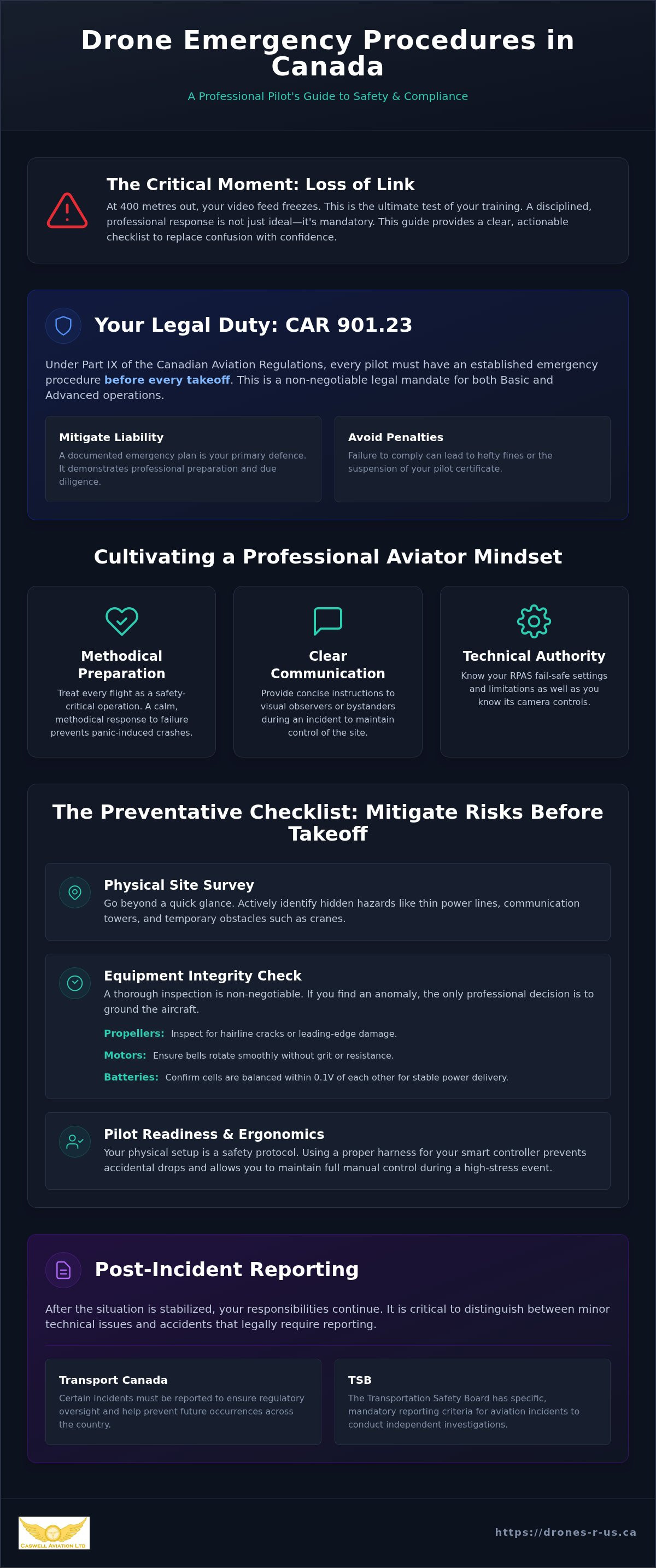
Under Part IX of the Canadian Aviation Regulations, specifically CAR 901.23, every pilot must have an emergency procedure established before takeoff. This is not a suggestion. It is a legal mandate for both Basic and Advanced operations. Attempting to "wing it" during a crisis can lead to severe penalties, including hefty fines or the suspension of your pilot licence. This regulation is a cornerstone of drone emergency procedures Canada compliance, ensuring that every pilot is prepared for the unexpected. These rules are deeply integrated with the requirements for obtaining your Transport Canada drone certification. By formalizing your procedures, you prove to the regulator that you possess the technical competence to manage risks in complex environments.
The Professional Aviator Personality
Transitioning from a hobbyist to a "Master Practitioner" requires a shift in mindset. A professional pilot approaches every flight with a culture of discipline, understanding that a calm, methodical response to technical failure is what prevents a "panic-induced" crash. This veteran mentor approach doesn't just improve safety; it leads to better aerial photography results. When you don't have to fight anxiety about a potential flyaway, you can focus on the precision of your flight path. Key traits of this professional mindset include:
- Methodical Preparation: Treating every flight as a safety-critical operation, regardless of the location.
- Clear Communication: Providing concise instructions to visual observers or bystanders during an incident to maintain control of the site.
- Technical Authority: Knowing your equipment's fail-safe settings as well as you know the camera controls.
- Personal Security: Utilizing tools like The Wellbeing App to maintain safety and round-the-clock monitoring when operating in remote or isolated areas.
Developing these habits early ensures that you remain stable and effective when the unexpected happens. It allows you to move from a state of worry to a state of readiness.
The Preventative Checklist: Mitigating Risks Before Takeoff
Effective drone emergency procedures Canada begin long before the motors spin. A professional pilot views the pre-flight phase as a critical safety buffer that identifies potential failures before they occur. By following a structured preventative checklist, you reduce the likelihood of having to manage a high-stakes crisis in the air. This methodical preparation is what separates a Master Practitioner from a casual operator.
Your physical site survey must go beyond a quick glance at the sky. You should actively identify hidden hazards such as thin power lines, telecommunication towers, and temporary obstacles like cranes. Simultaneously, verify the integrity of your equipment. Inspect propellers for hairline cracks or leading-edge damage. Ensure your motor bells rotate smoothly without grit, and confirm that battery cells are balanced within 0.1V of each other. If your preventative checks reveal any anomalies, the only professional decision is to ground the aircraft until repairs are completed.
Ergonomics as a Safety Protocol
Pilot readiness includes your physical and ergonomic setup. Using a drone harness for smart controller is a vital safety measure that prevents accidental drops during a flight. A harness redistributes the weight of the hardware, significantly reducing pilot fatigue during long missions. This stability allows you to maintain focus on the airspace rather than struggling with the weight of the controller. It also ensures your hands are free to manage secondary emergency tools, such as a radio or a handheld GPS, without compromising the flight path.
Airspace and Weather Verification
A professional briefing requires checking NOTAMs and NAV CANADA weather reports to ensure the environment is within your aircraft's operational limits. Establish a "hard deck" altitude and clear "no-fly" boundaries to organize your session safely. In urban environments, set your lost link altitude to at least 20 metres above the highest building in your flight path to ensure a clear return trajectory. If an incident does occur despite these precautions, you must be prepared to Report a drone incident to Transport Canada using their official channels. Maintaining this level of discipline is easier when you have completed advanced training that emphasizes real-world risk mitigation.
Software readiness is your final line of defence. Always verify that your Return-to-Home (RTH) altitude is calculated based on the tallest obstacle in the immediate area. A common error is leaving the RTH at a factory default that is too low for the local terrain. Confirming these settings as part of your drone emergency procedures Canada workflow ensures that the aircraft's automated responses work for you, not against you, during a loss-of-link event.
Executing drone emergency procedures Canada requires a calm, clinical approach when technical failures occur mid-air. Once the aircraft is in flight, the window for decision-making narrows to seconds. A professional pilot must be ready to transition from automated flight to manual intervention without hesitation. This section outlines the immediate actions required to mitigate the three most common in-flight crises while remaining compliant with Canadian drone regulations. Practicing these responses ensures that your reactions are instinctive rather than reactive.
Step-by-Step: Managing a Flyaway
A flyaway occurs when the aircraft stops responding to control inputs and begins to drift or accelerate in an unintended direction. Your first priority is to regain manual control. If your hardware allows it, immediately switch the flight mode to ATTI or Manual. This action overrides GPS-dependent functions, which are often the root cause of the glitch. If the aircraft remains unresponsive, you must track its heading and estimate the potential crash point. If the drone is likely to enter controlled airspace, you are legally required to notify the appropriate NAV CANADA Air Traffic Services (ATS) unit immediately to ensure the safety of manned aviation. Furthermore, if a flyaway results in an injury to bystanders, having completed a course with First Medical Training Ltd ensures you are prepared to provide immediate first aid.
Loss of link, or a Command and Control (C2) failure, happens when the connection between the controller and the drone is severed. Standard drone emergency procedures Canada protocols dictate that you should remain at the home point. Avoid moving your position, as this can introduce new signal interference from nearby structures or terrain. Monitor your display for a reconnection. If the link flickers, try to initiate an RTH override to bring the aircraft to a safer landing spot. If the connection is restored near the ground, be prepared to take manual control for a precision landing to avoid obstacles that automated sensors might miss.
A "Critical Battery" warning or a sudden power failure demands an immediate, non-negotiable descent. When the voltage drops below safe thresholds, the aircraft will often initiate a forced landing at its current location. As a Master Practitioner, you must use any remaining control authority to steer the drone toward the least populated area. Throughout this process, maintain verbal control of your site. Direct your visual observer to clear bystanders from the projected landing zone. Clear, calm communication prevents secondary accidents and ensures you remain in control of the situation even when the hardware fails. This level of discipline is a core component of the Advanced training and flight reviews provided to professional operators.
Post-Incident: Reporting Requirements to Transport Canada and the TSB
Once the aircraft is secured and the immediate danger has passed, your focus must shift from tactical response to administrative compliance. Distinguishing between a minor technical glitch and a reportable accident is a key skill for professional pilots. While a hard landing that only damages your own equipment might not require a federal report, any incident that compromises public safety or involves other aircraft triggers mandatory drone emergency procedures Canada reporting protocols. Handling this phase with precision ensures your licence remains in good standing and helps maintain the integrity of the national airspace.
Transportation Safety Board Reporting Thresholds
The Transportation Safety Board of Canada (TSB) must be notified immediately of certain "serious" occurrences. These include any incident resulting in death or serious injury, collisions with a manned aircraft, or any accident involving a drone weighing more than 25 kg. If the event involves a fire on board or causes an uncontrolled fire on the ground, you must report it as soon as possible. Initial reports are made via the TSB 24/7 reporting line at 1-800-387-3557, followed by a full online submission within 30 days. Failing to report a qualifying accident is a serious breach of federal law.
Maintaining Your Records
Documenting every incident in your pilot logbook is essential for maintaining your recency and demonstrating a professional safety culture. Your log should include the exact time, location, weather conditions, and a detailed root cause analysis of the failure. This level of detail is invaluable during a drone flight review Canada, as it shows the reviewer you take accountability for your operations. If an incident is serious enough to require registration cancellation, you must complete this through the Drone Management Portal within 7 days of the aircraft being destroyed. Proper record-keeping transforms a failure into a documented learning opportunity that can prevent future equipment loss.
Beyond TSB requirements, Transport Canada generally expects notification within 24 hours for significant incidents occurring under your pilot certificate. If you are operating under a Special Flight Operations Certificate (SFOC), check your specific document, as it often mandates reporting within 24 to 48 hours. Clear, honest documentation protects you from future liability and helps the entire industry improve safety standards. If you are unsure about your reporting status, it is best to consult with Transport Canada certification experts to ensure you remain fully compliant.
Mastering Emergency Skills with Caswell Aviation Training
Mastering the theoretical side of drone emergency procedures Canada is a vital prerequisite, but true professional confidence comes from practical, high-pressure repetition. Caswell Aviation provides the structured environment necessary to transition from reading checklists to executing them instinctively. As of mid-2026, there are 21,472 pilots in Canada with an Advanced certificate, a group defined by their ability to manage complex risks with technical authority. Our training programs are designed to help you join these ranks by bridging the gap between regulatory knowledge and field performance.
Our Advanced Drone Training is built on the Master Practitioner philosophy. We don't just review the rules; we immerse you in mock emergency drills that simulate real-world failures. These exercises force you to prioritize actions under stress, such as managing a loss-of-link event while maintaining site security. For industrial pilots, our Level 1 Complex certification training offers the specific discipline required for high-stakes operations. We also emphasize the use of Fitek Gear harnesses to ensure controller stability. A secure controller prevents the catastrophic scenario of a dropped unit during a critical flight phase, allowing you to keep your hands free for secondary safety tasks.
Preparing for the Advanced Flight Review
The Advanced Flight Review is the ultimate test of your readiness. Reviewers often focus on your ability to articulate and demonstrate drone emergency procedures Canada requirements in real time. You should be prepared to answer common examiner questions regarding flyaway protocols in controlled airspace and the exact steps for regaining manual control. During the practical flight test, you must show that your emergency responses are methodical and calm. Building this confidence is a core component of our preparation process, ensuring you can handle RPAS complex operations without hesitation.
Next Steps for Professional Pilots
Taking the next step in your aviation career requires a commitment to ongoing education and disciplined practice. You can start by enrolling in our online drone courses to master the theory of flight safety and regulatory compliance from any location. For those ready for their practical certification, booking an in-person flight review with a veteran mentor provides the personalized feedback needed to refine your skills. This mentorship ensures you aren't just meeting the minimum standards but are operating at a level of excellence expected in the professional industry. Book your Advanced Flight Review with Caswell Aviation today to secure your standing as a certified professional pilot.
Advancing Your Professional Safety Standard
Mastering drone emergency procedures Canada is a continuous process that separates the professional aviator from the casual operator. By integrating a standardized checklist into your workflow, you ensure every flight is grounded in discipline and regulatory compliance. Whether you're conducting a site survey to identify local hazards or managing a mid-air loss-of-link event, your ability to remain calm and methodical is your greatest asset. Proper documentation and reporting further solidify your reputation as a safe practitioner within the national airspace.
Refining these skills requires more than just reading; it demands hands-on experience and expert guidance. Caswell Aviation offers Transport Canada compliant training and access to professional flight reviewers who specialize in preparing you for high-pressure scenarios. As a specialized Fitek Gear retailer, we also provide the ergonomic tools necessary to maintain controller stability during critical moments. Master your safety protocols with Caswell Aviation training to ensure you're ready for any challenge the sky presents. Your commitment to safety is the foundation of a successful aviation career.
Frequently Asked Questions
Do I need to report a drone crash to Transport Canada if no one was hurt?
You must report the incident to the TSB if the drone weighs more than 25 kg or if it was involved in a collision with a manned aircraft. Even if there are no injuries, serious property damage or fires must be reported as soon as possible. If the drone is destroyed, you are legally required to cancel its registration through the Drone Management Portal within 7 days of the occurrence.
What is the most common cause of drone flyaways in Canada?
The most frequent causes of flyaways are GPS signal interference and compass calibration errors. These issues often occur near large metal structures or high voltage power lines that disrupt the internal sensors of the aircraft. Professional drone emergency procedures Canada training emphasizes switching to manual or ATTI mode to regain control. Maintaining a clear line of sight and avoiding known interference zones are the most effective preventative measures.
How do I contact NAV CANADA during a drone emergency?
You should contact the appropriate Air Traffic Services (ATS) unit immediately if your drone is likely to enter controlled airspace during an emergency. This is typically done via telephone using the specific emergency numbers provided for your flight region. Having these contact numbers pre-loaded into your mobile phone or printed in your flight bag is a mandatory part of a professional pilot's emergency preparation and risk mitigation strategy.
Does my drone emergency plan need to be written down?
Yes, having a written emergency plan is a legal requirement under CAR 901.23 for every flight operation. While you do not necessarily need to submit it before every flight, it must be established and ready for immediate execution. A written plan is particularly critical during an Advanced Flight Review. Examiners will expect you to articulate and demonstrate your written procedures to prove you can manage complex operations safely.
What should I do if my drone battery catches fire?
If a drone battery catches fire on board or causes an uncontrolled fire on the ground, you must report the incident to the TSB as soon as possible. If the fire poses an immediate threat to people or property, call 9-1-1 immediately. Always use a fire-safe bag for transporting damaged batteries and never attempt to fly an aircraft that has shown signs of battery swelling or thermal instability.
Is a drone controller harness considered a safety device?
A drone controller harness is a vital safety device that prevents accidental equipment drops and reduces pilot fatigue during long missions. By securing the controller to your body, you ensure that your hands remain free to manage secondary emergency tools if needed. Fitek Gear harnesses are specifically designed for smart controllers to provide the stability required for precision flight. This stability is a key factor in maintaining control during crises.
How often should I update my drone emergency procedures?
You should review your procedures before every flight during your site survey to account for local hazards. Additionally, you must update your documentation whenever Transport Canada or the TSB releases new regulatory requirements. For example, significant updates are effective on November 4, 2025, and further changes are proposed for 2026. Staying current with these changes ensures your operations remain compliant and your safety protocols reflect the latest standards.
What are the penalties for not having an emergency plan in Canada?
Operating without an established emergency plan can lead to significant administrative penalties, including fines or the suspension of your pilot certificate. Beyond the legal costs, Transport Canada has the authority to cancel your registration or certificate if you are found in breach of CAR 901.23. Failing to have drone emergency procedures Canada protocols in place also significantly increases your personal liability. Professional training ensures you meet these legal obligations effectively.
Leave a comment