

The Cost of Advanced Drone Certification in Alberta: A 2026 Professional Guide
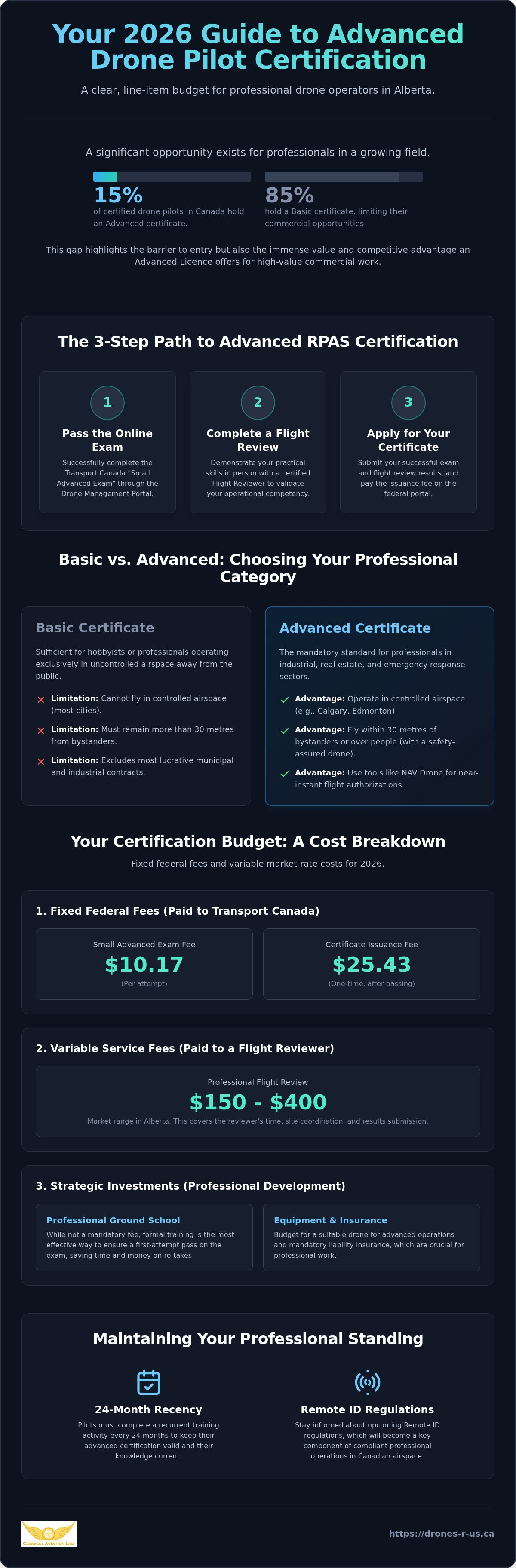
Only 15% of certified drone pilots in Canada hold an Advanced certificate. This statistic highlights a significant barrier to entry for many, yet it also represents a massive opportunity for those willing to invest in their professional standing. You've likely realized that the path to high-value commercial work involves more than just buying a prosumer drone. It requires managing a complex web of regulations and fees that can feel opaque. It's common to feel concerned about the total cost of advanced drone certification Alberta operators face, especially when hidden expenses like insurance and equipment are factored into the equation.
We've built this guide to replace that uncertainty with a clear, line-item budget for your 2026 certification journey. You'll learn exactly what to expect for Transport Canada exam fees, certificate issuance, and the mandatory flight reviews that often cause the most stress for applicants. We'll also look at how professional training transforms these costs into a strategic investment, ensuring you have the confidence to meet every regulatory requirement without paying for a second attempt. From initial study to final licensing, here is the roadmap for your professional aviation career.
Key Takeaways
- Identify the fixed federal fees for Transport Canada exams and certificate issuance to establish an accurate baseline for your certification budget.
- Evaluate the market rates for professional flight reviews and learn how to select a reviewer who provides mentorship rather than just a basic assessment.
- Determine the total cost of advanced drone certification Alberta professionals should expect when factoring in training, equipment, and liability insurance.
- Realize the long-term ROI of investing in professional ground school to minimize the risk of expensive exam failures and operational delays.
- Understand the 24-month recency requirements and upcoming Remote ID regulations to ensure your professional operations remain compliant and airworthy.
Understanding the Path to Advanced RPAS Certification
In Canada, Remotely Piloted Aircraft Systems (RPAS) are strictly governed by the Canadian Aviation Regulations. These rules categorize operations based on the level of risk to the public and other airspace users. Advanced operations involve flying in controlled airspace, operating within 30 metres of bystanders, or flying directly over people using a safety-assured drone. Understanding the total cost of advanced drone certification Alberta operators must budget for is the first step toward building a sustainable aerial service business. This certification is not merely a permit; it is a professional credential that validates your technical expertise and commitment to aviation safety.
The path to becoming an advanced pilot follows a logical three-step sequence. First, you must pass the Transport Canada online exam. Second, you must complete a practical flight review with an approved evaluator. Finally, you apply for the certificate through the federal portal. By 2026, professional certification has become the mandatory standard across Alberta's industrial sectors. Whether you are inspecting pipelines or surveying urban construction, this license proves you can manage the complexities of modern Canadian airspace.
Advanced vs. Basic: Choosing Your Professional Category
A Basic certificate is often sufficient for hobbyists or pilots working exclusively in rural, uncontrolled environments. However, its operational limits frequently hinder business growth. Basic operators cannot fly in controlled airspace or near bystanders, which excludes most lucrative municipal and industrial contracts. If your work requires you to operate in Calgary or Edmonton, or near people on a job site, the Advanced certificate is necessary. Industries like telecommunications, emergency response, and commercial real estate demand the flexibility that only an Advanced license provides. This category allows you to use tools like the NAV Drone app for near-instant digital authorization in restricted zones.
The Role of Transport Canada in Your Licensing Journey
Transport Canada centralizes all pilot activities through the Drone Management Portal. This system tracks your exam attempts, drone registrations, and flight review results. Maintaining an accurate pilot profile is a requirement for compliance and professional accountability. The Pilot Certificate – Advanced Operations is a formal federal aviation document. Within the portal, you will pay the fixed federal fees associated with your license. The Advanced exam fee is $10.17, and the certificate issuance fee is $25.43. While these administrative costs are relatively low, they represent the final stage of a journey that involves significant preparation and technical training at a professional drone training centre.
Breaking Down the Direct Costs: Exams, Reviews, and Licensing
Calculating the total cost of advanced drone certification Alberta pilots face requires looking at both fixed government fees and variable service provider rates. It's not just one price tag. It's a series of investments. Understanding these numbers upfront prevents budget overruns and ensures you're prepared for every stage of the process. While some costs are non-negotiable federal fees, others depend on the quality and complexity of the practical assessment you choose.
Federal Fees: What You Pay Directly to the Government
Transport Canada keeps the direct administrative costs relatively low to encourage compliance across the aviation industry. As of 2026, the Small Advanced Exam fee is $10.17. This fee is paid through the Drone Management Portal for each attempt you make. After successfully passing both the online exam and your practical flight review, you'll pay a $25.43 issuance fee to receive your official Pilot Certificate – Advanced Operations. Additionally, each drone in your professional fleet must be registered with the federal government for a nominal fee per aircraft.
Flight Review Fees: Budgeting for the Practical Assessment
The flight review is a mandatory in-person assessment that validates your ability to operate safely in complex environments. Market rates for a professional flight review typically range from $150 to $400. This fee covers the reviewer's time, site coordination, and the technical submission of your results to Transport Canada. When you evaluate professional drone training costs, you must account for this practical component. Prices can fluctuate based on the reviewer's location or specific site requirements.
Some professional pilots require a Level 1 Complex certification for specialized industrial operations. These reviews are more intensive than standard advanced assessments and require a higher level of technical oversight. Because of this added complexity, the cost of advanced drone certification Alberta operators pay for this tier is generally higher than the standard market range. It's a strategic choice for those working in high-risk environments. If you're ready to finalize your credentials, we provide Advanced & Level 1 Complex Flight Reviews led by mentors who prioritize your long-term operational success.
Training Investment: Online Ground School vs. In-Person Coaching
Choosing the right training method is a critical decision that directly impacts the total cost of advanced drone certification Alberta candidates pay. Many pilots attempt self-study to minimize initial expenses, but the Advanced Exam requires a high passing grade of 80%. Failing this exam repeatedly leads to multiple re-write fees and significant delays in starting your commercial operations. Professional ground school provides a structured environment where complex aviation topics are simplified for practical application. This approach ensures you pass on your first attempt, making it a high-ROI choice for serious operators who value their time.
The financial difference between self-study and professional instruction is often offset by the speed of entering the workforce. A pilot who spends months struggling with technical manuals loses potential revenue from missed contracts. In contrast, a student who completes a formal program can often move from registration to certification in a matter of weeks. We focus on delivering this efficiency through a curriculum that balances regulatory theory with the realities of the field.
The Benefits of Online Drone Courses for Professionals
Busy professionals often lack the flexibility for multi-day classroom sessions. Online drone courses allow you to learn at your own pace during off-hours while maintaining your current workload. These programs provide comprehensive coverage of TP-15263 knowledge requirements, including meteorology, air law, and flight theory. By using a modular curriculum, you can revisit difficult concepts until you've mastered them. This methodical approach builds the technical foundation necessary for both the written exam and the practical flight review without requiring travel or time away from your business.
In-Person Coaching: When the Extra Cost is Justified
While digital learning is efficient for theory, some pilots benefit from hands-on instruction. In-person training allows you to develop flight skills under the direct supervision of a Master Practitioner. This mentorship is invaluable for mastering complex manoeuvres and emergency procedures that are difficult to learn through a screen. Expert oversight also reduces the risk of equipment damage during the learning phase. Professional drones are expensive assets; preventing a single crash through expert coaching can save your business thousands of dollars in repairs or replacements. This 1-on-1 guidance ensures you're prepared for the high-stakes environment of a Transport Canada flight review.
Budgeting for Professional Success: Equipment and Recency Costs
Achieving your licence is only the first phase of a long-term business plan. To maintain a professional operation, you must account for the ongoing cost of advanced drone certification Alberta pilots encounter over the lifespan of their career. This total cost of ownership includes regulatory compliance, liability protection, and the specialized equipment required to sustain high-utilization flight schedules. Ignoring these downstream expenses can lead to operational bottlenecks or unexpected financial strain during your first year of business.
Commercial liability insurance is an essential budget item that many newcomers overlook. Most standard business insurance policies exclude aviation, so you'll need a dedicated drone policy to protect against third-party property damage or injury. Additionally, professional-grade drones require a maintenance budget for consumables like high-cycle batteries and propellers. Setting aside funds for periodic hardware inspections prevents minor wear from becoming a catastrophic mid-flight failure, ensuring your assets remain airworthy and profitable.
Staying Current: The Cost of Regulatory Compliance
Transport Canada mandates that all Advanced RPAS certificate holders maintain recency every 24 months. You can meet this requirement by completing a new flight review, attending a safety seminar, or finishing a recurrent training program. While the certificate itself does not expire, your legal right to fly depends on documented proof of these activities. Managing this process involves an administrative time cost for logbook maintenance and record-keeping. Staying informed about evolving Drone Regulations in Canada ensures you don't miss these critical deadlines, which would otherwise result in a grounded fleet and lost revenue. This proactive approach to the cost of advanced drone certification Alberta operators manage is what separates hobbyists from true aviation professionals.
Professional Gear: Ergonomics and Field Efficiency
Long missions in Alberta's diverse industrial landscapes demand more than just technical skill; they require physical endurance. Investing in pilot ergonomics is a necessary operational expense that prevents long-term strain and improves mission focus. Using a professional drone harness allows you to distribute the weight of heavy smart controllers across your shoulders and back rather than relying on your neck and wrists. When choosing the best drone harness, look for systems that offer stability and quick-release capabilities. We recommend using Fitek Gear drone harnesses for smart controllers to ensure you remain comfortable and precise during eight-hour workdays. If you're ready to upgrade your field setup, you can shop our professional pilot gear to find the right ergonomic solutions for your fleet.
Why Caswell Aviation is the Professional Choice for Certification
Choosing a training partner is as important as the equipment you fly. At Caswell Aviation, we bring over 25 years of experience from both manned and unmanned aviation into our curriculum. We treat drone operations with the same discipline found in traditional flight schools. This culture of precision ensures that the cost of advanced drone certification Alberta pilots invest in results in more than just a piece of paper. It builds a foundation of safety-critical habits that protect your business and your reputation in the field. Our goal is to transition you from a hobbyist mindset into a professional aviation career.
A Holistic Approach to Drone Pilot Training
We don't just teach you how to pass an exam. Our training integrates technical theory with practical field expertise to prepare you for the realities of industrial work sites. Whether you're navigating urban environments or remote resource sectors, we provide the technical support you need to succeed. Our relationship with students continues long after the initial licensing phase. We help you scale your operations by offering specialized gear and ongoing guidance. If you're ready to start your professional journey, you can Contact Caswell Aviation for a consultation on your specific training needs.
Preparing for the Advanced Flight Review with Confidence
The flight review is often the most stressful part of the certification process. We eliminate this anxiety through a structured checklist approach that mirrors professional aviation standards. When you book a review with us, you're evaluated by a Veteran Mentor who understands the nuances of the Canadian Aviation Regulations. This mentorship ensures you're ready for complex operations, not just a basic skills test. We focus on your ability to manage risks and execute missions with technical accuracy. For a detailed breakdown of what to expect during your assessment, read our guide on Advanced Drone Flight Review Preparation. We ensure that the total cost of advanced drone certification Alberta operators manage remains predictable by helping you pass your review on the first attempt.
Securing Your Future in Canadian Aviation
Transitioning from an enthusiast to a certified professional requires a clear understanding of your total investment. You now have a comprehensive roadmap for the fixed government fees, flight review market rates, and the long-term maintenance costs of your certificate. By budgeting for these expenses early, you ensure your business remains compliant and airworthy in a strictly regulated industry. Managing the cost of advanced drone certification Alberta pilots face is a strategic step toward securing high-value commercial contracts and industrial work.
Your professional aviation journey begins with the right preparation and expert mentorship. We provide Transport Canada compliant flight reviews and expert-led online and in-person courses to guide you through every stage of the process. We also offer high-quality Fitek Gear ergonomics to support your physical health during long missions. Start your professional drone career with Caswell Aviation training and gain the technical confidence needed to excel in the field. We look forward to supporting your operational success in the airspace.
Frequently Asked Questions
How much does the Transport Canada Advanced drone exam cost?
The Transport Canada online exam for the Pilot Certificate – Advanced Operations costs $10.17 per attempt. This fee is paid directly through the federal Drone Management Portal before you begin the test. Because the passing grade is set at 80%, many pilots find that professional preparation is necessary to avoid the cost of multiple re-writes.
Is there a recurring fee for the Advanced Pilot Certificate?
There is no recurring annual subscription fee for the certificate itself, as Canadian pilot certificates don't expire. However, you must meet recency requirements every 24 months to maintain your legal right to fly. Meeting these requirements may involve costs for recurrent training, safety seminars, or a new flight review with a professional evaluator.
What is the average price for an Advanced flight review in Canada?
A professional flight review typically ranges from $150 to $400 depending on the reviewer's expertise and the complexity of the assessment site. This is a primary factor in the total cost of advanced drone certification Alberta operators must budget for. This fee covers the reviewer's technical assessment and the formal submission of your results to Transport Canada.
Can I get a refund if I fail my drone pilot exam?
Transport Canada doesn't provide refunds for failed exam attempts or certificate applications. The $10.17 exam fee is a non-refundable administrative charge for using the online testing system. This policy makes it vital to utilize structured training programs so you don't lose time and money on unsuccessful attempts.
How much should I budget for drone insurance for a small business?
Small business owners should contact a specialized aviation insurance broker to get a quote tailored to their specific industry and equipment. While not a fixed government fee, commercial liability insurance is a critical operational expense. Premiums depend on your flight history, the value of your fleet, and the specific risks associated with your commercial contracts.
Are there additional costs for a Level 1 Complex certification?
Yes, Level 1 Complex flight reviews generally involve higher service fees because they require more intensive technical oversight than standard advanced reviews. These assessments are designed for high-risk industrial operations and specialized mission profiles. You'll need to coordinate directly with a qualified reviewer to determine the specific rates for these advanced technical evaluations.
Does the cost of certification include the drone registration fee?
No, the pilot certification process and drone registration are separate administrative tasks with individual fees. Every drone weighing between 250g and 25kg must be registered for a fee of $5 per aircraft. This is a one-time cost paid through the Drone Management Portal and is not included in your exam or certificate issuance fees.
Is online drone training cheaper than in-person ground school?
Online training is typically more affordable than in-person coaching because it removes the need for travel and physical classroom overhead. It allows you to manage the cost of advanced drone certification Alberta requirements by learning at your own pace. Many professionals prefer this method as it provides a high ROI by minimizing time away from active work sites.
Leave a comment