
Professional Drone Safety Training in Canada: The 2026 Pilot's Guide
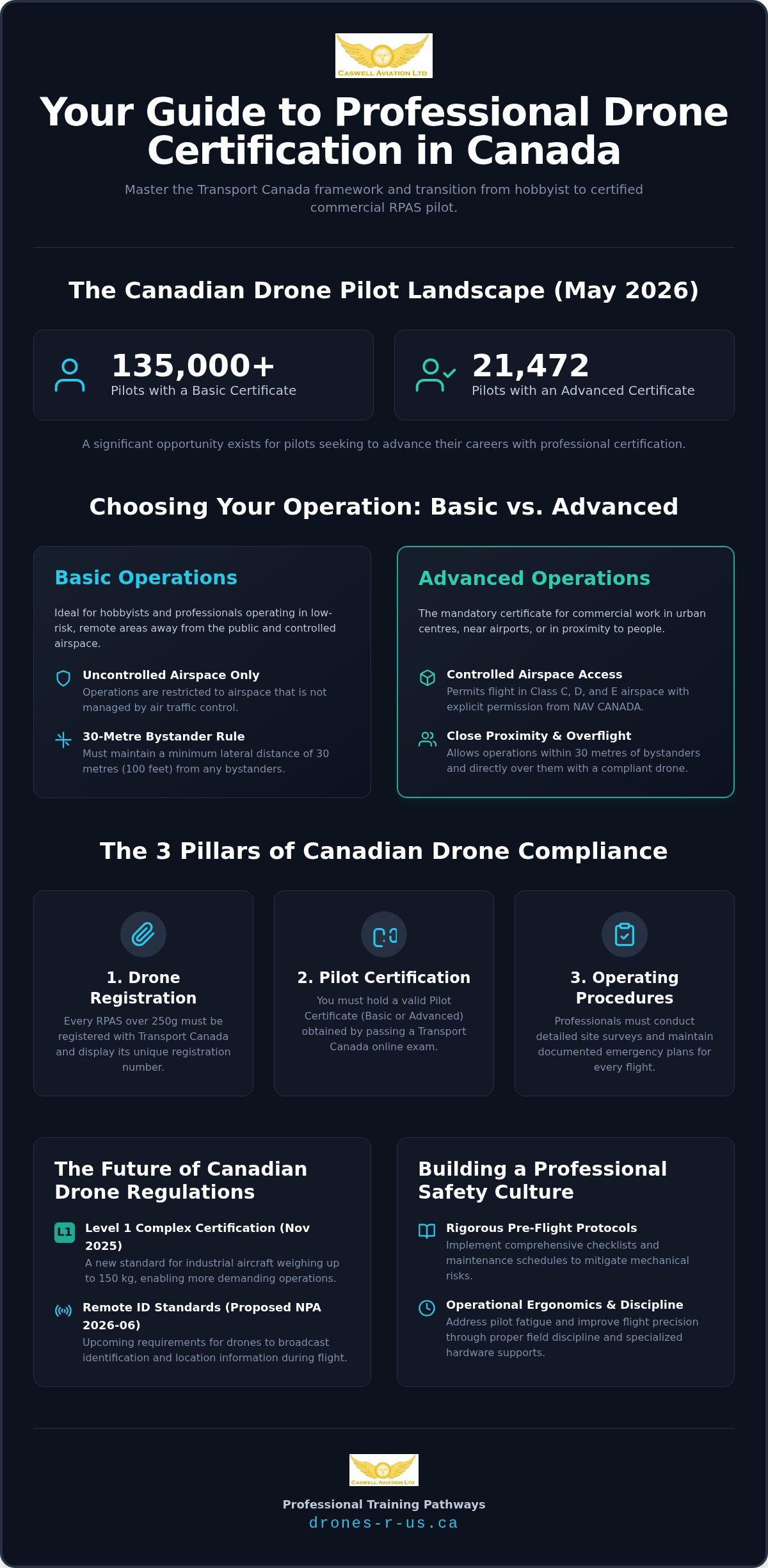
As of May 2026, over 135,000 Canadians hold a Basic drone certificate, yet only 21,472 have achieved the Advanced level. This gap represents a significant opportunity for those looking to transition from hobbyist to professional. If you're searching for a drone safety course Calgary pilots trust, you likely realize that the path to professional certification involves more than just passing a test. It requires a deep understanding of the 2026 regulatory environment, including the November 2025 implementation of Level 1 Complex certifications for industrial aircraft weighing up to 150 kilograms.
It's understandable to feel overwhelmed by the technical distinctions between Basic and Advanced operations or the pressure of a Flight Review. Navigating NAV CANADA requirements and the physical demands of long field days shouldn't stand in the way of your career. This guide will help you master the regulatory requirements and technical skills needed to become a certified professional drone pilot in Canada. We'll examine the new Remote ID standards proposed in NPA 2026-06, break down the complexities of controlled airspace, and show you how to maintain peak performance through ergonomic discipline.
Key Takeaways
- Understand the mandatory registration and certification requirements for all Remotely Piloted Aircraft Systems (RPAS) weighing over 250 grams within the 2026 Transport Canada framework.
- Identify the critical operational differences between Basic and Advanced certificates, focusing on airspace classifications and the 30-metre lateral distance rule for bystanders.
- Develop a proactive safety culture by implementing rigorous pre-flight checklists and maintenance protocols to mitigate mechanical risks during industrial missions.
- Improve flight precision and reduce operational errors by addressing pilot fatigue through ergonomic field discipline and the use of specialized hardware supports.
- Evaluate how a professional drone safety course Calgary pilots and national students utilize can streamline the path toward achieving Advanced and Level 1 Complex certifications.
Navigating the Transport Canada Drone Certification Framework
The Canadian aviation landscape changed significantly with the introduction of Part IX of the Canadian Aviation Regulations. This structure, known as the Remotely Piloted Aircraft System (RPAS) framework, ensures that all pilots share the sky safely with manned aircraft. If you operate a drone weighing over 250 grams, a Pilot Certificate isn't optional; it is a legal requirement enforced by Transport Canada. The 'Small RPAS' category refers to drones that weigh between 250g and 25kg.
Transport Canada serves as the primary governing body for these operations. They utilize a document called TP 15263, which outlines the specific Knowledge Requirements for pilots. Whether you are a newcomer or a seasoned hobbyist, understanding the Transport Canada Drone Certification Framework is essential for staying compliant and avoiding significant fines. Enrolling in a drone safety course Calgary professionals recommend ensures you are prepared for these rigorous standards.
The Three Pillars of Canadian Drone Compliance
Maintaining professional standards requires more than just flying skills. Compliance is built on three distinct requirements:
- Drone registration: You must register every aircraft in your fleet through the Transport Canada portal. Each drone must clearly display its unique registration number.
- Pilot certification: You are required to pass a standardized online exam. The difficulty depends on whether you intend to fly in Basic or Advanced environments.
- Standard Operating Procedures (SOPs): Professional pilots must conduct a detailed site survey before every flight. You must also have a documented emergency plan to handle equipment failures or airspace incursions.
Why Professional Training Trumps Self-Study
While the Small Basic exam is accessible, the transition to professional operations involves high stakes. Many pilots find that a drone safety course Calgary based or online provides the technical depth that self-study lacks. Professional training covers complex subjects like air law, meteorology, and navigation theory in a practical context. This structured approach helps you realize the responsibilities of a commercial pilot.
Technical mastery also reduces equipment loss. Understanding the physics of radio frequency link loss helps pilots prevent "fly-aways" and manage signal interference in urban centres. By choosing structured training through Caswell Aviation, you move beyond the hobbyist mindset. You adopt the discipline of a master practitioner, ensuring that every mission is executed with precision and technical authority.
Choosing Between Basic and Advanced RPAS Operations
The division between Basic and Advanced certificates defines where and how you can legally fly. Transport Canada categorizes operations based on specific risk factors, primarily proximity to bystanders and the complexity of the surrounding airspace. For those starting their journey with a drone safety course Calgary based or online, understanding these boundaries is the first step toward professional competency. Basic operations are restricted to uncontrolled airspace. Crucially, you must maintain a minimum lateral distance of 30 metres from any bystander. This rule is a frequent point of failure for uncertified pilots; if a person is within 30 horizontal metres of your flight path, you're non-compliant.
Advanced operations allow you to enter controlled airspace, specifically Class C, D, and E. These areas are typically found near airports or within urban centres where air traffic density is higher. Flying in these zones requires an Advanced Pilot Certificate and explicit permission from NAV CANADA, often coordinated through digital authorization tools. To ensure you're following the latest 2026 standards, refer to the official guidelines for Navigating the Transport Canada Drone Certification Framework.
When to Pursue an Advanced Certificate
If your professional goals involve working in urban centres or near people, the Advanced certificate is mandatory. It permits operations within 30 metres of bystanders and even directly over people, provided your aircraft has the required safety declaration from the manufacturer. This certification also unlocks the ability to apply for Special Flight Operations Certificates (SFOCs). These are necessary for missions that fall outside standard rules, such as flights at high altitudes or complex industrial surveys in restricted zones. Transitioning to this level requires a commitment to higher safety standards and technical discipline.
Flight Reviews: The Final Hurdle for Advanced Pilots
Passing the Advanced online exam is only the first stage of certification. You must also complete a flight review with an authorized examiner to prove your practical skills. This in-person assessment verifies that you can safely handle the aircraft and execute emergency procedures under pressure. You'll need to demonstrate a thorough pre-flight briefing, site survey, and command of the drone through various flight patterns. Understanding What is a Drone Flight Review in Canada? will help you prepare for what examiners expect during the evaluation. If you're ready to move beyond basic flight restrictions, you can view our flight review schedules to finalize your professional standing.
Building a Professional Safety Culture for Canadian Drone Pilots
Professional aviation relies on a proactive mindset rather than a rigid adherence to a list of rules. Establishing a drone safety course Calgary pilots trust involves moving beyond basic compliance to foster a true safety culture. Organizations like the Aerial Evolution Association of Canada emphasize that a professional safety culture is a deliberate approach to risk management. It requires every pilot to anticipate potential failures before they occur. This mindset ensures that safety remains the primary objective of every mission, regardless of commercial pressure or project timelines.
The 'Pre-Flight Checklist' is the most effective tool for preventing mechanical failure. Even the most advanced aircraft can suffer from hardware degradation or firmware glitches. A structured inspection of propellers, battery health, and sensor calibration ensures that the aircraft is airworthy before it leaves the ground. Beyond the machine, pilots must assess their own readiness using the 'IMSAFE' mnemonic. This standard aviation tool prompts pilots to evaluate their fitness based on Illness, Medication, Stress, Alcohol, Fatigue, and Emotion. If any of these factors are compromised, the flight should not proceed. Crew Resource Management (CRM) in RPAS operations is the effective use of all available resources, including personnel, hardware, and information, to ensure mission success and flight safety.
Risk Mitigation and Site Surveys
A professional site survey is the foundation of risk mitigation. Pilots must identify localized hazards such as high-tension power lines, physical obstacles, and micro-weather patterns that could affect flight stability. Understanding NOTAMs (Notices to Airmen) is also critical, as these alerts provide real-time information about temporary flight restrictions or nearby manned aircraft activity. In complex environments, the role of a Visual Observer (VO) is indispensable. A VO helps maintain Visual Line of Sight (VLOS) and allows the pilot to focus on the technical execution of the flight while the observer monitors the surrounding airspace for potential incursions.
Maintaining Recency and Professional Standards
Obtaining a certificate is only the beginning of a professional career. Transport Canada requires pilots to meet recency requirements every 24 months to keep their certificates valid. This can be achieved through recurrent training or by attending a recognized drone safety course Calgary centres provide. Maintaining a detailed logbook of flight hours and maintenance activities is essential for audit readiness and proves your commitment to professional standards. For a deeper look at the legal framework, consult the Drone Regulations in Canada: The 2026 Professional Reference Guide to stay ahead of evolving requirements.
Operational Ergonomics: Enhancing Safety Through Field Discipline
Safety culture extends beyond regulatory compliance to include the pilot's physical endurance and field discipline. Operating a heavy Smart Controller for a full eight-hour shift creates physical fatigue that directly correlates with cognitive decline and operational errors. A comprehensive drone safety course Calgary professionals choose should integrate ergonomic discipline into its syllabus. Pilots must view themselves as industrial athletes who require proper support to maintain peak performance throughout the day. High-stakes missions in controlled airspace demand sustained focus; any physical discomfort acts as a distraction that can compromise the safety of the entire operation.
The link between physical strain and mental errors is well-documented in aviation. When a pilot is distracted by neck pain or arm fatigue, their situational awareness decreases. This physical toll makes it harder to adhere to the IMSAFE standards mentioned previously. By prioritizing ergonomic health, you ensure that your technical skills remain sharp from the first flight to the final landing. Proper posture and equipment support are not just about comfort; they are foundational elements of a professional safety framework.
The Role of Drone Harnesses in Safety
A professional harness serves as a critical safety tool rather than a simple accessory. By redistributing the weight of the controller across the shoulders and upper back, it eliminates the localized neck strain caused by traditional single-point straps. This redistribution of mass allows for greater hands-free stability during ground operations. When a pilot needs to consult a digital map, communicate with a Visual Observer, or adjust a site survey document, the harness keeps the controller secure and perfectly positioned. We utilize Fitek Gear drone harnesses for smart controllers to ensure our pilots maintain this level of professional field discipline during complex missions.
Maximizing Efficiency with Professional Gear
Standard neck straps are largely insufficient for the weight and bulk of modern DJI Smart Controllers used in commercial environments. Ergonomic instability often leads to micro-tremors or shaky control inputs, which can negatively impact the technical quality of aerial photography and video. A stable, harnessed platform allows for the precise, minute stick adjustments required for close-proximity inspections or smooth cinematic shots. For a detailed analysis of hardware selection, read our professional guide on Choosing the Best Drone Harness for Smart Controllers. Investing in a dedicated support system ensures you can maintain the technical authority needed for long-duration flight windows. To equip yourself or your flight team with professional-grade ergonomic supports, you can browse our full range of Fitek Gear.
Professional Training Pathways with Caswell Aviation
Caswell Aviation operates as a comprehensive aviation partner rather than a simple vendor. Our veteran-led approach instils the culture of discipline found in traditional high-stakes industries. For those seeking a drone safety course Calgary professionals rely on, we provide a structured pathway from initial registration to complex industrial operations. Our training doesn't just prepare you for an exam; it builds the technical authority needed to manage high-stakes missions. We facilitate the transition from Basic certificates to Advanced and the recently implemented Level 1 Complex certifications.
Integration of the Radiotelephone Operator's Restricted Certificate (ROC-A) is a core component of our professional programme. As an authorized examiner, we help pilots master the protocols required for clear communication with air traffic control. This skill is vital for anyone operating in controlled airspace where coordination with manned aircraft is a daily reality. Our mentorship ensures you understand the nuances of radio theory and emergency procedures before you enter a live environment.
Online Ground School vs. In-Person Training
We offer self-paced online modules designed to prepare students for the Advanced written exam. These digital courses provide the flexibility needed for national students to study at their own pace without sacrificing technical depth. For more complex regulatory topics or technical flight skills, we provide instructor-led sessions that offer direct mentorship. We also develop customized corporate training solutions for small businesses looking to integrate drone technology into their existing workflows safely and efficiently.
Mastering Level 1 Complex Operations
Transport Canada implemented new regulations for specialized industrial missions on November 4, 2025. These rules introduced the Level 1 Complex certification for aircraft weighing between 25 kg and 150 kg. This certification is necessary for pilots engaged in high-stakes industrial inspections or large-scale aerial imagery projects. Our curriculum prepares you for the $50.85 exam and the rigorous operational standards required for these heavy-lift platforms. You can find more details in The Complete Guide to Transport Canada Drone Certification. Mastering these complex operations ensures your team remains compliant while utilizing the most capable technology available.
Advancing Your Professional Aviation Career in 2026
Success in the Canadian drone industry requires more than just basic flight skills. It demands a holistic approach that combines strict regulatory compliance with a proactive safety culture and ergonomic field discipline. By mastering the distinctions between Basic, Advanced, and Level 1 Complex operations, you position yourself as a leader in a maturing market. Utilizing professional hardware supports and structured checklists ensures your missions remain safe and efficient.
Choosing a drone safety course Calgary professionals trust provides the mentorship needed to navigate evolving Transport Canada requirements. Caswell Aviation offers veteran-led instruction and Transport Canada compliant training designed for the modern pilot. Our national online course access allows you to begin your programme immediately, regardless of your location. We're here to help you transition from a hobbyist to a master practitioner with technical authority.
Ready to secure your future in the skies? Enroll in a Professional Drone Safety Course at Caswell Aviation today and take command of your professional development. We look forward to seeing you in the flight deck.
Frequently Asked Questions
How do I get a drone pilot certificate in Canada in 2026?
You obtain a certificate by passing the Transport Canada online exam for either Basic or Advanced operations. The Small Basic exam consists of 35 questions with a 65% pass mark; the Small Advanced exam has 50 questions requiring 80%. After passing the Advanced exam, you must successfully complete an in-person flight review. Registering your aircraft is also mandatory for drones between 250g and 25kg for a $10 fee.
Is a drone safety course mandatory for sub-250g drones?
No, a pilot certificate is not legally required for microdrones weighing less than 250 grams. While these aircraft are exempt from registration and formal certification, you must still operate them in a way that does not endanger aviation safety or people on the ground. Many professionals still choose a drone safety course Calgary pilots recommend to ensure they understand airspace boundaries and privacy laws even when flying micro-class hardware.
What is the difference between a Basic and Advanced drone licence?
The primary differences involve airspace access and proximity to bystanders. A Basic certificate limits you to uncontrolled airspace and requires you to stay at least 30 metres away from people. An Advanced certificate permits flight in controlled airspace (Class C, D, and E) and allows operations within 30 metres of bystanders or directly over them, provided your equipment meets specific safety declarations. This level is essential for most commercial missions.
How much does a professional drone flight review cost in Canada?
The cost for a flight review is set by the independent reviewer and typically ranges between $150 and $400. This is a practical assessment where you demonstrate your ability to fly safely and handle emergency procedures. Caswell Aviation provides professional flight reviews for both Advanced and Level 1 Complex certificates. This fee is separate from the $25 Transport Canada issuance fee paid after you pass the review.
What is a Level 1 Complex drone certification?
Level 1 Complex certification is a regulatory tier implemented on November 4, 2025, for drones weighing between 25 kg and 150 kg. This certification is intended for specialized industrial missions and requires passing a specific exam with a $50.85 fee per attempt. It represents a maturing industry where larger aircraft are used for heavy-lift applications. Training for this level focuses on the increased technical demands of managing heavier remotely piloted systems.
How long is my Transport Canada drone pilot certificate valid?
A Transport Canada pilot certificate does not expire, but you must maintain recency every 24 months to keep it valid. You can meet this requirement by completing a recurrent training activity, such as attending a drone safety course Calgary centres offer or participating in a Transport Canada safety seminar. Pilots are responsible for keeping a record of their recency activities in their logbooks to prove compliance during a potential audit.
Do I need a ROC-A certificate to fly a drone commercially?
You need a Radiotelephone Operator's Restricted Certificate (ROC-A) if your operations require communication with air traffic control. This is a standard requirement for Advanced pilots working in controlled airspace or near airports. Holding an ROC-A ensures you understand aviation radio protocols and can coordinate safely with manned aircraft. Caswell Aviation is an authorized ROC-A examiner and integrates this training into our professional development pathways for commercial pilots.
Can I take a drone safety course online for my Advanced exam?
Yes, you can complete your ground school training entirely online to prepare for the Small Advanced exam. Caswell Aviation offers a comprehensive Online Basic and Advanced Drone Course Package that covers all required knowledge areas, including air law, meteorology, and navigation. This flexible format allows you to study at your own pace from any location in Canada before scheduling your mandatory in-person flight review with one of our authorized examiners.
Leave a comment