

Mastering Drone Camera Settings: 2026 Canadian Guide
Your high-end drone hardware is only as capable as the pilot's technical discipline and understanding of light. If you're still relying on automatic modes, you're likely leaving professional-grade image quality on the table. It's a common frustration to return from a long day in the field only to find your footage looks flat or grainy. Many pilots also struggle with the physical fatigue of long sessions and the anxiety of navigating complex 2026 Transport Canada regulations for controlled airspace.
We understand that achieving cinematic results requires a balance of technical precision and legal compliance. This guide teaches you how to dial in the best camera settings for drone photography to produce high-resolution, professional content every time. We'll examine manual exposure controls, the importance of colour profiles, and streamlined workflows that keep you efficient. You'll also learn how to maintain full compliance with the latest aviation rules; ensuring your creative output is as legitimate as it is beautiful.
Key Takeaways
- Learn why transitioning from automatic to manual exposure is necessary to achieve professional consistency in varying Canadian light conditions.
- Discover how to identify the best camera settings for drone photography to produce high-resolution, cinematic results for commercial clients.
- Understand the ergonomic importance of smart controllers and professional harnesses in maintaining stability during complex aerial manoeuvres.
- Clarify the 2026 Transport Canada regulatory framework to ensure your flights remain compliant within controlled airspace.
- Realize the benefits of mentor-led training for mastering the technical and legal requirements of the modern aviation industry.
The Evolution of Drone Photography: Defining the Canadian Perspective
Drone photography represents the professional intersection of remote piloting and traditional cinematography. While the history of aerial photography began with rudimentary tools like balloons and kites, the 2026 Canadian landscape is defined by sophisticated Remotely Piloted Aircraft Systems (RPAS) capable of immense precision. This technological shift has democratised access to the skies, allowing Canadian industries to capture visual data that was once cost-prohibitive. The "drone revolution" has transitioned from a hobbyist pursuit into a high-stakes commercial discipline. Success in this field requires more than just flight skills; it demands a deep technical mastery of the best camera settings for drone photography to ensure every frame meets rigorous professional standards.
Canada’s diverse geography presents unique atmospheric challenges for aerial artists. The harsh, low-angle sunlight typical of northern latitudes during winter months creates high-contrast environments that can easily overwhelm a digital sensor. Conversely, the hazy, humid conditions often encountered across various Canadian regions during warmer months require specific filtering and exposure adjustments to maintain clarity. A veteran pilot treats the drone as a flying tripod, understanding that environmental factors like wind resistance and temperature directly impact sensor performance and image stability. Reliability in the field is built on this foundation of technical discipline and preparation.
Beyond the Bird's-Eye View
Modern aerial imagery has moved past simple high-altitude snapshots. We now utilise "top-down" orthomosaic perspectives to capture intricate textures for land analysis and urban planning. Low-altitude orbits are used to emphasise the scale of Canadian infrastructure, such as bridge reinforcements or new transit corridors. In 2026, professional perspective implies precision. We use repeatable flight paths to ensure that imagery remains consistent over months of data collection, providing a reliable record of progress that traditional photography cannot match.
The Commercial Value of Professional Aerial Imagery
Commercial clients across the provinces now expect high-resolution assets that solve specific business problems. In real estate marketing, this involves showcasing property boundaries and community context with clear, distortion-free stills. Industrial sectors rely on professional imagery services to monitor construction site evolution with accuracy. Creative storytelling also benefits from this professionalisation, as cinematic production value is added to corporate videos and tourism media. Identifying the best camera settings for drone photography is the first step in delivering these high-value services. Whether you are documenting a remote mining operation or a luxury estate, the goal is to provide a finished product that is both visually striking and technically flawless.
Mastering Technical Fundamentals: Camera Settings for Aerial Excellence
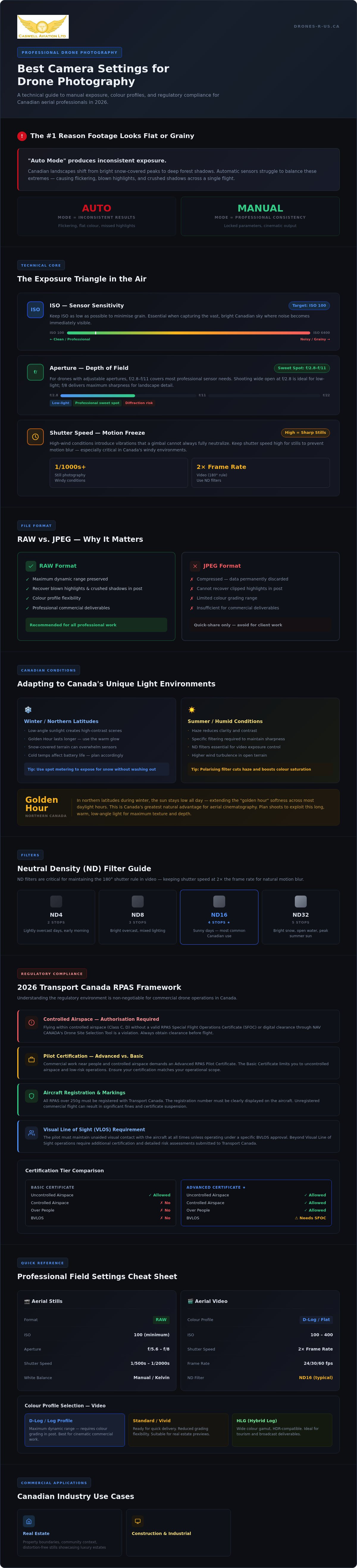
Relying on "Auto Mode" is the primary reason why many pilots fail to achieve professional consistency. In the Canadian landscape, where lighting transitions from bright snow-covered peaks to deep forest shadows, automatic sensors often struggle to find a balance. This results in inconsistent exposure and distracting flickers across a single flight. Mastering the best camera settings for drone photography requires locking in your parameters manually. We recommend shooting exclusively in RAW format to preserve maximum dynamic range. This provides the flexibility to recover highlights and shadows during post-processing that compressed JPEGs simply lose.
Timing is equally important for technical success. In northern latitudes, the "Golden Hour" often lasts longer during winter months due to the lower angle of the sun. This provides a soft, warm glow that enhances the natural texture of the terrain. However, Canadian pilots must also contend with significant wind. High-wind conditions introduce vibrations that a gimbal cannot always fully neutralize. To combat this, keep your shutter speed high for stills to prevent motion blur. If you find manual exposure challenging during high-pressure flights, our online drone courses provide step-by-step guidance for professional field operations.
The Exposure Triangle in the Air
Precision in the air starts with ISO management. Keep your ISO at 100 whenever possible to minimize grain, especially when capturing the vast, bright Canadian sky. For drones with adjustable apertures, staying between f/2.8 and f/11 is the sweet spot for most professional sensors. If you're shooting video, Neutral Density (ND) filters are essential to maintain the 180-degree shutter rule. This ensures your motion looks natural and cinematic rather than choppy. While focusing on these technical details, always ensure you are operating within the current Transport Canada drone rules to maintain safety and compliance.
Composition Techniques for Professional Pilots
Professional imagery relies on more than just exposure; it requires intentional composition. We use the Rule of Thirds to create balance by placing horizons or subjects along the grid lines of the controller screen. Leading lines are also highly effective in the Canadian context. Use the natural curves of rivers or the geometric lines of the Trans-Canada Highway to guide the viewer’s eye through the frame. For videography, implementing the "Parallax Effect" by moving the drone laterally while rotating the camera creates a sense of depth that makes your content stand out. Achieving these results consistently is easier when you understand the best camera settings for drone photography for each specific environment.
Professional Gear and Ergonomics: Optimizing the Pilot Experience
Professional drone photography isn't just about the hardware in the sky. The pilot's interface on the ground is equally critical for achieving smooth, cinematic results. Smart Controllers have largely replaced mobile device attachments in 2026 because they offer superior screen brightness and better reliability in extreme Canadian temperatures. However, these integrated units are significantly heavier than traditional controllers. Holding a heavy device for multiple battery cycles leads to physical fatigue. This discomfort often results in poor creative choices and shaky gimbal control, undermining even the best camera settings for drone photography.
Fatigue is a silent killer of image quality. When your neck and shoulders are strained, your fine-motor control suffers. This makes smooth orbits and gradual camera tilts nearly impossible to execute. To maintain professional standards, pilots must prioritize their physical setup as much as their flight logs and Transport Canada Drone Safety Regulations compliance. Precision requires a stable platform, and that platform starts with the pilot's body.
The Fitek Gear Advantage
Experienced pilots realize that a standard neck strap is insufficient for modern, heavy smart controllers. A simple strap concentrates weight on the cervical spine, leading to long-term strain and reduced concentration. We recommend using a full drone harness to distribute the weight across your shoulders and upper back. This ergonomic shift stabilizes the controller against your torso, allowing your hands to focus entirely on precise joystick inputs. A stable harness is a professional secret for maintaining the steady hands required for complex cinematic manoeuvres and long-exposure aerial shots.
Essential Field Kit for Aerial Photographers
Beyond the drone and harness, your field kit must be optimized for high-performance data collection. Use high-speed microSD cards with V30 or V60 ratings to ensure that 4K or 8K video streams aren't throttled during high-bitrate recording. A portable landing pad is also a necessity in the Canadian wilderness to protect your gimbal and lens from dust, snow, or tall grass. For a deeper look at optimizing your hardware, read our guide on choosing the best drone harness for smart controllers. These small adjustments ensure that your technical execution matches the best camera settings for drone photography for every client project.
Regulatory Compliance: Navigating Transport Canada Rules for Creatives
Technical mastery and legal compliance are inseparable in the professional aviation industry. You might understand the best camera settings for drone photography, but those skills are irrelevant if you cannot legally access the airspace your client requires. In the 2026 Canadian regulatory framework, Transport Canada distinguishes strictly between Basic and Advanced operations. Basic operations are limited to uncontrolled airspace and must maintain a horizontal distance of at least 30 metres from bystanders. For the majority of professional creative work, particularly in urban centres or near people, an Advanced Certificate is a non-negotiable requirement.
Operating in controlled airspace requires more than just a certificate; it demands active coordination with NAV CANADA. Professional pilots use the NAV Drone application or direct coordination to secure flight authorizations. This process ensures that your creative vision doesn't interfere with manned aviation. Additionally, commercial pilots must maintain meticulous records. Transport Canada requires you to keep a pilot logbook and a record of every flight incident or maintenance action. These logs prove your "recency" and professional standing during a site inspection or a client audit.
The Path to Advanced Certification
Earning an Advanced Certificate requires passing the Small Advanced Exam with a score of 80% or higher. This exam covers complex subjects like meteorology, flight theory, and Canadian aviation law. Once the written portion is complete, you must pass an in-person flight review with an authorized reviewer. This practical assessment ensures you can handle emergency procedures and safely manage a flight crew. For a detailed breakdown of these requirements, consult the complete guide to Transport Canada drone certification in 2026. Preparing with a veteran mentor is the most efficient way to ensure you pass this rigorous evaluation.
Safety as a Creative Catalyst
A disciplined approach to safety actually expands your creative freedom. When you perform a thorough site survey and risk assessment, you identify hazards like power lines or signal interference before they ruin a shoot. Staying sharp with current regulations is also a legal requirement; pilots must meet recency requirements every 24 months to keep their certificates valid. You can find more details on staying compliant in our drone regulations in Canada: the 2026 professional reference guide. If you're ready to transition from a hobbyist to a certified professional, we invite you to explore our advanced training programs to secure your standing in the industry.
By integrating these legal prerequisites into your pre-flight workflow, you protect your business and your equipment. Understanding the best camera settings for drone photography is only half the battle. The other half is ensuring that every frame you capture is backed by the proper certification and safety protocols required by Canadian law.
Elevating Your Content: Training and Service Solutions
Self-teaching provides a basic foundation, but it has distinct limits within the highly regulated Canadian aviation sector. Mastering the best camera settings for drone photography is a complex task that involves more than just reading a manual. It requires an understanding of how light interacts with specific sensors during high-speed manoeuvres and how to adjust those parameters in real-time. Mentor-led training offers the direct feedback necessary to bridge the gap between hobbyist snapshots and professional-grade assets. This professional oversight ensures you don't just learn the settings, but you understand the logic behind every technical choice.
For many Canadian organizations, the decision comes down to a choice between developing in-house expertise or outsourcing to a specialist. Both paths require a commitment to quality and safety. Caswell Aviation Ltd serves as a comprehensive resource for both options. We provide the veteran mentorship required for pilots to earn their certifications, while also delivering high-end imagery for clients who prefer to hire an established professional. This dual approach ensures that your aerial content always meets the highest standards of the 2026 industry.
Professional Training and Flight Reviews
Our training programs focus on preparing pilots for Advanced and Level 1 Complex operations. We emphasize the practical application of flight theory, ensuring you are prepared for the rigours of the Transport Canada exam. Preparing for your Flight Review with a veteran mentor significantly increases your chances of success on the first attempt. We provide a structured environment to practise emergency procedures and precision flight paths. You can view our current course availability and schedules at drones-r-us.ca to begin your professional journey.
Bespoke Aerial Imagery Services
If your business requires immediate, high-resolution results without the overhead of maintaining a drone department, our imagery services are the ideal solution. We provide customized photography and video solutions tailored to the specific needs of Canadian industries, from infrastructure inspection to cinematic marketing. Our team handles all aspects of flight planning, coordination, and post-processing. We are committed to delivering compliant, cinematic content that utilizes the best camera settings for drone photography for every unique project. Contact Caswell Aviation Ltd to discuss your specific aerial imagery requirements and receive a professional consultation.
Advancing Your Aerial Career with Technical Precision
Success in the Canadian drone industry requires a balance of artistic vision, technical discipline, and legal compliance. We have examined how moving beyond automatic modes is essential for professional consistency and high-resolution results. You now understand that physical ergonomics and the use of stable harnesses directly impact your ability to execute complex shots without fatigue. It's also clear that aligning your creative work with the 2026 Transport Canada regulatory framework is the only way to ensure long-term commercial viability.
Implementing the best camera settings for drone photography is a continuous process of refinement. As a national service provider with Transport Canada Advanced Certified Instructors and an official retailer for Fitek Gear, Caswell Aviation is your partner in professional growth. We bridge the gap between complex technical requirements and stunning visual output. Book Your Transport Canada Drone Training or Flight Review today to solidify your standing in the aviation industry. The Canadian sky offers immense opportunity for those who prioritize safety and technical excellence.
Frequently Asked Questions
Do I need a license for drone photography in Canada in 2026?
Yes, you require a Pilot Certificate from Transport Canada if your drone weighs between 250 grams and 25 kilograms. This process involves passing either the Small Basic or Small Advanced online exam. You must also register your aircraft with Transport Canada for a fee of $5 and clearly mark the registration number on the drone before your first flight.
What is the difference between Basic and Advanced drone certification for photographers?
Basic certification allows for operations in uncontrolled airspace provided you stay at least 30 metres away from bystanders. Advanced certification is required for flights in controlled airspace, near airports, or within 30 metres of people. Most professionals choose the Advanced path to ensure they can legally access urban centres and restricted client sites where the best camera settings for drone photography are most needed.
Can I fly a drone for photography in a city centre or near bystanders?
Flying in a city centre or near bystanders is permitted only if you hold an Advanced Certificate and use a drone with a manufacturer safety declaration for those specific operations. Since most Canadian urban cores are located within controlled airspace, you must also secure flight authorization from NAV CANADA. These regulations ensure that high-resolution commercial photography does not compromise public safety or manned aviation.
What is the best drone for professional aerial photography right now?
The DJI Mavic 4 Pro is currently a top choice for professionals due to its high-resolution sensor and reliable flight performance. Other capable alternatives include the Autel EVO Lite+, which offers 6K video capabilities, and the Skydio X10 for autonomous tracking. Professional pilots often pair these high-end drones with ergonomic harnesses and smart controllers to maintain the precise control required for cinematic results.
How much does a professional drone flight review cost in Canada?
The cost of a professional drone flight review varies depending on the provider and the level of preparation required. This practical assessment is a mandatory requirement for the Advanced Certificate and must be conducted by an authorized reviewer. You should contact a certified training centre such as Caswell Aviation to discuss current scheduling and specific requirements for your in-person evaluation.
Do I need insurance for commercial drone photography in Canada?
While liability insurance is not federally mandated by Transport Canada for all operations, it is a standard professional requirement for commercial work. Most Canadian clients and real estate boards will require proof of at least $1 million in liability coverage before you begin a project. For industrial or government contracts, coverage requirements often increase to $5 million to account for higher operational risks.
How do I legally fly in controlled airspace for a photo shoot?
To fly in controlled airspace, you must hold an Advanced Certificate and obtain a flight authorization through the NAV Drone application. This system coordinates your flight with NAV CANADA to ensure you remain separated from other aircraft. Following this protocol allows you to focus on the best camera settings for drone photography while ensuring your operation remains entirely within the legal framework.
What are the recency requirements for Canadian drone pilots in 2026?
Canadian drone pilots must complete a recurrent training activity every 24 months to maintain their flight privileges. This requirement can be met by passing a Transport Canada online exam, attending an authorized safety seminar, or completing a professional flight review. You are also required to maintain a pilot logbook that documents your flight time and any maintenance or incidents to prove your ongoing operational experience.
Leave a comment