
How to Upgrade Your Basic Drone Licence in Canada: A Step-by-Step 2026 Guide
A Basic Pilot Certificate tells the world you can fly safely in a quiet field, but an Advanced Certificate proves you are a disciplined aviation professional. If you've ever been grounded by a 5.6-kilometre airport buffer or the 30-metre bystander rule, you know that a basic licence eventually limits your professional potential. You aren't alone if the transition feels daunting. Many pilots feel anxious about the 80% passing grade required for the advanced exam or the technical pressure of an in-person flight review.
Upgrading basic drone license Canada doesn't have to be a confusing or overwhelming process. This guide provides the exact roadmap you need to transition from hobbyist operations to complex, professional missions. You'll learn how to master the 50-question advanced exam, navigate the "Phase 2" regulatory updates implemented in late 2025, and prepare for a successful flight review with a qualified evaluator. By following these methodical steps, you can move beyond simple flights and start a legitimate career in the Canadian drone industry.
Key Takeaways
- Understand the operational freedom gained by moving to the Advanced category, including the ability to fly within five metres of bystanders and inside controlled airspace.
- Discover the specific steps for upgrading basic drone license Canada, beginning with a comprehensive ground school curriculum to prepare for the rigorous Transport Canada technical exam.
- Prepare for the mandatory in-person flight review by organizing essential documentation such as your pilot certificate, drone registration, and logbooks.
- Maintain your professional standing by meeting the 24-month recency requirements through activities like flight reviews or specialized aviation seminars.
- Learn how veteran-led training and professional-grade gear can bridge the gap between basic hobbyist skills and advanced commercial proficiency.
Understanding the Transition: Basic vs. Advanced Operations
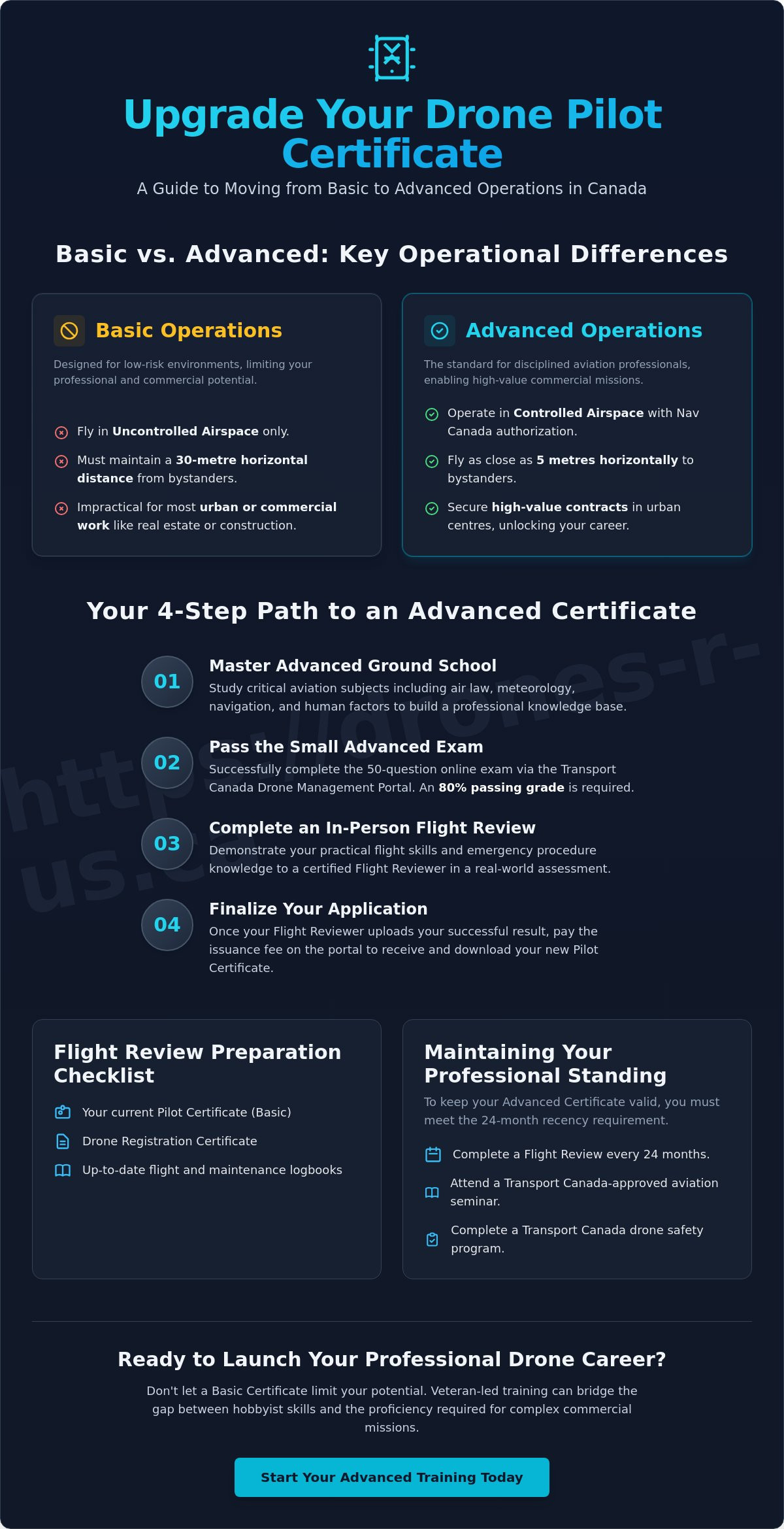
The distinction between Basic and Advanced operations is more than an administrative hurdle; it represents a fundamental shift in how you interact with the national airspace. Under the framework of Canadian drone regulations, Basic operations are restricted to uncontrolled airspace and require you to maintain a horizontal distance of 30 metres from bystanders. This category is designed for low-risk environments where the pilot operates in isolation from other aircraft and people. While this is a logical starting point, it often acts as a ceiling for those pursuing commercial growth.
The process of upgrading basic drone license Canada involves moving into the Advanced Operations category. This transition allows you to operate in controlled airspace and significantly closer to people. The most notable change is the "5-metre rule," which permits flight as close as five metres horizontally to bystanders. To complete this upgrade, you must satisfy three core requirements:
- The Small Advanced Exam: A technical test with a higher passing grade (80%) and a focus on coordination and emergency procedures.
- The Flight Review: A practical, in-person assessment by a qualified reviewer to verify your operational skills.
- The Portal Application: Formally requesting your new certificate through the Transport Canada Drone Management Portal after passing both the exam and review.
Professional beginner drone pilot training in Canada often begins with the Basic exam because it establishes a baseline for safety and airmanship. It allows you to build flight hours and technical familiarity in lower-stakes environments before tackling the complexities of advanced certification.
Why a Basic Licence May Not Be Enough for Your Goals
A Basic Certificate is sufficient for rural inspections or landscape photography in isolated areas. However, if your goal is to work in urban centres, you'll find the 30-metre rule almost impossible to follow. Real estate photography and construction site monitoring almost always require flying near buildings or roads where bystanders may be present. Without an Advanced certificate, these high-value contracts remain out of reach. You aren't just obtaining a new document; you're securing the legal right to operate where the business is actually happening.
Key Regulatory Differences You Must Realize
Upgrading your status requires a mental shift from "staying away" to "actively coordinating." In the Advanced category, you must communicate with Nav Canada to receive flight authorizations in controlled zones. You also need to realize that your equipment must meet specific standards. You must ensure your drone has a Safety Assurance declaration from the manufacturer for the specific type of operation you intend to perform. This certification is also the necessary prerequisite for "Level 1 Complex" flight reviews, which allow for even more sophisticated commercial applications, such as operations over people, as your career progresses.
Step-by-Step Guide to Upgrading Your Drone Pilot Certificate
Transitioning to advanced operations is a methodical process that requires more than just flight hours. The path for upgrading basic drone license Canada follows a regulated four-step sequence designed to ensure public safety in complex environments. You are moving from a recreational or low-risk framework into a professional aviation standard. This transition demands a higher level of theoretical knowledge and practical skill.
To successfully navigate this upgrade, follow these specific steps in order:
- Step 1: Master the Advanced ground school curriculum. You must study subjects beyond basic flight safety, including air law, meteorology, and human factors.
- Step 2: Pass the Small Advanced Exam. This is a proctored-style online test via the Transport Canada Drone Management Portal.
- Step 3: Complete a Flight Review. You must demonstrate your proficiency in person to a certified Flight Reviewer.
- Step 4: Finalize your application. Once your flight review results are uploaded, you must pay the issuance fee and download your new Pilot Certificate – Advanced Operations.
If you find the technical curriculum daunting, reviewing structured online drone courses can simplify the complex terminology before you attempt the exam.
Tackling the Small Advanced Exam
The Advanced exam is significantly more rigorous than the Basic version. While the Basic exam consists of 35 questions with a 65% passing grade, the Advanced exam contains 50 questions and requires an 80% score to pass. You have only 60 minutes to complete it. The questions focus heavily on coordination with air traffic control and emergency procedures. Using a comprehensive Transport Canada drone certification guide as a primary study reference will help you identify the specific sections of the Canadian Aviation Regulations (CARs) that appear most frequently on the test.
Navigating the Drone Management Portal
The Transport Canada Drone Management Portal is the central hub for your certification. Before you can even book a flight review, you must ensure your drone is registered and that your exam results are visible in your profile. Detailed instructions for Getting a drone pilot certificate emphasize that your personal information in the portal must match your government ID exactly. A common administrative error that delays certificate issuance is a name mismatch between the portal profile and the flight reviewer's records. Once your reviewer submits your results, the portal will prompt you to pay the required fee. Only after this payment is processed can you download and carry your digital certificate, which is a legal requirement for every flight.
Preparing for Your Advanced Flight Review
The practical flight review is the final gatekeeper in the process of upgrading basic drone license Canada. Unlike the automated online exam, this is a face-to-face evaluation with a certified Flight Reviewer. You should view the reviewer as a veteran mentor whose goal is to confirm that you can translate regulatory theory into safe, disciplined flight. This assessment is not merely about stick skills; it is an evaluation of your entire operational workflow and your ability to manage risk in real time.
Preparation begins with organizing your documentation. You are required to present your Pilot Certificate (Basic), proof of drone registration, and detailed pilot logbooks. These documents establish your legal standing and your history of flight experience. Without these items, the review cannot proceed. A successful Advanced Flight Review is divided into two distinct phases: the ground briefing and the flight manoeuvres.
During the ground briefing, you must demonstrate your pre-flight methodology. This involves conducting a comprehensive site survey, performing weather checks using aviation-specific tools, and briefing the reviewer on emergency procedures. Once the aircraft is in the air, you will perform specific manoeuvres, including controlled take-offs, manual flight patterns without GPS assistance, and a demonstration of failsafe triggers. The reviewer will observe how you maintain situational awareness and whether you can execute a landing safely if a system failure occurs.
Common Mistakes to Avoid During the Review
Many candidates fail the review because they skip the "tailboard" meeting or pre-flight site survey. You must treat the reviewer as a member of your flight crew and communicate every safety check clearly. Another frequent error is a lack of technical familiarity with the drone's emergency settings. You should know exactly how your "Return to Home" altitude is configured and how to override it if necessary. Finally, inadequate record-keeping or missing maintenance logs for your aircraft can signal a lack of professional discipline, leading to an unsuccessful result.
The Importance of a Standardized Operations Manual
While not strictly mandatory for every individual pilot, having a written Operations Manual demonstrates a high level of professional behaviour. It provides a structured framework for your checklists and emergency protocols, making it easier for the reviewer to see that you have a repeatable, safe process. Organizing your flight logs and maintenance records within this manual ensures you are prepared for inspection at any time. For a more detailed preparation list, refer to this guide on drone flight reviews to ensure no technical requirement is overlooked.
Professional Requirements: Recency and Pilot Ergonomics
Obtaining your certificate is a major milestone, but the process of upgrading basic drone license Canada implies a commitment to ongoing professional standards. Unlike a driver's licence, your Pilot Certificate – Advanced Operations requires you to prove your competency every 24 months. Transport Canada enforces this recency requirement to ensure that pilots remain current with evolving regulations, such as the "Phase 2" updates that reshaped the industry in late 2025. This ensures that the high safety standards of the Canadian airspace are maintained by every active practitioner.
To keep your certificate valid, you must complete at least one recognized recency activity within a 24-month window. These activities include:
- Successfully passing a Small Advanced Exam.
- Completing a flight review with a certified reviewer.
- Attending a Transport Canada-sanctioned safety seminar or specialized training session.
Failure to meet these requirements renders your certificate invalid for advanced commercial operations. Maintaining your status is a continuous cycle of education and practice, not a one-time achievement.
Maintaining Your Pilot Competency
The most effective way to manage your professional standing is through meticulous record-keeping. A detailed pilot logbook serves as your primary evidence of recency and operational experience. Beyond the legal minimums, you should realize that recency is about building a disciplined safety culture. Using online ground school updates allows you to stay informed about technical changes without waiting for your next formal review. This proactive approach ensures you are never caught off guard by a regulatory shift or a surprise inspection during a job site visit.
Investing in Professional Gear for Long Missions
Advanced operations often involve long hours in the field, which introduces physical demands that many hobbyists overlook. Professional smart controllers are heavy. Holding one for a full day of industrial inspections or aerial mapping leads to significant muscle fatigue and reduced control precision. While a simple neck strap is a common starting point, it is often insufficient for professional-grade controllers because it concentrates weight on the neck and limits your range of motion.
A Fitek Gear drone harness for smart controllers represents a specialized ergonomic solution. By distributing the weight across your shoulders and back, it reduces fatigue and allows you to maintain the focus required for advanced missions near bystanders. This improvement in pilot ergonomics directly impacts the safety and quality of your flight. You can read more about these benefits in our guide on choosing a drone harness. High-quality gear is a functional necessity for any serious pilot.
If you are ready to improve your operational endurance and safety, you can browse our professional drone harnesses and training resources to ensure you are fully prepared for your next mission.
Advancing Your Career with Caswell Aviation Ltd
Caswell Aviation Ltd serves as a professional bridge for pilots upgrading basic drone license Canada. We realize that moving from recreational flight to commercial operations requires a significant shift in discipline and technical knowledge. Our training programs are designed to simplify the complex technical language found within Part IX of the Canadian Aviation Regulations. By providing a structured and modular syllabus, we help you transition from a basic operator to a certified advanced pilot with confidence and precision.
Our flight reviews are led by instructors who bring a "Master Practitioner" perspective to every evaluation. This veteran-led approach focuses on building real-world confidence rather than just meeting the minimum regulatory requirements. We emphasize risk-based decision-making and standard operating procedures. This ensures you are prepared for the unpredictable nature of commercial flight environments, where coordination with air traffic control and bystander safety are paramount. You aren't just passing a test; you are adopting a professional aviation culture.
Comprehensive Online and In-Person Training
We offer flexible online drone courses that include comprehensive video modules and PDF study guides. These resources are specifically tailored for busy professionals and small business owners who must master the advanced curriculum on their own schedule. For those who require more hands-on guidance, our in-person training sessions offer immediate, technical feedback from instructors who have managed complex flight operations across various industries. This level of preparation is essential for high-stakes missions. For example, advanced aerial photography for real estate requires a deep understanding of both flight safety and technical camera precision within urban centres.
Your Next Steps to Professional Certification
Transitioning to an Advanced certificate is the most direct path to unlocking your commercial potential. The industry is evolving rapidly, and holding the correct credentials allows you to participate in the growth of the Canadian drone sector. Whether you are expanding into industrial inspections or agricultural mapping, the Advanced certificate is your primary tool for legal and professional success. To begin your upgrade, you can select from our range of ground school packages or book a flight review with one of our certified evaluators. Caswell Aviation Ltd remains committed to providing the Canadian drone community with the high-level training and specialized gear needed to maintain a culture of aviation safety and operational excellence.
Start your advanced drone training with Caswell Aviation Ltd today!
Elevating Your Professional Aviation Standards
Transitioning from basic to advanced operations is a definitive step toward a serious career in the Canadian drone industry. You now understand that upgrading basic drone license Canada requires a combination of rigorous theoretical study and a successful in-person evaluation. By mastering the current regulatory landscape and preparing your documentation for a flight review, you move from the limitations of rural flight into the high-value opportunities found in controlled and urban airspace.
Caswell Aviation Ltd is here to support this transition with Transport Canada compliant training and a team of professional flight reviewers who value safety and precision. We also serve as a specialized Fitek Gear retailer, ensuring you have the ergonomic harnesses needed for long-duration missions. Success in this field depends on your commitment to recency and your willingness to adopt a professional aviation mindset. When you are ready to take the final step toward your advanced certificate, we are prepared to guide you through the process.
Book Your Advanced Flight Review with Caswell Aviation Ltd and secure your place in the future of professional flight. Your path to complex operations starts with a single, disciplined decision.
Frequently Asked Questions
Does a drone licence expire in Canada?
Pilot certificates for drone operations in Canada do not have an expiry date. However, your certificate is only legally valid if you have completed a recognized recency activity within the previous 24 months. This requirement ensures that all pilots remain current with the latest safety standards and regulatory updates, such as the Remote ID mandates introduced in late 2026.
Can I fly in controlled airspace with only a Basic certificate?
You are not permitted to fly in controlled airspace with a Basic certificate. This type of operation is strictly limited to holders of an Advanced certificate who have also obtained the necessary flight authorization from Nav Canada. Basic operations must remain in uncontrolled airspace and maintain a distance of at least 5.6 kilometres from airports and 1.9 kilometres from heliports.
How much does it cost to upgrade from a Basic to an Advanced drone licence?
The administrative fees set by Transport Canada include a $10 charge for the Small Advanced Exam and a $10 fee for the issuance of the new certificate. These costs are paid directly through the Drone Management Portal. You must also factor in the cost of a mandatory in-person flight review, which is set by the individual reviewer and typically ranges between $150 and $400 depending on the provider.
Do I need to take a new exam if I already have my Basic certificate?
Yes, you must pass the Small Advanced Exam to qualify for the upgrade. The Advanced exam is a separate, more rigorous test consisting of 50 questions with an 80% passing grade requirement. It covers specialized topics not found in the Basic curriculum, including air traffic control communications, advanced flight theory, and coordination procedures for controlled environments.
What happens if I fail my Advanced flight review?
If you do not pass your flight review, you are allowed to retake it at a later date. Your flight reviewer will provide a debriefing to identify the specific manoeuvres or ground briefing items that did not meet the required standard. While there is no regulated waiting period between attempts, you should use the time to practice the identified skills before scheduling a new session with your evaluator.
Is beginner drone pilot training in Canada mandatory for the upgrade?
Formal training is not a legal requirement for upgrading basic drone license Canada, but it is highly recommended for success. The technical complexity of the Advanced exam and the practical demands of the flight review often require structured study. Most professionals utilize ground school resources to ensure they understand the specific "Phase 2" regulatory changes and human factors involved in complex operations.
Can I use a micro drone (under 250g) to take my Advanced flight review?
You cannot use a micro drone for an Advanced flight review. The review must be conducted using a remotely piloted aircraft (RPA) that weighs between 250 grams and 25 kilograms. Additionally, the drone must be registered with Transport Canada and must possess a manufacturer’s Safety Assurance declaration for the specific category of advanced operation you are being tested on.
How do I prove my recency to Transport Canada if requested?
You prove your recency by producing a pilot logbook or digital record that shows you have completed a qualifying activity within the last 24 months. These activities include passing an exam, completing a flight review, or attending a sanctioned safety seminar. If you are stopped for an inspection, you must be able to show these records alongside your Pilot Certificate – Advanced Operations to demonstrate you are flying legally.
Leave a comment