
How to Fly Drones Legally in Canada: The 2026 Professional Pilot Guide
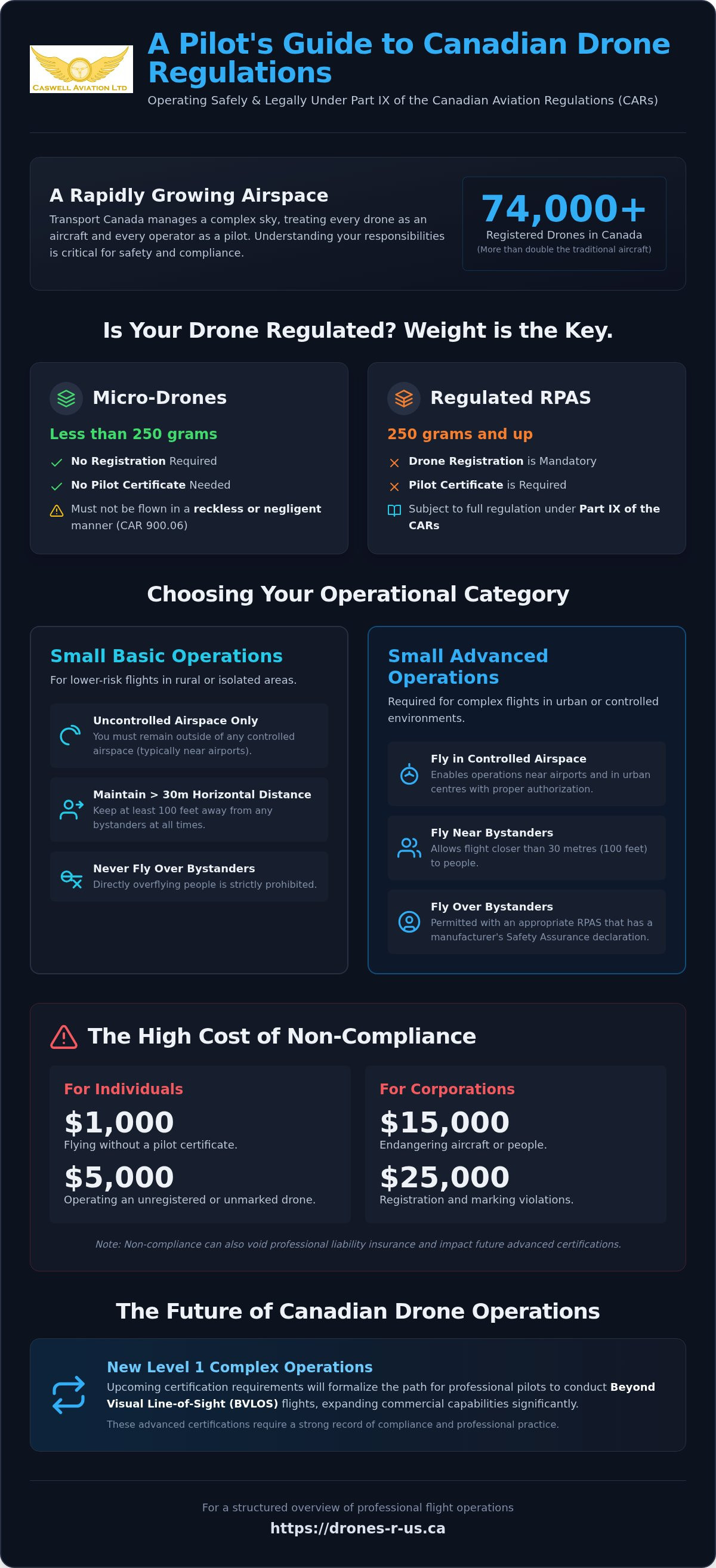
Did you know there are now over 74,000 registered drones in Canada? That's more than double the number of traditional aircraft currently in our skies. This rapid growth has led to a sophisticated regulatory environment that can feel daunting to even the most experienced operators. If you're feeling uncertain about which certificate you need or worried about the steep fines for non-compliance, you aren't alone. Understanding how to fly drones legally in Canada is a disciplined aviation practice that requires a clear, methodical approach.
This guide serves as your professional roadmap to mastering the Transport Canada regulatory framework. You'll learn exactly how to operate your drone safely and legally while avoiding the common pitfalls of confusing terminology. We will preview the 2026 certification requirements, explain the new Level 1 Complex Operations for BVLOS flights, and provide a direct path to confident, compliant operations in any airspace. Whether you are a hobbyist or a commercial pilot, this structured overview ensures you have the knowledge to stay airworthy and legal.
Key Takeaways
- Identify the specific legal requirements under Part IX of the Canadian Aviation Regulations to ensure your flight operations meet federal safety standards.
- Discover how to fly drones legally in Canada by selecting the correct certification level based on your intended flight environment and proximity to bystanders.
- Navigate the registration process and exam requirements for Small Basic and Small Advanced certificates with a methodical, step-by-step approach.
- Implement professional pre-flight site surveys and visual line-of-sight protocols to mitigate operational risks and avoid costly Transport Canada fines.
- Explore the requirements for the new Level 1 Complex certification to expand your professional capabilities into beyond visual line-of-sight operations.
Understanding the Canadian Drone Regulatory Framework
Transport Canada treats every drone as an aircraft and every operator as a pilot. This fundamental perspective shapes the Canadian Drone Regulatory Framework, which is codified under Part IX of the Canadian Aviation Regulations (CARs). These rules apply to all Remotely Piloted Aircraft Systems (RPAS), a term that encompasses the aircraft itself, the control station, and the command and control link. Understanding how to fly drones legally in Canada begins with recognizing that you are operating within a complex, shared airspace managed by federal authorities to ensure public safety.
The primary factor determining your legal obligations is the weight of your aircraft. Transport Canada divides drones into categories based on their Maximum Take-Off Weight (MTOW). Any drone weighing 250 grams or more must be registered, and the pilot must hold a valid certificate. This threshold is the dividing line between casual use and regulated aviation. For those seeking professional growth, Caswell Aviation Ltd provides the structured training necessary to move beyond hobbyist basics into the disciplined world of certified flight operations.
The Legal Status of Micro-Drones
Micro-drones are aircraft weighing less than 250 grams. While these small devices do not require registration or a pilot certificate, they are not exempt from the law. Pilots must still operate in a manner that does not endanger aviation safety or the lives of people on the ground. CAR 900.06 explicitly prohibits reckless or negligent operation. Many professional pilots choose to move beyond micro-drones, opting to organize their fleet with larger, registered aircraft. These heavier systems offer the stability, wind resistance, and advanced sensor suites required for high-quality aerial data collection and commercial reliability.
The Consequences of Non-Compliance
Violating Canadian aviation laws carries significant financial and professional risks. As of 2026, Transport Canada has established a strict fine structure to deter unsafe practices. For individuals, flying without a pilot certificate can result in a fine of up to $1,000. Operating an unregistered or unmarked drone carries a penalty of up to $5,000. Corporations face even steeper consequences, with fines reaching $25,000 for registration violations and $15,000 for endangering aircraft or people. Beyond the immediate costs, a lack of certification can void your professional liability insurance. Maintaining a clean pilot record is essential for anyone planning to apply for advanced certificates or Level 1 Complex operations in the future. Safety is a professional requirement, not a suggestion.
Basic vs. Advanced Operations: Which One Do You Need?
Choosing the right operational category is the most critical decision you'll make when learning how to fly drones legally in Canada. Transport Canada separates flight operations into two distinct paths: Basic and Advanced. This distinction isn't based on your skill level as a pilot but on the specific environment where you intend to fly and the risks associated with that mission. Matching your certification to your flight goals is the only way to ensure compliance.
A key technical requirement for any advanced mission is a Safety Assurance declaration. This is a formal statement from the manufacturer confirming the drone meets specific safety standards for flying near people or in controlled airspace. Before you commit to a specific category, you must verify that your equipment is compliant. Understanding these Operational Requirements for Legal Flight ensures you don't accidentally violate federal law by using a drone that hasn't been declared safe for the task.
Criteria for Basic Operations
Basic operations are generally reserved for lower-risk, rural, or isolated environments. To qualify for this category, you must meet three strict conditions during every second of your flight:
- You must fly exclusively in uncontrolled airspace.
- You must maintain a horizontal distance of at least 30 metres (100 feet) from any bystanders.
- You must never fly directly over people.
For many hobbyists, these rules provide enough freedom to enjoy the craft. However, if your goals include professional photography or industrial inspections in urban centres, you'll likely find these boundaries too restrictive. Most commercial work in developed areas naturally falls outside these limits.
When to Step Up to Advanced Operations
Advanced operations are necessary if you need to fly in controlled airspace or near bystanders. Controlled airspace typically surrounds airports and busy urban areas, where coordination with NAV CANADA is mandatory. If your flight path brings you within 30 metres of people, or if you need to fly directly over them, you are performing an advanced operation by definition. This requires a higher level of discipline and technical knowledge.
This category requires more than just an online exam. You must hold an Advanced Pilot Certificate and successfully complete a formal flight review with a qualified examiner. This practical assessment ensures you can handle the complexities of high-stakes environments. If you're ready to transition into professional work, completing one of our online drone courses is the most efficient way to prepare for the rigorous advanced exam and flight review process. Choosing the correct category from the start saves you time and prevents the stress of potential regulatory scrutiny.
The Path to Certification: Exams and Flight Reviews
Achieving certification is a multi-step process that transforms you from a casual user into a recognized pilot within the national aviation system. The first administrative requirement is registering your drone through the Transport Canada Drone Management Portal. This involves a $10 fee for any aircraft weighing between 250 grams and 25 kilograms. Once your aircraft is marked with its unique registration number, you can proceed to the testing phase. Understanding The Path to Certification is essential for anyone learning how to fly drones legally in Canada without facing administrative delays or penalties.
The online exams for both Basic and Advanced certifications cost $10 per attempt. While the Basic exam is open to those 14 years and older, the Advanced exam requires a minimum age of 16. These tests are not merely formalities; they require a deep understanding of the Canadian Aviation Regulations and the physics of flight. After passing, your certificate remains valid indefinitely, provided you meet recency requirements every 24 months. Common recency activities include passing an exam, attending a safety seminar, or completing a flight review.
Preparing for the Transport Canada Written Exam
The written exam challenges your knowledge across four primary pillars: air law, navigation, meteorology, and airmanship. You will face questions on everything from cloud formations to right-of-way rules in shared airspace. The 2026 exam interface is designed for efficiency, but the technical nature of the questions can be overwhelming without proper study. Many candidates find that self-study alone is insufficient for the Advanced exam's complexity. Utilizing structured online drone courses allows you to organize your study time effectively and ensures you grasp the nuances of the regulatory framework before sitting for the test.
What to Expect During a Professional Flight Review
If you are pursuing Advanced certification, passing the written exam is only half the battle. You must also successfully complete a practical assessment with an authorized flight reviewer. This in-person evaluation confirms that you can apply theoretical knowledge to real-world flight conditions. The reviewer will scrutinize your pre-flight checklists, your ability to manage emergency procedures, and your precision during specific flight manoeuvres. Preparation is the key to success in this high-pressure environment. For a comprehensive breakdown of the skills you will need to demonstrate, consult our What is a Drone Flight Review Canada guide. This practical milestone is the final hurdle before you can legally operate in controlled airspace or near bystanders.
Operational Requirements for Legal Flight
Legal certification is merely the starting point for a professional pilot. The daily reality of how to fly drones legally in Canada requires a commitment to operational discipline and meticulous documentation. Maintaining Visual Line of Sight (VLOS) is a non-negotiable requirement for both Basic and Advanced operations. While you are the pilot in command, utilizing a Visual Observer (VO) is a recommended practice for complex missions. A VO helps you scan the sky for other aircraft and ground hazards, allowing you to focus on the technical aspects of the flight while ensuring the aircraft remains within your sight at all times.
Before every takeoff, you must conduct a thorough pre-flight site survey. This process involves identifying potential obstacles, such as power lines or tall structures, and establishing clear emergency landing zones. This isn't just a safety tip; it's a regulatory requirement under the Canadian Aviation Regulations. Additionally, you must maintain accurate records for every flight. Transport Canada requires pilots to keep a log of flight times, maintenance activities, and any incidents that occur. These records must be available for inspection upon request and are vital for proving your compliance during a regulatory audit.
Navigating Airspace with NAV CANADA
Airspace management is a collaborative effort between pilots and NAV CANADA. You must use the NAV Drone app to verify the status of your intended flight area before every mission. In Class G uncontrolled airspace, you are responsible for your own separation from other aircraft. However, in controlled airspace, you must request and receive authorization through the app before launching. For high-complexity missions near major airports, direct coordination with local Air Traffic Control (ATC) may be necessary. Professionalism in these communications builds trust within the aviation community and ensures the safety of the entire national airspace system.
Professional Field Safety and Ergonomics
Operational safety is directly linked to pilot comfort and situational awareness. During long missions, pilot fatigue can lead to lapses in judgment and safety violations. Investing in a professional drone harness for smart controller is essential for maintaining VLOS while reducing physical strain. Proper ergonomics allow you to keep your eyes on the aircraft rather than struggling with heavy hardware. Beyond the pilot, your equipment requires regular inspections and documented maintenance to ensure continued Transport Canada compliance. If you need to upgrade your operational standards, we invite you to book a professional flight review to refine your field procedures and ensure your operations meet the highest industry standards.
Advancing Your Career with Caswell Aviation Ltd
The transition from a recreational hobbyist to a professional pilot is a significant career milestone. It requires shifting from a mindset of play to one of high-stakes aviation discipline. Learning how to fly drones legally in Canada at a commercial level involves more than just passing an initial exam. It demands a partnership with an experienced mentor who understands the nuances of the industry. Caswell Aviation Ltd serves as this partner, providing the technical expertise and regulatory guidance needed to succeed in a competitive market. We offer the precision and reliability expected in safety-critical training environments, helping you realize your potential as a certified operator.
Specialized Training for Complex Operations
The introduction of the Level 1 Complex certification in late 2025 has created new opportunities for industrial and commercial applications. This certificate allows for lower-risk beyond visual line-of-sight (BVLOS) flights in uncontrolled airspace without the need for a specific SFOC for every mission. These operations are essential for sectors like agriculture, forestry, and remote infrastructure sensing. Our specialized training programmes prepare you for these demanding environments by focusing on risk management and technical precision. In-person training is particularly effective for mastering the complexities of high-stakes aerial photography and video. By working directly with a veteran mentor, you learn the practical techniques that separate a hobbyist from a professional. This hands-on experience is vital for building a professional portfolio that attracts high-value clients.
Next Steps: Joining the Professional RPAS Community
The final step in your professional development is booking an Advanced or Level 1 Complex flight review. This practical assessment is where your theoretical knowledge meets real-world application. Caswell Aviation Ltd provides the steady, professional environment required for these reviews, ensuring you feel confident and prepared. Staying updated on the latest drone regulations in Canada is a continuous requirement for any serious operator. Regulations evolve as technology advances, and maintaining your edge requires ongoing education. Our role is to act as your long-term partner in this evolving industry. Contact us today to schedule your training or flight review and take the definitive step toward your career as a professional pilot.
Building Your Future in Canadian Aviation
Mastering the regulatory landscape is the first step toward a successful career in the RPAS industry. You've now gained a clear understanding of the differences between operational categories and the importance of maintaining rigorous safety logs. Learning how to fly drones legally in Canada is a continuous process of education and practical application. By following these established protocols, you'll protect your professional reputation and ensure the safety of the national airspace.
Caswell Aviation Ltd provides the expert mentorship you need to navigate these requirements with confidence. We offer specialized Transport Canada Advanced and Level 1 Complex certification training, along with professional flight review services to validate your skills. As an official retailer of Fitek Gear pilot harnesses, we also ensure you have the ergonomic equipment necessary for safe, long-duration missions. Start your professional drone training with Caswell Aviation Ltd today and join a community of disciplined pilots. The skies are open to those who prioritize compliance and excellence.
Frequently Asked Questions
Do I need a licence to fly a drone in Canada if it is under 250 grams?
No, you don't need a pilot certificate or registration to fly a microdrone weighing less than 250 grams. These aircraft are exempt from the majority of Part IX regulations. However, you must still operate in a manner that does not endanger aviation safety or people on the ground. Reckless or negligent operation is strictly prohibited under CAR 900.06. While the barrier to entry is low, maintaining high safety standards is still a professional requirement for every pilot.
How much does it cost to get a drone certificate in Canada in 2026?
Obtaining your certification involves specific government fees. In 2026, registering a drone costs $10. The Small Basic and Small Advanced exams both require a $10 fee per attempt. If you are pursuing the new Level 1 Complex Operations, the exam fee is $50, and the certificate itself costs $125. These administrative costs are separate from any professional training or flight review services you may choose to invest in to ensure you pass on your first attempt.
Can I fly my drone in a city or over people legally?
Flying in urban environments or near bystanders requires an Advanced Pilot Certificate. To operate within 30 metres of people, your drone must have a manufacturer's safety declaration for that specific operation. Flying directly over people is more restricted and requires a higher level of safety assurance. Understanding these distinctions is a core part of learning how to fly drones legally in Canada. Always verify your drone's capabilities before planning a mission in a populated area.
What happens if I fly my drone in controlled airspace without authorization?
Operating in controlled airspace without NAV CANADA authorization is a serious violation of the Canadian Aviation Regulations. For individuals, fines for flying in restricted areas or endangering people can reach $3,000. Corporations face penalties of up to $15,000 for the same offences. Beyond financial consequences, unauthorized flights create significant risks for manned aircraft. Pilots must use tools like the NAV Drone app to secure proper clearance and maintain a clean regulatory record at all times.
Is drone insurance mandatory for commercial pilots in Canada?
Transport Canada does not legally mandate liability insurance for drones weighing between 250 grams and 25 kilograms. However, most professional operators carry it to mitigate financial risk. Without insurance, you are personally liable for any property damage or bodily injury caused by your aircraft. Most commercial clients and municipal permits will require proof of at least $1 million to $5 million in public liability coverage before allowing you to begin work on their property.
How long is a Transport Canada drone pilot certificate valid for?
Your drone pilot certificate does not have an expiry date. It remains valid as long as you can provide proof of a recency activity completed within the last 24 months. You can satisfy this requirement by passing a Transport Canada exam, attending an authorized safety seminar, or completing a flight review. Failing to maintain your recency makes your certificate invalid for flight operations. Keep a digital copy of your recency proof with your pilot certificate during every mission.
What is the difference between a Basic and an Advanced flight review?
There is no such thing as a Basic flight review. Only the Advanced and Level 1 Complex certifications require an in-person practical assessment. A flight review is conducted by an authorized reviewer who evaluates your ability to perform pre-flight checks, manage emergency procedures, and execute precise manoeuvres. While Basic pilots only need to pass an online exam, Advanced pilots must prove their skills in the field to ensure they can safely handle more complex and high-stakes flight environments.
How can I fly a drone legally for my small business?
To fly a drone legally for your small business, you must first register your aircraft and obtain the certificate that matches your operating environment. Most commercial work occurs in controlled airspace or near people, which typically necessitates an Advanced Pilot Certificate. You must also maintain detailed logs of your flights and equipment maintenance. Learning how to fly drones legally in Canada for business purposes ensures you protect your investment and maintain compliance with federal aviation standards.
Leave a comment