
Drone School Calgary: A Professional Guide to Canadian RPAS Certification
Flying a drone for commercial purposes is no longer just a technical skill; it's a serious commitment to aviation safety and regulatory compliance. If you're researching how to get a drone license in Canada, you've likely realized that the gap between hobbyist flying and professional operation is significant. Transport Canada's framework is rigorous, and the penalties for non-compliance can reach C$15,000 for corporations. It's natural to feel some trepidation about the complexity of the exams or the pressure of a professional flight review.
We understand that mastering these regulations while maintaining flight efficiency is a difficult balance. This guide provides a clear roadmap to help you navigate the transition to Advanced and Level 1 Complex certifications with confidence. You'll learn exactly what's required for the latest Transport Canada standards, including the 20-hour ground school requirement for complex missions. We also explore how professional-grade ergonomic gear can reduce physical fatigue, ensuring you stay sharp and safe during every minute of your operation.
Key Takeaways
- Identify the specific regulatory requirements that distinguish Basic operations from Advanced and Level 1 Complex flight missions in Canada.
- Understand the professional training path for how to get a drone license Calgary, including the necessary ground school and exam prerequisites.
- Prepare for a successful Advanced flight review by mastering the technical manoeuvres and safety protocols expected by professional aviation examiners.
- Learn about the new Level 1 Complex Operations certificate and the mandatory 20-hour ground school requirement for advanced commercial applications.
- Enhance your operational efficiency and safety through the use of ergonomic flight gear designed for long-duration professional missions.
Understanding the Canadian Drone Certification Landscape
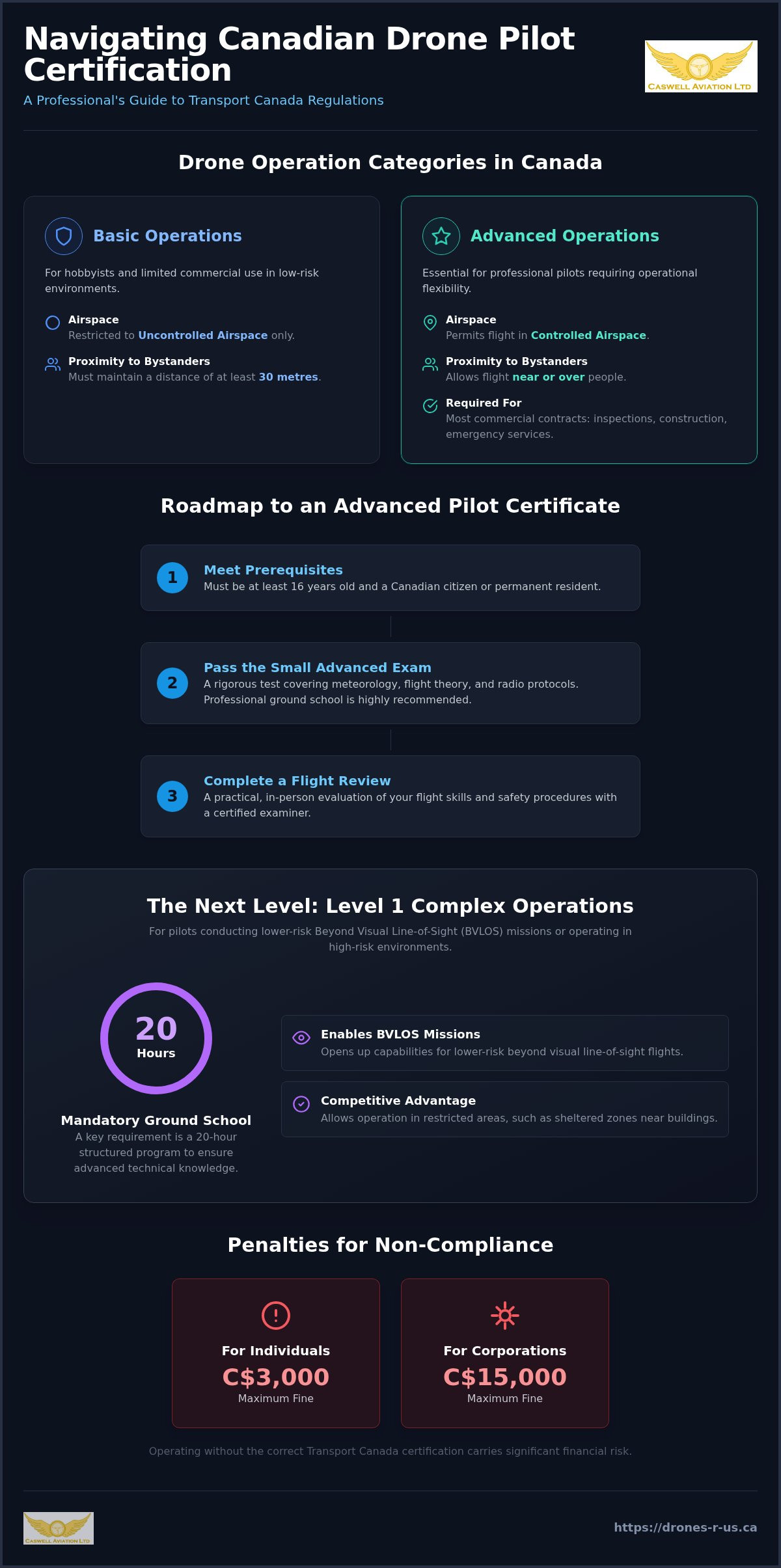
Transport Canada serves as the primary governing body for all Remotely Piloted Aircraft Systems (RPAS) in the country. Their framework ensures that drone operations integrate safely into the existing national airspace. When you look into how to get a drone license Calgary, you'll find that the regulations are divided into two main categories: Basic and Advanced. Basic operations are restricted to uncontrolled airspace and require pilots to maintain a distance of at least 30 metres from bystanders. However, most professional applications require significantly more flexibility.
The Canadian drone regulations mandate an Advanced Pilot Certificate for anyone flying in controlled airspace, near bystanders, or over crowds. For professionals, this certification isn't just a legal requirement; it's a badge of technical proficiency that opens doors to higher-value contracts in construction, inspections, and emergency services. Operating without the correct certificate can lead to significant fines. For instance, individuals can face penalties of up to C$3,000, while corporations can be fined up to C$15,000 for non-compliance.
The Roadmap to an Advanced Pilot Certificate
To begin your journey toward an Advanced Pilot Certificate and understand how to get a drone license Calgary, you must be at least 16 years old and a Canadian citizen or permanent resident. While some start with the Small Basic Exam, professionals usually focus on the Small Advanced Exam immediately. This exam is more rigorous and covers topics like meteorology, flight theory, and radio protocols. While self-study is possible, a structured online drone course significantly improves pass rates. These programs provide the depth needed to understand complex aviation charts and emergency procedures. This preparation ensures you're ready for both the written test and the subsequent flight review required for full certification.
Defining Level 1 Complex Operations
The regulatory environment continues to evolve with the introduction of Level 1 Complex Operations. This certification is designed for pilots conducting lower-risk beyond visual line-of-sight (BVLOS) missions or operations in high-risk environments. A key requirement for this level is the completion of a mandatory 20-hour ground school program. This structured education ensures that pilots possess the advanced technical knowledge required to manage the increased risks associated with complex flight profiles. Obtaining this certificate allows you to operate in areas previously restricted, such as sheltered operations near buildings. It provides a distinct competitive advantage for those looking to expand their professional capabilities in the industrial and surveying sectors.
Selecting a Professional Drone School: Essential Criteria
Choosing a training provider is the most critical decision when researching how to get a drone license Calgary. A curriculum should go beyond simply memorizing test questions. It must provide deep context for real-world scenarios, such as emergency response planning and airspace coordination. Professionals should prioritize schools that offer both comprehensive ground school and in-person flight reviews. This integrated approach ensures a consistent learning path from the first lesson to your final certification.
The aviation background of the school's leadership is a key indicator of quality. Schools led by seasoned aviation experts offer insights into safety cultures that tech-only providers often overlook. This perspective is vital when following the official steps for getting a drone pilot certificate through Transport Canada. You want a mentor who understands the "why" behind the rules. This ensures you develop the discipline required for high-stakes commercial operations.
Online vs. In-Person Training Modalities
Busy professionals often find that an online drone course provides the necessary flexibility to balance work and education. These modules allow you to digest complex topics like meteorology and flight theory at your own pace. However, building reliable muscle memory requires actual flight time under supervision. Hybrid models have become the industry standard for a reason. They combine digital theory with instructor-led sessions to clarify difficult concepts. This structure is particularly helpful for meeting the 20-hour ground school requirement for complex operations. It ensures you don't just pass the exam but also handle the aircraft with precision in the field.
The Value of Industry-Specific Training
Generic training provides a foundation, but professional success often requires specialization. Your training should reflect the specific operational risks of your sector, whether that is real estate, construction, or industrial inspection. For example, flying near heavy machinery on a construction site requires different safety protocols than capturing architectural video. Specialized education helps reduce operational liability by teaching you to identify site-specific hazards. Some industry professionals report that documented, professional-grade training can be a positive factor when discussing coverage with insurance providers. It demonstrates a commitment to high-level safety standards that exceed the minimum legal requirements.
Mastering the Advanced Drone Flight Review
The flight review represents the final practical assessment in the Transport Canada drone pilot certification process. It is a face-to-face evaluation where an authorized reviewer observes your ability to operate an RPAS safely and effectively. Reviewers prioritize your command of the aircraft and your adherence to safety protocols over flashy flying. You will be expected to demonstrate specific technical manoeuvres, such as precision hovering, controlled ascents and descents, and flying a predefined pattern like a square or figure eight.
A significant portion of the review occurs before the motors even start. You must perform a comprehensive site survey to identify potential hazards, such as power lines or nearby bystanders. The reviewer will also assess your use of pre-flight checklists. Following a disciplined routine shows that you have the professional mindset required for Advanced operations. If you are researching how to get a drone license Calgary, remember that your ability to handle emergency procedures, such as a lost link or a battery failure, is often the deciding factor in a successful review.
Preparation Strategies for Pilot Candidates
Preparation is more than just practice flights. You should conduct a thorough self-audit of your equipment and flight logs to ensure everything is in order. Every professional pilot must master the Standard Operating Procedures (SOPs) specific to their aircraft. These documents outline how you manage normal and emergency flight phases. For a deeper look at the specific expectations of this assessment, consult our guide on What is a Drone Flight Review in Canada?. Familiarity with your SOPs ensures that your responses to reviewer questions are instinctive rather than hesitant.
Post-Review Requirements and Certificate Issuance
Once you successfully complete the review, the reviewer will enter your results into the Drone Management Portal. You must then log in to the portal to pay the required fee and download your Advanced Pilot Certificate. This document grants you the authority to fly in controlled airspace and closer to people, but it also carries heavy responsibilities. You are now legally required to maintain a flight log and keep your contact information updated.
Certification is not a one-time event. To keep your privileges active, you must follow the 24-month recency rule. This means you need to complete a recency activity, such as a flight review or a specialized training course, every two years. This cycle ensures that all Advanced pilots remain current with evolving regulations and technical standards. This ongoing commitment is a core part of the process for anyone learning how to get a drone license Calgary for long-term career growth.
Operational Excellence: Beyond the Certificate
Mastering the technical requirements for how to get a drone license Calgary is a significant milestone, but it is only the foundation of a professional career. Operational excellence requires integrating high-level production standards into every mission. Whether you are providing drone aerial photography and video for real estate or industrial inspections, the value you deliver is measured by the quality and safety of your output. High-resolution imagery and stable video feeds drive the commercial value of your services, allowing clients to make informed decisions based on the data you provide. Achieving this level of quality requires more than just a certificate; it demands disciplined team communication and the use of safety protocols that prevent operational downtime.
The Role of Professional Pilot Gear
Modern smart controllers offer incredible functionality, but their weight can become a physical liability during long-duration missions. Professional pilots often overlook the physical demands of standing for hours while maintaining precise control over sensitive joysticks. This is where ergonomic support becomes a safety requirement rather than a luxury. Using a Fitek Gear drone harness provides the stability needed for complex manoeuvres while significantly reducing neck strain and pilot fatigue. By distributing the weight of the controller across the shoulders and torso, you maintain the mental focus required for high-risk operations. Reducing physical discomfort ensures that your last flight of the day is as safe and precise as your first, preventing the small errors that often lead to incidents.
Developing Robust Standard Operating Procedures
A professional drone department is built on a culture of safety. This begins with developing robust Standard Operating Procedures (SOPs) that guide every phase of flight. These documents are not just for internal use; they are essential for Transport Canada compliance. Your SOPs should detail everything from battery management and pre-flight weather checks to emergency landing protocols in congested areas. For a comprehensive look at the legal framework guiding these procedures, refer to our guide on Drone Regulations in Canada. Maintaining meticulous documentation protects your business and demonstrates a professional maturity that clients and regulators respect. It ensures that every member of your flight team follows a consistent, repeatable, and safe workflow.
To build a more resilient and professional flight operation, consider investing in our specialized training and ergonomic gear.
Advancing Your Career with Caswell Aviation Ltd
Securing your certification is the entry point into a competitive industry. To truly excel, you need a partner that understands the long-standing requirements of aviation compliance and professional growth. Caswell Aviation Ltd provides comprehensive training paths that guide you from your initial research on how to get a drone license Calgary to achieving Advanced and Level 1 Complex certifications. We offer more than just a syllabus; we provide access to seasoned aviation experts who conduct professional flight reviews with a focus on safety and precision. This mentorship ensures you don't just meet the minimum standards but exceed them.
Beyond training, Caswell Aviation Ltd supports your operational success through specialized services and equipment. Our drone aerial photography and video services help businesses leverage high-quality data for growth, while our retail division equips your team with Fitek Gear harnesses. These ergonomic solutions are essential for maintaining peak performance during demanding field missions. By integrating professional-grade gear with expert education, you create a sustainable career path built on technical mastery and physical longevity.
Your Partner in Aviation Compliance at Caswell Aviation Ltd
Transitioning from a hobbyist to a professional pilot requires a fundamental shift in mindset. Caswell Aviation Ltd bridges this gap by offering a mentor-led approach to drone education. We focus on the practical application of regulations, ensuring you understand how to navigate complex airspace safely. For those ready to begin their journey, our Online Drone Course provides a structured environment to master the theoretical requirements of the Transport Canada exams. This foundation is critical for anyone looking to build a reputation for reliability and safety in the commercial sector.
Summary of Professional Next Steps
Choosing the right certification level depends on your specific career goals. If you intend to fly in controlled airspace or near bystanders, the Advanced Pilot Certificate is mandatory. For those pushing the boundaries of technology with BVLOS missions, the Level 1 Complex certification is the next logical step. Once you've completed your ground school, booking your flight review with an experienced examiner from Caswell Aviation Ltd is your final hurdle. For more information on where this path can lead, explore our guide on Drone Pilot Jobs in Canada. We are here to support every stage of your professional development.
Elevate Your Professional Flight Standards
Transitioning from basic flights to complex commercial operations requires a disciplined approach to aviation safety. By now, you understand the necessity of selecting a training partner that offers more than just test preparation. Success in the field depends on a thorough grasp of Transport Canada regulations and the ability to maintain precision during high-pressure missions. Whether you're mastering the 20-hour ground school for Level 1 Complex operations or refining your manoeuvres for an Advanced flight review, your commitment to standards defines your professional reputation.
If you're ready to learn how to get a drone license Calgary, we provide the comprehensive support needed to reach your goals. Our team offers Transport Canada compliant training and is comprised of experienced Advanced and Level 1 Complex reviewers. We also serve as a specialized Fitek Gear retailer to ensure your field operations remain safe and ergonomic.
Start your professional drone journey with Caswell Aviation Ltd today. We look forward to helping you build a safe and prosperous career in the Canadian skies.
Frequently Asked Questions
Do I need a drone school to get certified in Canada?
You aren't legally required to attend a drone school for Basic or Advanced certificates, but it's highly recommended for professional success. Self-study often misses the technical nuances required for the Small Advanced Exam. A school provides structured ground school that ensures you understand aviation theory and safety protocols. For Level 1 Complex operations, completing a 20-hour ground school program is a mandatory prerequisite for certification.
What is the difference between an online drone course and in-person training?
Online courses focus on the theoretical knowledge needed to pass Transport Canada's written exams. They offer flexibility for professionals who need to study at their own pace. In-person training provides hands-on flight experience and direct instructor feedback. This is vital for building the muscle memory required for precision manoeuvres. Many pilots choose a hybrid model to ensure they're prepared for both the written test and the practical flight review.
How much does a Transport Canada flight review cost?
The cost of a flight review varies depending on the provider and the complexity of the assessment. While Transport Canada charges a C$10 fee for the exam attempt and a C$125 fee for the certificate issuance, the reviewer's fee is separate. Most professional schools charge for the reviewer's time and expertise. It's best to contact a qualified school directly to discuss their current rates for Advanced and Level 1 Complex reviews.
How long does it take to get an Advanced Pilot Certificate?
Most candidates complete the process in two to four weeks. This timeline includes studying for the Small Advanced Exam, passing the online test, and scheduling a flight review. Your personal schedule and the availability of a reviewer will influence the total duration. If you're researching how to get a drone license Calgary, starting with a structured course can accelerate your learning and help you meet these milestones more efficiently.
Can a drone school help me fly in controlled airspace?
Yes, a school prepares you for the Advanced Pilot Certificate, which is the legal requirement for flying in controlled airspace. Instructors teach you how to read aviation charts and coordinate with air traffic control. This knowledge is essential for maintaining safety in busy environments. Once you hold an Advanced certificate, you gain the privilege to operate in areas that are strictly off-limits to Basic pilots.
What are the requirements for Level 1 Complex drone operations?
To obtain a Level 1 Complex certificate, you must pass a specific Transport Canada exam and complete at least 20 hours of ground school. A successful flight review is also required. This certification is designed for lower-risk beyond visual line-of-sight missions. It permits operations in higher-risk environments, such as sheltered operations near buildings. These requirements ensure that pilots have the technical depth to manage more sophisticated flight profiles safely.
Why is a drone harness important for professional pilots?
A professional harness is critical for reducing physical fatigue and improving flight stability. Long missions with heavy smart controllers can cause significant neck and shoulder strain. This discomfort often leads to a loss of focus, which increases the risk of operational errors. Using an ergonomic harness distributes the weight across your torso. This allows you to maintain precise control over the joysticks during complex manoeuvres without the distraction of physical pain.
How do I maintain my drone pilot licence recency?
You must complete a recency activity every 24 months to keep your certificate valid. This can include taking a flight review, attending a safety seminar, or completing a self-paced training program. Failing to meet this requirement means you can no longer legally exercise the privileges of your certificate. Keeping a detailed log of your recency activities is a standard part of how to get a drone license Calgary and maintain professional compliance over time.
Leave a comment