

Drone Photography in Canadian Controlled Airspace 2026
With over 90,000 registered users on the NAV Drone app and more than a thousand flight authorization requests processed every week, the Canadian sky has never been more crowded or more strictly regulated. If you're a professional photographer, the prospect of capturing a skyline near a major airport or a busy urban centre often feels like a legal minefield. You've likely experienced the frustration of waiting for NAV CANADA authorizations or the genuine anxiety that comes with the threat of heavy fines for non-compliance. It's difficult to know exactly which certificate you need when the stakes for your business are this high.
Mastering the requirements for drone photography in controlled airspace Canada doesn't have to be a source of constant stress. We understand that you need clear, actionable information to keep your operations moving. This guide provides a definitive roadmap for 2026, clarifying the critical distinctions between Basic and Advanced operations. You'll learn how to navigate the latest Transport Canada standards, utilize the NAV Drone platform efficiently, and ensure your professional aerial imagery remains both stunning and fully legal.
Key Takeaways
- Identify the specific boundaries of Class C, D, and E zones to determine when your photography project requires access to restricted airspace.
- Master the essential requirements for drone photography in controlled airspace Canada by completing the two-step Advanced Certification process.
- Navigate the NAV Drone application to secure real-time flight authorizations for missions alongside manned aircraft.
- Implement professional safety standards including comprehensive site surveys and the effective use of visual observers in high-traffic urban centres.
- Transition from Basic to Advanced operations through structured training and professional Flight Reviews to ensure full compliance in 2026.
Defining Controlled Airspace for Canadian Drone Photographers
Controlled airspace isn't just a technical term; for a professional photographer, it represents the most profitable locations in Canada. These zones include Class C, D, and E areas, which often encompass major city centres, industrial hubs, and transit corridors. Securing high-quality aerial imagery in these restricted zones is often the difference between a standard portfolio and a premium commercial offering. However, entering these areas without understanding the requirements for drone photography in controlled airspace Canada carries significant risk. Transport Canada enforces strict compliance, and unauthorized flights can result in substantial fines or the suspension of your pilot certificate. In 2026, the distinction between hobbyist micro-drones and professional Remotely Piloted Aircraft Systems (RPAS) is clearer than ever, making regulatory knowledge a core business asset.
Airspace Classes and Your Photography Business
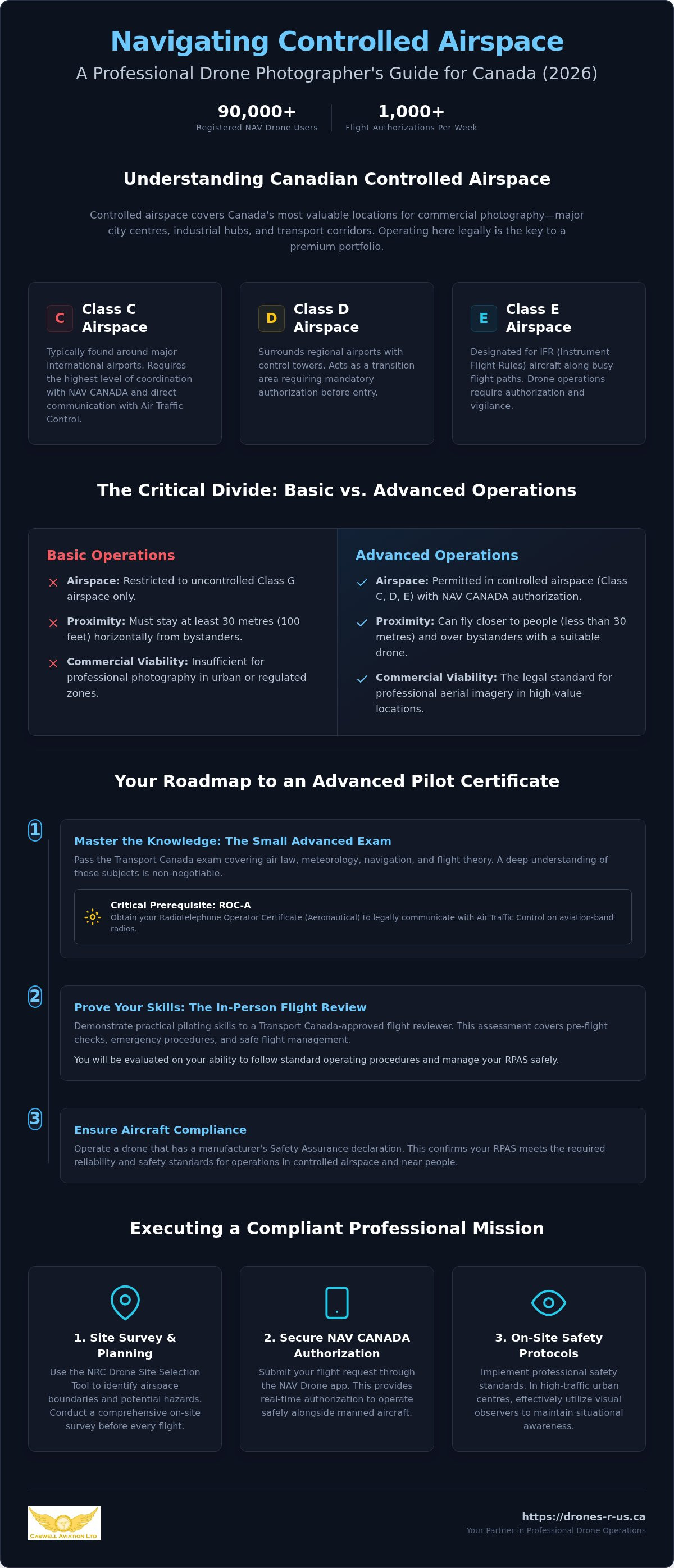
Understanding the specific Canadian airspace classes is the first step in mission planning. Class C airspace is typically found around major international airports and requires the highest level of coordination with NAV CANADA. Class D and E zones act as transition areas near regional airports or along busy flight paths. Professional pilots use the NRC Drone Site Selection Tool to identify these boundaries before arriving on-site. This data-driven approach prevents accidental incursions and ensures that your flight plan accounts for local air traffic density. Identifying these zones early allows you to build realistic timelines for client projects and manage expectations regarding authorization delays.
The "Advanced" Threshold for Professional Imagery
While micro-drones under 250 grams operate under a different set of rules, professional-grade photography usually requires heavier equipment for better sensor quality and flight stability. For these operations, a Basic Pilot Certificate is insufficient. To legally operate in controlled zones, you must hold an Advanced Pilot Certificate. This certification proves you possess the technical knowledge to coordinate with air traffic control and manage complex flight environments. Additionally, your aircraft must have a manufacturer’s Safety Assurance declaration for operations in controlled airspace. You can find more detail on these prerequisites in this Transport Canada drone certification guide. Adhering to these standards protects your business reputation and ensures the safety of the national civil aviation system.
Obtaining Your Advanced Pilot Certificate for Controlled Airspace
Securing the legal right to fly in restricted zones begins with the Advanced Pilot Certificate. This credential is the cornerstone of the requirements for drone photography in controlled airspace Canada. Unlike the Basic certificate, which is limited to uncontrolled Class G airspace, the Advanced certification involves a rigorous two-step process. You must first pass the Transport Canada Small Advanced Exam and subsequently complete an in-person Flight Review with a qualified reviewer. This dual-layered approach ensures that every pilot operating near airports or urban centres possesses the necessary technical proficiency and safety awareness.
Mastering the Advanced Small RPAS Exam
The 2026 version of the Advanced Small RPAS exam demands a deep understanding of air law, meteorology, navigation, and flight theory. Navigating the technical requirements for drone photography in controlled airspace Canada requires a disciplined study approach to master these subjects. A critical prerequisite for the Advanced exam is obtaining your ROC-A (Radiotelephone Operator Certificate). This certificate is essential because it allows you to legally use aviation-band radios to communicate with Air Traffic Control, a requirement for many photography missions in Class C or D airspace. Following Transport Canada drone safety guidelines ensures that you're studying the correct material for this high-level certification.
The Professional Flight Review Process
Passing the online exam is only half the battle. You must demonstrate your practical skills during an in-person assessment. During this review, a Transport Canada-approved reviewer will evaluate your ability to conduct a safe flight, manage emergencies, and follow standard operating procedures. You'll need to present mandatory documentation, including your pilot logbooks and proof of drone registration. Understanding what is a drone flight review Canada helps you prepare for the specific manoeuvres and safety checks required to pass on your first attempt.
Once you've earned your certificate, you must maintain recency requirements every 24 months to keep it valid. This involves completing a recurrent training activity to ensure your knowledge of evolving regulations remains current. Caswell Aviation Ltd facilitates this entire transition from student to certified professional, offering both online drone courses and in-person training tailored to the 2026 regulatory landscape. This structured support system helps you move past the technical hurdles so you can focus on the creative aspects of your photography business.
Securing NAV CANADA Authorization via NAV DROID
Holding an Advanced Certificate proves your technical competence, but it does not grant you a "blank cheque" to fly in restricted zones whenever you choose. Every mission within these boundaries requires specific permission from NAV CANADA, the entity responsible for all civil air navigation in the country. Their primary role is to ensure the safe separation of drones from manned aircraft. Coordinating your flight through their digital infrastructure is one of the most critical requirements for drone photography in controlled airspace Canada. You must treat this authorization process as a mandatory part of your pre-flight workflow rather than an optional step.
The process has become significantly more streamlined with the adoption of digital coordination tools. By following the official NAV CANADA drone flight authorization procedures, professional pilots can plan their missions with high precision. This system allows Air Traffic Control (ATC) to see your planned operations in real-time, which is essential for maintaining safety in shared environments. Using these tools correctly demonstrates your professionalism and your commitment to aviation safety standards.
The Step-by-Step Authorization Workflow
To begin, you must download and register for the NAV Drone application, which many industry veterans still refer to by its earlier iteration, NAV DROID. Once registered, you will submit a detailed flight plan that includes your exact geographic boundaries, maximum altitude, and the expected duration of the mission. The application evaluates your request against current air traffic patterns and active restricted zones. If the flight is feasible, you'll receive a digital authorization. You must acknowledge this authorization through the app before you launch your aircraft. In certain high-stakes environments, ATC may also include specific communication protocols, such as a requirement to monitor a specific radio frequency or provide a phone number for immediate contact.
Managing Timelines for Commercial Clients
Professional photographers need to distinguish between automated and manual approvals to manage their business operations effectively. While many requests in less congested areas receive near-instant automated authorization, missions in high-density urban centres often trigger a manual review. For these complex shoots, you should allow a minimum lead time of 48 hours. This buffer ensures that NAV CANADA coordinators have sufficient time to review your request without compromising your project schedule. Setting realistic expectations with your clients is vital. Explain that the requirements for drone photography in controlled airspace Canada involve external regulatory timelines that are beyond your direct control. This approach builds professional trust and prevents the temptation to conduct non-compliant flights under pressure from tight deadlines.
Operational Safety and Field Requirements for Professionals
Field operations in restricted zones require more than just a permit. Every mission must begin with a comprehensive site survey to identify obstacles, electromagnetic interference, and local air traffic patterns. In high-traffic urban environments, maintaining situational awareness is a primary challenge for any pilot. Professional photographers often utilize visual observers (VOs) to monitor the surrounding airspace while the pilot focuses on the camera feed. This division of labour is a key part of the requirements for drone photography in controlled airspace Canada, ensuring that the operation remains safe even in complex conditions.
Emergency preparedness is equally critical. You must have established protocols for dealing with equipment failures, such as fly-aways or unexpected airspace incursions. If your aircraft enters a restricted area without authorization or loses communication with the controller, you must be prepared to contact Air Traffic Control immediately. Having these procedures documented and practised ensures a calm, regulated response to high-stakes situations. Safety isn't a one-time checklist; it's a continuous process that defines your professional reputation.
Pilot Ergonomics and Control Precision
Commercial photography missions often span several hours, placing significant physical strain on the pilot. Using ergonomic gear like a professional drone harness is essential for maintaining control precision. We recommend the Fitek Gear harness for pilots using smart controllers; it redistributes the weight of the device across the shoulders and back. This reduction in fatigue allows for steadier stick movements and more precise framing of your shots. Better weight distribution doesn't just improve comfort; it directly enhances the quality of the final imagery by allowing you to focus entirely on the creative aspects of the flight rather than physical discomfort.
Documentation and Compliance Checklists
Maintaining a detailed journey log is a mandatory requirement for every flight conducted in controlled airspace. This log should include flight times, battery cycles, and any technical issues encountered during the mission. You must also keep your pilot certificate and drone registration accessible at all times while on-site to provide to authorities if requested. For a deeper look at reporting standards and legal duties, consult the drone regulations Canada 2024 guide. Additionally, carrying at least $1 million in liability insurance is the recognized professional standard, protecting your business from the financial impact of unforeseen incidents in these higher-risk areas.
To ensure your field operations meet all national standards, you can book your Advanced Flight Review with our experienced team of professional reviewers.
Next Steps: Certification and Professional Training
Transitioning from a hobbyist photographer to a regulated commercial operator requires a fundamental shift in discipline. While you now understand the theoretical requirements for drone photography in controlled airspace Canada, the practical application of these rules in a high-stakes aviation environment is best learned through experienced guidance. A "Veteran Mentor" brings a culture of safety and precision that prevents the non-compliance issues leading to heavy fines. Scaling your business effectively means moving beyond "good enough" and adopting the standards of professional aviation.
Comprehensive Training Solutions
Choosing the right training format depends on your current experience level and business goals. For pilots who prefer flexibility, an online self-study path is often the best way to master the Advanced Small RPAS exam. Enrolling in the Caswell Aviation online drone course provides a modular, efficient syllabus designed to help you pass the Transport Canada exam on your first attempt. If your project involves specialized aerial imagery or complex urban environments, customized in-person training provides the hands-on technical authority you need. This training focuses on the practical skills required to manage a crew and coordinate with air traffic control effectively.
Once you've completed your studies, the next step is to book your Advanced or Level 1 Complex Flight Review. These assessments are conducted by professional flight reviewers across Canada who evaluate your ability to manage real-world flight scenarios. A Level 1 Complex review is particularly relevant for those looking to operate in the most challenging environments. This structured approach ensures that you aren't just "passing a test" but are truly prepared for the responsibilities of flying near manned aircraft. Accessing professional reviewers who understand the nuances of the 2026 regulations is vital for your certification success.
Equipping Your Photography Business
Your hardware choices must align with the regulatory landscape of 2026. This means selecting aircraft that carry the specific Safety Assurance declarations required for operations in controlled zones. Using compliant hardware is a non-negotiable part of the requirements for drone photography in controlled airspace Canada. Additionally, professional field operations demand gear that supports the pilot during long-duration missions. Investing in Fitek Gear drone harnesses is a practical step toward improving your on-site performance. These harnesses allow for better weight distribution of smart controllers, which directly translates to smoother camera movements and more refined photography framing.
Mastering the sky requires more than just a drone; it requires a partnership with experts who understand the intersection of technology and law. If you're ready to secure your place in Canada's restricted zones, contact Caswell Aviation to start your professional journey. We offer the comprehensive training and flight reviews you need to turn your aerial photography into a fully compliant commercial success.
Mastering Your Professional Flight Operations for 2026
Navigating the complexities of restricted zones is a hallmark of a professional drone photographer. Success in 2026 relies on a disciplined combination of Advanced Certification, meticulous digital coordination through NAV CANADA, and a commitment to field safety. By mastering the legal framework and technical procedures, you move from being a hobbyist to a trusted industry partner.
Adhering to the specific requirements for drone photography in controlled airspace Canada ensures your business remains both profitable and compliant. This transition is easier when you have access to expert advice for professional photographers and comprehensive online training modules. Our team of Transport Canada Authorized Flight Reviewers is ready to help you validate your skills and expand your operational reach.
Take the final step toward professional certification today. Book Your Advanced Drone Flight Review with Caswell Aviation and gain the confidence to capture stunning imagery in any environment. We look forward to seeing your business reach new heights in the Canadian sky.
Frequently Asked Questions
Do I need a licence to take drone photos in my own backyard if it's in controlled airspace?
Yes, if your property sits within a Class C, D, or E zone and you operate a drone weighing 250 grams or more, you must hold an Advanced Pilot Certificate. Backyard flights aren't exempt from federal aviation laws. You also require digital authorization from NAV CANADA before takeoff. Operating without these credentials, regardless of land ownership, can lead to significant fines from Transport Canada.
How long does it take to get NAV CANADA authorization for a photography shoot?
Authorization times vary based on the complexity of the airspace. Many requests through the NAV Drone app receive near-instant automated approvals if the location is outside high-risk zones. However, missions in dense urban centres or near major airports often require manual review by a controller. For these complex projects, you should submit your flight plan at least 48 hours in advance to ensure your project timeline remains on track.
Can I fly a micro-drone (under 250g) in controlled airspace for photography without a certificate?
You don't need a pilot certificate or registration to fly a micro-drone under 250 grams in controlled airspace. However, you must operate in a manner that doesn't endanger aviation safety or people on the ground. While the strict requirements for drone photography in controlled airspace Canada for heavier drones don't apply, you're still prohibited from interfering with manned aircraft and must follow all general safety guidelines.
What is the difference between Basic and Advanced drone certification for photographers?
The primary difference lies in where you can fly and how close you can get to people. Basic certification limits you to uncontrolled Class G airspace and requires a 30-metre horizontal distance from bystanders. Advanced certification allows you to operate in controlled zones with NAV CANADA coordination and fly within 30 metres of bystanders. For professional photographers, the Advanced Certificate is essential for capturing urban skylines or regional infrastructure.
What equipment is mandatory for drone photography in restricted areas?
To fly in restricted areas, your drone must have a manufacturer's Safety Assurance declaration for controlled airspace. You must also carry your Pilot Certificate, proof of drone registration, and a physical or digital journey log. If your mission requires radio communication with Air Traffic Control, a Radiotelephone Operator Certificate (ROC-A) and an aviation-band radio are mandatory components of the requirements for drone photography in controlled airspace Canada.
How do I check if my photography location is in controlled airspace?
You can verify your location using the NRC Drone Site Selection Tool or the official NAV Drone application. These tools provide interactive maps that display the boundaries of Class C, D, and E airspace across the country. It's a professional standard to check these maps during the pre-flight planning phase of every photography mission. This ensures you identify restricted zones before arriving on-site to avoid accidental incursions.
What happens if I fly in controlled airspace without ATC coordination?
Operating in controlled airspace without coordination is a serious violation of the Canadian Aviation Regulations. It creates a significant safety risk for manned aircraft and can result in individual fines of up to C$3,000 or corporate fines reaching C$15,000. Beyond financial penalties, Transport Canada may suspend or cancel your pilot certificate. Professional photographers should always prioritize legal compliance to protect their business reputation and the safety of the national airspace.
Does Caswell Aviation provide flight reviews for the Advanced Certificate?
Yes, Caswell Aviation provides professional flight reviews for both Advanced and Level 1 Complex certifications. Our Transport Canada Authorized Flight Reviewers conduct these assessments nationally to help pilots validate their practical skills. We also offer comprehensive online training modules and in-person sessions to prepare you for the technical demands of the review. These services are designed to move you efficiently from the exam phase to full operational status.
Leave a comment