
Drone Flight Review Calgary: Your Guide to Advanced RPAS Certification in 2026
What if your drone flight review isn't actually a test of how well you can fly? While your ability to control the aircraft is essential, Transport Canada is looking for something far more critical: your commitment to a professional safety culture. Scheduling a trusted drone flight review is the first step toward moving beyond basic operations. Preparing for an advanced certification often feels like navigating a fog of complex regulations and shifting documentation requirements. It's natural to feel some anxiety about the in-person assessment, especially when the stakes for your commercial operations are so high.
This guide will help you master the specific requirements and preparation steps needed to pass your Transport Canada flight review and secure your advanced drone pilot certificate. We'll examine the full syllabus, provide a comprehensive checklist for your site survey, and explain how to organize your documentation to ensure a successful evaluation. By the end of this article, you'll have the clarity and confidence required to demonstrate your expertise as a master practitioner in the Canadian airspace. Whether you're refining your emergency procedures or double-checking your pilot licence details, we're here to help you navigate the process with precision.
Key Takeaways
- Understand that the drone flight review Calgary pilots undergo is a formal evaluation of safety culture and regulatory compliance rather than just manual flight skills.
- Learn how to conduct a comprehensive site survey and prepare the necessary emergency documentation to meet Transport Canada's strict standards.
- Prepare for the in-person assessment by mastering the pre-flight inspection and initial briefing stages of the evaluation.
- Avoid the most frequent causes of failure by refining your pre-flight planning and maintaining a steady, methodical pace during emergency drills.
- Discover how professional equipment, such as Fitek Gear harnesses, can provide the stability and organization required for high-stakes certification flights.
The Role of the Flight Review in Canadian Drone Regulations
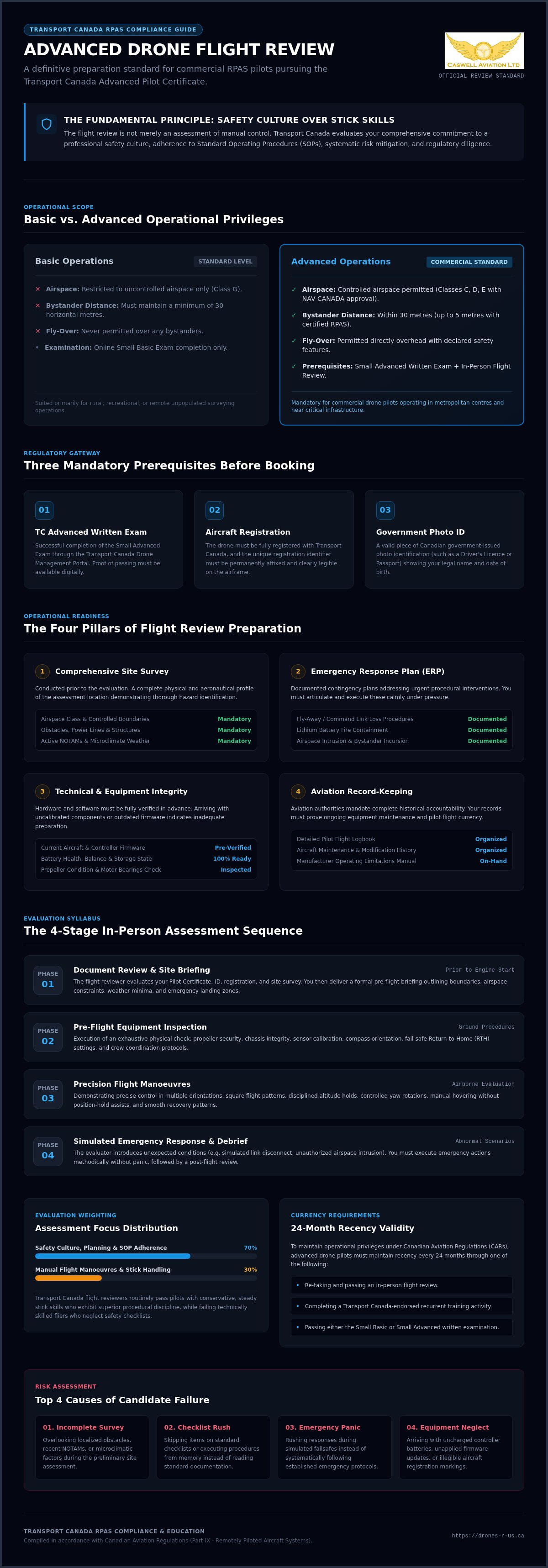
The flight review serves as the critical practical assessment for pilots pursuing an Advanced Remotely Piloted Aircraft Systems (RPAS) certificate. While the online written exam tests your knowledge of air law and meteorology, the review focuses on your ability to apply those concepts in the field. Transport Canada mandates this in-person evaluation to ensure that every pilot can safely manage the complexities of professional flight. By utilizing a third-party reviewer to validate competency, the regulator maintains a high standard of safety across the industry. This process confirms that you aren't just good at taking tests, but are a capable pilot ready for real-world challenges.
Advanced vs. Basic Operations: Why the Review Matters
The primary reason to seek this certification is the expanded operational freedom it provides. Under Canadian drone regulations, pilots are categorized based on the risk level of their missions. Basic operations are restricted to uncontrolled airspace and must remain 30 metres away from bystanders. In contrast, an Advanced Pilot Certificate grants you the privilege to fly in controlled airspace and closer to people, provided you use a drone with a manufacturer safety declaration. This is a legal necessity for commercial pilots working in urban areas or near critical infrastructure. Completing a drone flight review Calgary services provide is also a reliable way to meet the 24-month recency requirements. These rules ensure that your skills remain sharp and your licence stays in good standing with the authorities.
Prerequisites Before You Book Your Assessment
Before you schedule your appointment at a flight centre, you must satisfy several regulatory requirements. First, you must have successfully passed the Small Advanced Exam through the Transport Canada Drone Management Portal. You cannot attempt the practical review without this digital record. Additionally, your aircraft must be registered and clearly marked with its registration number in a permanent fashion. On the day of your drone flight review Calgary session, you must present a valid piece of government-issued photo ID. Arriving with your documentation organized reflects the discipline required of a professional pilot. It sets a positive tone for the assessment and demonstrates that you understand the administrative side of aviation safety.
Essential Preparation for Your Advanced Flight Review
Success in a drone flight review Calgary session depends heavily on your pre-flight groundwork. You must conduct a comprehensive site survey before you ever meet your reviewer. This document identifies obstacles, power lines, and potential bystanders within your operational area. It proves you've analyzed the environment with the discipline of a professional aviator. A well-documented survey isn't just a formality; it's the foundation of your safety plan and the first thing a reviewer will look for to gauge your competence.
Technical readiness is equally vital. Ensure your aircraft firmware is current and all batteries are fully charged for both the drone and the controller. You'll be expected to perform specific flight manoeuvres with precision, including square patterns and emergency landings. Reviewing the Transport Canada flight review requirements will help you understand the exact performance criteria for each turn and hover. Practising these movements until they become second nature allows you to focus on safety communications during the actual assessment.
Documentation and Standard Operating Procedures (SOPs)
Professionalism is reflected in the quality of your paperwork. You need a written emergency plan that covers specific scenarios like fly-aways, battery fires, and loss of command link. Maintaining a professional flight log and maintenance record shows you treat your equipment like a registered aircraft rather than a hobbyist tool. Organize your pilot licence and drone registration documents so they're ready for immediate inspection. Having these items in a dedicated binder or digital folder demonstrates a high level of preparedness that sets a positive tone for the entire review.
Technical Readiness and Gear Organization
Check the weather conditions and NOTAMs (Notices to Airmen) on the morning of your assessment. High winds or temporary flight restrictions can ground a mission before it starts, and recognizing these factors is part of the test. Using ergonomic tools like Fitek Gear harnesses can significantly improve your stability during the flight. This physical stability allows for smoother control inputs during complex manoeuvres, especially when nerves are high. For a deeper look at the requirements, consult our Transport Canada drone certification guide to ensure no detail is overlooked. If you're feeling uncertain about the practical flight, booking in-person training can help you refine your techniques under the guidance of a veteran practitioner.
What to Expect During Your In-Person Flight Assessment
The day of your assessment begins with a formal briefing. Your reviewer will outline the sequence of events and establish clear communication protocols. This stage is less about testing and more about ensuring both parties understand the safety parameters of the mission. Following the briefing, you'll lead a pre-flight inspection and a site safety walkthrough. This is your opportunity to demonstrate that you've accounted for all risks identified in your initial survey. You must show the reviewer that you've followed NAV CANADA drone flight planning guidelines, particularly if your review takes place near controlled airspace.
During the flight portion, the reviewer observes your command and control of the aircraft. They aren't looking for aggressive manoeuvres; they want to see deliberate, steady, and safe movements. Once the flight is complete, you'll move into a post-flight debriefing. The reviewer will provide feedback on your performance before submitting the final results to Transport Canada through the Drone Management Portal. Choosing a professional service for your drone flight review Calgary ensures that this process is handled with the industry-standard discipline expected of an advanced pilot.
Mandatory Flight Manoeuvres and Skills
You'll be required to execute several specific skills to prove your manual proficiency. These include:
- Controlled Takeoff and Landing: Smoothly ascending to a hover and returning to a designated spot within a small margin of error.
- Precision Patterns: Flying a square pattern and performing steady circles while maintaining a consistent altitude and orientation.
- Emergency Procedures: Handling a simulated lost link scenario or a battery malfunction with calm, pre-planned actions.
The Reviewer’s Perspective: What They Are Scoring
It's a common mistake to focus solely on "stick" skills. Reviewers prioritize safety culture over technical flair. They'll evaluate how you communicate with your visual observer and whether you maintain situational awareness at all times. A significant portion of the score comes from the oral questioning phase, often referred to as "Ground School on the fly." You might be asked to explain airspace classifications or weather theory during the pre-flight check. Showing up with professional gear, such as a Fitek Gear harness, suggests that you take your role seriously. It signals to the reviewer that you've invested in the stability and organization required for high-stakes commercial operations.
Overcoming Common Mistakes and Flight Review Anxiety
Many pilots approach their drone flight review Calgary assessment with significant nerves. This anxiety often stems from a misunderstanding of the reviewer's role. Instead of viewing them as an adversary, treat them as a professional colleague. They're there to ensure the safety of the national airspace, just like you. The most effective way to manage these nerves is through meticulous preparation. When you're confident in your documentation and your gear, the flight portion becomes a standard demonstration of your daily routine.
Poor pre-flight planning remains the #1 reason pilots fail their assessment. It's rarely a lack of technical "stick" skill that causes an issue. Most often, it's a failure to account for local environmental factors or a lack of organized documentation. Another frequent pitfall is 'rushed' pilot syndrome during emergency drills. When a reviewer simulates a failure, the natural instinct is to react as fast as possible. However, speed is the enemy of safety. A professional pilot takes a breath, consults their checklist, and executes a deliberate response. Showing that you can remain calm under pressure is exactly what the reviewer wants to see. Don't let the pressure of the moment force you into skipping your established safety protocols.
Top 5 Errors Made During Flight Reviews
Identifying common pitfalls allows you to build a more robust flight plan. Many unsuccessful candidates share similar oversights that are easily avoided with discipline. These include:
- Failure to check for local airspace restrictions or NOTAMs on the day of the flight.
- Inadequate battery management, leading to low-voltage warnings mid-assessment.
- Over-reliance on automated flight modes, such as GPS-assisted hovering or auto-landing.
- Incomplete site surveys that miss obvious hazards like power lines or nearby towers.
- General lack of familiarity with common drone pilot errors in Canada.
Building Confidence Through Practice
Practice is the only true antidote to anxiety. You should simulate every required manoeuvre in a safe, uncontrolled environment until it becomes muscle memory. Consider conducting a "mock" review with a mentor pilot who can critique your SOPs and communication style. Physical stability also plays a role in your performance. Using a professional drone harness reduces physical fatigue and minimizes the hand tremors that often accompany high-stakes testing. This allows you to maintain precise control during the square patterns and circles required by Transport Canada. If you're ready to move forward, schedule your professional flight review with our team to finalize your certification and advance your career.
Professional Training and Reviews with Caswell Aviation Ltd
Caswell Aviation Ltd acts as a comprehensive partner for pilots seeking their Advanced RPAS certification. Our services extend beyond the final assessment to include both online drone courses and in-person training programmes. This holistic approach ensures that you aren't just prepared for the test, but are equipped for a successful career in the industry. Whether you require an Advanced or a specialized Level 1 Complex flight review, we provide a structured environment rooted in aviation discipline. Scheduling a drone flight review Calgary pilots trust means working with reviewers who understand the nuances of the local airspace and national regulations. We guide you through the transition from the written exam to the practical application of your skills with steady, professional confidence.
Why Choose Our National Flight Review Services?
Our reviewers bring backgrounds in professional aviation, offering insights that go beyond the standard syllabus. We don't just mark pass or fail; we provide tailored feedback to improve your operational safety and efficiency. This mentorship is valuable for both individual hobbyists looking to turn professional and corporate drone teams managing large-scale projects. We support you through the entire certification journey, from initial exam preparation to the final submission of results in the portal. Our goal is to foster a culture of safety that stays with you long after the certificate is issued. We take pride in being a stable, deeply knowledgeable resource for the Canadian drone community.
Equipping for Success: Fitek Gear for Pilots
Success in the field requires more than just knowledge. It requires the right tools to maintain control during every mission. We retail specialized Fitek Gear drone harnesses designed specifically for smart controllers. These harnesses are an essential part of a professional kit, providing ergonomic benefits that reduce fatigue during long field operations or complex missions. During a high-stakes review, the added stability helps eliminate the small, nervous inputs that can affect flight precision. By distributing the weight of the controller across your shoulders, you can focus entirely on your safety procedures and flight path. This gear is a practical investment for any pilot who values precision and long-term physical comfort. If you're ready to secure your certificate, book your professional flight review today and join a community of certified professionals.
Advancing Your Career in the Canadian Airspace
Securing your Advanced Pilot Certificate is a significant milestone that transforms your operational capabilities from basic flights to complex commercial missions. Success depends on moving beyond manual stick skills to embrace a comprehensive safety culture. By mastering your site surveys, organizing your emergency procedures, and practising your mandatory manoeuvres, you eliminate the uncertainty that often leads to failure. Booking a drone flight review Calgary pilots rely on ensures you are evaluated by a veteran practitioner who values discipline and regulatory compliance.
Caswell Aviation supports your entire certification journey with Transport Canada authorized flight reviewers and comprehensive online training support. We also provide specialized Fitek Gear for smart controllers to give you the physical stability required for high-stakes assessments. This combination of education and professional equipment prepares you to operate with precision in any environment. Book Your Advanced Flight Review with Caswell Aviation today to finalize your credentials. You have the skills; now it's time to demonstrate them with the confidence of a master practitioner.
Frequently Asked Questions
How do I book a drone flight review in Canada for 2026?
You can book your assessment by contacting an authorized provider directly or searching the Transport Canada Drone Management Portal. When scheduling a drone flight review Calgary pilots should ensure they've already passed the Small Advanced Exam. Once you select a reviewer, you'll coordinate a date and location for the practical evaluation. It's best to book at least two weeks in advance to allow time for thorough site preparation and equipment checks.
What documents must I present to the reviewer during the flight review?
You must present a valid piece of government-issued photo identification to verify your identity before the session begins. Additionally, you need to show your Small Advanced Exam results and the registration certificate for the drone you'll be flying. The reviewer will also inspect your site survey, standard operating procedures, and written emergency plan. Having these documents organized in a professional binder demonstrates the discipline required for advanced drone operations.
Can I fail a Transport Canada drone flight review?
Yes, it's possible to fail if you don't meet the specific performance criteria or if you commit a safety violation. Common reasons for failure include inadequate pre-flight planning, failing to maintain situational awareness, or poor communication with a visual observer. If you don't pass, the reviewer will provide a debriefing on the areas that require improvement. You can attempt the review again after a mandatory waiting period and further practice.
How long does a typical Advanced flight review take to complete?
A typical Advanced assessment usually takes between 90 minutes and two hours to complete. This timeframe includes the initial briefing, the oral questioning phase, the pre-flight inspection, and the actual flight manoeuvres. The duration may vary slightly depending on the complexity of the site and the weather conditions on the day of the test. Arriving early with your gear organized ensures that you maximize the time available for the practical demonstration.
Do I need a flight review for a Basic drone pilot certificate?
No, a flight review isn't required for a Basic Pilot Certificate. To obtain a Basic licence, you only need to pass the Small Basic Exam online. However, if you intend to fly in controlled airspace or within 30 metres of bystanders, you must upgrade to the Advanced category. This upgrade requires passing the more difficult Advanced exam and successfully completing an in-person flight review with an authorized reviewer at a training centre.
What happens after I successfully pass my flight review?
Once you pass, the reviewer will enter your results into the Transport Canada Drone Management Portal. You'll receive a notification to log in, pay the required certificate issuance fee, and download your new Pilot Certificate - Advanced Operations. This digital document is your official licence and must be available whenever you're flying. Remember to keep your skills sharp by meeting the 24-month recency requirements to maintain your professional operational privileges.
Can I use any drone for my flight review, or must it be a specific model?
You can use any registered drone for the review, provided it's capable of performing the required manoeuvres. However, if you plan to use that drone for advanced operations later, it must have a manufacturer safety declaration for the specific category of flight. Most pilots choose a familiar aircraft they use for their daily work. Using a professional harness during the review can help maintain the steady control required to pass.
Is the flight review conducted in controlled or uncontrolled airspace?
Most assessments are conducted in uncontrolled airspace to simplify the logistics of the evaluation. However, a drone flight review Calgary session can occur in controlled airspace if the reviewer has the necessary authorizations from NAV CANADA. Regardless of the location, you must demonstrate your ability to identify airspace classifications and comply with all local regulations. Your reviewer will confirm the specific boundaries and safety parameters during the initial briefing phase.
Leave a comment