

Commercial Drone Pilot Course Calgary: Your Guide to Professional RPAS Certification
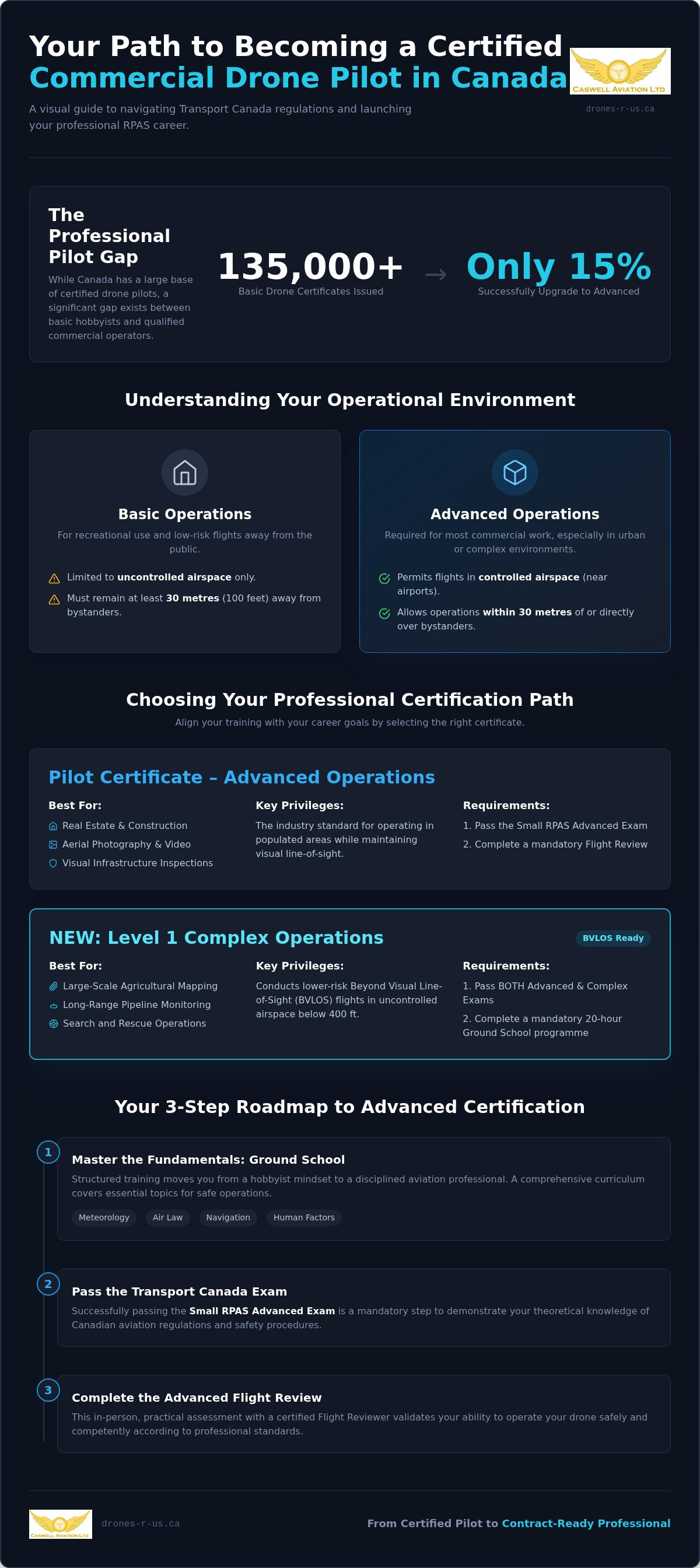
Did you know that while over 135,000 Canadians hold a Basic drone certificate, only about 15 percent have successfully upgraded to the Advanced level required for professional work? Transitioning from a hobbyist to a certified pilot involves more than just technical skill; it requires a disciplined approach to aviation safety and regulatory compliance. You might feel a sense of confusion when faced with Transport Canada's complex jargon or anxiety about the high standards of the mandatory Advanced Flight Review. These are common hurdles for many pilots looking to enter the industry and realize their professional potential.
Enrolling in a structured commercial drone pilot course will help you bridge this gap with confidence. This guide outlines exactly how to master the requirements for your Pilot Certificate for Advanced Operations and the new Level 1 Complex certification. We will explore the return on investment for professional training, the logistics of passing your flight review, and the ergonomic tools that make long days in the field manageable. By the end of this article, you will have a clear roadmap to secure high-stakes commercial contracts and operate as a respected RPAS professional in the Canadian market.
Key Takeaways
- Navigate the regulatory landscape by understanding the mandatory legal requirements for any RPAS operations conducted beyond basic recreational use.
- Identify the specific industries that require Level 1 Complex certification versus the standard Advanced Pilot Certificate to align your training with your professional goals.
- Streamline your path to certification through a structured commercial drone pilot course Calgary professionals trust to prepare for the Transport Canada Advanced Small RPAS Exam.
- Recognize the importance of operational ergonomics and specialized hardware to prevent fatigue and maintain precision during demanding commercial missions.
- Gain insight into the transition from a certified pilot to a contract-ready professional by leveraging mentor-led training and industry-specific expertise.
Understanding the Canadian Commercial Drone Landscape
In Canada, the term "drone" is formally replaced by Remotely Piloted Aircraft Systems (RPAS). This distinction is critical because it highlights that a commercial operation involves an entire system, including the aircraft, the control station, and the communication links. If you intend to use your aircraft for work, you've entered a professional aviation environment. Transport Canada oversees the Canadian drone regulations that govern every flight. Adhering to these national standards is not just a legal formality; it's a prerequisite for securing professional liability insurance and landing corporate contracts. Most industrial clients will not permit an uncertified pilot on their job site due to the associated safety risks.
The Distinction Between Basic and Advanced Operations
The regulatory framework divides operations into two categories based on risk. Basic operations are limited to uncontrolled airspace and must remain at least 30 metres away from bystanders. However, most professional work in urban areas or near critical infrastructure requires an Advanced certificate. Advanced Operations are defined as flights conducted within 30 metres of bystanders, over bystanders, or within controlled airspace. To operate effectively in these environments, completing a commercial drone pilot course Calgary provides the necessary technical foundation. As of May 2026, over 21,000 pilots have achieved this Advanced status to meet the growing demand for complex aerial data collection.
The Role of Ground School in Aviation Safety
Earning your certificate requires more than just manual dexterity with a controller. Professional training focuses on aircraft management and situational awareness. A structured ground school syllabus covers essential aviation subjects such as Meteorology, Air Law, and Navigation. You'll also study Human Factors, which examines how stress and fatigue affect pilot performance. This comprehensive approach ensures you don't just "fly" but actually manage a safe operation. A commercial drone pilot course Calgary students attend at Caswell Aviation will follow a modular syllabus designed to help you pass the Transport Canada written exam on your first attempt. Relying on a professional curriculum moves you past the "hobbyist" mindset and into the culture of discipline required for high-stakes commercial missions.
Advanced vs. Level 1 Complex: Selecting Your Course Path
Choosing the right certification level is the first strategic decision you'll make as a professional pilot. While both pathways allow for commercial work, the scope of operations varies significantly. The Advanced certificate has long been the benchmark for pilots working in urban centres or near controlled airports. However, the introduction of the Level 1 Complex certification in late 2025 created a specific path for lower-risk Beyond Visual Line of Sight (BVLOS) missions. Selecting a commercial drone pilot course Calgary professionals trust ensures you don't over-invest in training you don't need, or conversely, find yourself restricted by a certificate that limits your contract potential.
When the Advanced Certificate is Sufficient
For many operators, the Advanced certificate provides all the necessary privileges to run a successful business. This level is ideal for sectors like real estate, standard aerial photography, and visual infrastructure inspections. It allows you to fly in controlled airspace and within 30 metres of bystanders. To obtain this Transport Canada drone pilot certificate, you must pass the Small Advanced exam and a mandatory flight review. It is a pragmatic choice for those whose work remains within visual line of sight and focuses on high-quality imagery or basic data collection.
Stepping Up to Level 1 Complex Operations
If your business plan involves large-scale agricultural mapping, long-range pipeline monitoring, or search and rescue, the Level 1 Complex certification is the logical step. This path requires passing both the Advanced and Level 1 Complex exams, plus a mandatory 20-hour ground school programme. The primary advantage is the ability to conduct BVLOS operations in uncontrolled airspace below 400 feet without the need for a Special Flight Operations Certificate (SFOC). Investing in this higher-level commercial drone pilot course Calgary early on can save you months of regulatory delays when scaling your operations. Caswell Aviation facilitates this transition by offering modular online courses and in-person sessions that respect the time constraints of working professionals. If you're unsure which path fits your specific industry goals, you can review our course syllabus to see which curriculum aligns with your operational needs.
The Path to Certification: Ground School to Flight Review
The transition from a recreational flyer to a professional pilot requires a disciplined, four-step progression. This process moves you from theoretical understanding to demonstrated field competence. Choosing a commercial drone pilot course Calgary professionals recommend allows you to follow a proven syllabus that aligns with Transport Canada's current standards. This structured path minimizes the risk of exam failure and ensures you are ready for the responsibilities of high-stakes contracts.
Mastering the Advanced Written Exam
The Transport Canada Small Advanced exam is a rigorous assessment of your aviation knowledge. It costs $10 per attempt and requires a passing grade of 80 percent. Many candidates find the regulatory jargon and meteorology sections challenging without professional guidance. Effective study strategies involve breaking the curriculum into manageable modules, such as air law, navigation, and human factors. Instructor-led sessions are invaluable for clarifying misunderstood regulations, such as the specific distances required from bystanders or the nuances of operating in controlled airspace. A well-organized ground school programme provides the depth needed to move beyond simple memorization.
Preparing for Your Professional Flight Review
After passing the written exam, you must complete an in-person flight review with a qualified reviewer. This session is an evaluation of your operational safety and professional discipline. A reviewer looks for a systematic approach to flight, including the use of comprehensive checklists and emergency procedures. You must arrive prepared with your site survey, drone registration, and proof of passing the advanced exam. This is an opportunity to demonstrate that you can manage an aircraft safely in a commercial environment. To learn more about the specific manoeuvres and documentation required, you can read our guide on What is a Drone Flight Review in Canada?.
The Drone Management Portal and Final Issuance
Once you pass the flight review, the reviewer will upload your results to the system. You must then log into the Transport Canada Drone Management Portal to pay the $25 issuance fee for your digital certificate. This portal serves as your ongoing administrative centre for pilot credentials and aircraft registrations. Completing this final administrative step officially authorizes you to operate as an Advanced Pilot in Canada. This methodical approach ensures that your commercial drone pilot course Calgary experience leads directly to a valid, professional qualification. Maintaining your digital records in the portal is a critical part of being a compliant, professional operator.
Professional Equipment and Ergonomics for Field Operations
Operating a drone commercially involves more than just mastering the flight controls. While a commercial drone pilot course Calgary focuses heavily on regulatory compliance and flight manoeuvres, the physical reality of field operations is often overlooked. A typical commercial mission can last several hours, requiring sustained concentration and physical endurance. Professional pilots must manage not only the aircraft but also complex ground station equipment, often in challenging weather conditions or on active industrial sites. Integrating ergonomic tools into your workflow is a practical necessity for maintaining the precision required for high-stakes contracts.
The Importance of a Drone Harness for Smart Controllers
Modern smart controllers are sophisticated pieces of hardware, but they are also heavy. Holding a controller for a full battery cycle is manageable; doing so for six hours of infrastructure inspection is a different matter. Using a professional harness shifts the weight of the controller from your wrists and fingers to your shoulders and core. This reduction in neck and back strain is essential for maintaining focus during multi-hour flights. A stabilized remote allows for finer stick inputs, which is critical when flying in the controlled airspace discussed in previous sections. You can find more detail in our guide on Choosing the Best Drone Harness for Smart Controllers.
Why Professionals Choose Fitek Gear
Reliability in the field is non-negotiable. Fitek Gear is designed specifically for the rigours of aviation environments, offering high-performance harnesses that integrate seamlessly with professional smart controllers. These harnesses prevent the "pendulum effect" often found with cheap neck straps, ensuring the controller remains exactly where you need it. Better ergonomics directly translate to safer flight operations by reducing pilot fatigue and allowing for a better field of view. As a specialized retailer, Caswell Aviation provides the same gear used by our own instructors during a commercial drone pilot course Calgary. This ensures students are equipped with professional-grade tools from the very start of their career. If you're ready to upgrade your field setup for better comfort and control, you can browse our professional pilot gear to find the right harness for your controller.
Precision and safety are the hallmarks of a professional pilot. By addressing the physical demands of the job before you arrive on-site, you position yourself as a prepared and disciplined operator. High-quality gear doesn't just improve comfort; it reinforces the professional standards that corporate clients expect from their RPAS contractors. Investing in the right equipment is as important as the certification itself when it comes to building a sustainable drone business.
This commitment to excellence and safety-first instruction is a value shared across many types of certification and training. For instance, if you are looking for high-quality education for a new driver in your family, you can click here for Seattle Driving Academy to learn more about their professional teen programmes.
Advancing Your Career with Caswell Aviation
Caswell Aviation Ltd acts as a master practitioner for those entering the professional RPAS industry. Unlike organizations that only offer a basic test-prep syllabus, our approach integrates technical hardware expertise, professional aerial imagery services, and compliant training. This multi-faceted perspective helps you understand not just how to pass an exam, but how to maintain a reliable fleet and deliver high-quality data to your clients. When you finish a commercial drone pilot course Calgary with us, you gain access to a partner that understands the high-stakes environment of industrial flight and safety-critical operations.
A Holistic Resource for Professional Pilots
A successful drone business requires a safety-first culture and a reliable support network. We provide a comprehensive ecosystem that includes initial ground school, advanced flight reviews, and specialized pilot gear. This ensures you have a consistent point of contact for technical questions or regulatory updates as your business grows. Maintaining your skills is a legal requirement; Transport Canada mandates that pilots keep their knowledge current every 24 months. We assist in this by providing ongoing education and recency training that reflects the latest industry trends. For a deeper look at the long-term regulatory requirements, you can consult The Complete Guide to Transport Canada Drone Certification.
Next Steps for Your Commercial Journey
Transitioning from certification to your first commercial contract involves building a professional portfolio and a robust operational manual. Our instructors, who act as veteran mentors, provide practical insights into how to structure your missions for maximum efficiency. They bridge the gap between passing a test and executing a complex industrial mission. Whether you are pursuing an Advanced certificate or the new Level 1 Complex certification, the goal is the same: becoming a pilot who corporations trust with their most sensitive data and high-stakes operations. This commitment to safety and regulatory compliance is vital in many professional fields, much like the training provided in a NY 18 hour concealed carry course for those seeking specialized firearms certification.
If you are ready to move beyond hobbyist flying and enter the professional market, the first step is selecting a training path that fits your schedule. We offer flexible online modules and hands-on in-person training to help you prepare for the Small Advanced exam and your subsequent flight review. Taking a commercial drone pilot course Calgary through Caswell Aviation Ltd ensures you are learning from active industry professionals who value precision over marketing hype. You can enrol in a Caswell Aviation Ltd drone course today to begin your professional certification process.
Elevating Your Professional RPAS Standards
Transitioning from a hobbyist to a professional pilot requires a disciplined approach to both regulatory knowledge and field ergonomics. Mastering the Advanced or Level 1 Complex certification paths is essential for anyone looking to secure high-stakes contracts in Canada's growing drone market. A structured education ensures you aren't just passing an exam; you're building a safety-first culture that protects your business and your reputation. We provide Transport Canada compliant training and access to expert flight reviewers who guide you through every step of the certification process with a mentor-led approach. Additionally, our status as a specialized Fitek Gear retailer ensures you have the ergonomic support needed for long-duration commercial missions in the field.
Choosing a commercial drone pilot course Calgary professionals rely on is the most efficient way to navigate these complex requirements and start your journey. We are here to act as your partner, providing the technical repair expertise and training support necessary for long-term success. Launch your professional aviation career with Caswell Aviation today. With the right training and high-performance equipment, you can operate with the steady confidence of a seasoned professional.
Frequently Asked Questions
How much does it cost to get a commercial drone license in Canada?
Obtaining your certificate involves several fixed government fees. Transport Canada charges $10 for each attempt at the Small Advanced exam and a $25 fee to issue the certificate itself. You must also account for the cost of a mandatory in-person flight review, which is conducted by third-party reviewers. These costs are separate from the tuition for a commercial drone pilot course Calgary students use to prepare for these assessments.
Do I need a commercial drone pilot course if I already fly for fun?
You require a pilot certificate for any operation that does not meet the specific recreational criteria. While hobbyists can fly in uncontrolled airspace away from people with a Basic certificate, most commercial contracts mandate an Advanced certificate. Professional training ensures you understand the liability, insurance, and safety-critical protocols that separate commercial work from casual flight. It moves you from simply operating a device to managing an aviation system.
What is the difference between an Advanced and a Level 1 Complex certificate?
The Advanced certificate allows for operations in controlled airspace and within 30 metres of bystanders. The Level 1 Complex certificate, introduced in November 2025, specifically enables lower-risk beyond-visual-line-of-sight (BVLOS) operations in uncontrolled airspace. Choosing the right commercial drone pilot course Calgary path depends on whether your business requires standard urban imagery or long-range industrial data collection.
How long does it take to complete a professional drone training programme?
The timeline depends on your chosen certification level and study pace. A standard Advanced ground school programme typically takes several days of intensive study, followed by the flight review. However, the Level 1 Complex certification requires a mandatory 20-hour ground school programme. Most professionals can complete the entire process, including exams and field evaluations, within a few weeks of dedicated effort.
Can I take my Transport Canada drone exam online?
Yes, you must complete all Transport Canada written exams through the official online Drone Management Portal. Each exam attempt for Basic or Advanced operations costs $10. The system provides your results immediately upon completion. While the exam is online, the mandatory flight review for Advanced and Level 1 Complex certificates must be conducted in person with a qualified reviewer.
What happens if I fail my drone flight review?
If you don't pass your flight review, you are permitted to attempt it again after addressing the deficiencies identified. The reviewer will provide a briefing on the specific areas where your performance didn't meet the required standard, such as emergency procedures or site survey documentation. It's common for candidates to require additional practice on specific manoeuvres or checklist discipline before a successful second attempt.
Are there specific drone pilot recency requirements I need to follow?
You must update your flight crew recency every 24 months to keep your certificate valid. This requirement can be met by completing a flight review, passing a Transport Canada exam, or attending a qualifying safety seminar. Keeping a detailed log of these activities is essential, as you may be required to show proof of recency during a ramp inspection or when applying for specialized contracts.
Do I need a separate ROC-A restricted operator certificate for drone work?
Yes, you need a Restricted Operator Certificate with Aeronautical Qualification (ROC-A) if you intend to use an aviation-grade radio. This is a legal requirement for communicating with Air Traffic Control or monitoring traffic at uncontrolled aerodromes. While the drone pilot certificate covers flight rules, the ROC-A is a separate qualification issued by Innovation, Science and Economic Development Canada for radio frequency use.
Leave a comment