
Advanced Flight Review Drone Canada: The 2026 Professional Certification Guide
Achieving your Advanced Pilot Certificate is no longer just a legal requirement; it's the definitive boundary between a casual operator and a recognized aviation professional. In a landscape where Transport Canada has issued over 22,000 Advanced certificates as of mid-2026, the standard for excellence has never been higher. You likely recognize that the path to operating in controlled airspace feels daunting. Between the technical nuances of the Small Advanced Exam and the pressure of your advanced drone flight review, the process often brings more anxiety than clarity. Many pilots find themselves overwhelmed by the documentation needed to organize a compliant flight bag at the test centre or the physical fatigue of long days on site.
This guide will help you master the certification requirements so you can approach your evaluation day with absolute confidence. We will examine expert preparation strategies, clarify the differences between Advanced and Level 1 Complex certifications, and share professional ergonomic tips to keep you focused in the field. By the end of this resource, you will have a clear roadmap to build a professional reputation for safety and compliance in the Canadian drone industry.
Key Takeaways
- Confirm your eligibility by passing the Small Advanced Exam before booking your mandatory in-person flight evaluation.
- Develop a comprehensive Standard Operating Procedures (SOPs) manual to navigate the ground assessment and practical flight manoeuvres successfully.
- Distinguish between standard Advanced operations and Level 1 Complex certifications to ensure you are legally prepared to fly over people.
- Implement a 30-day preparation timeline and conduct a thorough site survey to excel during your advanced drone flight review Calgary.
- Utilize professional ergonomic equipment to reduce physical fatigue and maintain the high level of focus required for Transport Canada compliance.
Understanding the Advanced Flight Review Requirements in Canada
The flight review represents the final, mandatory step in obtaining your Pilot Certificate - Advanced Operations. While the Small Advanced Exam tests your theoretical knowledge, the in-person evaluation confirms your ability to apply that knowledge safely in a real-world environment. This process is not merely a test; it is a professional validation that allows you to operate in controlled airspace and within 30 metres of bystanders. For those seeking an advanced drone flight review Calgary, this step is critical. Because nearly the entire city falls within controlled airspace, this certification is the only legal path for commercial work in the region.
At Caswell Aviation Ltd, we view the flight reviewer as more than an evaluator. Our team acts as a veteran mentor. We guide you through the complexities of the regulatory framework while ensuring your field operations meet the highest standards. This partnership helps bridge the gap between passing a test and becoming a reliable industry professional who understands the gravity of aviation safety.
The Legal Framework for RPAS Operations
The foundation of all Remotely Piloted Aircraft System (RPAS) activity in the country is found within Part IX of the Canadian Aviation Regulations (CARs). These Canadian Drone Regulations establish a clear distinction between Basic and Advanced paths. Professionals must choose the Advanced path to unlock the full potential of their equipment and business capabilities. In 2026, the industry has matured significantly. Transport Canada now expects a higher level of procedural discipline and robust documentation from all applicants. By August 2026, the integration of Remote ID technologies has moved from a concept to a phased reality. You must demonstrate that you are an aviation administrator who prioritizes safety and risk mitigation over simple flight skills.
Prerequisites: What to Bring to Your Review
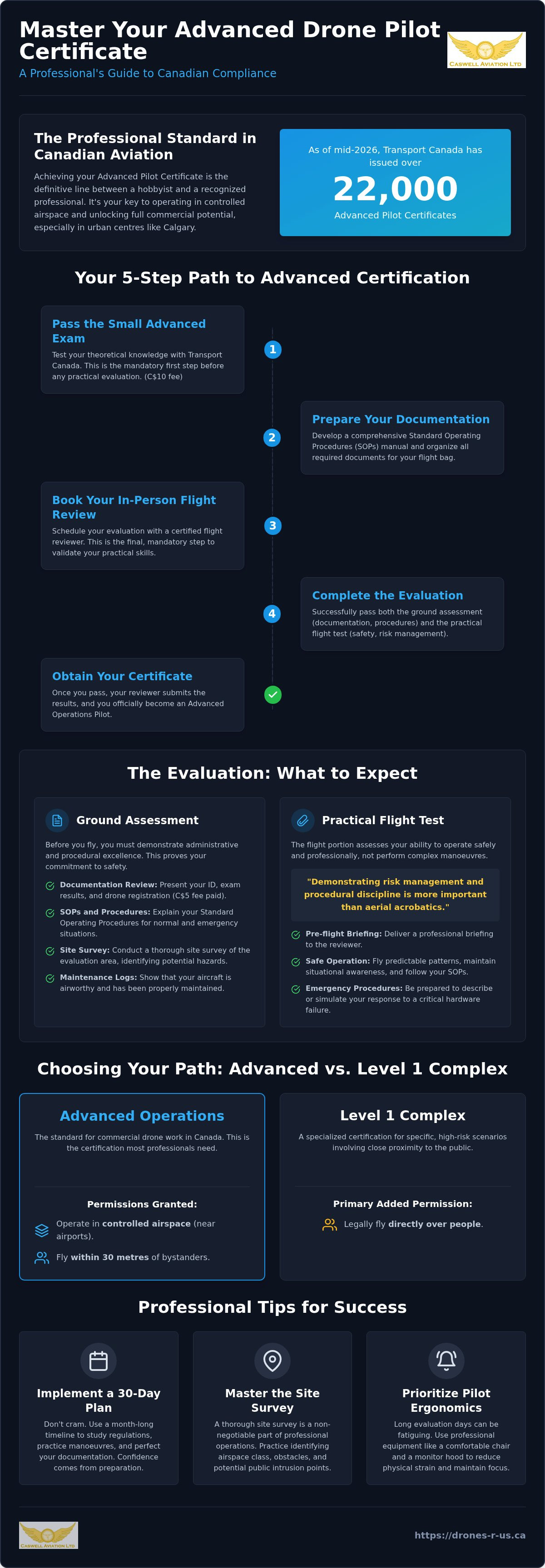
Preparation begins long before you arrive at the flight field. You cannot book an evaluation without first passing the Small Advanced Exam, which carries a C$10 fee. On the day of your review, you must present specific documentation to your reviewer to proceed with the assessment:
- Proof of Exam Completion: A digital or printed copy of your official Transport Canada exam results showing a passing grade.
- Valid Identification: Government-issued ID that clearly displays your full name and date of birth.
- Drone Registration: The Certificate of Registration for the specific aircraft you intend to use for the evaluation. Ensure the C$5 registration fee is paid and the registration mark is visible on the drone.
It is also helpful to have your Standard Operating Procedures (SOPs) and site survey templates ready for inspection. These documents prove you have a structured approach to flight safety. Being organized shows the reviewer that you respect the regulations and are prepared for the responsibilities of an Advanced Pilot Certificate.
The Technical Breakdown: What Happens During the Evaluation?
The evaluation follows a structured path designed to verify your competency as a professional pilot. It is divided into a ground assessment and a practical flight test. While many candidates focus on their flying ability, the reviewer is primarily looking for a safety-oriented mindset. Demonstrating that you can manage risks and follow established procedures is more important than executing complex aerial acrobatics. For your advanced drone flight review Calgary, preparation must extend beyond the controller to include your documentation and situational awareness.
Central to this process is your Standard Operating Procedures (SOPs) manual. This document serves as your operational blueprint. It outlines how you handle everything from routine battery swaps to critical hardware failures. A well-organized SOP manual proves to the reviewer that you operate with the discipline required for Transport Canada Drone Certification. You should also be prepared to deliver a professional pre-flight briefing, which includes a comprehensive site survey of the evaluation area.
Ground Assessment and Documentation Review
Before the drone ever leaves the ground, you must prove your administrative compliance. The reviewer will verify your maintenance logs to ensure the aircraft is airworthy and check your pilot recency records. When preparing for an advanced drone flight review Calgary, remember that the ground assessment is often where pilots feel the most pressure. You must demonstrate a clear understanding of airspace classifications and show that you have checked for local NOTAMs (Notices to Airmen) that could affect your flight. Expect detailed questions on emergency procedures. You need to explain, step-by-step, how you would manage a fly-away, a lost command link, or an on-site battery fire. This stage confirms that you are a prepared aviator who can think clearly under pressure.
Mandatory Flight Manoeuvres and Skills
Once the ground portion is complete, you will move to the practical flight evaluation. The reviewer will observe your ability to execute standard manoeuvres with precision. These include:
- Precision Launch and Recovery: Executing smooth take-offs and landings while maintaining control in varying field conditions.
- Steady Hover and Flight Patterns: Holding a stable position at a specific altitude and flying predetermined patterns, such as rectangles or circles, precisely.
- System Failure Simulation: Managing the aircraft during a simulated loss of GPS or other system failures while maintaining Visual Line of Sight (VLOS).
The goal is to show that you remain in full control of the aircraft at all times. If you feel you need to refine these skills before your assessment, consider booking in-person training to practice under the guidance of an expert.
Advanced vs. Level 1 Complex Reviews: Choosing Your Path
Choosing between a standard Advanced Review and a Level 1 Complex Review depends entirely on your operational goals. A standard Transport Canada drone certification allows you to fly within controlled airspace and as close as 30 metres horizontally to bystanders. However, many commercial projects in high-density areas require the ability to fly directly over people. This is where the Level 1 Complex (L1C) certification becomes essential. While both require an advanced drone flight review Calgary, the L1C evaluation involves significantly higher technical rigor and specialized safety declarations from the drone manufacturer. This path ensures you meet the strict safety margins required for urban missions.
The standard Advanced certificate is often sufficient for rural inspections or construction sites with controlled access. If your business model involves cinematography in public parks or infrastructure inspections in active city centres, the Complex path is the professional standard. You can find technical study materials and DPAC Pilot Resources to help you understand these distinctions before committing to a specific review type. Understanding your path early saves time and ensures you book the correct evaluation for your career trajectory.
When to Pursue Level 1 Complex Certification
Level 1 Complex certification is mandatory for any operation where the drone will fly over bystanders. This is common in high-density urban environments where maintaining a 30-metre buffer is physically impossible. To qualify, you must use an aircraft that has a manufacturer safety declaration specifically for complex operations. Holding this certificate provides a significant competitive advantage when bidding on corporate contracts or government tenders. It demonstrates to clients that you have the specialized training and equipment necessary to manage the highest levels of risk. If you intend to work in the energy or geomatics sectors, this certification is frequently a prerequisite for employment.
Preparing Your SOPs for Complex Operations
Your Standard Operating Procedures (SOPs) must be significantly more detailed for a Complex review. You need to include specific risk mitigation strategies for flying over people, such as parachute deployment protocols or advanced lost-link behaviours. The reviewer will scrutinize your ability to maintain safety in public spaces where variables are harder to control. Caswell Aviation assists pilots in refining these manuals to ensure they meet the 2026 standards for complex missions. We help you organize your documentation so that your advanced drone flight review Calgary reflects a sophisticated understanding of urban flight safety. This preparation reduces the risk of failure and builds your reputation as a disciplined professional.
Strategic Preparation: The Checklist and Pilot Ergonomics
Success during an advanced drone flight review Calgary is rarely the result of luck. It is the outcome of a methodical preparation strategy that begins weeks before you meet your evaluator. Many candidates underestimate the mental and physical stamina required to maintain peak performance throughout a multi-hour assessment. By treating your preparation like a professional flight mission, you reduce the risk of simple oversights that could lead to a failure. A disciplined approach ensures you arrive at the flight field with your equipment, documentation, and mindset fully aligned with 2026 aviation standards.
One often overlooked aspect of preparation is the practice site survey. You shouldn't wait until the day of your review to assess your surroundings. Visit your intended flight location at least seven days prior to identify potential hazards, such as power lines or magnetic interference. This early reconnaissance allows you to refine your site-specific safety plan and build familiarity with the environment. When you show up for your actual evaluation, your confidence will be rooted in direct experience rather than guesswork.
The Pre-Review Preparation Checklist
Follow this 30-day timeline to ensure you are ready for the technical and administrative demands of the review process:
- Step 1 (30 Days Out): Conduct a thorough review of what is a drone flight review Canada requirements to align your study habits with current Transport Canada expectations.
- Step 2 (21 Days Out): Update all aircraft firmware and conduct comprehensive battery health checks to prevent technical glitches during the flight.
- Step 3 (14 Days Out): Organize your physical flight kit, ensuring you have safety vests, landing pads, and high-visibility cones ready for deployment.
- Step 4 (7 Days Out): Perform a mock site survey and practice your emergency procedures at a local field to build muscle memory.
- Step 5 (48 Hours Out): Print and organize all required documentation into a professional flight binder for easy access during the ground assessment.
Maximizing Focus with Fitek Gear Drone Harnesses
Pilot fatigue is a significant threat to safety and decision-making during long evaluation days. Holding a heavy smart controller for extended periods leads to neck strain and hand tremors, which can negatively impact your precision during flight manoeuvres. Utilizing a drone harness for smart controller is a practical solution for maintaining stability and focus. These ergonomic tools distribute the weight of the controller across your shoulders, allowing you to operate with a relaxed posture.
Reviewers often notice the gear you use. When you arrive equipped with professional ergonomic solutions like Fitek Gear harnesses, it demonstrates a Master Practitioner mindset. It shows you prioritize safety and operational longevity over shortcuts. This level of professionalism suggests you're prepared for the responsibilities of an Advanced Pilot Certificate. If you're ready to upgrade your field kit, you can browse our selection of professional ergonomic harnesses to prepare for your upcoming assessment.
Completing Your Certification with Caswell Aviation
Booking your advanced drone flight review Calgary with a Transport Canada approved reviewer is the final hurdle in your professional journey. At Caswell Aviation, we prioritize a steady, methodical environment that allows you to demonstrate your skills without unnecessary pressure. Our reviewers bring years of industry experience to the field, offering a level of technical authority that goes beyond a simple pass or fail assessment. We understand that your goal is to build a career in high-stakes sectors like geomatics or infrastructure inspection; our process reflects those professional standards.
Choosing a veteran mentor for your evaluation ensures that you receive practical feedback on your operational safety and administrative habits. We provide a holistic resource for pilots, offering everything from initial training to specialized Level 1 Complex reviews. This integrated approach means you can rely on a single partner for your certification, ergonomic gear needs, and future career development in aerial photography and video.
Why Choose Caswell Aviation for Your Review?
Our expertise spans the entire spectrum of Canadian drone operations. We specialize in both standard Advanced and Level 1 Complex certifications nationwide, ensuring you have the correct credentials for your specific market. By maintaining a professional and serious atmosphere, we help reduce candidate anxiety, allowing you to focus on the procedural discipline required for success. Whether you're a newcomer or an experienced operator, our goal is to ensure you meet the 2026 regulatory standards with precision. We also offer authorized retail options for Fitek Gear, helping you maintain the ergonomic focus discussed in previous sections.
Next Steps After Passing Your Review
Once you successfully complete your flight review, your reviewer will upload the results to the Transport Canada Drone Management Portal. You must then log in to the portal to apply for your physical Pilot Certificate - Advanced Operations and pay the required issuance fee. After payment, you can download and print your certificate immediately. This document is your legal authorization to operate in controlled airspace across the country.
Maintaining your status as a professional pilot requires ongoing commitment. Transport Canada mandates that you keep your knowledge current through a recency activity every 24 months. This can include attending a safety seminar, completing a self-paced study program, or undergoing another flight review. We invite you to book your professional Advanced & Level 1 Complex Flight Review today and take the final step toward your commercial aviation career.
Advancing Your Professional Aviation Career
Professional certification is the definitive step toward a sustainable career in the Canadian drone industry. Success requires a balance of technical proficiency, administrative discipline, and physical readiness. By mastering your Standard Operating Procedures and selecting the appropriate certification path, you ensure your operations meet the highest safety standards. Whether you're preparing for an advanced drone flight review Calgary or pursuing a Level 1 Complex certificate, your choice of evaluator matters.
Caswell Aviation provides the technical authority you need to navigate the 2026 regulatory landscape. As Transport Canada Approved Reviewers and specialists in Advanced and Level 1 Complex certifications, we offer the veteran mentorship necessary for a successful evaluation. We also support your field operations as an authorized Fitek Gear retailer, providing ergonomic solutions that maintain your focus during high-pressure missions.
Book Your Professional Flight Review with Caswell Aviation today to secure your place in the future of professional aviation. Your commitment to excellence starts with the right preparation.
Frequently Asked Questions
How long does a Transport Canada drone flight review typically take?
It usually takes between 1.5 to 2 hours. This includes the ground assessment and the practical flight portion. The ground portion covers documentation, SOPs, and emergency procedures. The flight portion tests mandatory manoeuvres like precision hovering and system failure simulations. Factors like weather or complex site surveys can extend the time. Being organized with your flight bag helps the reviewer maintain a professional and efficient pace throughout the session.
What happens if I fail my advanced flight review on the first attempt?
You must wait at least 24 hours before attempting another evaluation. There is no limit on the number of attempts; however, you should use the time to address the specific areas where you were unsuccessful. Your reviewer will provide a debriefing to highlight deficiencies. It's recommended to practice your SOPs and manoeuvres thoroughly before booking your next advanced drone flight review Calgary to ensure a successful second attempt.
Do I need to provide my own drone for the flight review evaluation?
Yes, you must provide a drone that's registered with Transport Canada and capable of performing advanced operations. The aircraft must be in a safe state for flight and have all necessary firmware updates. You're responsible for ensuring the drone meets the safety declarations required for the specific review type. Reviewers don't typically provide aircraft because you must demonstrate proficiency on the equipment you intend to use professionally. Ensure your batteries are fully charged.
Can I perform my flight review in an indoor facility in Canada?
No, Transport Canada requires the flight review to be conducted outdoors in a real-world environment. This ensures you can manage environmental factors like wind, signal interference, and bystander safety. Indoor flights don't fall under the same Part IX regulations as outdoor RPAS operations. To obtain your certificate, you must demonstrate competence in the actual conditions you'll face during commercial or professional missions. Evaluation sites are chosen specifically for these outdoor requirements.
Is drone insurance required for the flight review in 2026?
Transport Canada doesn't legally mandate liability insurance for RPAS operations under Part IX. However, many flight reviewers and training centres require proof of insurance to protect against third-party damages during the evaluation. It's a professional standard to carry at least C$100,000 in liability coverage. You should check with your specific reviewer beforehand to confirm their requirements for the day of the assessment. This demonstrates a professional mindset focused on risk mitigation and responsibility.
How much does an advanced flight review cost in Canada?
The cost for a review is set by the individual training provider. While rates differ across the country, you should also budget for mandatory government fees. Transport Canada requires a C$10 payment for the Small Advanced Exam and a C$5 fee for drone registration. These government costs are separate from the service fee charged by your chosen evaluator. Check the Drone Management Portal for any updated administrative fees before you begin the certification process.
What is the difference between a flight review and a flight exam?
The flight exam, officially the Small Advanced Exam, is an online theoretical test hosted by Transport Canada. It evaluates your knowledge of regulations, weather, and flight theory. The flight review is the subsequent in-person practical evaluation. You must pass the online exam first to become eligible for the review. While the exam proves you understand the rules, the review proves you can safely apply them in the field. Both are required for the Advanced certificate.
How long is the advanced drone pilot certificate valid for?
Your Pilot Certificate - Advanced Operations remains valid indefinitely, provided you meet recency requirements. You must complete a recognized recency activity every 24 months to maintain your legal status. This ensures that all pilots stay updated on changing regulations and safety protocols. Options for recency include attending safety seminars or completing a self-paced study program. Always carry your certificate and proof of recency when conducting professional missions or an advanced drone flight review Calgary.
Leave a comment