
Advanced Drone Pilot License Alberta: The 2026 Professional Certification Guide
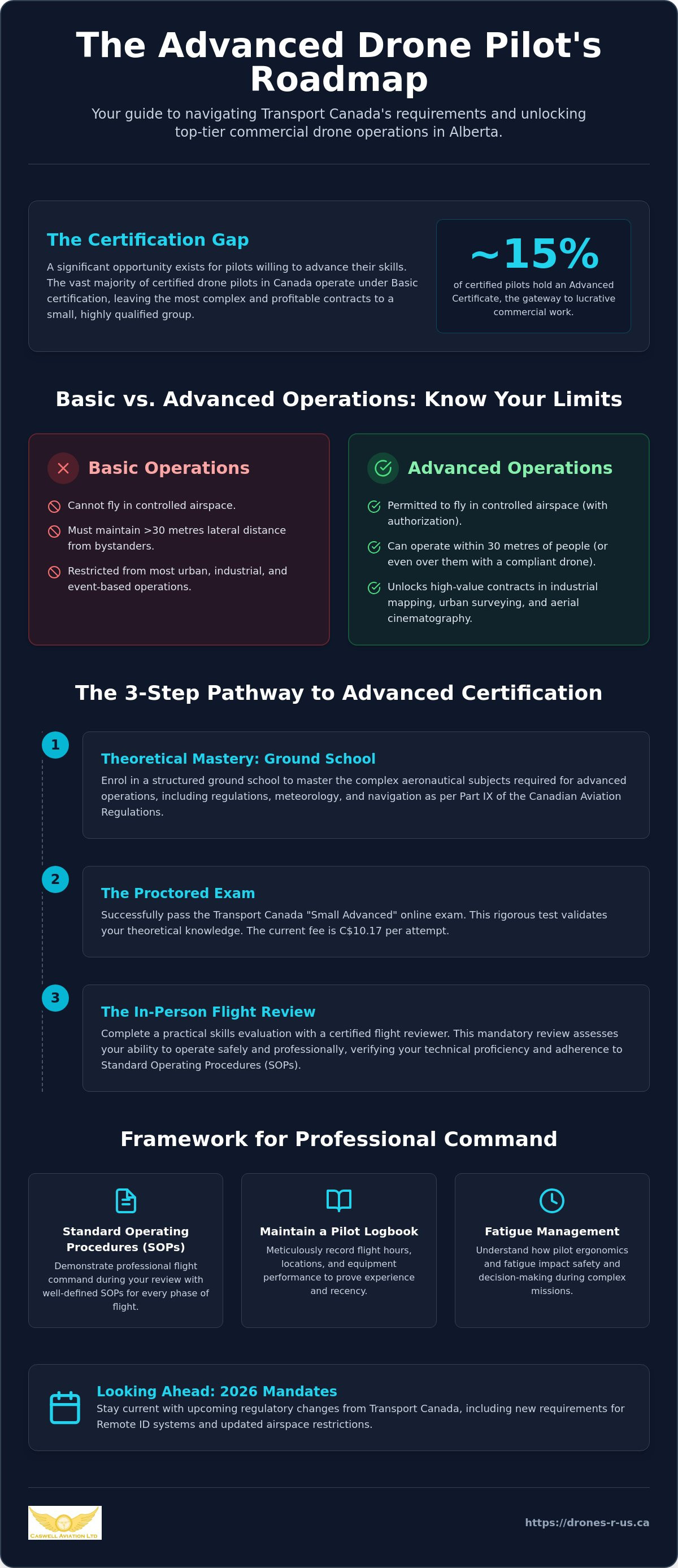
Only about 15 percent of certified drone pilots in Canada have successfully stepped up to the Advanced level, even though this certification is the primary gateway to the most lucrative commercial contracts nationally. If you've spent your evenings trying to decode Part IX of the Canadian Aviation Regulations or felt a spike of anxiety thinking about the mandatory in-person flight review, you aren't alone. It's difficult to balance a professional career with the rigorous study required to obtain a drone pilot licence Alberta, especially as Transport Canada introduces new 2026 mandates like Remote ID systems and updated airspace restrictions.
At Caswell Aviation Ltd, we understand that you want more than just a passing grade; you want the technical command to operate safely in complex environments and the credentials to lead high-stakes projects. This guide provides a clear, methodical roadmap to mastering the Advanced Small RPAS exam and preparing for a successful flight review. We'll examine the latest regulatory changes from the 2026-005 amendment, practical safety protocols for operating near people, and the specific steps required to elevate your aviation career with confidence and precision.
Key Takeaways
- Understand the specific legal framework and operational privileges that distinguish Advanced certification from Basic operations within controlled airspace.
- Learn the methodical three-step sequence to secure your drone pilot license Alberta, starting with structured ground school and concluding with the proctored Transport Canada exam.
- Identify the essential Standard Operating Procedures (SOPs) required to demonstrate professional flight command during a mandatory in-person flight review.
- Explore how pilot ergonomics and fatigue management protocols directly impact safety outcomes and decision-making during complex commercial missions.
- Discover professional training resources and flight review booking options designed to support your transition into high-value aviation and aerial photography roles.
Navigating the Advanced Drone Certification Landscape in Alberta
Many pilots begin their professional journey by searching for a drone pilot license Alberta, but it is essential to understand the jurisdictional framework first. While your flight operations may be based in Calgary, Edmonton, or the industrial hubs of the Wood Buffalo region, all Remotely Piloted Aircraft System (RPAS) rules fall under federal authority. You are complying with the Canadian Drone Regulations established by Transport Canada. These standards ensure that a pilot certified in Red Deer maintains the same safety competencies as one in Toronto or Vancouver.
The Advanced Pilot Certificate is widely recognized as the gold standard for Canadian commercial operators. In Alberta, our industrial landscape demands a high level of technical competency. Whether you are monitoring tailing ponds in the oil sands or utilizing precision sensors for large-scale agriculture, you will likely encounter environments where Basic certification is insufficient. Industrial sites often involve proximity to personnel, complex infrastructure, and controlled airspace, all of which require the legal privileges granted by an advanced license.
Basic vs. Advanced Operations: Determining Your Requirements
The primary differentiator between operational categories is the 30-metre lateral distance rule. Under Basic regulations, a pilot must maintain a minimum distance of 30 metres from any bystander. This restriction effectively prevents drone use in most urban environments, active construction sites, or busy industrial facilities. If your work involves urban surveying or infrastructure inspection, you will almost certainly require an advanced certificate to operate legally. Transitioning to advanced operations marks your shift from a recreational hobbyist to a professional who adheres to strict aviation discipline. It allows you to fly within 30 metres of people, and even over them, provided you use a drone with the appropriate safety declaration.
The Commercial Value of Professional RPAS Certification
Securing a drone pilot license Alberta is a strategic investment in your commercial viability. High-value contracts in sectors like industrial mapping and aerial cinematography are rarely awarded to those with only Basic credentials. Major firms prioritize contractors who can demonstrate rigorous compliance with Transport Canada standards. This certification is also a critical factor for insurance providers. Holding an advanced certificate often leads to better coverage options and reduced liability, as it proves you have mastered complex aeronautical theory. Professional certification builds the corporate trust necessary to lead specialized missions and access the most profitable tiers of the provincial drone economy.
The Three-Step Pathway to Earning Your Advanced Pilot Certificate
Achieving a professional drone pilot licence Alberta requires a structured approach that mirrors traditional aviation training. You cannot simply purchase a drone and begin commercial operations in controlled airspace without following the legal sequence. Transport Canada mandates a specific progression to ensure all advanced pilots possess the necessary theoretical knowledge and practical command. This process begins with academic preparation and culminates in a hands-on evaluation of your flight skills.
The pathway is divided into three distinct phases:
- Theoretical Mastery: Enrolling in a ground school to study the complex aeronautical subjects required for advanced operations.
- The Proctored Exam: Passing the Transport Canada Advanced Small RPAS online exam, which currently costs C$10.17 per attempt.
- The Flight Review: Successfully completing a practical evaluation with a certified flight reviewer to verify your operational safety and technical proficiency.
One critical habit you should establish from day one is the maintenance of a professional pilot logbook. Recording your flight hours, locations, and equipment performance is not just a best practice; it is a vital part of your aviation record. A detailed logbook serves as evidence of your experience and recency, which is essential during flight reviews or when you are bidding on high-value industrial contracts.
Mastering the Advanced Small RPAS Exam
The advanced exam is a rigorous assessment of your understanding of air law, meteorology, navigation, and human factors. In the 2026 testing environment, rote memorisation of outdated question banks is no longer an effective strategy. Transport Canada has shifted toward scenario-based questions that require you to apply your knowledge to real-world flight situations. To ensure you are fully prepared for these complexities, we recommend reviewing The Complete Guide to Transport Canada Drone Certification for a deep dive into theory mastery.
Ground School: Structured Learning for Aviation Excellence
Choosing the right training environment is a pivotal decision for your career. While online modules offer the flexibility to study around a professional work schedule, in-person mentorship provides the depth of feedback that only a seasoned veteran can offer. Our "Master Practitioner" approach at Caswell Aviation Ltd simplifies complex technical concepts, such as Part IX of the Canadian Aviation Regulations, into manageable, actionable steps. This structured learning prepares your mental framework for high-stakes commercial flight operations where precision is non-negotiable. If you are ready to begin this process, exploring our online drone courses is an excellent first step toward professional certification.
Preparing for the Advanced Flight Review: A Professional Framework
The flight review serves as the definitive practical assessment for your drone pilot license Alberta. It's a field-based evaluation where you must demonstrate a disciplined command of your aircraft and a rigorous commitment to safety protocols. Unlike a training session, the reviewer does not provide instruction; they act as a neutral evaluator of your Standard Operating Procedures (SOPs). Your ability to follow these procedures under observation is what determines your success. They're looking for an aviation mindset, not just a skilled pilot.
Preparation begins long before you arrive at the flight field. You must present essential documentation, including your drone registration certificate, a valid piece of government-issued identification, and your pilot logbook. Many candidates fail because they overlook these administrative prerequisites. A professional site survey tool, whether digital or paper-based, is also required to show you've assessed the local airspace and potential hazards. Common pitfalls often include a lack of communication with the reviewer or failing to verbalize your safety checks during the process.
If you treat the review with the same gravity as a high-value commercial contract, you'll likely succeed. Diligent practice in various weather conditions will ensure you maintain the precision required for a drone pilot license Alberta. Remember that the reviewer is evaluating your decision-making as much as your stick-and-rudder skills. If conditions are unsafe, the most professional decision you can make is to postpone the flight.
The Flight Review Checklist: Essential Documentation and Procedures
Success hinges on your ability to conduct a professional pre-flight site survey and a clear emergency briefing. You must account for nearby obstacles, weather conditions, and bystander safety. During the flight, you'll be asked to perform specific manoeuvres, such as a lost-link procedure or a controlled landing after a simulated system failure. You must demonstrate precise control during both standard and abnormal flight manoeuvres to pass. To understand the full scope of this evaluation, read our detailed guide on What is a Drone Flight Review in Canada?
Level 1 Complex Operations: Expanding Your Operational Scope
As of May 2026, Transport Canada has issued only 507 Level 1 Complex certificates. This advanced tier requires a mandatory 20-hour ground school and enables high-risk operations in densely populated areas. Mastering these complex requirements is a prerequisite for pilots aiming for Beyond Visual Line of Sight (BVLOS) missions. As the regulatory landscape shifts toward the proposals in NPA 2026-005, this certification will become the new benchmark for specialized industrial services. Preparing for these transitions now ensures you remain at the forefront of the provincial aviation industry.
Maximizing Operational Safety Through Pilot Ergonomics and Recency
Professional aviation safety is not merely a matter of passing a written exam. It involves managing the physical and mental state of the pilot during every phase of a mission. Pilot fatigue is a major risk factor in commercial aviation accidents, often occurring long before a pilot realizes their focus is slipping. When you operate for several hours in the field, your cognitive load increases. This physical and mental exhaustion directly affects your ability to make split-second safety decisions or respond to sudden system alerts.
Alberta's climate presents unique challenges that can impact mission success. High winds in the foothills or intense sun on the prairies quickly drain a pilot's energy. These environmental stressors reduce your precision and slow your reaction times. Maintaining a "Safety First" culture means recognizing when physical strain begins to compromise your flight command. It involves setting personal limits that are even stricter than the federal regulations. A professional who holds a drone pilot license Alberta knows that the most important safety equipment is a rested and focused mind.
The Impact of Ergonomic Gear on Mission Success
The physical interface between the pilot and the controller is a critical component of flight safety. A specialized Fitek Gear drone harness for smart controllers reduces physical strain by distributing the weight of the hardware across your shoulders and back. This prevents the neck and shoulder fatigue that often leads to shaky manoeuvres during delicate operations. Using an ergonomic neck strap is another simple but effective way to maintain focus. It allows you to keep your hands relaxed on the controls rather than gripping the unit to support its weight. For a deeper look at your equipment options, see our guide on Choosing the Best Drone Harness for Smart Controllers.
Maintaining Professional Standards and Recency Requirements
Regulatory compliance doesn't end once you receive your drone pilot license Alberta. Transport Canada’s 24-month recency requirements ensure that every pilot remains current with the latest aviation standards. As of July 2026, you must complete a recurrent training activity to maintain the validity of your certificate. This might involve a self-paced study program provided by Transport Canada or an advanced workshop at a recognized flight school. Staying sharp is a continuous process. You must also integrate new hardware and software updates into your existing SOPs to ensure your equipment remains as reliable as your skills. If you want to improve your operational comfort and safety, you can explore our professional drone accessories designed for long-duration missions.
Advancing Your Aviation Career with Caswell Aviation Training
Securing a drone pilot license Alberta is a significant milestone, but the quality of your training determines your long-term success in the field. Caswell Aviation Training provides a curriculum designed by active aviation and aerial imagery experts who understand the practical realities of flight operations. Our courses go beyond the basic requirements of Transport Canada; they integrate years of real-world experience in drone aerial photography and video. This ensures that you aren't just learning to pass a test, but are developing the technical skills required to produce professional results for your clients.
Our training environment is built on a foundation of reliability and precision. We offer comprehensive preparation for both Advanced and Level 1 Complex flight reviews, led by seasoned professionals who serve as your veteran mentors. Beyond education, we focus on field efficiency. Equipping your team with Fitek Gear harnesses for smart controllers is a practical way to improve endurance and control during long missions. By synthesising technical theory with ergonomic discipline, we help you build a sustainable career in the provincial aviation sector.
Why Choose a Veteran-Led Flight School?
Our "Master Practitioner" philosophy is at the heart of everything we do. We believe in teaching you how to fly with the discipline of a traditional aviator. This approach is particularly valuable for corporate teams and individual pilots who need to navigate the specific demands of the Alberta industrial market. We provide customized training solutions that address the unique challenges of your specific industry, whether it involves urban infrastructure or remote resource sites. You gain direct access to instructors who have transitioned from high-stakes industries into modern RPAS technology, bringing a culture of thoroughness to every session.
Getting Started with Your Advanced Training Programme
Taking the next step in your professional journey is a straightforward process. You can enrol in our upcoming ground school sessions or book a flight review clinic through our online portal. Before your session, ensure your equipment is registered and your pilot logbooks are up to date. This preparation is essential for a successful certification journey and demonstrates your commitment to professional standards. If you are ready to elevate your career and secure your drone pilot license Alberta, you can Enrol in Advanced Drone Training with Caswell Aviation today. We are here to partner with you as you master the complexities of the 2026 regulatory landscape.
Elevating Your Professional Aviation Standards in 2026
Securing your drone pilot license Alberta is more than a regulatory hurdle; it's a commitment to joining the top tier of Canadian aviators. By mastering the three-step pathway of ground school, proctored exams, and practical reviews, you position yourself to lead high-value missions in Alberta's energy and agricultural hubs. Success in this field requires a synthesis of theoretical knowledge and hands-on command. You've learned that safety is maintained through both mental discipline and physical ergonomics. Utilizing specialized tools and adhering to 24-month recency requirements ensures your operations remain efficient and legally compliant as regulations evolve.
As a specialized Fitek Gear retailer with Transport Canada Qualified Flight Reviewers on staff, we provide the expert-led online and in-person training necessary to navigate these complexities. Our "Master Practitioner" philosophy ensures you receive the mentorship needed to transition from basic operations to complex commercial projects. Whether you are conducting urban surveys or industrial inspections, we are here to support your professional growth with reliability and technical authority. Take the definitive step toward your aviation future today.
Start Your Advanced Drone Certification with Caswell Aviation
We look forward to seeing you excel in the skies over Alberta.
Frequently Asked Questions
How long does it take to get an advanced drone pilot license in Alberta?
The timeline for obtaining a drone pilot license Alberta depends on your study pace and the availability of a flight reviewer. Most candidates complete their ground school training within three to four weeks. Once you pass the proctored Transport Canada online exam, you can book a flight review immediately. Weather and scheduling permitting, a dedicated pilot can often move from enrolment to full certification in approximately one month.
Do I need an advanced certificate to fly a drone for commercial work in Canada?
You don't strictly need an advanced certificate for all commercial work, but it's necessary if your mission requires flying in controlled airspace or within 30 metres of bystanders. Basic operations are restricted to uncontrolled airspace and must stay far from people. Since most industrial and urban contracts in Alberta involve these conditions, the advanced certificate is the practical standard for professional operators seeking high-value projects.
What happens if I fail my Transport Canada advanced drone exam or flight review?
If you fail the Advanced Small RPAS exam, you must wait 24 hours before making another attempt. Each attempt requires a new application and the payment of the C$10.17 fee to Transport Canada. If you fail a flight review, you'll need to schedule a new session with your evaluator. It's best to review your feedback and practice the specific manoeuvres that caused the failure before rebooking.
Can I fly in controlled airspace with a basic drone certificate?
No, a basic certificate doesn't permit entry into controlled airspace under any circumstances. Basic pilots are limited to uncontrolled airspace and must maintain a lateral distance of 30 metres from any person not involved in the operation. To access the airspace surrounding major airports or fly in urban centres, you must hold an advanced certificate. You must also follow the specific coordination procedures required by NAV CANADA.
How much does a professional drone flight review cost in 2026?
Transport Canada charges a fixed fee of C$25.43 for the issuance of a Pilot Certificate for Advanced Operations once you've passed your review. The cost of the flight review itself is determined by the specific flight school or evaluator you choose. You should contact a qualified provider directly to discuss their current rates for practical evaluation sessions. Additionally, remember that drone registration carries a separate C$10 fee per aircraft as required by Part IX regulations.
What are the recency requirements for advanced drone pilots in Canada?
Advanced pilots must complete a recurrent training activity every 24 months to keep their drone pilot license Alberta valid for flight. Transport Canada offers a self-paced study program that satisfies this requirement, but many professionals choose advanced workshops to stay current with new technology. You're required to carry proof of your recency, such as a completion certificate or updated logbook. You must have this whenever you're operating your RPAS for commercial or recreational purposes.
Does Caswell Aviation offer in-person training for corporate groups?
Yes, we specialize in providing customized in-person training for corporate teams across Canada. These sessions are tailored to the specific industrial needs of your organization, such as infrastructure inspection or aerial mapping. Our instructors can travel to your location to provide hands-on mentorship and conduct flight reviews for your entire crew. This ensures that your team develops a consistent safety culture and masters the technical skills required for your specific operations.
Leave a comment