

Online Drone Course Canada: The Professional Path to Certification and Licensing Costs in 2026
As of August 2026, over 88,000 registered drone pilots operate across the country, yet a significant portion of applicants still find themselves stalled by the technical jargon in Part IX of the CARs. It's difficult to plan a commercial venture when the total drone license cost Canada mandates remains obscured by confusing regulatory layers and varying flight review fees. You've likely felt the pressure of the Advanced online exam, knowing that a single failure can delay your operations and increase your total investment.
This guide provides a professional pathway to certification, stripping away the complexity to help you master Transport Canada requirements and understand every cost involved. We'll examine the specific fees for registration and exams, the requirements for Advanced Operations, and the emerging standards for Level 1 Complex certification. This structured approach ensures you're prepared to pass your exam on the first attempt and transition smoothly into professional flight operations. By following this mentor-led roadmap, you'll move from uncertainty to operational discipline, securing your Pilot Certificate with the precision that the aviation industry demands.
Key Takeaways
- Identify the specific weight thresholds and airspace categories that dictate whether you require a Basic or Advanced Pilot Certificate.
- Calculate the total drone license cost Canada pilots must budget for in 2026, including non-negotiable Transport Canada fees and professional training expenses.
- Determine the difference between basic test preparation and a professional ground school curriculum that covers essential subjects like Air Law and Meteorology.
- Understand the requirements for the mandatory in-person flight review and how to choose an authorized reviewer with industry expertise.
- Recognize the importance of ergonomic gear and mentor-led training in maintaining safety and efficiency during long-duration field operations.
Navigating the Transport Canada Regulatory Landscape
Professional drone operations in Canada are strictly governed by Part IX of the Canadian Aviation Regulations (CARs). Every Remotely Piloted Aircraft System (RPAS) weighing between 250 grams and 25 kilograms requires mandatory pilot certification and registration. Operating outside these rules isn't just a safety risk; it's a barrier to commercial legitimacy and long-term career growth. This Canadian Drone Regulations Overview illustrates how the framework has evolved to integrate drones into the national airspace alongside traditional aircraft, treating them as legitimate aviation assets. Deciding on a path depends on your operational goals and the specific drone license cost Canada requires for your chosen certificate level.
Basic vs. Advanced Pilot Certificates
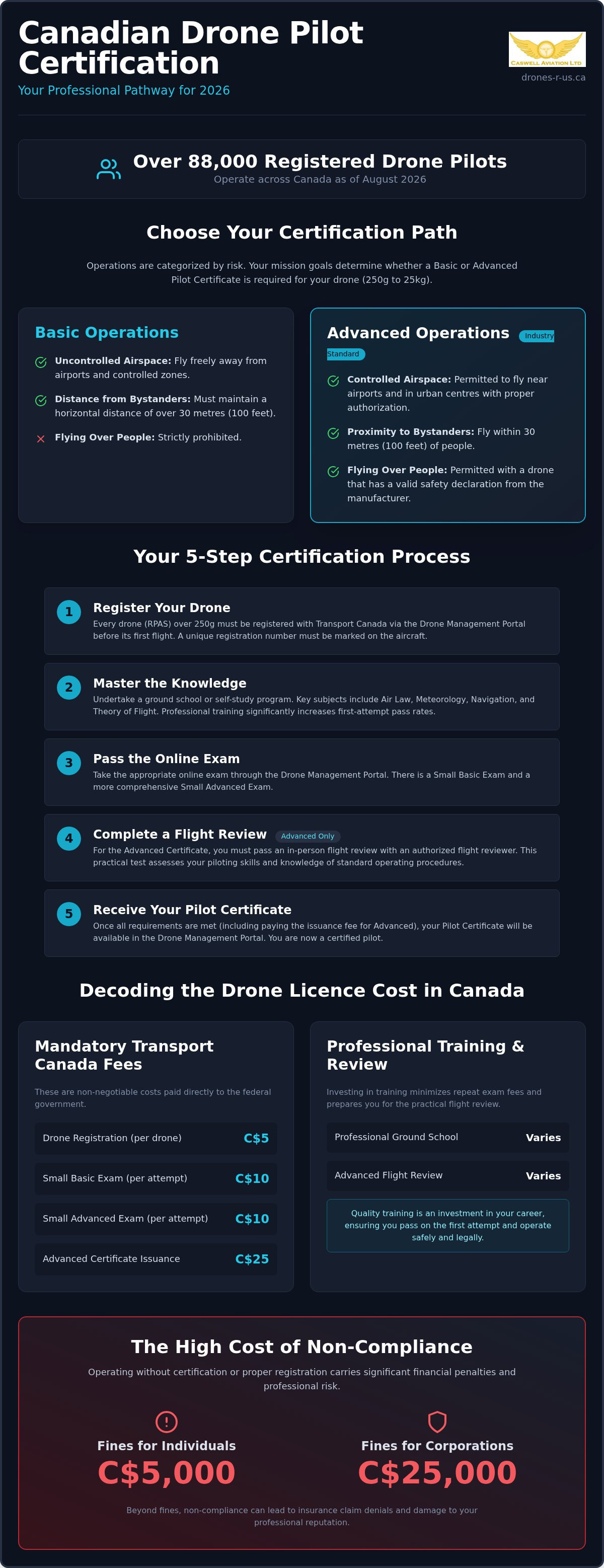
Transport Canada categorizes operations based on the risk level of the flight environment. Basic operations are restricted to uncontrolled airspace and require pilots to maintain a horizontal distance of at least 30 metres from bystanders. If your mission requires flying in controlled zones, within 30 metres of bystanders, or directly over people, you must obtain an Advanced certificate. The Pilot Certificate, Advanced Operations, is the industry standard for commercial work, providing the legal flexibility needed for urban inspections and complex media projects.
The 2026 Legal Requirements for RPAS Operators
Compliance begins at the Drone Management Portal. Every drone over 250g must be registered for a C$5 fee before its first flight. Beyond registration, pilots must maintain detailed logs for three years. These records include flight dates, locations, and any maintenance performed on the aircraft. If you replace a motor or update firmware, you must record it. This discipline ensures that your equipment remains airworthy and that you can provide proof of due diligence if Transport Canada requests an audit.
Understanding the total drone license cost Canada involves more than just government exam fees. Professional pilots must also account for the financial impact of non-compliance. Fines for operating without a certificate can reach C$5,000 for individuals and C$25,000 for corporations. Perhaps more importantly, commercial insurance providers often refuse coverage if the operator cannot produce valid maintenance logs or certificates. Safety-critical training ensures you meet these standards while protecting your professional reputation and your equipment.
Decoding the Drone License Cost in Canada for 2026
Becoming a professional pilot requires a clear financial roadmap. While the entry costs for basic operations are minimal, the professional path involves several distinct layers of investment. Understanding the total drone license cost Canada mandates helps you avoid unexpected expenses during your certification journey. You'll need to account for federal administrative fees, educational resources, and practical assessments. Preparation saves money. Budgeting requires precision.
Transport Canada Government Fees
The federal government maintains a fixed fee schedule for all RPAS activities. These are non-negotiable costs paid directly through the Drone Management Portal. It's important to get these right to avoid administrative delays.
- Small Basic Exam: C$10 per attempt.
- Small Advanced Exam: C$10 per attempt.
- Pilot Certificate Issuance: C$25 for Advanced operations, paid after successfully passing the flight review.
- Drone Registration: C$5 per aircraft.
It's essential to review the official Transport Canada drone pilot certificate requirements to ensure you're applying for the correct level of operation. While certificates don't expire, you must complete a recency activity every 24 months. This might involve taking a safety seminar or re-writing an exam, which could incur additional small fees over time.
Professional Training and Flight Review Investment
Self-study is an option, but many professionals find it leads to multiple failed exam attempts. Each failure adds to your total drone license cost Canada budget. Investing in a comprehensive ground school provides the technical depth needed to pass the Advanced exam on your first try. These courses vary in price depending on the level of mentor support and the depth of the curriculum provided. Quality training is an investment in your career's longevity.
The flight review is the final practical hurdle for Advanced pilots. Authorized reviewers set their own rates for this service. Generally, you can expect these to fall between C$150 and C$300. This assessment confirms your ability to handle the aircraft safely in real-world conditions. Choosing a reviewer with deep industry experience ensures you receive valuable feedback beyond a simple pass or fail grade.
Hidden Costs and Operational Gear
Beyond the paperwork, professional operations require reliable hardware and safety equipment. Insurance premiums vary based on your specific industry, but they remain a non-negotiable part of a commercial budget. Maintenance costs for batteries and propellers should also be projected over a three-year period. For those spending long days in the field, ergonomic equipment like Fitek harnesses becomes a vital investment. These tools reduce physical strain and allow you to focus on the mission at hand. If you're ready to begin your professional journey, exploring structured online drone courses can help you streamline the entire certification process.
Evaluating Online Drone Courses: What Professionals Need to Prioritize
Selecting a training provider is a critical decision that influences your long-term operational success. While many low-cost "test prep" options exist, they often focus on rote memorization rather than technical mastery. A professional ground school provides a comprehensive curriculum covering Air Law, Meteorology, Navigation, and Flight Operations. This depth is essential because the drone license cost Canada professionals pay includes the time spent retaking exams if the initial training was insufficient. Busy professionals across the country benefit from on-demand learning, but you should prioritize courses that offer direct instructor support over static, automated slide decks. Access to a veteran mentor ensures that complex regulatory questions are answered with practical, field-tested context.
Core Knowledge Requirements for the Advanced Exam
The Small Advanced exam requires a sophisticated understanding of the Canadian aviation environment. You must demonstrate a clear grasp of Airspace Classification, ranging from the highly restricted Class A to the uncontrolled Class G. Mastery of Canadian Aviation Regulations (CARs) Part IX is mandatory, as is the ability to interpret a Pilot Operating Manual for various aircraft types. Beyond technical specs, you'll study human factors and physiological aspects of flight. This includes understanding how fatigue, stress, and visual illusions can compromise safety during a mission. Organizations like the Drone Pilot Association of Canada emphasize that this theoretical foundation is what separates a hobbyist from a professional pilot who is ready for high-stakes environments.
Transitioning to Level 1 Complex Operations
As the industry evolves, many operators are looking toward Level 1 Complex certification to expand their service offerings. This advanced tier is designed for high-risk operations, such as flying near large crowds or in more restricted environments. Achieving this status requires a mandatory 20-hour ground school curriculum specifically tailored to complex mission profiles. High-quality online training prepares you for these requirements by bridging the gap between basic flight theory and advanced risk mitigation strategies. Holding a Complex-rated certificate provides a significant strategic advantage when bidding on corporate or government contracts. It demonstrates a level of discipline and training that exceeds standard requirements. If you're planning your career path, starting with a structured professional ground school ensures you have the prerequisite knowledge to scale your operations as new regulations emerge.
Bridging the Gap: From Online Theory to the Flight Review
The transition from passing an online exam to executing a professional mission requires more than just a certificate. For Advanced pilots, the in-person flight review is a mandatory regulatory requirement that validates your practical airmanship. It's the bridge between theoretical knowledge and field-ready discipline. When selecting a flight reviewer, look for a professional with established industry experience who understands the nuances of commercial operations. A veteran mentor provides feedback that helps you avoid common mistakes, such as failing to maintain situational awareness or neglecting proper pre-flight documentation. Every step you take here ensures that the total drone license cost Canada professionals invest results in a safe, compliant, and profitable career.
Preparing for Your Advanced Flight Review
Preparation is a methodical process. You shouldn't book your review until you feel completely confident in your aircraft's handling and your operational workflows. This stage requires a systematic approach to your flight environment and equipment.
- Step 1: Successfully pass the Transport Canada Advanced online exam to confirm your theoretical foundation.
- Step 2: Develop and document your own Standard Operating Procedures (SOPs). These documents define how you handle everything from normal takeoff to emergency landings.
- Step 3: Conduct a thorough site survey and pre-flight briefing for your reviewer. This demonstrates that you can identify hazards and mitigate risks before the rotors spin.
You can learn more about the specific steps in our guide to what is a drone flight review Canada.
What to Expect During the Practical Assessment
The flight review isn't just a test of your thumb skills. It's an evaluation of your decision-making under pressure. Your reviewer will ask you to demonstrate control during emergency maneuvers, such as a lost-link scenario or a sudden motor failure. You must also show proficiency in reading aeronautical charts and checking NOTAMs (Notices to Airmen) in real-time. These skills ensure you don't inadvertently wander into restricted airspace or conflict with manned aviation. Clear communication with your crew and maintaining constant situational awareness are the hallmarks of a professional pilot. If you're ready to complete this final step, booking your Advanced and Level 1 Complex flight reviews with an authorized specialist ensures you meet the highest standards of safety and compliance.
Elevating Your Operations with Caswell Aviation Ltd and Fitek Gear
Achieving certification is a significant milestone, but maintaining a professional standard requires ongoing discipline and the right equipment. Caswell Aviation Ltd approaches training through a veteran mentor lens, moving beyond simple test preparation to instill a culture of safety-critical precision. While understanding the initial drone license cost Canada requires is vital for your business plan, the long-term value of your investment depends on operational efficiency. Professional pilots often face grueling days in the field, where physical fatigue can lead to lapses in judgment or technical errors. By partnering with a mentor who has transitioned from traditional aviation into modern RPAS technology, you gain insights that a standard syllabus cannot provide.
Professional Gear for Professional Pilots
Field operations often involve long hours of monitoring telemetry and maintaining visual line of sight. Holding a smart controller for extended periods causes neck and back strain, which directly impacts your flight precision. Utilizing specialized equipment like a drone harness for smart controllers is a practical solution for reducing pilot fatigue. Fitek Gear harnesses are specifically designed for the rigours of the Canadian environment, providing the stability needed for complex or advanced flights. This ergonomic support ensures your hands remain steady and your focus stays on the aircraft rather than physical discomfort. Investing in professional-grade harnesses is a hallmark of an operator who prioritizes safety and results over the long term.
Your Long-Term Partner in Aviation Excellence
The regulatory landscape continues to evolve, making continuing education a necessity rather than an option. Transport Canada requires pilots to complete a recency activity every 24 months to keep their certificates valid. Caswell Aviation Ltd serves as a national resource for these requirements, offering advanced flight reviews and updated curriculum as new standards emerge. This ongoing relationship helps you stay competitive when applying for drone pilot jobs in Canada, where employers value candidates with verified technical authority and a commitment to compliance. Whether you're seeking Level 1 Complex certification or simply need to maintain your current status, having a stable partner ensures you're never navigating these changes alone. If you're ready to move from student to practitioner, you can start your professional journey with Caswell Aviation Ltd today. We provide the expertise and the gear necessary to turn your certification into a sustainable aviation career.
Securing Your Professional Future in Canadian Aviation
Becoming a certified pilot in 2026 involves more than passing a single exam. It requires a strategic approach to the total drone license cost Canada mandates for commercial success. We've explored how regulatory mastery and the right ground school provide the foundation for your career. By choosing a path that combines technical theory with practical airmanship, you position yourself as a legitimate participant in the national airspace. Safety and compliance aren't just rules; they're the pillars of a sustainable business model.
Caswell Aviation Ltd provides the specialized mentorship needed to navigate these requirements with precision. Our status as authorized Transport Canada Flight Reviewers and our expertise in Level 1 Complex operations ensure you receive a comprehensive training model that translates directly to field success. From your first online lesson to the final practical assessment, we stand as your partner in aviation excellence. Register for a professional online drone course with Caswell Aviation Ltd to begin your journey with confidence and the backing of veteran industry experts.
Frequently Asked Questions
Is an online drone course in Canada sufficient to get my licence?
An online course provides the necessary theoretical foundation to pass the Transport Canada exams. However, for an Advanced certificate, you must also complete an in-person flight review. Online training ensures you understand the complex regulations and air law required for the online portal test. Once you pass the theoretical exam, you must book a session with an authorized reviewer to validate your practical skills in the field environment.
How much does it cost to get a drone license in Canada in 2026?
The total drone license cost Canada pilots face includes several fixed government fees and variable training expenses. Transport Canada charges C$10 per exam attempt and C$5 for drone registration. If you pursue an Advanced certificate, you'll pay a C$25 issuance fee plus the cost of a flight review, which typically ranges from C$150 to C$300. Professional online ground school fees are additional but help prevent the cost of repeated exam failures.
How long does it take to complete an online drone course?
Completion times depend on the certificate level and your prior aviation knowledge. A standard Advanced ground school usually requires 15 to 20 hours of focused study to master the technical curriculum. For those pursuing Level 1 Complex certification, a mandatory 20-hour ground school requirement is currently in effect. Most professionals spread this learning over two weeks to ensure they fully absorb the material before attempting the difficult and technical online exam.
Do I need an Advanced certificate to fly a drone for work in Canada?
Your certificate level is determined by your flight environment rather than whether you're being paid. You require an Advanced certificate if your work involves flying in controlled airspace, within 30 metres of bystanders, or directly over people. Since most commercial projects occur in urban areas or near structures where people are present, the Advanced certificate has become the practical industry standard for professional drone operators across the entire country.
What happens if I fail the Transport Canada Advanced exam?
If you don't achieve the 80 percent passing grade, you must wait 24 hours before attempting the exam again. Each subsequent attempt requires a new C$10 fee payment, which adds to the total drone license cost Canada pilots must manage. Repeated failures often indicate a lack of depth in your study materials. Investing in a structured ground school with mentor support helps you identify knowledge gaps in subjects like meteorology or air law.
Can I take the flight review before passing the online exam?
You cannot complete a flight review without first passing the Small Advanced online exam. Transport Canada requires the exam results to be linked to your digital account before a flight reviewer can submit your practical assessment. Once you pass the theoretical test, you'll receive a reference number that your reviewer uses to validate your skills. This sequence ensures that every pilot in the field possesses a baseline understanding of aviation safety and regulations.
Are online drone courses recognized by Transport Canada?
Transport Canada does not officially accredit specific schools, but they provide a list of organizations that declare their curriculum meets the required knowledge standards. Professional ground schools align their content with the TP 15263 document to ensure students are prepared for the official exams. Choosing a provider with authorized flight reviewers on staff ensures that your training remains consistent with current federal expectations and the safety protocols required for professional aviation work.
What is the difference between a flight review and a flight exam?
A flight review is a practical skills validation conducted by a private authorized reviewer for the Advanced certificate. In contrast, a flight exam is a more rigorous assessment typically associated with higher-risk operations or complex certifications. While both evaluate airmanship, the review focuses on your ability to operate safely within standard Advanced parameters. The exam involves stricter criteria and specific mission profiles defined by the latest 2026 regulatory updates for complex flights.
Leave a comment