

How to Start a Drone Business in Alberta: A Professional 2026 Roadmap
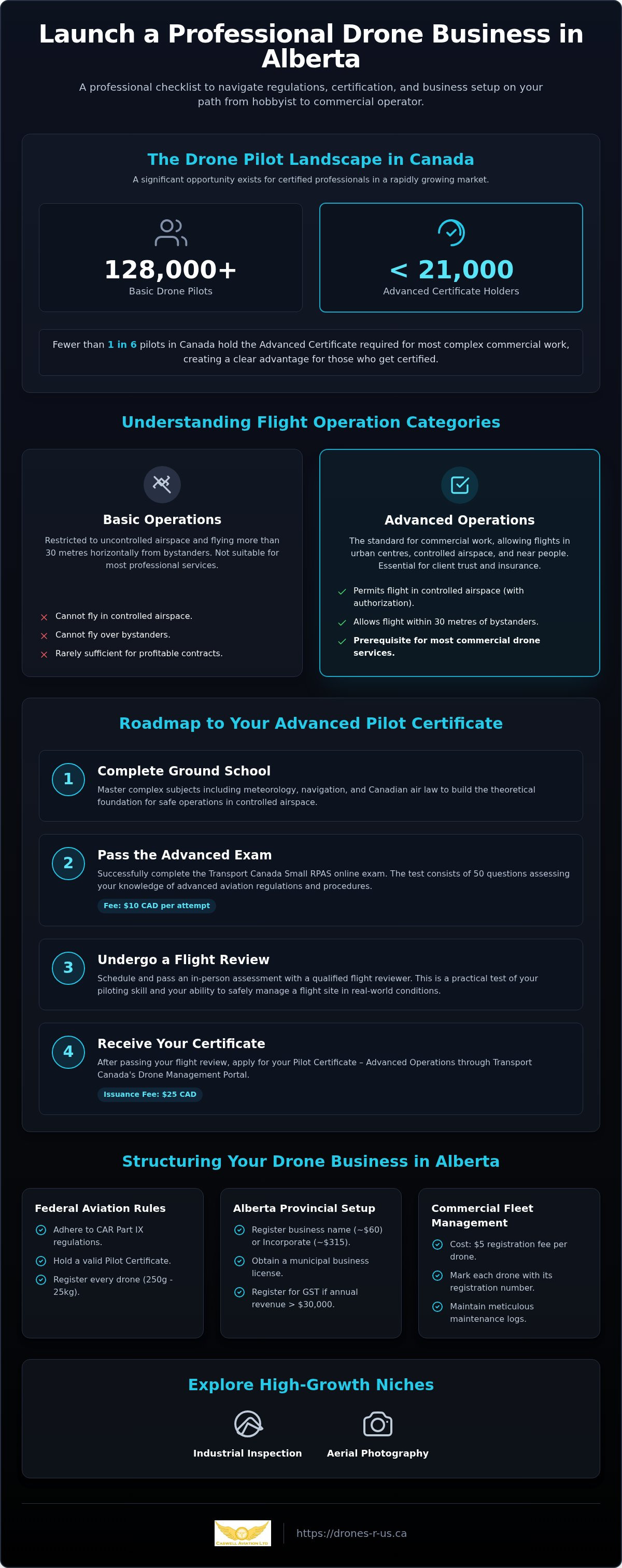
While there are over 128,000 basic drone pilots in Canada, fewer than 21,000 have secured the Advanced Pilot Certificate required for complex commercial work. This gap represents a significant opportunity for anyone entering the professional market. Understanding how to start a drone business in Alberta involves more than just buying a high-end aircraft; it requires a disciplined approach to aviation safety and provincial compliance. You’ve likely realized that the transition from flying for fun to operating for profit is filled with regulatory hurdles and technical choices that can stall your progress before you take flight.
We recognize that navigating the divide between Basic and Advanced operations or sourcing specialized insurance can be frustrating. This roadmap simplifies that journey by providing a professional checklist to move you from hobbyist to business owner with confidence. You'll learn the exact steps to navigate Transport Canada regulations, Alberta's business registration requirements, and the equipment standards necessary for a successful operation. We will cover everything from securing your flight review to identifying the most profitable niches in the province's growing industrial landscape.
Key Takeaways
- Understand the regulatory distinction between Basic and Advanced operations to ensure full compliance with Transport Canada’s RPAS framework.
- Identify the specific steps required to secure an Advanced Pilot Certificate, including ground school prerequisites and professional flight reviews.
- Follow a methodical roadmap on how to start a drone business in Alberta that covers provincial registration and the creation of standard operating procedures.
- Explore high-growth niches such as industrial inspection and professional aerial photography to determine your primary service offering.
- Learn how a combination of online theory and in-person practical training builds the technical foundation necessary for complex flight operations.
Navigating the Regulatory Landscape for Alberta Drone Startups
Establishing a legal foundation for how to start a drone business in Alberta begins with a firm grasp of the regulatory framework. Every commercial operation in the country is governed by Transport Canada’s Remotely Piloted Aircraft Systems (RPAS) rules. These regulations categorize flights into Basic or Advanced operations. While Basic operations are suitable for rural areas away from people and controlled airspace, they rarely suffice for professional services. Most profitable contracts occur in environments that require an Advanced Pilot Certificate. An Advanced Operation is the standard for any commercial work conducted in urban centres or within 30 metres of bystanders. If you plan to fly in restricted airspace or near buildings, the Advanced certification isn't optional; it's a prerequisite for insurance and client trust.
Federal vs Provincial Requirements
When you're determining how to start a drone business in Alberta, you must manage two distinct levels of government. At the federal level, you must adhere to the Canadian drone regulations specified in Canadian Aviation Regulations (CAR) Part IX. This includes pilot licensing and drone registration. Provincially, you're responsible for the legal structure of your business. Whether you choose to incorporate or register a trade name as a sole proprietor, you must file through an Alberta registry agent. Business registration for a sole proprietorship typically costs around $60, while provincial incorporation fees are $275 plus the cost of a NUANS report, which is approximately $40. Even if you operate as a sole proprietor, you'll need a municipal business license to operate legally in your local area. If your annual revenue exceeds $30,000, registering for GST is mandatory.
Registering Your Commercial Fleet
Your aircraft are the core of your business, and they must be accounted for individually. Every drone in your fleet weighing between 250 grams and 25 kilograms requires registration with Transport Canada. This process costs $5 per aircraft and must be completed before the drone’s first flight. Once registered, you're required to mark the drone with its unique registration number in a permanent, visible location. Beyond simple registration, professional standards demand meticulous record-keeping. You must maintain a comprehensive maintenance log for every aircraft in your business fleet. These logs track flight hours, battery cycles, and any hardware repairs or firmware updates. This discipline ensures safety and protects your investment from avoidable mechanical failure. For those looking for professional guidance on these standards, resources available at learn more can help you establish these critical operational habits early on.
Securing Your Advanced Pilot Certificate and Flight Review
Transitioning from a hobbyist to a professional requires a methodical approach to certification. When researching how to start a drone business in Alberta, you'll find that the Advanced Pilot Certificate is the essential credential for commercial viability. This process is more rigorous than the basic exam and requires a combination of theoretical knowledge and practical skill. Following a logical sequence ensures you don't miss critical prerequisites that could delay your operations.
The journey to professional certification involves four distinct steps:
- Step 1: Ground School. Complete a comprehensive ground school course. You must master complex subjects like meteorology, navigation, and Canadian air law to operate safely in controlled airspace.
- Step 2: The Advanced Exam. Pass the Transport Canada Advanced Small RPAS online exam. This test consists of 50 questions, and each attempt costs $10 CAD.
- Step 3: The Flight Review. Book an in-person assessment with a qualified reviewer. This is a practical demonstration of your ability to handle the aircraft and manage a flight site safely.
- Step 4: Certificate Issuance. Once you pass your review, apply for your Pilot Certificate; Advanced Operations through the Drone Management Portal. There is a $25 issuance fee for this certificate.
The Importance of a Professional Flight Review
A Flight Review is not just a test of your stick-and-rudder skills; it's an evaluation of your command as a pilot. Reviewers follow strict Transport Canada drone safety guidelines to ensure you can manage real-world risks. During the assessment, you'll be expected to perform thorough pre-flight checklists, demonstrate emergency procedures like lost link protocols, and maintain constant spatial awareness. Passing this review is the final hurdle to licensing. Many professionals choose Caswell Aviation's Flight Review services to ensure they meet the highest industry standards during their evaluation.
Scaling to Level 1 Complex Certification
For those looking to differentiate their business, the Level 1 Complex certification offers a distinct competitive advantage. This elite tier of licensing allows for high-risk or specialized operations that fall outside standard advanced parameters. Having this certification is often a requirement for bidding on large-scale industrial contracts in sectors like oil and gas or infrastructure monitoring. Caswell Aviation offers specialized training for this level, helping you master the advanced maneuvers and safety protocols required for complex environments. Mastering these skills is a vital part of understanding how to start a drone business in Alberta that can scale into high-value industrial sectors.
Structuring Your Drone Business for Long-Term Success
Building a sustainable operation requires more than technical skill; it demands a robust commercial framework. When you are determining how to start a drone business in Alberta, your first major decision involves selecting a legal structure that aligns with your growth and liability needs. Registering your Alberta business as a sole proprietorship is often the fastest route for individuals, but incorporation offers a liability shield that is vital for high-stakes aviation work. A corporation acts as a separate legal entity, which protects your personal assets if the business faces legal challenges. Regardless of the structure, you must develop a Standard Operating Procedure (SOP) manual. This document ensures that every mission, from initial site survey to final data delivery, follows a consistent safety and quality protocol. It's the mark of a Master Practitioner who values discipline over flashy marketing.
Establishing a professional brand involves more than a logo; it requires proof of regulatory awareness. Clients in the industrial and agricultural sectors look for partners who understand the complexities of Canadian aviation. For a deep dive into the legal requirements you'll need to reference daily, consult our Drone Regulations in Canada: The 2026 Professional Reference Guide. This resource helps you align your business operations with the latest federal standards. Maintaining this level of documentation builds the trust necessary to secure long-term contracts with sophisticated corporate clients.
Aviation Liability Insurance in Alberta
Standard general liability insurance often fails to protect drone operators because most policies specifically exclude aviation activities. You need a specialized policy that differentiates between hull insurance and liability insurance. Hull insurance covers the cost of repairing or replacing your aircraft if it crashes. Liability insurance, however, covers damage your drone might cause to third-party property or people. In Alberta's industrial sectors, most prime contractors require a minimum of $2 million to $5 million in aviation-specific liability coverage before you can set foot on a job site. You must ensure your policy is active and specifically names the aircraft in your registered fleet. Beyond insurance, managing the vehicles needed to reach these remote sites is a key logistical consideration; Alliance Fleet Solutions offers professional B2B fleet management and leasing to support your commercial operations.
Professional contracts protect both your business and your clients from the inherent variables of flight. Your agreements should include clear clauses regarding weather delays; high winds or heavy rain can ground a mission without notice. You must also define data ownership and usage rights. Clarify whether the client receives exclusive rights to the raw footage or if your business retains the right to use the media for promotional purposes. Setting professional payment terms, such as a booking deposit and final payment upon delivery of the data, ensures a steady cash flow and confirms the client's commitment to the project. For businesses looking to automate these workflows with field service software, read more about how JobPerfect can help.
Choosing a profitable niche is a pivotal step when learning how to start a drone business in Alberta. Your specialization will determine the type of aircraft you fly and the specific sensors you need to master. Professionalism in this industry is built on technical proficiency and the ability to deliver high-value data to your clients. Selecting a niche is a core component of how to start a drone business in Alberta that remains profitable over the long term.
- Real Estate and Corporate Video: There is a consistent demand for polished marketing content in Alberta's residential and commercial markets. For a deeper look at this sector, see The Professional Guide to Corporate Drone Video in Alberta.
- Industrial Inspection: This niche requires advanced sensors like thermal cameras and high-zoom optics. It involves technical work for the oil and gas or utilities sectors that demands extreme precision and safety compliance.
- Mapping and Surveying: This is high-margin work serving construction and land development. It requires knowledge of photogrammetry and specialized software to produce accurate 3D models and topographical maps.
The Role of Specialized Field Equipment
Professional pilots understand that their interface with the machine is as important as the drone itself. High-quality smart controllers are necessary for superior outdoor visibility and signal reliability. For those spending hours in the field, ergonomics become a safety factor. We recommend the Fitek Gear drone harness for smart controllers to manage the weight of professional equipment. This harness redistributes the load across your shoulders, which reduces pilot fatigue and ensures your hands remain steady during critical flight maneuvers. Improving your physical comfort directly impacts the quality of your aerial deliverables and overall flight safety.
Essential Maintenance and Backup Kits
Success in the field relies on the "two is one, one is none" rule. You should always carry spare batteries, propellers, and high-speed memory cards to avoid mission failure due to a single component issue. A field repair kit is necessary for minor adjustments like tightening frame screws or cleaning sensitive camera lenses between flights. Professional pilots prioritize ruggedized transport cases to protect their fleet from dust, moisture, and impact during transit. These habits ensure your business remains operational even when working in remote or harsh environments. To maintain peak performance during long days on-site, equip your operation with ergonomic Fitek Gear drone harnesses.
Launching Your Operations with Caswell Aviation
Finalizing the blueprint for how to start a drone business in Alberta requires a transition from theoretical planning to operational execution. Caswell Aviation serves as a comprehensive partner during this phase, providing the technical training and professional reviews necessary to meet federal standards. By leveraging online courses, you can build a strong theoretical foundation in meteorology and air law from any location. This flexible learning model is followed by in-person training sessions designed to refine your hands-on mastery of complex flight manoeuvres. These practical sessions prepare you for real-world industrial environments where precision is mandatory.
Your business readiness is solidified through a professional Flight Review conducted by industry veterans. This assessment is more than a regulatory box to check; it's an opportunity to have your standard operating procedures vetted by an expert. Additionally, performing like a professional requires the right equipment. Utilizing Fitek Gear ergonomic harnesses ensures you maintain control and comfort during long days on-site, signalling to clients that you prioritize safety and efficiency in your field operations. You can find these specialized tools and training resources at learn more.
The Mentor-Led Approach to Drone Business
Choosing a mentor-led path is significantly more efficient than attempting self-study. Master Practitioners provide context that textbooks cannot, offering insights into how regulations translate to daily flight operations. As technology and Transport Canada requirements evolve, having access to ongoing support ensures your business remains compliant and competitive. For a detailed breakdown of the licensing path, consult The Complete Guide to Transport Canada Drone Certification in 2026. This resource serves as a vital reference as you scale your operations.
Next Steps: Your 30-Day Launch Plan
Executing a structured timeline helps you maintain momentum. This modular plan outlines the critical path for how to start a drone business in Alberta within a single month:
- Week 1: Enroll in a professional ground school course and complete your provincial business registration through an Alberta registry agent.
- Week 2: Successfully pass the Transport Canada Advanced written exam and acquire your primary and backup drone fleet.
- Week 3: Complete your in-person Flight Review and finalize your aviation liability insurance policy.
- Week 4: Launch your marketing presence and secure your first commercial contract using your new certification and professional portfolio.
By following this methodical sequence, you ensure that every legal and technical requirement is met before you accept your first paid mission.
Taking Flight in Alberta’s Professional Drone Market
You now possess the foundational roadmap to navigate the complex intersection of federal aviation law and provincial business requirements. Transitioning from a hobbyist to a business owner requires more than just technical skill; it demands a commitment to safety protocols and a clear understanding of your chosen niche. Success in this sector is reserved for those who prioritize regulatory compliance and invest in the specialized training necessary for high-stakes industrial work. Understanding how to start a drone business in Alberta is the first step in a journey that rewards discipline and operational precision.
As you move forward, remember that you don't have to manage this transition alone. Our team consists of Transport Canada Advanced and Level 1 Complex experts who are ready to guide your progress. With professional Flight Reviewers on staff and as an authorized Fitek Gear retailer, we provide the tools and certifications you need to operate at the highest level. Start your professional drone career with Caswell Aviation training today. The opportunity in Alberta’s airspace is significant, and with the right preparation, your business is ready for departure.
Frequently Asked Questions
Do I need a special license to start a drone business in Alberta?
Yes, you require a Pilot Certificate from Transport Canada to operate any drone weighing between 250 grams and 25 kilograms for commercial work. For most professional applications, an Advanced Pilot Certificate is necessary. Additionally, you must register your business provincially and obtain a municipal business license. This dual layer of federal aviation compliance and provincial business law is the foundation for how to start a drone business in Alberta successfully and legally.
Can I fly a drone commercially with only a Basic Pilot Certificate?
You can technically fly commercially with a Basic Pilot Certificate, but your operations are severely restricted. You must remain in uncontrolled airspace and stay at least 30 metres away from bystanders. These limitations make it difficult to fulfill contracts in urban areas or industrial sites. Most professionals upgrade to an Advanced Certificate to fly in controlled airspace and closer to people, which is where the majority of profitable commercial opportunities exist.
What is a Transport Canada Flight Review and how do I pass it?
A Flight Review is a mandatory in-person skills assessment conducted by a qualified reviewer. To pass, you must demonstrate proficiency in flight planning, site surveys, and emergency procedures. Reviewers look for disciplined use of checklists and a high degree of spatial awareness. Preparing through a mentor-led training program ensures you understand the technical standards required to satisfy the reviewer and secure your Advanced Pilot Certificate with confidence.
How much does it cost to get drone liability insurance in Canada?
Insurance costs vary based on your coverage limits and the complexity of your operations. Standard policies for commercial drone work typically range from $1 million to $5 million in liability coverage. While we don't sell insurance, we recommend sourcing a policy that specifically includes aviation activities, as many general business policies exclude drone-related incidents. You should contact a specialized aviation insurance broker to receive a quote tailored to your specific fleet and risk profile.
What are the best industries for drone pilots in Alberta right now?
The most active sectors for drone services include industrial inspection, mapping for land development, and professional aerial photography. Alberta's energy and utility sectors frequently require high-precision inspections of infrastructure, which demands advanced sensors and technical expertise. Additionally, the construction industry relies on drone-based photogrammetry for accurate site monitoring. Focusing on these high-margin niches is a strategic way to build a sustainable and profitable drone operation in the province.
Is a drone harness like Fitek Gear really necessary for beginners?
While not legally required, an ergonomic harness is a vital tool for anyone serious about professional field operations. Smart controllers are heavy, and holding them for extended periods causes fatigue that can lead to control errors. Using a Fitek Gear harness redistributes the weight across your shoulders, allowing for steadier hand movements and improved focus. Beginners who adopt professional ergonomic habits early are better prepared for the physical demands of long commercial flight days.
What happens if I fly a commercial drone without a certificate?
Flying a drone for commercial purposes without a valid certificate is a violation of the Canadian Aviation Regulations. Individuals can face fines of up to $1,000, while corporations can be fined up to $5,000 for non-compliance. Beyond financial penalties, operating without a certificate makes it impossible to secure aviation liability insurance. This exposes your business to massive personal liability in the event of an accident or property damage during a flight.
How often do I need to renew my Transport Canada drone pilot certificate?
Your Pilot Certificate itself does not expire, but you must maintain recency to keep it valid. Transport Canada requires pilots to complete a recurrent training activity every 24 months. This can involve attending a safety seminar, completing a self-paced study program, or passing an additional flight review. Keeping a record of these activities in your pilot logbook is essential to prove you are legally current if you are ever audited by aviation authorities.
Leave a comment