

High-Impact Drone Marketing Videos: The Professional Canadian Guide
A high-quality aerial shot can define a brand, but a single regulatory fine can dismantle a marketing budget. Many businesses are eager to capture the unique perspective that professional drone marketing videos Calgary specialists provide, yet they often hesitate due to the complexity of Transport Canada regulations. It's a valid concern. Operating a commercial Remotely Piloted Aircraft System (RPAS) requires more than just a steady hand; it demands a thorough understanding of the current aviation framework and a commitment to safety-first operations.
You likely realize that stunning 4K footage is only effective if the production process is legal, streamlined, and professional. This guide provides the technical and strategic roadmap you need to produce world-class aerial content anywhere in Canada without the risk of non-compliance. We will examine the essential flight certifications, the importance of ergonomic gear for precision control, and the storytelling techniques that transform raw footage into high-impact marketing assets.
Key Takeaways
- Transition from simple aerial shots to strategic 4K and 8K assets that align with high-end corporate branding standards.
- Navigate the complexities of Transport Canada regulations to ensure your drone marketing videos Calgary projects remain fully compliant in both Basic and Advanced flight environments.
- Recognize the role of professional-grade hardware and ergonomic gear in maintaining a stable video downlink and achieving precise cinematography.
- Implement a strategic production framework focused on "hero shots" that serve specific marketing objectives like brand awareness or customer conversion.
- Combine technical flight mastery with professional storytelling to eliminate the risks associated with amateur operations and inconsistent video quality.
The Evolution of Professional Drone Marketing Videos
Professional drone marketing has transitioned from a niche novelty into a core component of high-end corporate communication. Today, drone marketing videos Calgary firms utilize are far more than simple "bird’s eye" shots. They function as strategic assets designed to communicate specific brand values through high-resolution imagery. While the history of aerial videography involves various platforms from fixed-wing aircraft to helicopters, modern Remotely Piloted Aircraft Systems (RPAS) allow for a level of precision that was previously unattainable. Corporate branding now demands 4K and 8K standards to ensure clarity on large-format displays. Stock footage often feels disconnected from a brand’s specific identity, which is why organizations across Canada now prioritize custom aerial imagery from providers like Caswell Aviation to maintain visual consistency and authenticity.
Why Aerial Content is No Longer Optional
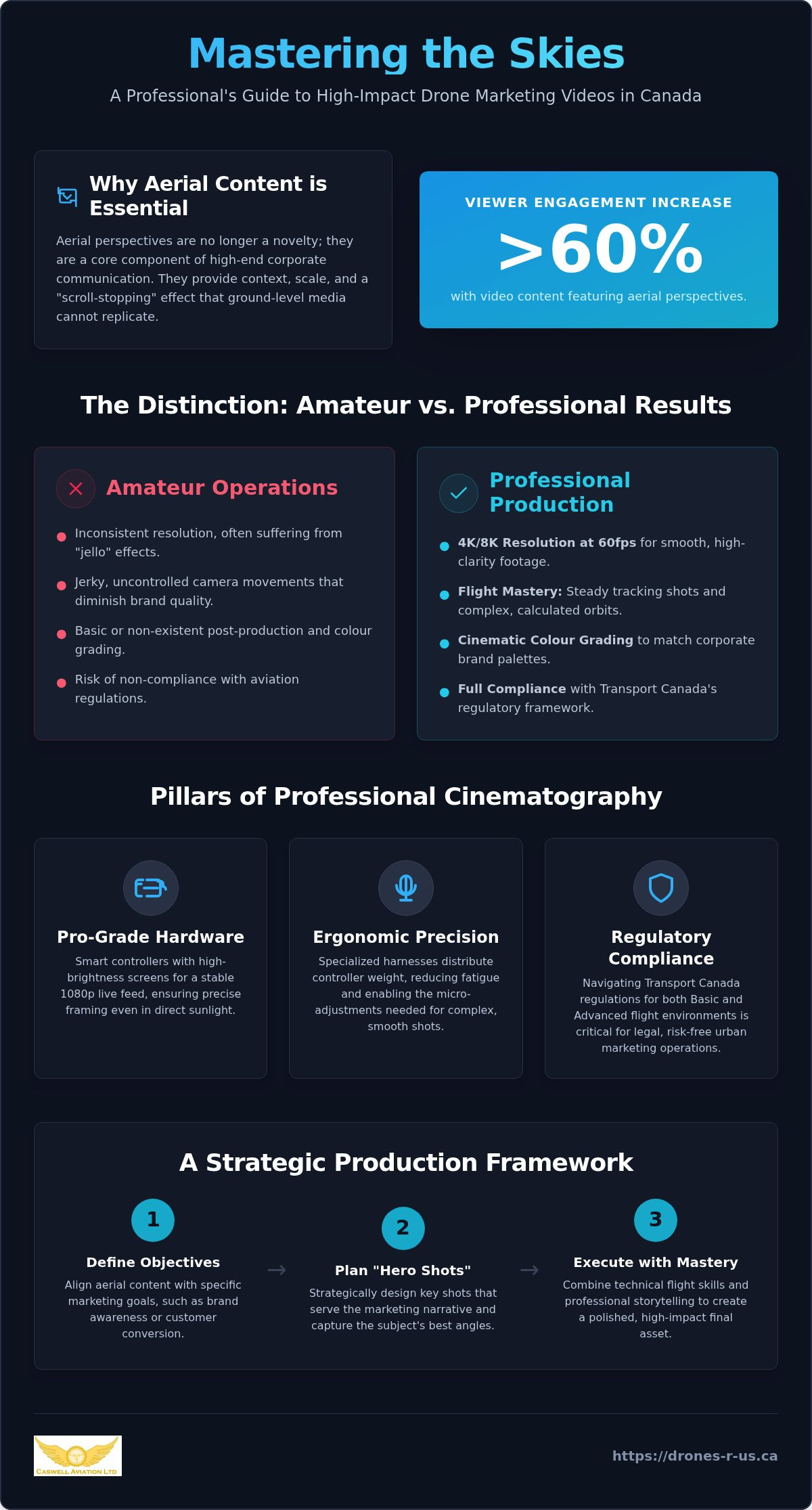
Digital engagement data indicates that video content featuring aerial perspectives can increase viewer engagement by over 60%. This "scroll-stopper" effect is critical for capturing attention in saturated digital markets. Beyond aesthetics, aerial views provide essential context for real estate and infrastructure projects by clearly defining property boundaries and proximity to neighbourhood amenities. For industrial or commercial operations, drones offer the only practical way to capture the true scale of a facility in a single, continuous shot. It's a method that provides a comprehensive view of logistics, site progress, and operational capacity that ground-level photography simply cannot replicate.
The Distinction Between Amateur and Professional Results
The gap between amateur flights and professional production is defined by technical precision and disciplined execution. A professional baseline now requires 4K resolution at 60fps to ensure smooth motion and the ability to utilize slow-motion effects in post-production. Amateur footage often suffers from "jello" effects or jerky camera movements that can diminish a brand's perceived quality. High-end results also rely on sophisticated post-production workflows that distinguish a professional service from a hobbyist effort. When businesses invest in drone marketing videos Calgary projects, they expect a level of polish that matches their corporate reputation.
- Color Grading: Converting flat, raw log profiles into cinematic finishes that match specific corporate colour palettes.
- Flight Mastery: Utilizing professional-grade ergonomic gear to maintain steady tracking shots and complex orbits.
- Strategic Framing: Ensuring the subject remains the central focus through calculated gimbal movements rather than random pans.
Consistent, smooth flight paths are essential. Jerky movements or inconsistent speeds suggest a lack of control, which subconsciously reflects poorly on the brand being featured. Professional pilots focus on the narrative of the shot, ensuring every movement serves a specific marketing objective.
Technical Standards for High-Impact Aerial Cinematography
High-impact cinematography is built on a foundation of professional-grade hardware and disciplined operator technique. When executing drone marketing videos Calgary campaigns, the difference between a usable shot and a world-class asset often comes down to the reliability of the video downlink. Smart controllers with integrated high-brightness screens are essential. They provide a consistent 1080p live feed, allowing the pilot to frame shots with absolute precision even in direct sunlight. This stability is a prerequisite for "one-take" efficiency. It reduces the time spent on set and ensures that every flight minute translates into high-value footage for the client.
The Role of Ergonomics in Flight Precision
Precision flight is physically demanding. Professional pilots often overlook the impact of fatigue on their control inputs, yet it is a primary cause of jerky camera pans. Utilizing specialized equipment like Fitek Gear ergonomic harnesses allows pilots to distribute the weight of the controller across their shoulders. This setup stabilizes the hands; it enables the micro-adjustments required for complex flight paths. When the pilot is not struggling with the weight of the hardware, they can focus entirely on the nuances of the shot. Maintaining this level of physical stability is just as important as following Transport Canada drone regulations regarding safe and controlled operations. Steady hands are the secret to the cinematic smoothness that defines professional production.
Sensor Size and Optics
The quality of the final image is dictated by the physics of the camera sensor. A 1-inch sensor is the industry baseline for professional results. This size provides the dynamic range necessary to capture detail in both bright highlights and deep shadows. It's essential for outdoor marketing shoots where lighting conditions change rapidly. Beyond the sensor, Neutral Density (ND) filters are required to manage shutter speed. These filters allow the pilot to achieve a cinematic motion blur by keeping the shutter speed at double the frame rate. Choosing the right optics is also a strategic decision. Wide-angle lenses are ideal for capturing vast industrial landscapes. Telephoto lenses provide a compressed perspective that makes urban environments feel dense and energetic. For those looking to upgrade their production capabilities, investing in professional drone training ensures that your technical skills match your hardware.
- 1-Inch Sensors: Necessary for low-light performance and high dynamic range.
- ND Filters: Essential for maintaining the 180-degree shutter rule for natural motion.
- Smart Controllers: Provide the low-latency downlink required for precise framing.
- Ergonomic Harnesses: Reduce physical strain to ensure smooth, consistent control inputs.
Navigating Transport Canada Regulations for Urban Marketing
Commercial drone operations in Canada are governed by a strict set of rules designed to ensure public safety and airspace integrity. For businesses commissioning drone marketing videos Calgary projects, understanding these Transport Canada drone regulations is the first step toward a successful production. Certification is not optional. Any pilot receiving compensation for flight services must hold a valid Pilot Certificate. While some perceive these regulations as restrictive, they actually provide a clear framework for professional operators to work safely in complex environments. Drones weighing 250 grams or more must be registered with Transport Canada for a $10 fee, ensuring every aircraft on a commercial set is accounted for.
Transport Canada distinguishes between Basic and Advanced operations based on the proximity to bystanders and the type of airspace. Basic operations are generally limited to uncontrolled airspace and require staying at least 30 metres away from people. However, urban marketing often requires filming in controlled zones or near public gatherings. This necessitates the Level 1 Complex Operations designation, which came into full force on November 4, 2025. This framework allows for expanded privileges, including operations in congested areas, provided the pilot has passed the Level 1 Complex exam ($50) and obtained the corresponding certificate ($125).
Advanced Certification: Unlocking Restricted Airspace
Holding an Advanced Drone Certificate is the only way to legally film in controlled airspace or within 30 metres of bystanders. To achieve this status, a pilot must pass a rigorous online exam and complete an in-person flight review with a qualified examiner. For a brand, hiring an advanced pilot is a critical risk management strategy. It ensures the operator has the technical knowledge to coordinate with NAV CANADA and the flight skills to manage emergencies. This certification level provides the creative freedom to capture "hero shots" for drone marketing videos Calgary productions in busy city centres without the risk of federal fines or grounded operations.
Safety Protocols and Liability
A professional flight is defined by what happens before the propellers even spin. Systematic pre-flight checklists and detailed site surveys are the hallmark of a disciplined pilot. These protocols ensure that potential hazards, such as power lines or local flight restrictions, are identified and mitigated. Privacy is another key consideration in public marketing shoots. Professional pilots understand how to manage bystanders and adhere to Canadian privacy laws. Finally, while Transport Canada does not legally require liability insurance for all flights, it is a standard requirement for commercial contracts. Ensuring your provider is fully insured protects both the pilot and your organization from unforeseen incidents during production.
Planning Your Drone Video Production: A Strategic Framework
Success in drone marketing videos Calgary campaigns depends entirely on the pre-flight planning phase. A flight without a specific objective is simply a collection of clips; a strategic production is a sequence of assets. You must define your primary goal before the aircraft leaves the ground. Are you building brand awareness, providing an educational site walkthrough, or driving a direct conversion? Knowing the desired outcome dictates the flight paths, the altitude, and the technical settings of the camera. This clarity ensures that every minute of flight time produces high-value content that aligns with your corporate narrative.
Identifying "hero shots" is the next priority. These are the definitive visuals that represent your brand’s core message. For a commercial developer, this might be a sweeping orbit of a completed project. For an industrial firm, it could be a top-down view of logistics in motion. Coordinate with ground crews well in advance to ensure the site is "camera ready." Removing debris, organizing equipment, and clearing vehicles from the frame prevents costly delays. Post-production can fix many things, but it cannot easily remove a misplaced truck from a 4K sequence. Set a realistic timeline that accounts for one day of filming and approximately two weeks for professional editing and colour grading.
Step-by-Step Production Checklist
A methodical approach minimizes on-set errors and maximizes efficiency. Start with a site survey to identify physical obstacles and calculate sun angles; lighting is most dramatic during the "golden hours" of early morning or late afternoon. Develop a storyboard that integrates aerial views with ground-level perspectives to create a cohesive story. You must also secure necessary flight authorizations from NAV CANADA well in advance. If you require assistance with these complex requirements, you can book professional aerial photography and video services to ensure every detail is handled by experts.
Storytelling Techniques for Aerial Marketing
Effective aerial storytelling uses specific maneuvers to evoke an emotional response. The "Reveal" shot starts at a low altitude and rises slowly to show the full scale of a project, creating a sense of discovery. The "Orbit" keeps the viewer’s focus on a central subject while showcasing the surrounding centre of activity. This technique is particularly effective for real estate and urban development. Finally, use the "Bird’s Eye" perspective for shots intended for graphic overlays. These high-altitude, top-down views provide a flat, stable background that is perfect for text-heavy marketing slides or digital annotations.
- The Reveal: Builds anticipation by gradually showing the scope of the location.
- The Orbit: Highlights the subject’s relationship with its environment.
- The Bird’s Eye: Creates a clean canvas for data-driven marketing graphics.
Elevating Your Brand with Professional Aerial Solutions
Technical mastery and regulatory discipline are the dual pillars of professional aerial content. When commissioning drone marketing videos Calgary specialists, you aren't just purchasing raw footage; you're securing a compliant, high-stakes aviation operation. The fusion of cinematic skill and legal certification ensures that your brand is represented with both precision and safety. Amateur operations may offer lower initial costs, but the potential for inconsistent quality and federal fines creates a liability that far outweighs the savings. A professional approach guarantees that your marketing assets are produced using the highest industry standards, resulting in a significantly higher return on investment.
Choosing a Partner with National Expertise
Working with a team that understands the full RPAS lifecycle provides a distinct competitive advantage. Providers who offer both professional flight training and active production services bring a unique depth of knowledge to every project. This dual expertise leads to superior on-site problem solving, as the pilot understands the technical limitations of the hardware and the regulatory boundaries of the airspace. By choosing a partner with a national scope, you ensure that your drone marketing assets are future-proofed against evolving Transport Canada requirements. This stability is essential for maintaining brand consistency across multiple regions and long-term campaigns.
Professional results are the product of specialized gear and certified expertise. Utilizing high-end 4K sensors and ergonomic control systems allows for the level of cinematic smoothness that corporate audiences expect. When these technical assets are managed by a pilot holding Advanced and Level 1 Complex certifications, the risk of operational delay is virtually eliminated. This streamlined process allows your marketing team to focus on the narrative while the flight crew manages the complexities of the Canadian airspace.
Next Steps: From Concept to Cinema
Moving from a conceptual idea to a finished cinematic product requires a clear communication channel. You should begin by preparing your internal marketing team with a specific list of required "hero shots" and site-specific details. A project consultation is the most efficient way to align your marketing goals with the technical realities of drone flight. During this phase, you can discuss airspace authorizations, site preparation, and the post-production timeline. If you're ready to secure high-impact aerial content that meets all federal standards, consult with Caswell Aviation for your professional drone needs. Our team provides the national authority and technical discipline required to bring your vision to life safely and effectively.
- Strategic Alignment: We ensure flight paths match your specific marketing objectives.
- Regulatory Certainty: Every flight is conducted by certified pilots in full compliance with current laws.
- Technical Excellence: We utilize professional-grade hardware for stable, high-resolution 4K output.
Securing Your Competitive Edge with Professional Aerial Imagery
High-impact aerial content is the result of merging strategic planning with rigorous aviation standards. You now understand that producing world-class drone marketing videos Calgary requires more than just high-resolution hardware. It demands a thorough mastery of Transport Canada regulations and a commitment to the technical discipline that separates cinematic assets from amateur footage. By prioritizing safety and precision, you protect your brand's reputation while capturing perspectives that drive meaningful engagement.
Success on set is achieved through the use of specialized tools and qualified expertise. As national flight review experts and Fitek Gear ergonomic specialists, we provide the stability and knowledge required for complex urban operations. Our team of Transport Canada Advanced certified pilots ensures that every flight is compliant, efficient, and tailored to your specific corporate objectives. We focus on the technical details so your team can focus on the results.
Elevate your brand with professional aerial video from Caswell Aviation. We are ready to help you transform your marketing vision into a high-performance reality. Let's start planning your next project today.
Frequently Asked Questions
Do I need a special licence to use drone video for my business marketing?
Yes, any commercial operation of a drone weighing between 250 grams and 25 kilograms requires a Pilot Certificate from Transport Canada. This rule applies to the drone marketing videos Calgary businesses use for digital promotion. You must pass the online exam and register your aircraft. Since you're using the footage for business gain, hobbyist exemptions don't apply; you're held to professional aviation standards.
Can drones fly in controlled airspace for marketing purposes in Canada?
Drones can fly in controlled zones if the pilot holds an Advanced Operations Pilot Certificate and receives authorization from NAV CANADA. This process is typically managed through the NAV Drone application. Flights in these areas require coordination with local air traffic control units. Advanced certification is a prerequisite for urban marketing projects located near airports or within the restricted flight paths of major city centres.
How much does a professional drone marketing video typically cost?
Pricing for professional aerial video depends on the project scope, equipment needs, and post-production requirements. A standard commercial shoot at a single location generally ranges from $1,500 to $4,000. Factors such as the requirement for Advanced certification, specialized lens kits, or Level 1 Complex operations will influence the final cost. It's best to request a consultation to receive an accurate estimate for your specific branding goals.
What is the difference between an Advanced and a Basic drone pilot certificate?
A Basic certificate limits you to uncontrolled airspace at least 30 metres away from bystanders. An Advanced certificate is required for complex environments, including controlled airspace and flying within 30 metres of people. Achieving Advanced status requires passing a more rigorous exam and completing an in-person flight review. Most high-impact marketing projects in populated areas require an Advanced pilot to ensure full regulatory compliance and safety.
How do I know if a drone pilot is actually Transport Canada certified?
You should always ask the pilot to produce their Pilot Certificate - Small Remotely Piloted Aircraft (VLOS). This document is issued by Transport Canada and specifies the pilot's name and their certification level. Professional operators carry this certificate, either digitally or physically, on every set. You can also verify that their drone displays a valid registration number, which is required for all aircraft weighing 250 grams or more.
Can drones film inside buildings for corporate marketing videos?
Drones can be operated indoors, and these flights aren't governed by Transport Canada’s Canadian Aviation Regulations. However, indoor flight requires specialized skills and often smaller drones with guarded propellers to prevent property damage. Pilots must still follow strict safety protocols to protect staff and interior assets. Indoor aerial shots are highly effective for showcasing the scale of manufacturing facilities, warehouses, or large corporate lobbies.
What happens if a drone pilot flies without a certificate in Canada?
Flying a drone for commercial purposes without a certificate can lead to significant federal penalties. Individual pilots can be fined up to $1,000, while corporations can face fines up to $5,000 for non-compliant operations. Operating an unregistered drone or entering restricted airspace without permission carries additional fines. Beyond financial risks, flying without a certificate often voids liability insurance, leaving your business legally vulnerable in the event of an accident.
How long does it take to get the final edited drone marketing video?
The standard turnaround time for a professionally edited video is approximately two weeks following the shoot. This period allows for data backup, raw footage review, cinematic colour grading, and sound design. Projects requiring complex graphic overlays or multiple revision cycles might take longer. Establishing a clear production schedule during the planning phase ensures that your drone marketing videos Calgary assets are ready to launch alongside your broader campaign materials.
Leave a comment