

Drone Pre-Flight Checklist Canada: The 2026 Professional Guide
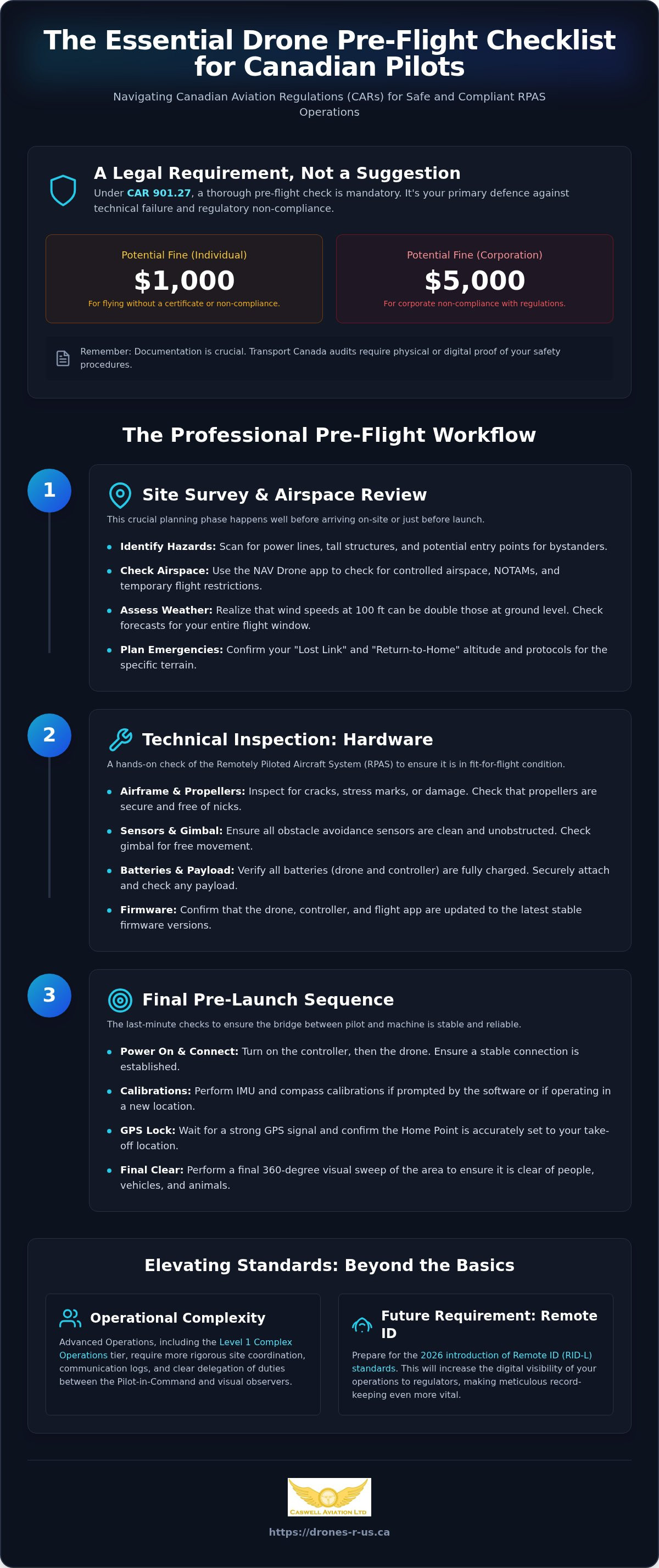
Would you risk a $5,000 personal fine or a catastrophic equipment failure just to save five minutes on the ground? In the current aviation environment, maintaining a rigorous drone pre-flight checklist Canada isn't just a professional habit; it's a legal requirement under CAR 901.27. We understand that the pressure to stay compliant can be daunting, especially with the 2026 introduction of Remote ID (RID-L) standards and the new Level 1 Complex Operations certification tier.
It's common to feel a sense of anxiety regarding shifting airspace permissions or the technical health of your aircraft. You want to focus on the mission at hand, whether that involves precision agriculture or industrial inspections, without the lingering fear of a Transport Canada audit. This guide provides the steady, repeatable workflow you need to eliminate guesswork and reduce the risk of a crash. We will detail the exact steps for technical inspections, NAV CANADA coordination, and the specific regulatory updates that every professional pilot must realize to remain safely and legally in the air.
Key Takeaways
- Realize the legal necessity of a drone pre-flight checklist Canada as your primary defence against regulatory non-compliance and Transport Canada fines.
- Identify critical environmental hazards through a structured site survey, focusing on power lines, tall structures, and bystander safety zones.
- Execute a professional hardware inspection to detect structural anomalies and ensure all sensors are clear for optimal obstacle avoidance.
- Implement a methodical final pre-launch sequence, including IMU and compass calibrations, to ensure the bridge between pilot and machine remains stable.
- Elevate your operational standards by integrating formal training and professional flight reviews into your long-term safety and compliance strategy.
Understanding the Legal Requirement for RPAS Pre-Flight Checklists in Canada
Operating a Unmanned Aerial Vehicle (UAV) in Canadian airspace involves more than technical skill; it requires strict adherence to a regulated safety culture. Many pilots view a drone pre-flight checklist Canada as a helpful tool for beginners, but this is a misconception. In Canada, maintaining a pre-flight checklist is a mandatory legal requirement under CAR 901.27. This regulation ensures every flight begins with a systematic verification of equipment and environment. It acts as your primary defence against technical failure and regulatory non-compliance. Failing to follow these procedures doesn't just risk your gear; it exposes you to significant liability and potential grounding.
Documentation is a critical component of professional flight operations. During a Transport Canada audit, verbal assurances carry no weight. You must provide physical or digital proof of your safety procedures and site assessments. This record-keeping demonstrates that you've fulfilled your duty of care as a pilot. With fines for flying without a certificate reaching $1,000 for individuals or $5,000 for corporations, the cost of being unorganized is high. A standardized process also helps minimize complacency, which remains a leading cause of pilot error. Even seasoned professionals can overlook a loose propeller or a shifting wind pattern without a written prompt to verify them.
Transport Canada Regulations and CAR 901.27
CAR 901.27 serves as the mandate for operational safety and equipment airworthiness. Pilots must ensure the RPAS is in a fit-for-flight condition before every take-off. This involves more than a quick glance at the airframe. You're required to record specific site survey data and current weather conditions. These variables directly impact the safety of the flight path and the stability of the aircraft. By documenting these factors, you create a verifiable trail of professional due diligence. This becomes especially important as Remote ID (RID-L) standards become the norm in 2026, increasing the visibility of your operations to regulators and the public alike.
Basic vs. Advanced Operational Requirements
Operational complexity dictates the depth of your pre-flight routine. Advanced operations, including the Level 1 Complex Operations tier introduced for lower-risk BVLOS flights, require more rigorous site coordination and communication logs. The Pilot-in-Command (PIC) holds ultimate responsibility but may delegate specific checklist duties to visual observers. This delegation must be clear and recorded to maintain the chain of command. For pilots looking to transition from hobbyist levels to professional work, understanding these nuances is essential. You can find more details in our guide on Transport Canada drone certification. This transition requires a deeper commitment to the administrative side of aviation to ensure every flight remains within the bounds of the law.
Conducting a Professional Site Survey and Airspace Review
A professional flight begins long before the propellers spin. The site survey represents the centre of your operational planning. It is a distinct phase from the final pre-launch check. During this stage, you must identify physical hazards such as power lines, tall structures, and potential bystander entry points. This spatial awareness allows you to define your flight boundaries and safety buffers. Establishing these parameters is a core component of any drone pre-flight checklist Canada, ensuring that you remain in control of the environment as much as the aircraft.
Establishing emergency procedures is a critical part of this review. You need to confirm your "Lost Link" and "Fly-away" protocols based on the specific terrain of your mission. For instance, a return-to-home altitude that works in a flat field may be insufficient in a forested area or an urban environment with varying building heights. Weather assessment is equally vital. You must realize that wind speeds at 100 feet are often double those measured at ground level. This gradient can significantly impact your battery endurance and flight stability.
Utilizing NAV Drone and Airspace Maps
Digital tools are indispensable for modern airspace management. You must check for controlled airspace and active NOTAMs (Notice to Airmen) using the official NAV Drone app. This tool provides real-time data on temporary flight restrictions and multi-RPAS activities. Identifying nearby aerodromes or heliports is mandatory. These locations may require direct coordination or monitoring of specific radio frequencies to ensure deconfliction with manned aircraft. Following the standards found in the Transport Canada Flight Reviewer's Guide helps ensure your planning meets national aviation requirements.
Assessing Environmental and Weather Conditions
Environmental factors extend beyond simple rain or snow. You should verify the K-Index to assess geomagnetic activity. High K-Index values can cause unpredictable interference with GPS and compass signals, leading to positioning errors. For professional operations, check local METARs or TAFs to confirm cloud ceiling heights and visibility. These reports ensure you can maintain Visual Line of Sight (VLOS) throughout the mission. Battery health is also temperature-dependent. Ensure the ambient air temperature is within the operating range for your lithium-polymer (LiPo) batteries to prevent sudden voltage drops.
Executing a thorough drone pre-flight checklist Canada builds a foundation of safety that protects your equipment and your reputation. If you are looking to refine these skills in a practical setting, our in-person training offers hands-on experience with these professional workflows.
Technical Inspection: Preparing Your RPAS Hardware for Flight
A physical inspection requires a tactile approach to detect structural anomalies that a visual scan might miss. You must touch the airframe and feel for hairline fractures or loose components. This hands-on method is a core part of a professional drone pre-flight checklist Canada. While performing these checks, you should also clean all sensors and camera lenses using a clean microfibre cloth. Dust or fingerprints on obstacle avoidance sensors can lead to erratic flight behaviour or mission failure. Similarly, verify that gimbals and filters are securely locked and balanced to prevent unnecessary motor strain. Your MicroSD card requires attention as well; ensure it's formatted and has sufficient capacity to store the data for your specific mission. Referencing NRC's Drone Pre-Flight Checklist can provide a standardized baseline for these technical requirements.
Battery Management and Power Systems
Lithium-polymer (LiPo) batteries are the lifeblood of your RPAS and require careful handling. Inspect each battery for swelling, often called "puffiness," or any physical damage to the outer casing. A swollen battery indicates internal degradation and poses a significant fire risk. Check the battery terminals for any signs of debris or carbon buildup that could impede a clean power connection. Verify that battery levels are at 100% and that all cells are balanced within your flight application. Unbalanced cells can lead to sudden voltage drops during flight. Finally, confirm that the battery is seated firmly in the drone. You should hear an audible click to ensure the latch is fully engaged and won't dislodge during high-speed manoeuvres.
Structural Integrity and Propeller Maintenance
Propellers are high-stress components that demand frequent replacement. Examine each blade for nicks, chips, or stress whitening near the hub. Stress whitening appears as a pale mark on the plastic and indicates the material is close to failing. Even small imperfections can cause aerodynamic imbalance. Check the motor mounts and arm hinges for any play or looseness that could cause excessive vibration. Vibration reduces flight efficiency and can interfere with sensitive IMU readings. Inspect the landing gear for stability and ensure any retractable components function smoothly. Spin each motor manually to listen for grit or bearing noise. Maintaining a consistent drone pre-flight checklist Canada is the only way to guarantee hardware reliability over time.
The Final Pre-Launch Sequence: Controller and Software Calibration
Once you've verified the structural integrity of your aircraft, the focus shifts to the bridge between pilot and machine. This phase of the drone pre-flight checklist Canada ensures that internal sensors and communication links function within optimal parameters. You must calibrate the Inertial Measurement Unit (IMU) and compass if prompted by the flight software or whenever you move to a new flight location. These sensors are sensitive to electromagnetic interference and local magnetic variations. A misaligned compass can lead to "toilet bowling" or loss of directional control. Setting your Return to Home (RTH) altitude is a critical decision. It's vital that it's high enough to clear the tallest obstacle in your immediate area, including trees and power lines, plus a safety buffer of at least 5 to 10 metres. Finally, verify your signal strength. If you're in an urban environment, manually select the least congested frequency to maintain a stable video downlink.
Firmware Updates and Signal Strength Checks
A robust drone pre-flight checklist Canada also includes managing your digital ecosystem. Field updates are a common source of frustration and mission delays. Ensure all firmware updates for the drone, controller, and batteries were completed at home using a stable internet connection. Once on-site, check that the "Home Point" has been updated and appears accurately on your map view. This verification ensures the aircraft knows exactly where to return if a link is lost. You should also confirm your failsafe settings. Depending on your mission profile, you'll choose for the drone to hover, land, or return to home upon signal loss. Professional pilots realize that these settings aren't "set and forget" but must be adjusted for every unique site survey.
Pilot Ergonomics and Controller Readiness
Technical readiness extends to the pilot. Maintaining a clear visual line of sight (VLOS) requires you to position yourself to avoid screen glare and physical obstructions. Using a drone harness for smart controller is a professional standard that reduces neck strain and improves control precision. Fitek Gear harnesses are the preferred choice for pilots who realize that physical comfort directly impacts flight safety during long, complex missions. This ergonomic support allows for steady stick movements and better situational awareness. When you're comfortable, your reactions are faster and your inputs are more precise. To equip yourself with professional-grade gear, browse our selection of Fitek Gear harnesses and enhance your operational readiness.
Elevating Safety Standards with Professional Training and Equipment
Safety is not a static state; it is a skill that requires consistent practice through formal education and regular flight reviews. While a drone pre-flight checklist Canada provides the necessary structure, your ability to execute it effectively depends on your training and the quality of your equipment. Professionalism in the RPAS industry is defined by a commitment to these standards. As you move from Basic to Advanced operations, the complexity of your site surveys and technical checks increases. This transition demands a deeper understanding of the regulatory framework and a higher level of operational discipline. A professional checklist is a living safety culture. It is not just a piece of paper; it balances your regulatory duty with technical precision.
Caswell Aviation provides the framework to move from a hobbyist to a compliant, professional RPAS pilot. By combining rigorous training with high-quality gear, you ensure that every flight is conducted with precision and care. We offer the expertise needed to navigate the evolving Canadian regulations, including the 2026 Remote ID requirements. Implementing a comprehensive drone pre-flight checklist Canada is the first step toward that goal, but the true foundation is built on professional mentorship and reliable hardware.
Transitioning to Advanced RPAS Certification
An Advanced & Level 1 Complex Flight Review serves as more than a regulatory hurdle. It validates your ability to follow safety checklists under pressure and in complex environments. Professional mentorship plays a vital role in this process. A seasoned reviewer can help you identify subtle safety risks that an automated app or a basic checklist might overlook. These nuanced observations are what separate a veteran pilot from a novice. We encourage pilots to book a flight review to unlock the full potential of their commercial operations. This step ensures you are fully prepared for the responsibilities of a professional Pilot-in-Command (PIC) in 2026 and beyond.
Professional Pilot Gear for Field Operations
Pilot readiness includes the physical ability to maintain focus throughout a mission. Fitek Gear harnesses are an essential component of a professional pilot's kit. These ergonomic tools ensure proper weight distribution. This prevents the neck strain and physical fatigue that often lead to control errors during long assignments. When your controller is securely supported, you can focus entirely on the flight checklist and the aircraft's telemetry. Precision is the goal. This reduction in physical burden allows for a more methodical approach to safety. Proper gear is a safety feature; it is just as important as your propellers or your GPS signal.
Explore our professional drone courses and gear at Caswell Aviation to elevate your operational standards and ensure full regulatory compliance.
Mastering the Professional Flight Standard in 2026
Adopting a meticulous drone pre-flight checklist Canada is the most effective way to transition from basic operation to professional mastery. By prioritizing CAR 901.27 compliance and conducting thorough technical inspections, you protect your equipment and your standing with Transport Canada. We have explored how environmental awareness and pilot ergonomics contribute to a safe mission profile. These habits reduce the risk of accidents and ensure that you remain prepared for the complexities of modern airspace.
As national drone training leaders and authorized Fitek Gear retailers, we're here to support your growth. Our team consists of Transport Canada Advanced and Level 1 Complex experts who understand the nuances of high-stakes flight operations. Whether you're refining your site survey process or upgrading your field gear, professional guidance ensures you stay ahead of regulatory changes. Take the next step in your aviation career and book your Transport Canada Advanced Flight Review with Caswell Aviation today. Every safe flight begins with a disciplined start on the ground. We look forward to seeing you in the air.
Frequently Asked Questions
Is a written pre-flight checklist required by law in Canada?
Yes, a written or digital pre-flight checklist is a mandatory requirement under Canadian Aviation Regulation 901.27. You must ensure the aircraft is in a fit-for-flight condition before every take-off. While the law does not dictate the exact format, you must be able to produce evidence of your safety procedures if requested by a Transport Canada inspector. This documentation serves as proof that you have performed due diligence for every mission.
How long should a professional drone pre-flight checklist take to complete?
A thorough pre-flight process typically takes between 10 and 15 minutes for standard commercial missions. This timeframe allows you to conduct a physical hardware inspection, verify airspace through NAV Drone, and calibrate internal sensors. Rushing this sequence increases the risk of technical failure or regulatory oversight. Complex operations involving multiple payloads or advanced flight paths may require additional time for coordination and safety briefings.
What happens if I fly my drone without conducting a site survey?
Flying without a site survey is a violation of CAR 901.27 and can result in fines up to $1,000 for individuals or $5,000 for corporations. Beyond the legal penalties, you risk hitting unidentified hazards like power lines or entering restricted airspace. A site survey identifies local obstacles and bystanders, which is essential for maintaining safety. Skipping this step often leads to insurance claim denials if an accident occurs.
Can I use a mobile app as my only pre-flight checklist?
You can use a mobile app as your primary drone pre-flight checklist Canada, provided it captures all data required by Transport Canada. Many professional pilots use digital tools to log weather conditions, battery health, and airspace authorizations simultaneously. However, you should always have a physical backup or an offline version available. This ensures you can complete your safety protocols even in areas with poor cellular reception or during device failure.
What are the most common things pilots forget on their checklist?
Pilots frequently overlook formatting their MicroSD cards or updating the Return to Home (RTH) altitude for the current terrain. Another common omission is checking propellers for micro-cracks or stress whitening near the hub. These small details can lead to mission failure or aircraft damage if not caught on the ground. Including administrative items like verifying your pilot certificate is on your person can also prevent legal complications during an audit.
Do I need a different checklist for Advanced vs. Basic operations?
Advanced operations require a more detailed checklist that includes communication logs with air traffic control and coordination with visual observers. While the hardware inspection remains similar, the administrative and airspace requirements for Advanced missions are more stringent. You must record specific authorizations and ensure all team members are briefed on emergency procedures. Using a modular checklist allows you to scale your safety protocols based on the complexity of the flight.
What should I do if my drone fails a checklist item in the field?
You must ground the aircraft immediately if any item on your checklist fails the inspection. Never attempt to fly through a sensor error or structural issue. Professional pilots carry basic spare parts, such as propellers and extra batteries, to resolve minor issues on-site. If the problem involves internal hardware or software instability, the mission must be postponed until the aircraft is repaired and verified in a controlled environment.
How often should I update my drone's pre-flight checklist?
You should review and update your drone pre-flight checklist Canada whenever you introduce new equipment, update firmware, or when Transport Canada modifies aviation regulations. For example, the 2026 Remote ID (RID-L) requirements necessitated updates to many professional workflows. Periodic reviews ensure that your procedures remain relevant to your current mission profiles. Treating your checklist as a living document helps maintain a high standard of safety and keeps your operations fully compliant.
Leave a comment