

Drone Services for Business in Canada: The 2026 Professional Buying Guide
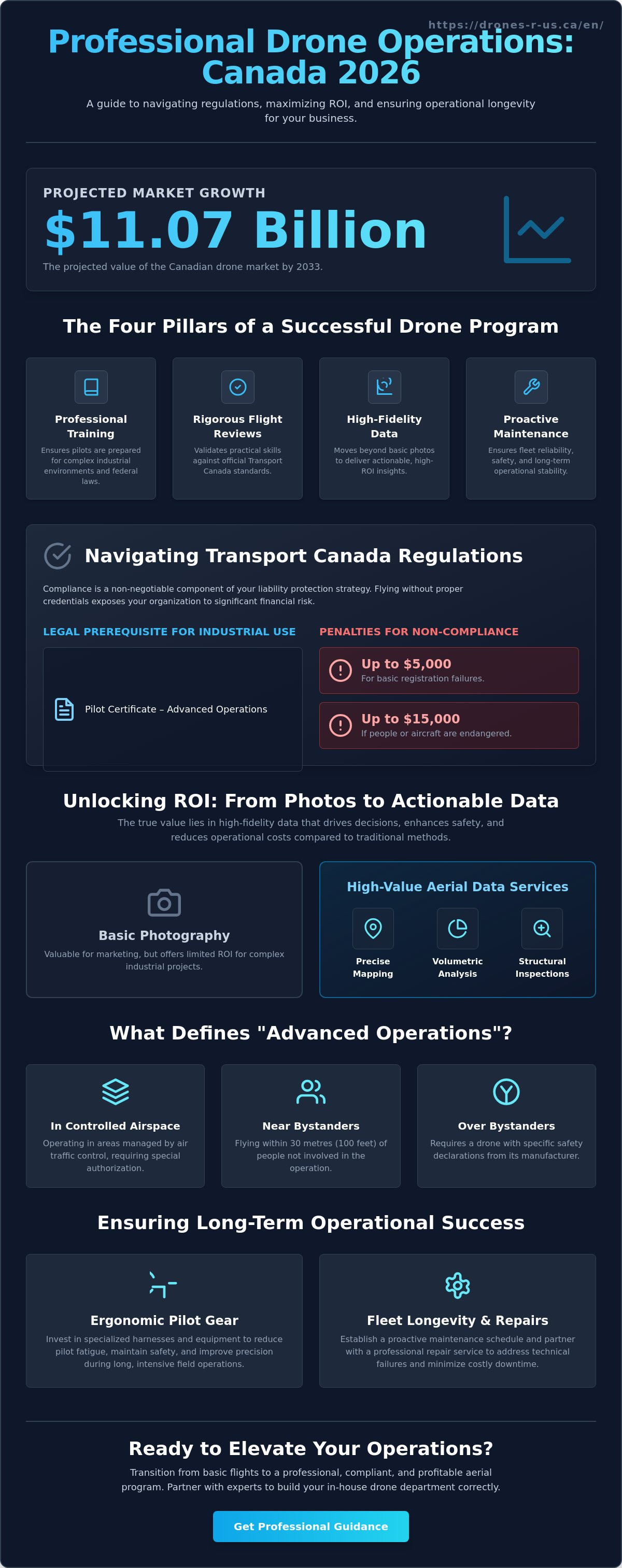
By 2033, the Canadian drone market is projected to reach $11.07 billion, yet many organizations still treat aerial technology as a peripheral tool rather than a regulated aviation asset. Investing in drone services for business Canada requires more than just purchasing hardware. It demands a disciplined approach to safety, compliance, and data integrity that mirrors traditional aviation standards.
You likely recognize that the potential for high-quality aerial mapping is immense, but the complexity of Transport Canada's RPAS regulations often creates a barrier to entry. It's frustrating to manage the fear of investing in the wrong equipment or worrying about pilot fatigue during intensive field operations. You need a reliable system that guarantees both legal standing and measurable business growth.
This 2026 professional buying guide simplifies the transition from basic flight to advanced industrial operations. We will outline the requirements for obtaining Advanced RPAS certification, explain how to secure high-quality data for construction and mapping, and detail the maintenance protocols necessary for a reliable fleet. You'll gain the technical authority needed to lead your team with the precision of a seasoned flight professional.
Key Takeaways
- Understand the 2026 RPAS regulatory landscape to ensure your organization remains compliant while transitioning to professional flight standards.
- Compare online and in-person training options to efficiently secure Advanced certifications and flight reviews for your operational team.
- Recognize the importance of ergonomic pilot gear, such as specialized harnesses, in maintaining safety and precision during complex drone services for business Canada.
- Identify how to move beyond basic photography to leverage high-quality aerial data that provides measurable returns for construction and mapping projects.
- Develop a strategy for fleet longevity by identifying common technical failures and establishing a reliable partnership for professional drone repairs.
Navigating Commercial Drone Services for Business in Canada
The Canadian RPAS landscape in 2026 is characterized by a mature regulatory framework and a significant shift toward industrial integration. Operating an Unmanned aerial vehicle (UAV) for commercial purposes now requires a level of discipline once reserved for traditional pilots. This transition from hobbyist roots to professional drone services for business Canada reflects a broader move toward safety and precision in national airspace.
A successful drone program is built on four functional pillars: professional training, rigorous flight reviews, high-fidelity data acquisition, and proactive maintenance. Relying on a "plug-and-play" approach is no longer viable for organizations that value risk mitigation. It's better to treat your drone fleet as a specialized aviation department that requires ongoing oversight and technical proficiency. This structured ecosystem ensures that your operations remain stable and productive over the long term.
The Role of Transport Canada in Your Business Strategy
Transport Canada serves as the primary governing body, ensuring that every commercial flight meets established safety thresholds. Obtaining a Pilot Certificate for Advanced Operations is a legal prerequisite for most industrial applications. This certification isn't just a piece of paper; it's a vital component of your liability protection strategy. Flying without the proper credentials exposes your corporation to fines of up to $5,000 for basic registration failures and up to $15,000 if people or aircraft are endangered. By prioritizing compliance, you protect your business from legal repercussions and ensure your team is prepared for complex environments.
Identifying High-Value ROI in Drone Applications
Modern drone applications have evolved far beyond basic photography. While "pretty pictures" have their place in marketing, the real return on investment lies in specialized data services. Modern sensors allow for precise mapping, volumetric stockpile analysis, and structural inspections that are safer and faster than traditional ground-based methods. This data enables project managers to identify site issues before they become costly delays.
In the context of Canadian aviation law, Advanced Operations are defined as flight activities conducted within controlled airspace, within 30 metres of bystanders, or directly over them, provided the drone meets specific safety declarations.
Comparing the costs of drone services to traditional surveying reveals a clear advantage in speed and data density. A drone can capture millions of data points in a single flight, providing a level of detail that ground crews would take days to replicate. This efficiency allows for more frequent site updates, which keeps stakeholders informed and projects on schedule. Transitioning to aerial data acquisition is a practical step toward modernizing your industrial workflow.
Choosing the Correct Drone Certification and Training Program
Selecting a training provider is a critical decision for any organization integrating drone services for business Canada. You aren't just purchasing a curriculum; you're investing in your team's ability to operate safely within a complex national airspace. The path to professional competency requires a strategic mix of theoretical knowledge and practical skill that aligns with current aviation standards. A well-organized training program ensures your pilots are prepared for the technical demands of industrial sites while remaining compliant with federal laws.
To build a resilient aerial department, you must evaluate how a course manages the transition from basic flight safety to advanced airspace management. Effective training should provide a clear roadmap for your staff, moving them from novice status to certified professionals who can handle high-stakes environments. This structured approach minimizes the risk of accidents and protects your capital investment in hardware.
Online Drone Courses: Flexibility for Busy Professionals
For many organizations, the primary hurdle to certification is the time required for ground school. Online drone courses provide a self-paced solution that allows your team to master theoretical concepts without neglecting their daily responsibilities. These programs should cover essential modules such as meteorology, navigation, and flight theory. Understanding how weather patterns affect flight stability is just as important as knowing which buttons to press on the controller. You can find a detailed breakdown of these requirements in The Complete Guide to Transport Canada Drone Certification in 2026, which serves as a baseline for your educational planning.
In-Person Drone Courses: Mastering the Practical Flight
While online learning handles the "why," in-person training focuses on the "how." Hands-on instruction is indispensable when preparing for complex industrial manoeuvres, such as close-proximity inspections or mapping in high-interference areas. Professional instructors provide real-time feedback that a digital interface cannot replicate. This mentorship is vital for successfully navigating Transport Canada drone regulations during the mandatory flight review. Practical sessions allow pilots to practice emergency procedures in a controlled environment, ensuring they remain calm during actual field failures. Reviewing our online drone courses and in-person training options will help you determine which format best suits your operational timeline.
Organizing a training schedule doesn't have to disrupt your business operations. Many successful firms utilize a "train-the-trainer" model or schedule practical flight reviews in blocks to maximize efficiency. By treating certification as a professional development milestone, you foster a culture of discipline and safety. This veteran approach to training ensures that when your team deploys for drone services for business Canada, they do so with the confidence of seasoned aviators.
Optimizing Field Operations: A Pilot’s Gear Buying Guide
Field operations represent the execution phase of any professional aerial program. While much focus is placed on the aircraft itself, the efficiency of your drone services for business Canada often depends on the physical readiness of the pilot. Ergonomics are a safety requirement, not a luxury. Long-duration inspections and mapping missions require sustained focus, and any physical strain directly impacts the quality of the data collected. Organizations like the Aerial Evolution Association of Canada emphasize the importance of professional standards in commercial flight, which includes the physical stability of the operator.
Pilot fatigue is a significant risk factor in long field operations. When a pilot is physically tired, their reaction times slow and their ability to make precise controller inputs diminishes. Reducing this strain ensures consistent data quality across various project sites. Investing in gear that supports the pilot's body allows for longer mission windows and more reliable results. This disciplined approach to equipment selection mirrors the standards found in traditional aviation sectors.
Fitek Gear Drone Harnesses for Smart Controllers
Professional pilots often prefer Fitek Gear Drone Harnesses for Smart Controllers because they redistribute the weight of the hardware across the torso. Standard neck straps concentrate the load on the cervical spine, which causes discomfort and limits mobility during multi-hour flights. In contrast, a full-body harness stabilizes the controller against the pilot's chest, providing a fixed platform for fine-tuned adjustments. This stability is crucial for Level 1 Complex flight precision, where maintaining a steady hover or a perfect flight line is mandatory. Fitek Gear harnesses realize better pilot control during high-wind scenarios by preventing the controller from shifting unexpectedly.
Essential Field Accessories for Canadian Climates
Operating in the Canadian wilderness requires specialized transport and storage solutions. Protecting your investment from moisture, dust, and impact is essential for maintaining fleet readiness. Professional-grade cases with custom foam inserts ensure that sensors and gimbals remain calibrated during transit over rough terrain. Battery management is another critical factor, especially in cold-weather operations where capacity can drop rapidly. Using insulated battery bags and maintaining a strict charging rotation helps prevent mid-flight power failures. These practical considerations ensure that your equipment remains functional regardless of the environment, allowing you to deliver reliable drone services for business Canada in any season.
Maximizing ROI with Specialized Aerial Imagery and Data Services
The value of drone services for business Canada is often misunderstood as simple visual capture. While high-resolution imagery is a core component, the true return on investment stems from how that data is processed and integrated into your operational workflow. Choosing between raw imagery and processed analytical data depends on your specific project goals. Raw photos are useful for quick visual inspections. Processed data sets like point clouds and orthomosaics provide the precision required for engineering and architectural standards. This distinction is critical for businesses that need to realize measurable growth from their aerial investments.
Successful integration requires moving beyond "pretty pictures" to functional data assets. Professional drone services provide the bridge between field operations and the office. By capturing data that is compatible with existing BIM and CAD workflows, drones allow for a seamless transition from site capture to digital analysis. This methodical approach ensures that every flight contributes directly to the project's bottom line.
The Power of Drone Mapping and Stockpile Analysis
Photogrammetry allows professionals to transform hundreds of individual aerial images into measurable 3D models. This process is particularly valuable for construction and mining firms that are centring their progress tracking on drone technology. By utilizing precise flight paths, drones capture overlapping data that can be used to calculate volume for inventory management with high accuracy. This replaces traditional, manual surveying methods that are often slower and more hazardous for ground crews. Integrating this information directly into site management software ensures that stakeholders have a real-time digital twin of their project. You can Explore our full range of professional drone services to see how these mapping solutions fit your specific industry needs.
Professional Aerial Photography and Video Solutions
High-quality visual assets remain essential for real estate and corporate branding. Capturing cinematic video requires more than just a high-end sensor; it demands a pilot who understands framing, lighting, and Canadian aviation safety protocols. Professional drone services for business Canada deliver high-resolution commercial imagery that meets the technical requirements for large-format printing and digital marketing. These assets serve as powerful tools for stakeholder presentations and investor relations, providing a perspective that traditional ground-based photography cannot achieve. If you are looking to elevate your brand, consider our specialized drone aerial photography and video services to capture your next project from the air.
Whether you are managing a massive construction site or marketing a luxury property, the quality of your aerial data is paramount. High-resolution sensors and stabilized gimbals ensure that every frame is sharp and every data point is accurate. This commitment to technical excellence allows your business to make informed decisions based on reliable, professional-grade information.
Ensuring Operational Longevity: Drone Repairs and Expert Support
Maintaining a fleet for drone services for business Canada is a significant capital commitment that requires a proactive approach to hardware health. You shouldn't wait for a failure to occur during a critical mission before seeking technical assistance. Professional fleet managers realize that operational longevity depends on a disciplined maintenance schedule. By treating your aircraft as high-precision aviation assets rather than disposable electronics, you protect your investment and ensure your team remains productive in the field.
Commercial drones face immense physical stress, particularly during long-duration industrial missions. Common failures typically occur in three areas: sensors, gimbals, and motors. Sensors can drift out of calibration over time, leading to inaccurate data. Gimbals are delicate mechanical systems that are prone to damage from vibrations or minor impacts. Motors eventually wear out after hundreds of flight hours. Identifying these issues early prevents costly downtime and ensures that your aerial data remains reliable for your clients.
DJI Drone Repair: Professional Service vs. DIY
While DIY repairs might seem cost-effective, they carry significant risks for certified commercial aircraft. Unauthorized repairs can void warranties and, more importantly, may result in an aircraft that no longer meets Transport Canada safety standards. Professional DJI drone repair expertise is critical for ensuring that every component is installed and calibrated according to factory specifications. Technicians utilize specialized diagnostic tools to verify flight controller integrity and sensor accuracy. Turnaround times for professional servicing generally depend on parts availability, but established firms often prioritize commercial clients to minimize operational disruptions. Keeping your equipment in peak condition is a fundamental requirement for maintaining your Advanced RPAS standing.
Building a Long-Term Partnership with Caswell Aviation Ltd
A sustainable business unit is built on more than just hardware. It requires an integrated strategy that combines professional training, ergonomic gear, and reliable technical support. This holistic approach ensures that your drone services for business Canada remain stable and profitable as the industry evolves. By partnering with a provider that understands the technical and regulatory nuances of the Canadian market, you gain a veteran mentor for your entire flight department. We can help you customize a service package that addresses the unique demands of your specific industry. Book your flight review or browse our professional services today to secure the future of your aerial operations.
Securing Your Competitive Edge in Canadian Airspace
Building a successful drone program requires a commitment to aviation standards and technical discipline. You now understand that navigating the regulatory landscape is just the beginning. True operational excellence comes from integrating Advanced RPAS certifications with ergonomic field gear and high-fidelity data acquisition. By treating your fleet as a professional aviation department, you ensure that your investment in drone services for business Canada delivers consistent, measurable returns.
Our team is dedicated to supporting your growth as a veteran practitioner in the industry. As a Transport Canada Advanced and Level 1 Complex Certified provider, we offer the technical expertise your team needs to stay compliant. Whether you require a specialized Fitek Gear retailer for ergonomic solutions or a professional DJI Drone Repair Centre to maintain your fleet, we provide the holistic support required for long-term success.
Shop our professional drone courses and services today to begin your transition toward professional-grade aerial operations. Your team is ready to lead the way in Canadian industrial innovation.
Frequently Asked Questions
Do I need a special license for drone services for business in Canada?
Yes, you need a Pilot Certificate – Small Remotely Piloted Aircraft (VLOS) issued by Transport Canada. For most professional drone services for business Canada, you'll specifically require the Advanced Operations certificate. This credential ensures you can legally operate in controlled airspace and near bystanders, which is a common requirement for industrial and urban job sites.
What is the difference between Basic and Advanced drone certification?
Basic certification is restricted to flights in uncontrolled airspace at least 30 metres away from bystanders. Advanced certification allows you to fly in controlled airspace, such as near airports, and closer than 30 metres to people. Most professional applications, including construction and infrastructure inspections, require the Advanced certificate to ensure full operational flexibility and legal compliance.
How much does a professional drone flight review cost in Canada?
Fees for flight reviews are set by independent third-party reviewers and vary depending on your location and the provider. While Transport Canada doesn't regulate these specific professional fees, you'll typically pay for the reviewer's time and technical evaluation. It's best to check with your local training centre to confirm current market rates in your specific region.
Can drones really provide accurate stockpile measurements for construction?
Drones provide highly accurate volumetric measurements by utilizing photogrammetry to turn aerial images into measurable 3D models. This technology allows construction firms to calculate inventory volumes with a level of precision that often surpasses traditional ground-based surveying. It's a faster, safer, and more cost-effective way to manage site materials without disrupting active ground operations.
Why should my business invest in a Fitek Gear harness for our pilots?
A Fitek Gear harness is an essential safety tool that redistributes the weight of a smart controller across the pilot's torso. Standard neck straps cause significant cervical strain during long-duration missions, which can lead to pilot fatigue and reduced precision. By providing a stable platform, the harness allows for finer controller inputs and more consistent data quality during complex flights.
What happens if my commercial DJI drone crashes during an operation?
If a crash occurs, you should immediately ground the aircraft and seek a professional diagnostic from a specialized DJI repair centre. Attempting unauthorized DIY repairs on a commercial aircraft can compromise its safety declarations and your legal standing with Transport Canada. Professional technicians ensure that every sensor and motor is calibrated to factory standards before the drone returns to service.
How long does it take to complete an Online Drone Course for Advanced certification?
Most professionals complete the ground school portion of an Online Drone Course in approximately 15 to 20 hours of study. These programs are designed to be self-paced, allowing your team to master complex subjects like meteorology and flight theory without disrupting their daily work. Once the online modules are finished, pilots are prepared to challenge the Transport Canada exam and schedule their flight review.
Are drone services for business available throughout all of Canada?
Professional drone services for business Canada are available nationwide, provided the pilot holds the correct certification for the specific airspace. Operations in remote northern regions or busy metropolitan centres simply require different levels of flight planning and regulatory coordination. As long as you follow Transport Canada's framework, you can deploy aerial technology in any province or territory.
Leave a comment