
Level 1 Complex Flight Review in Alberta: The 2026 Professional Guide
The jump from Advanced operations to a Level 1 Complex certification isn't just a minor upgrade; it's a total shift in professional accountability. If you're looking to secure an Advanced drone flight review that professionals across Canada can trust, you've likely realized that the 2026 regulatory environment demands more than just stick skills. It's natural to feel some pressure when facing new BVLOS safety standards and the detailed RPAS Operator Certificate (RPOC) requirements. You've worked hard to build your current flight hours, so the prospect of navigating complex Transport Canada updates can feel like a daunting hurdle.
This guide ensures you master every preparation step required to successfully pass your Level 1 Complex flight review. We'll cover the essential prerequisites, including the 20-hour ground school requirement and the C$50 exam fee, while providing a clear roadmap for your practical assessment. By the end of this article, you'll have a structured plan to achieve your Pilot Certificate for Level 1 Complex Operations and advance your career in the Canadian RPAS industry. Our focus is on providing the technical authority and grounded advice you need to transition into lower-risk BVLOS missions with confidence.
Key Takeaways
- Identify how Level 1 Complex operations enable lower-risk Beyond Visual Line of Sight (BVLOS) flights and expand your commercial service offerings.
- Follow a precise checklist of prerequisites, including the mandatory 20-hour ground school and a valid Advanced Pilot Certificate, before scheduling your review.
- Master the specific practical exercises and safety demonstrations required to pass your Advanced drone flight review Alberta with confidence.
- Learn why professional pilots prioritize ergonomic equipment like Fitek Gear harnesses to manage fatigue during high-stakes complex missions.
- Understand the final regulatory steps to secure your RPAS Operator Certificate (RPOC) and maintain compliance with Transport Canada's 2026 standards.
Understanding Level 1 Complex Operations in Alberta
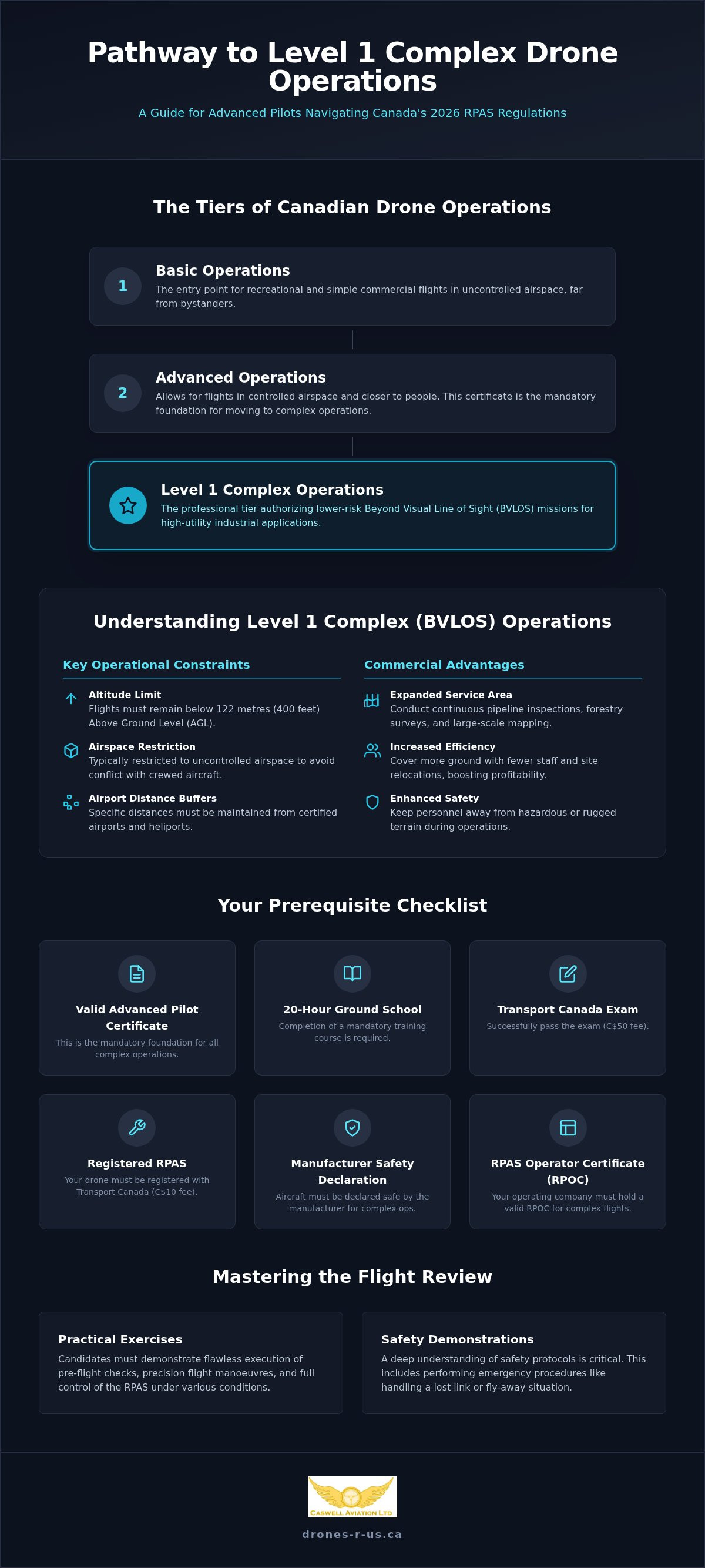
The Canadian RPAS regulatory framework categorizes drone flights based on the level of risk to people on the ground and other aircraft. Basic operations serve as the entry point, while Advanced operations allow for flight in controlled airspace and closer to bystanders. Level 1 Complex operations represent a professional tier that specifically authorizes lower-risk Beyond Visual Line of Sight (BVLOS) missions. This certification is vital for pilots who need to operate beyond their natural line of sight without the constant administrative burden of a Special Flight Operations Certificate (SFOC).
Alberta has solidified its position as a primary hub for these missions in 2026. The province's vast stretches of unpopulated and sparsely populated land provide the ideal environment for industrial Unmanned aerial vehicle (UAV) applications. From monitoring critical infrastructure in the oil sands to surveying remote forestry blocks, the ability to fly BVLOS is a fundamental requirement for modern operational efficiency. Successfully completing an Advanced drone flight review Alberta professionals facilitate is the bridge between standard visual operations and these high-utility complex missions.
The Scope of Lower-Risk BVLOS
Level 1 Complex operations are typically restricted to uncontrolled airspace to ensure that lower-risk BVLOS flights do not interfere with crewed aviation in high-traffic corridors. These missions involve small or medium RPAS and adhere to strict safety parameters. Key operational constraints include:
- Altitude Limits: All flights must remain below 122 metres (400 feet) above ground level to maintain separation from traditional aircraft.
- Distance Requirements: Operations must maintain specific buffers from certified airports and heliports to ensure regional air safety.
- Safety Declarations: Pilots must utilize hardware that has a manufacturer's safety declaration pre-validated for complex operations.
These rules prioritize safety while allowing for expanded range. Pilots must demonstrate a deep understanding of these boundaries during their practical assessment to ensure every flight remains within the legal and safety framework defined by Transport Canada.
Commercial Advantages of Complex Certification
The primary advantage of securing a Level 1 Complex certification is the significant expansion of service areas. Standard Advanced operations require the pilot or a visual observer to maintain constant sight of the aircraft, which often necessitates multiple launch points during a single day of work. Complex certification removes this bottleneck. This allows for continuous pipeline inspections, forestry surveys, and large-scale agricultural mapping without the need for frequent site relocations.
In the Alberta energy sector, there is a growing demand for pilots who can conduct long-range environmental monitoring and stockpile analysis. By reducing the operational footprint and the number of staff required on-site, companies can cover more ground more efficiently. This transition not only increases profitability but also enhances safety by keeping personnel away from hazardous or rugged terrain. Professional advancement in this field starts with mastering the transition from Advanced to Complex standards at Caswell Aviation.
Prerequisites for the Level 1 Complex Flight Review
Before booking your Advanced drone flight review Alberta session, you must meet specific regulatory benchmarks. The Level 1 Complex certification builds directly upon the Advanced framework. You cannot skip steps; a valid Advanced Pilot Certificate is the mandatory foundation. This ensures you already possess the core competencies required for controlled airspace and bystander safety before moving into the high-stakes world of Beyond Visual Line of Sight (BVLOS) operations.
Ensure your equipment is ready for the assessment. Your drone must be registered with Transport Canada, which involves a C$10 fee. Crucially, the aircraft must have a manufacturer's safety declaration specifically for Level 1 Complex operations. Without this declaration, the aircraft cannot legally be used for BVLOS missions, regardless of your individual pilot qualifications. Verifying this compatibility early prevents administrative delays on the day of your review.
The RPAS Operator Certificate (RPOC)
Many pilots confuse their individual pilot certificate with the RPOC. While your pilot certificate proves your personal competency, the RPOC is the organizational licence required to conduct Complex operations. It establishes a formal framework for liability and operational oversight. If you're an independent contractor, you'll need to apply for your own RPOC, which carries a C$125 fee. If you're an employee, you must be officially added to your company's existing certificate. This distinction is critical for legal compliance and insurance coverage in industrial settings.
Written Exams and Ground School
Technical proficiency is non-negotiable. You must pass the Transport Canada Level 1 Complex Operations exam, which has a C$50 fee. To qualify for the flight review, you're required to complete at least 20 hours of ground school from a recognized provider. This training goes far beyond basic Drone operation categories to cover advanced command links, signal latency, and complex weather analysis specific to BVLOS environments.
Mastering these technical details is easier with a mentor who understands the practical realities of the Alberta landscape. Reviewing your study materials through professional drone courses can help you identify gaps in your BVLOS theory before you head into the field. Focus your study on C2 link security and contingency planning for lost-link scenarios, as these are primary evaluation points during the practical review. A disciplined approach to ground school ensures you aren't just memorizing facts, but building the operational discipline needed for long-range missions.
Exercises and Expectations During the Flight Review
The Level 1 Complex flight review is a rigorous assessment of your operational discipline. A Transport Canada-certified reviewer from Caswell Aviation Ltd will observe your ability to manage a Beyond Visual Line of Sight (BVLOS) mission from start to finish. This isn't just a flight test; it's a verification of your professional standards and safety culture. When you book an Advanced drone flight review Alberta pilots rely on, expect to be questioned on your technical knowledge and your ability to remain calm under simulated pressure. The reviewer evaluates your proficiency with your specific RPAS model, ensuring you understand its flight characteristics, battery limitations, and command link vulnerabilities.
Pre-Flight and Site Survey Protocols
The evaluation begins long before the drone leaves the ground. You must conduct a comprehensive site survey that accounts for Alberta's specific environmental factors, such as sudden wind shifts or remote terrain obstacles. Reviewers look for a methodical approach to pre-flight checks. This process includes:
- System Integrity: Verifying the integrity of your command and control (C2) link and ensuring your ground station software is updated and configured correctly.
- Environmental Assessment: Identifying potential sources of electromagnetic interference that could affect your signal.
- Emergency Preparedness: Articulating clear emergency procedures for lost-link scenarios, fly-aways, or unexpected airspace incursions by crewed aircraft.
You must demonstrate that you have a plan for every contingency. A successful candidate shows they can manage the site safely without hesitating when a simulated emergency is introduced.
In-Flight Manoeuvres and Navigation
Once airborne, the focus shifts to precision and data-driven navigation. You must demonstrate take-off and landing accuracy while managing current weather conditions. Since Level 1 Complex operations involve BVLOS, you'll be required to navigate the RPAS using only your telemetry data and ground station interface. The reviewer assesses how well you maintain safe distances from obstacles you cannot see with your own eyes. Situational awareness is paramount. You must show that you can interpret sensor data to realize the aircraft's exact position and orientation at all times.
Securing your certification through a professional Advanced drone flight review Alberta ensures you're prepared for the realities of industrial field work. You'll also need to demonstrate clear communication protocols. Even when operating under a Level 1 Complex certificate, you must show how you would coordinate with other airspace users or air traffic services if an incident occurs. This level of communication ensures that your complex operations don't compromise the safety of the broader aviation community.
Professional Preparation: Safety and Pilot Ergonomics
Complex drone operations demand a level of sustained concentration that differs significantly from standard flights. While your Advanced drone flight review Alberta assessment verifies your technical ability, the reality of industrial BVLOS missions involves hours of monitoring telemetry and managing command links. Physical and mental fatigue are genuine safety risks in these high-stakes environments. Professional pilots manage these risks by standardizing their mission planning and utilizing equipment designed for long-duration field work. In Alberta's 2026 climate, environmental factors like high density altitude in the foothills or rapid temperature drops can stress both the aircraft and the pilot. Success in this field requires a holistic approach to safety that begins with your own physical readiness.
Preparing for your Advanced drone flight review Alberta is about more than just flying; it's about physical endurance. Standardizing your approach through the use of checklists ensures that even when fatigue sets in, your safety protocols remain consistent. This disciplined mindset is what separates a hobbyist from a professional master practitioner. By accounting for the physical demands of the job, you ensure that every flight is conducted with the same level of precision as the first flight of the day.
Ergonomics for Extended Missions
Maintaining precision control over a drone you cannot see requires absolute focus on the ground station interface. Holding a heavy smart controller for extended periods leads to neck and back strain, which eventually degrades your situational awareness. Professional operators use ergonomic solutions like Fitek Gear drone harnesses to distribute the weight across the shoulders and torso. This setup stabilizes the controller, allowing for minute stick adjustments even during the final hour of a long survey. By reducing physical discomfort, you ensure that your focus remains entirely on the mission data rather than your own fatigue.
Developing a Safety Management System (SMS)
A true professional pilot builds a culture of safety that continues long after the flight review is complete. This is best achieved through a structured Safety Management System (SMS). For Complex operations, this involves rigorous incident reporting and post-flight analysis to identify potential failure points before they lead to an accident. Every mission should be preceded by a standardized checklist to ensure consistency. For a deeper dive into the regulatory landscape, see The Complete Guide to Transport Canada Drone Certification in 2026.
Implementing these practices demonstrates the operational discipline required to maintain your RPOC status and ensures you remain a leader in the Canadian RPAS industry. If you want to ensure your gear matches your professional standards, consider upgrading to a Fitek Gear smart controller harness before your next mission. This investment in your physical well-being is a direct investment in the safety and success of your complex flight operations.
Booking Your Level 1 Complex Flight Review with Caswell Aviation
Choosing a reviewer is a critical decision for any professional pilot. At Caswell Aviation, we act as veteran mentors, guiding you through the transition from standard operations to the high-stakes world of Level 1 Complex certification. Our team brings over 25 years of aviation experience to every Advanced drone flight review Alberta session, ensuring you receive feedback rooted in real-world expertise. We understand that the regulatory environment can be overwhelming; therefore, we provide a structured, calm atmosphere that prioritizes your success and long-term safety.
The Caswell Aviation Advantage
Our reviewers understand the specific challenges of flying in the Alberta environment, from unpredictable wind patterns to the technical demands of remote industrial sites. We offer a holistic path to certification that includes everything from online ground school to the final practical assessment. This continuity ensures that the standards you learn during training are exactly what we look for during the review. Additionally, as an authorized retailer of Fitek Gear, we help you transition into your professional career with the ergonomic tools needed for long-duration BVLOS missions. We don't just sell a service; we partner with you to advance the standards of the Canadian RPAS industry.
Preparing for Your Review Date
Efficiency on the day of your review starts with a methodical approach to your documentation and gear. Arriving with a professional mindset and a fully prepared kit demonstrates the operational discipline required for Complex operations. Use this final checklist to ensure you're ready for your Advanced drone flight review Alberta session:
- Documentation: Bring a digital or printed copy of your Advanced Pilot Certificate and your RPOC documentation.
- Registration: Ensure your drone registration papers are current and the registration number is clearly marked on the aircraft.
- Hardware Prep: Update all firmware for your RPAS and ground station. Ensure all batteries are fully charged and cycled.
- Site Awareness: Be ready to discuss your pre-flight site survey and emergency contingency plans in detail.
Once you've confirmed your prerequisites, you can book your session through our streamlined online portal at drones-r-us.ca. After you successfully pass the review, the final step is to apply for your Pilot Certificate for Level 1 Complex Operations through the Transport Canada portal. This credential grants you the legal authority to conduct lower-risk BVLOS flights, opening new doors for professional advancement in sectors like energy, agriculture, and infrastructure monitoring.
Advancing Your Professional RPAS Career in Alberta
Mastering the Level 1 Complex certification involves more than just passing an exam; it requires a deep commitment to operational discipline and physical readiness. You now understand the necessity of the RPOC framework, the 20-hour ground school requirement, and the importance of ergonomic support like the Fitek Gear harness during long-range BVLOS missions. Securing an Advanced drone flight review Alberta professionals trust is the final step in unlocking high-value industrial opportunities across the province.
Caswell Aviation provides Transport Canada Authorized Flight Reviewers and expert-led training programmes designed for both Advanced and Complex certifications. As an authorized retailer of Fitek Gear ergonomic support systems, we ensure you have the tools to maintain focus in the field. It's time to elevate your operational standards and realize your potential in the evolving drone industry. Book your Level 1 Complex Flight Review with Caswell Aviation today and take the next step in your professional aviation journey. Your transition to complex operations starts with the right preparation and a mentor who understands the rigorous standards of the Canadian industry.
Frequently Asked Questions
What is the difference between an Advanced and a Level 1 Complex drone certificate?
The primary difference lies in the flight privileges regarding visual line of sight. An Advanced certificate allows you to fly in controlled airspace and within 30 metres of bystanders while maintaining visual contact. The Level 1 Complex certificate builds on these skills by authorizing lower-risk Beyond Visual Line of Sight (BVLOS) operations. This allows professionals to conduct long-range missions in uncontrolled airspace without needing a visual observer at all times.
Do I need a special drone for Level 1 Complex operations in Alberta?
Yes, your aircraft must have a specific manufacturer's safety declaration for Level 1 Complex operations. Many drones used for an Advanced drone flight review Alberta pilots conduct are only declared for Advanced operations. To fly BVLOS, the manufacturer must have submitted additional documentation to Transport Canada proving the aircraft meets the technical requirements for complex missions. Always verify your drone's status on the Transport Canada list of declared RPAS before your review.
How long does a Level 1 Complex flight review take to complete?
A typical session lasts between 90 minutes and two hours. This timeframe includes the initial oral knowledge verification, a detailed site survey, and the pre-flight safety briefing. The actual flight portion usually takes 30 to 45 minutes, depending on weather conditions and the complexity of the manoeuvres. We prioritize a methodical pace to ensure you can demonstrate your operational discipline and technical proficiency without feeling rushed during the assessment.
Can I perform the flight review if I do not own a drone yet?
No, you must provide a registered drone that is fully compliant with the safety standards for the certificate level you are seeking. The reviewer assesses your ability to operate a specific system, including its ground station software and emergency fail-safe settings. If you don't own a complex-certified aircraft, you may use a company-owned drone or a rental, provided it is properly registered with Transport Canada and you are familiar with its flight characteristics.
What happens if I fail one of the exercises during the flight review?
If you fail a mandatory exercise or commit a safety violation, the reviewer must terminate the assessment. You'll receive a detailed debriefing explaining the specific areas where you didn't meet the standard. Transport Canada regulations require a mandatory 24-hour waiting period before you can attempt a second Advanced drone flight review Alberta session. We recommend using this time to review your ground school notes and practice the specific manoeuvres that caused the initial failure.
Are there specific recency requirements for Level 1 Complex pilots in Canada?
Yes, you must meet the standard 24-month recency requirements to keep your certificate valid. This involves completing a flight review, passing a Transport Canada exam, or finishing a recognized training activity within the last two years. For Complex operations, we recommend maintaining a detailed digital logbook of your BVLOS flight hours. This documentation serves as proof of your ongoing competency and is often required by insurance providers and industrial clients across the province.
Is an RPAS Operator Certificate (RPOC) mandatory for all BVLOS flights?
Yes, the RPOC is a mandatory organizational requirement for all Complex operations in Canada. While your pilot certificate proves your individual skill, the RPOC proves that your business or employer has the necessary safety management systems in place. This certificate costs C$125 and must be secured before you commence any commercial BVLOS missions. It ensures that the responsibility for safety and liability is properly managed at an organizational level during complex missions.
How much does it cost to get a Level 1 Complex certification in 2026?
The total cost includes several mandatory government fees. You must pay C$50 for the Level 1 Complex Operations exam and C$125 for the issuance of the pilot certificate. Additionally, the RPAS Operator Certificate (RPOC) requires a C$125 fee. These costs are separate from your 20-hour ground school tuition and the professional fee for the flight review itself. Always ensure you have paid these fees through the Transport Canada portal before scheduling your practical assessment.
Leave a comment