

Flying a Drone Over People in Canada: 2026 Safety Guide
Can you legally fly a drone over people in Canada, or does a crowd make the flight off-limits? The flying drone over people Canada rules depend on more than distance. Your operation category, pilot qualifications and the aircraft’s manufacturer safety declaration all matter. An Advanced Pilot Certificate alone doesn’t make every drone eligible for an overflight.
It’s easy to confuse flying near people with flying directly over them. The rules treat these situations differently, and requirements can also depend on the drone’s weight and your planned operation. Checking the conditions before takeoff helps you avoid a regulatory breach and an unnecessary safety risk.
This guide explains when flights near or over people may be permitted, what to verify for your aircraft and operation, and when to choose a safer alternative. You’ll learn how pilot certification, safety declarations and flight planning fit together, so you can make a more informed go or no go decision. If your plans involve a more complex operation, structured training can help you build the knowledge to plan within the rules.
Key Takeaways
- The flying drone over people Canada rules distinguish flying near people from flying directly over them. Identify the planned flight path before assessing eligibility.
- Check the aircraft’s weight category and manufacturer safety declaration alongside your pilot qualifications. A certificate alone doesn’t authorize an overflight.
- Assess the specific operation and airspace before takeoff, and confirm the current Transport Canada requirements that apply.
- If the planned route isn’t eligible or safe, redesign it, adjust the timing, or keep people outside the flight path. Postpone or cancel if you can’t confirm the conditions.
- Structured training can help you understand the applicable rules and prepare for more complex operations. Verify whether an Advanced or Level 1 Complex flight review is relevant to your goals.
Flying Drone Over People Canada Rules: What the Rules Govern
Whether you can fly a drone over people in Canada depends on the applicable rules, the aircraft’s eligibility and the operation you plan to conduct. A pilot credential is only one part of the assessment. The aircraft must meet the requirements for that operation, including any applicable manufacturer safety declaration, and the flight must comply with airspace and other operating conditions.
The flying drone over people Canada rules also distinguish lateral proximity from direct overflight. Flying near someone means the drone is beside them, not above them. Flying directly over a person or crowd places them beneath the aircraft’s flight path, increasing their exposure if the drone loses control or has to land unexpectedly. For planning purposes, treat people who aren’t participating in or briefed on the operation as bystanders. Don’t assume that being close to a group is the same as flying over it.
What counts as flying over people?
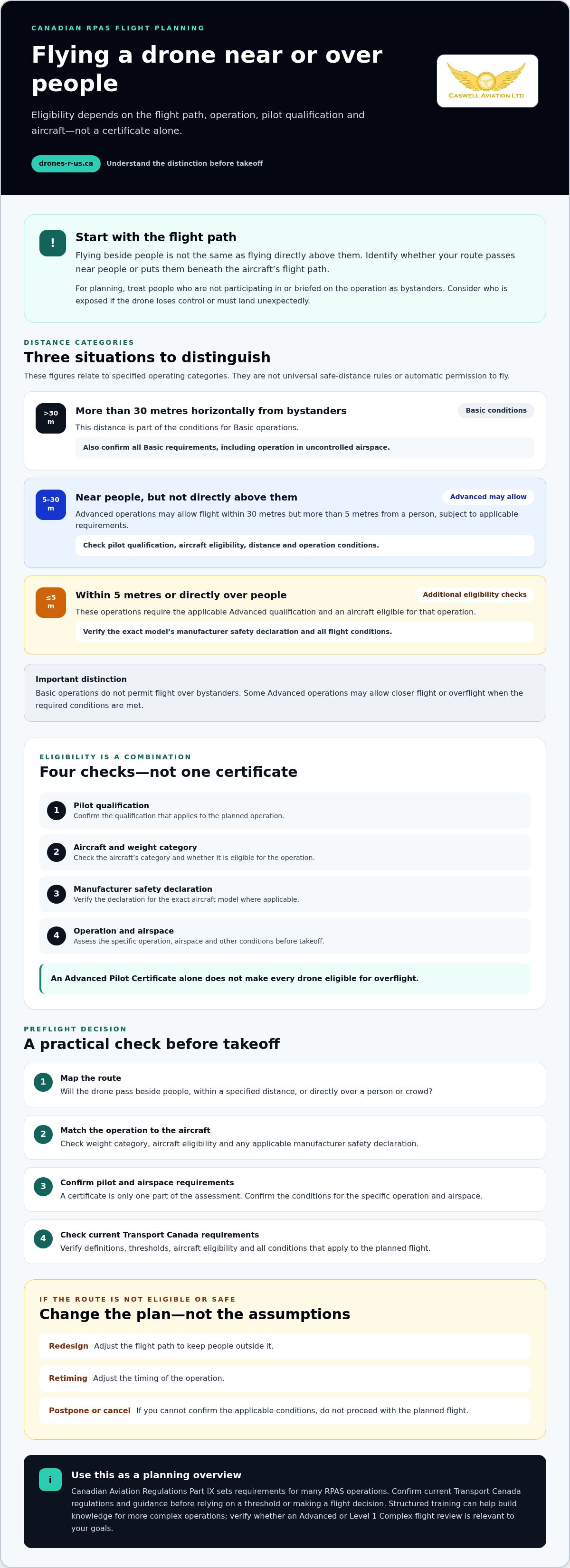
Distance matters, but it doesn’t tell the whole story. Transport Canada guidance distinguishes operations more than 30 metres from bystanders, operations within 30 metres but more than 5 metres away, and operations within 5 metres or directly over people. These figures relate to specified operating categories. They aren’t universal safe-distance rules or permission for every drone. Confirm how the current rules apply to your aircraft and planned flight.
A drone passing alongside spectators may be near them without crossing overhead. A route that takes it across a person or crowd is direct overflight. In either case, consider who is exposed and whether they are involved in the operation. Don’t rely on assumptions about what counts as a bystander under the applicable rules.
Which rule set applies to the flight?
Canadian Aviation Regulations Part IX sets requirements for many remotely piloted aircraft system (RPAS) operations. RPAS refers to the remotely piloted aircraft and the equipment used to control it. For a broad introduction to aircraft commonly called drones, see this overview of the Unmanned aerial vehicle (UAV). Wikipedia is background reading, not a source for Canadian flight authorization.
Aircraft category and operation type can change the requirements. For example, Basic operations don’t permit flight over bystanders, while some Advanced operations may allow closer flight or overflight when the required conditions are met. Pilot qualification, aircraft characteristics and safety declaration are separate checks. A certificate by itself doesn’t establish that a particular aircraft can conduct a particular flight.
Use this as a 2026 overview, not a substitute for checking current Transport Canada regulations and guidance. Before relying on any overflight threshold, verify its definition, your aircraft’s eligibility and the conditions that apply to your planned operation.
Flying Near People Versus Over Them: Why the Difference Matters
A drone passing beside a person and one crossing directly above them create different levels of exposure and may fall under different operating conditions. Basic and Advanced operations have distinct limits, but the pilot’s certificate is only one check. The aircraft must also be eligible for the specific operation.
| Flight situation | General distinction | What to check | Common misconception |
|---|---|---|---|
| More than 30 metres horizontally from bystanders | This distance is part of the conditions for Basic operations. | Confirm the operation meets all Basic requirements, including uncontrolled airspace. | Being beyond 30 metres means every other flight condition is automatically met. |
| Near people, but not directly above them | Advanced operations may allow flight within 30 metres but more than 5 metres from a person, subject to applicable requirements. | Check the pilot qualification, aircraft eligibility, distance and operation conditions. | Flying beside people is equivalent to flying over them. |
| Within 5 metres or directly over people | These operations require the applicable Advanced qualification and an aircraft eligible for that operation. | Verify the exact model’s safety declaration and all flight conditions. | An Advanced certificate alone makes any drone suitable for overflight. |
How Basic and Advanced operations differ
For Basic operations, pilots must remain more than 30 metres horizontally from bystanders and must not fly over them. Advanced operations can allow closer flight, including within 5 metres or directly overhead, only when the aircraft and operation meet the relevant requirements. These distances describe regulatory conditions, not a guarantee that a flight is safe in every setting. Check the current Transport Canada drone safety rules before planning a route.
Keep pilot qualification and aircraft capability separate in your planning. Holding an Advanced certificate doesn’t independently authorize every overflight. The aircraft’s declaration must support the intended operation, and other restrictions still apply.
Why aircraft safety declarations matter
A manufacturer safety declaration indicates which operations a particular aircraft model has been assessed to support. Check the exact make and model, then verify that its declaration covers the operation you intend to conduct. Don’t assume similar-looking models or a modified aircraft have the same eligibility. A declaration doesn’t override airspace restrictions or remove the need to manage risks at the site.
If the distinction between pilot privileges and aircraft eligibility is unclear, structured online drone training can help you understand the applicable requirements. Treat training as preparation, not permission. Verify the rules and aircraft status for each planned flight.
Can You Fly a Drone Over People in Canada? Check the Conditions
Sometimes, but there isn’t a blanket yes for every drone or flight. Whether an overflight may be permitted depends on the current rules for the operation, the aircraft’s capabilities and the conditions at the site. Assess these together before deciding. A pilot credential doesn’t make an otherwise ineligible aircraft suitable, and an aircraft declaration doesn’t override airspace restrictions.
For legal background, read this Canadian drone law overview. It isn’t a substitute for checking current Transport Canada guidance. The applicable requirements can depend on the aircraft category and the details of the planned operation.
Does a drone under 250 g have different rules?
Yes, some requirements differ for microdrones weighing under 250 g. Transport Canada’s current guidance says they don’t require registration or a pilot certificate. That doesn’t mean a small drone can automatically fly over anyone, anywhere. Pilots still need to operate safely and must not endanger people or other aircraft.
Before launching, check restrictions that apply to the planned location and people nearby. A light aircraft can still injure someone, and its low weight doesn’t settle whether a particular route is appropriate or allowed. Don’t treat an exemption from registration or certification as permission for an unsafe operation.
What must pilots verify before an overflight?
Work through the conditions for the specific flight rather than relying on one feature, such as weight or certification:
- Aircraft: Confirm the exact make and model, its category, and whether its manufacturer safety declaration supports the intended operation. Check any limits stated for that model.
- Pilot and operation: Confirm that your qualification matches the operation category and that the planned flight meets its conditions. Don’t assume an Advanced certificate alone authorizes overflight.
- Airspace and site: Check current airspace restrictions and any permissions or access conditions that apply at the location.
- People and risk: Identify who could be exposed along the route, including during takeoff, landing or an unexpected landing. Reconsider the plan if you can’t manage that risk.
For an operation near or over people, a clear answer requires matching the aircraft and pilot to the specific flight. If you can’t confirm the declaration, operating conditions or airspace status, don’t proceed based on an assumption. Structured online drone training can help build regulatory knowledge, but you must still verify that the aircraft and planned operation meet current requirements.
Preflight Checklist for a Drone Operation Near or Over People
Start with the route and the people who could be exposed, not with the assumption that your drone or certificate makes the flight acceptable. The flying drone over people Canada rules require you to assess the planned operation alongside aircraft eligibility, pilot qualifications and airspace. If any requirement is unclear, pause and verify it before takeoff.
Before takeoff, confirm the operation, people at risk, aircraft declaration, pilot qualification, airspace permissions, site conditions and abort plan.
- 1. Define the operation and exposure. Map the intended route, including takeoff, landing and likely diversion or landing areas. Identify bystanders who could be under or near the flight path. Consider whether people may enter the area while the drone is airborne, such as spectators moving closer to a filming location.
- 2. Verify the aircraft. Check the exact make and model, its weight category and the applicable Transport Canada manufacturer safety declaration. Confirm that the declaration supports the operation you plan to conduct, and review any stated limitations. Don’t rely on documentation for a similar model or a general claim about a product line.
- 3. Confirm pilot and operation eligibility. Check that your certificate and the operation category match the planned flight. Then confirm the specific conditions for that category, including applicable limits for proximity to people. A pilot certificate doesn’t replace the aircraft eligibility check.
- 4. Check airspace and site restrictions. Review current airspace information and confirm whether authorization is required. Check for access conditions or other site restrictions that could affect where you can take off, land or operate. A permitted flight category doesn’t, by itself, mean the airspace or location is open to your operation.
- 5. Assess the site and brief participants. Look at crowd movement, obstacles, takeoff and landing areas, and practical options if the flight needs to end early. Brief people involved in the operation on their roles and the plan. Keep uninvolved people out of planned risk areas, and reassess if the site changes.
- 6. Set stop conditions. Decide in advance when you’ll stop or reposition the flight. Examples include unexpected people entering the planned area, changing site conditions or loss of control. Know how you’ll bring the operation to a safe end under the circumstances. If the plan depends on people staying clear and they don’t, don’t continue based on an assumption.
Use the checklist again if the route, aircraft, airspace or people on site change. For structured learning that can help you prepare for applicable pilot requirements, explore online drone training.
If Overflight Is Not Eligible: Safer Options and Training Next Steps
If your aircraft, qualification or planned operation doesn’t meet the requirements, don’t try to make the flight fit by relying on assumptions. Rework the plan so the drone can capture what you need without passing over people, or postpone the operation until you can confirm an eligible approach. Safety and compliance come before the shot.
Plan a route that avoids people
A small change to the setup may remove the need for overflight. Consider whether you can:
- Choose a different launch point or camera position to frame the subject from outside the area where people are gathered.
- Move the flight to a time when the space is less busy, then reassess conditions on arrival.
- Redesign the route to keep the drone away from people, including during takeoff, landing and planned repositioning.
- Use barriers or controlled access only if they’re lawful, practical and genuinely keep uninvolved people out of the risk area. A barrier isn’t a substitute for meeting flight requirements.
Reassess the plan if the crowd grows or moves, or if weather or site conditions change. Postpone or cancel if you can’t confirm that the aircraft and operation are eligible, required permissions are in place, or people can be kept clear of the planned risk area. Don’t proceed just because the original schedule or camera angle is difficult to change.
When training or a flight review may help
If you’re unsure how the operation category, aircraft eligibility and pilot requirements fit together, structured training can help strengthen your understanding and support more confident planning. Start with Transport Canada’s current guidance on drone safety and operating rules, and consult its pilot certification information for the requirements relevant to your goals.
Advanced training and a flight review may be relevant if your intended work requires Advanced operations. Level 1 Complex training and a related flight review are intended for pilots pursuing that certification pathway, not as a general substitute for checking overflight eligibility. No certificate alone makes an aircraft suitable for every operation. Verify the aircraft declaration and conditions for each planned flight.
Caswell Aviation Ltd offers online drone courses, with optional in-person training, for pilots building regulatory knowledge or preparing for Transport Canada certification. If that’s a useful next step, explore its drone training options.
Make Your Next Flight a Confident, Informed One
The flying drone over people Canada rules call for a flight-specific decision, not a blanket yes or no. Flying near people and flying directly over them are different situations. Permission depends on the operation, the aircraft’s declared capabilities, the pilot’s qualifications and the applicable airspace conditions.
Before takeoff, verify each requirement for your exact aircraft and plan. If eligibility or safety is uncertain, redesign the route to avoid people, postpone the flight or cancel it. A certificate alone doesn’t make an overflight permitted, and changing site conditions may mean you need to change the plan.
Caswell Aviation Ltd offers online courses and optional in-person training for Transport Canada Advanced and Level 1 Complex certification, along with professional drone flight reviews. Explore Canadian drone training and flight review options.
Careful planning helps protect people and supports safer, more compliant drone operations. Take the time to verify the conditions, then fly only when they’re right.
Frequently Asked Questions
Can you legally fly a drone over people in Canada?
Some overflights may be permitted when the pilot, aircraft and planned operation meet current requirements. Under the flying drone over people Canada rules, an Advanced Pilot Certificate is required for operations over people, and the aircraft must have the applicable manufacturer safety declaration for that operation. Airspace restrictions and other operating conditions still apply. Check the requirements for your specific aircraft and flight before takeoff.
Can I fly a drone under 250 g over people in Canada?
Not automatically. Microdrones under 250 g don’t require registration or a pilot certificate under the general rules described by Transport Canada, but pilots must still fly safely and not endanger people or other aircraft. That exemption alone doesn’t confirm that a particular overflight is allowed. Check current federal guidance for the location, people who could be exposed and the planned operation before deciding whether to fly.
What is the difference between flying near people and flying over people?
Flying near people means the drone passes beside them, while flying over people means the aircraft’s route takes it directly above them. The distinction matters because operating conditions can differ. For example, Basic operations require pilots to remain more than 30 metres horizontally from bystanders and not fly over them. Advanced operations may allow closer flight, subject to aircraft eligibility and all applicable conditions.
Does an Advanced drone certificate let me fly over people?
No. An Advanced Pilot Certificate is a necessary qualification for the overflight conditions described in current guidance, but it doesn’t by itself authorize every flight over people. Confirm that the aircraft’s manufacturer safety declaration supports the specific operation. You must also meet applicable airspace requirements and operating conditions. Assess the actual route and the people who may be exposed, rather than relying on your certificate alone.
Do I need a special drone declaration to fly over people in Canada?
The aircraft must have the applicable manufacturer safety declaration for the planned operation. Declarations identify the operations a specific model has been assessed to support, so check the exact make and model rather than assuming a similar aircraft has the same eligibility. A declaration doesn’t replace pilot qualifications, airspace checks or safe flight planning. Confirm its status and scope before relying on it for an overflight.
What should I do if people enter my drone's flight path?
Stop or reposition the flight if people enter an area that puts them at risk or means your planned conditions can’t be maintained. Follow your preplanned procedure to bring the operation to a safe end, and don’t continue on the assumption that people will move away. Reassess the site before resuming. If you can’t keep the operation safe and compliant, land and postpone or cancel the flight.
Where can I check the current Canadian drone rules?
Check Transport Canada’s official “Flying your drone safely and legally” guidance and the current Canadian Aviation Regulations, Part IX, for rules applicable to remotely piloted aircraft systems. Review the information for your aircraft category and operation, including any relevant declaration, pilot qualification and airspace conditions. Guidance can change, so verify the requirements close to the planned flight rather than relying only on an older summary or article.
Leave a comment